Concrete Driveway: 7 Smart Benefits That Improve Your Home’s Appearance and Everyday Function
A well designed driveway does more than provide a place to park your vehicle. It creates the first impression of your property, supports everyday activities, and contributes to the overall appearance of your home. Installing a concrete driveway is a popular choice among American homeowners who want a durable, attractive, and relatively low maintenance surface that complements their property’s exterior.
From traditional suburban homes to modern residential properties, concrete offers flexibility in appearance, layout, and finishing options. However, achieving lasting performance requires proper site preparation, suitable materials, professional installation, and regular maintenance. Understanding these factors can help homeowners make informed decisions before starting a driveway improvement project.
What Is a Concrete Driveway?
A concrete driveway is a paved surface constructed using a mixture of cement, water, sand, and aggregates. Once placed and properly cured, the concrete develops the strength needed to support normal residential vehicle traffic.
Unlike loose gravel or some other driveway materials, concrete creates a firm, continuous surface that can be finished in several styles.
Residential concrete driveways are available in simple gray finishes, decorative patterns, exposed aggregate textures, and colored designs.
The final appearance and performance depend on the quality of the materials, ground conditions, slab thickness, drainage, and installation methods.
7 Benefits of Installing a Concrete Driveway
1. Strong and Durable Construction
One of the main reasons homeowners choose a concrete driveway is its ability to withstand regular vehicle traffic when properly designed and installed.
Concrete provides a rigid pavement surface that distributes vehicle loads across the supporting ground.
A properly constructed driveway can provide many years of service, although its actual lifespan depends on soil conditions, climate, maintenance, and vehicle weight.
The quality of the underlying base is especially important. Even strong concrete may crack or settle when placed over unstable or poorly compacted soil.
Professional planning helps reduce these risks and supports long term performance.
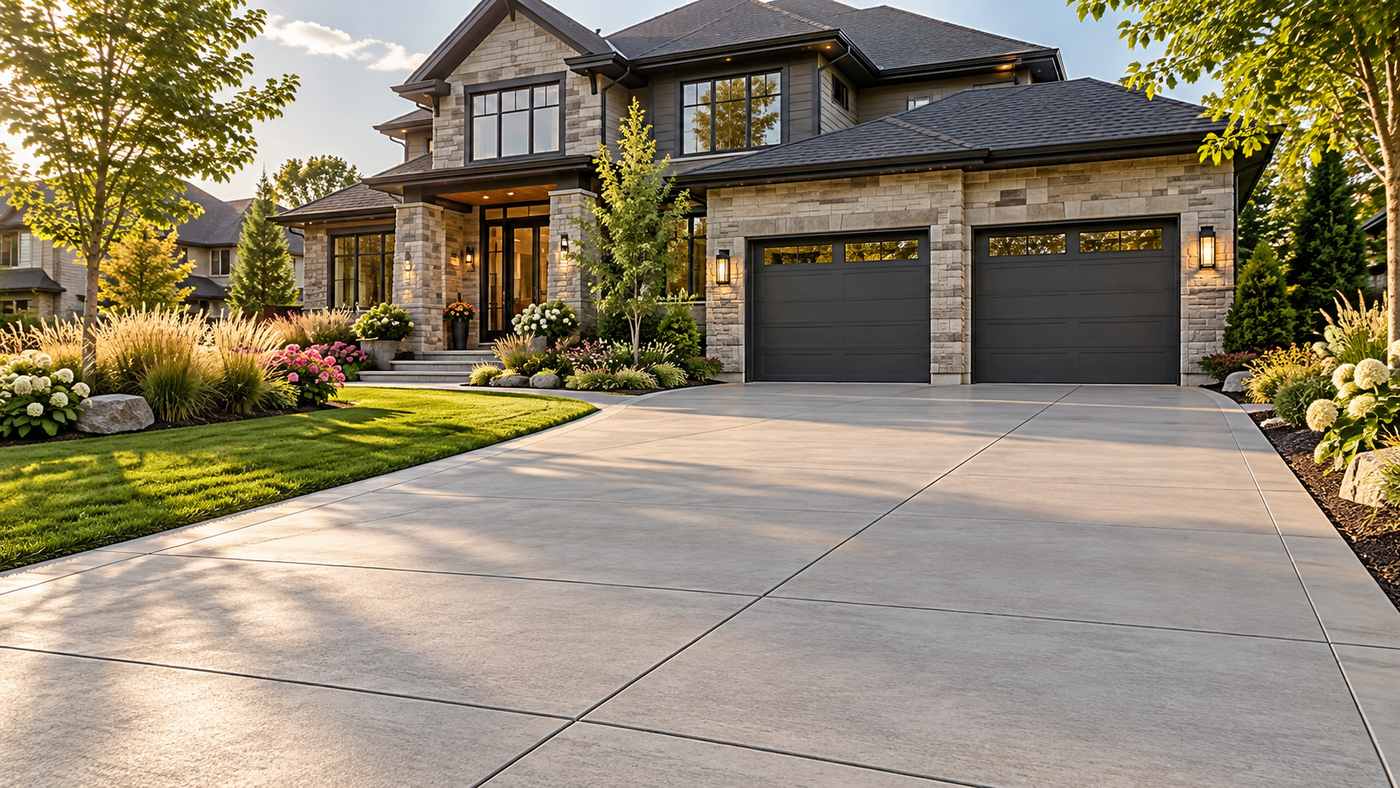
2. Improved Curb Appeal
Your driveway occupies a noticeable portion of your home’s exterior, making its appearance important.
A clean, professionally finished concrete surface can create a more organized and welcoming entrance.
Homeowners can select colors and textures that complement exterior siding, brickwork, landscaping, and garage doors.
Decorative borders or carefully planned control joint layouts can also provide visual interest.
For modern properties, a simple light gray driveway may complement minimalist architecture.
Traditional homes may benefit from subtle decorative textures that coordinate with existing outdoor features.
3. Relatively Low Maintenance Requirements
Concrete driveways generally require less routine surface maintenance than loose gravel driveways.
Gravel may need periodic leveling and replacement, while concrete offers a stable finished surface.
Basic concrete driveway maintenance includes cleaning debris, monitoring cracks, maintaining drainage, and applying suitable sealers when necessary.
However, concrete is not completely maintenance free.
Exposure to moisture, freeze and thaw cycles, heavy loads, and chemical substances can gradually affect its condition.
Following an appropriate maintenance routine helps protect the surface from avoidable damage.
4. Multiple Decorative Design Options
Concrete provides homeowners with several ways to personalize their outdoor spaces.
A traditional broom finish offers a straightforward appearance and useful traction.
Stamped concrete can imitate certain textures associated with stone, brick, or other decorative paving materials.
Exposed aggregate finishes reveal selected stones within the concrete surface, creating a distinctive appearance.
Coloring products and decorative borders provide further design flexibility.
These options allow a concrete driveway to coordinate with walkways, patios, and other landscaping features.
5. Stable Surface for Everyday Activities
A properly installed driveway creates a firm surface for parking vehicles and moving everyday household equipment.
This can make activities such as carrying groceries, moving trash containers, or using wheeled garden equipment more convenient.
A continuous pavement surface also avoids some of the loose material associated with gravel driveways.
Surface texture still matters, especially in rainy or icy conditions.
A finish that provides suitable traction is generally preferable to an excessively smooth surface for outdoor vehicle and pedestrian use.
6. Suitable for Different Residential Layouts
Concrete can be installed in a variety of shapes and sizes.
A narrow driveway serving a single garage has different requirements from a wide driveway supporting multiple vehicles.
Properties with curved entrances, sloped approaches, or additional parking areas may require customized layouts.
An experienced contractor can evaluate the available space and recommend appropriate dimensions, drainage arrangements, and slab construction.
The design should also consider local zoning requirements and driveway access regulations.
A practical layout improves usability without unnecessarily covering valuable yard space.
7. Potential Long Term Property Appeal
An attractive driveway can contribute to a home’s overall presentation.
Prospective buyers may appreciate a well maintained entrance that provides convenient parking and complements the property’s exterior.
A professionally installed driveway can also reduce the immediate need for significant paving improvements.
However, installing a new driveway does not guarantee an increase in resale value or complete recovery of construction costs.
Local real estate conditions, property characteristics, and installation quality influence its potential contribution.
Homeowners should prioritize practical benefits and long term usability rather than relying entirely on expected financial returns.
Popular Concrete Driveway Design Options
Choosing an appropriate surface finish affects both appearance and everyday maintenance.
Traditional Broom Finish Concrete
A broom finish is created by drawing a broom or specialized finishing tool across the surface while the concrete is still workable.
The resulting texture provides additional traction compared with an exceptionally smooth finish.
This option is commonly selected for residential driveways because it offers a simple appearance without elaborate decorative treatments.
Broom finished concrete can work well with contemporary and traditional homes.
Stamped Concrete Driveway
A stamped concrete driveway features decorative patterns impressed into freshly placed concrete.
Common designs resemble natural stone, slate, brick, or other paving textures.
Coloring techniques can enhance these patterns and create a more distinctive appearance.
However, decorative finishes often require specialized installation and additional maintenance.
Homeowners should discuss traction, sealing requirements, color durability, and potential repair challenges before selecting a stamped surface.
Exposed Aggregate Concrete
Exposed aggregate concrete reveals decorative stones within the surface.
The appearance depends on the selected aggregate materials, placement technique, and finishing process.
This style can complement natural stone landscaping and modern exterior designs.
Because the surface texture varies, homeowners should review completed examples before choosing an exposed aggregate finish.
Proper curing and finishing remain important for protecting the surface.
How Concrete Driveway Installation Works
Professional concrete driveway installation involves several stages that influence durability and overall performance.
Step 1: Site Evaluation and Planning
The first step involves examining the proposed driveway area.
Contractors assess dimensions, soil conditions, existing pavement, slope, drainage, and the expected vehicle loads.
Some projects require removing an old driveway before construction begins.
Homeowners should also confirm whether municipal permits, inspections, or homeowners association approvals are required.
An accurate site evaluation helps identify potential challenges before materials and equipment arrive.
Step 2: Excavation and Base Preparation
The ground must be prepared to support the new pavement.
This may involve excavation, removal of unsuitable material, grading, and compaction.
Depending on soil conditions and local specifications, a compacted aggregate base may be installed.
Proper drainage is especially important because standing water and unstable ground can contribute to future pavement problems.
Driveways should be graded to direct water away from vulnerable building areas while meeting applicable local drainage requirements.
Step 3: Concrete Placement and Finishing
After the site is prepared, forms are installed to establish the driveway’s shape and dimensions.
Concrete is placed, consolidated, leveled, and finished according to the project specifications.
The selected finish is applied at the appropriate stage of the setting process.
Contractors must also account for temperature, wind, humidity, and other environmental conditions.
Adding excessive water during placement or finishing can weaken the finished surface.
Experienced installers follow appropriate procedures to achieve the required strength and appearance.
Step 4: Jointing and Curing
Concrete naturally undergoes shrinkage as it hardens and dries.
Control joints are installed to encourage cracking at planned locations rather than allowing uncontrolled cracks throughout the driveway.
The joint layout depends on slab dimensions, thickness, and design requirements.
Curing is equally important because cement requires adequate moisture and suitable temperatures to continue developing strength.
Contractors may use approved curing compounds or other moisture retention methods.
Avoid driving on newly placed concrete until the contractor confirms it has developed adequate strength for vehicle traffic.
How Thick Should a Concrete Driveway Be?
Concrete thickness is an important construction consideration.
For ordinary passenger vehicles, a thickness of approximately four inches is common in residential applications.
However, this is not a universal requirement.
Driveways expected to support heavier trucks, recreational vehicles, or frequent delivery traffic may require greater thickness or additional engineering considerations.
Soil stability, local standards, concrete strength, and reinforcement specifications can also influence the design.
A four inch slab may use control joints spaced approximately eight to ten feet apart, depending on the layout and project specifications.
Final thickness and joint placement should be determined by a qualified contractor using applicable local requirements.
How Much Does a Concrete Driveway Cost in the USA?
Concrete driveway costs vary considerably across the United States.
A straightforward installation on a prepared site may be less expensive than a project involving extensive excavation, drainage improvements, demolition, or decorative finishing.
Several factors influence the final price:
- Total driveway area and concrete thickness
- Site accessibility and ground preparation
- Removal and disposal of existing pavement
- Concrete mix and reinforcement requirements
- Decorative colors, stamping, or exposed aggregate finishes
- Local labor rates, permits, and equipment costs
Instead of relying exclusively on national price averages, request detailed estimates from local contractors.
Make sure each quotation includes the same scope of work before comparing prices.
How to Choose a Reliable Concrete Driveway Contractor
Selecting an experienced contractor is essential for a successful residential paving project.
Look for professionals with a history of installing concrete driveways in your area.
Ask about their experience with local soil conditions, weather requirements, and municipal regulations.
Request examples of completed projects and check recent customer feedback.
A detailed written quotation should identify the planned driveway dimensions, base preparation, concrete specifications, reinforcement where required, finishing methods, curing approach, and payment terms.
Verify licensing and insurance as applicable in your state or municipality.
Avoid selecting a contractor solely because they provide the lowest estimate.
Quality workmanship and clear specifications are important considerations.
Concrete Driveway Maintenance Tips
Regular maintenance helps preserve a driveway’s appearance and reduce unnecessary deterioration.
Keep the Surface Clean
Remove leaves, dirt, and other debris regularly.
Wash the driveway using cleaning methods suitable for its finish and condition.
Address vehicle fluid spills promptly because oil and other substances can cause staining.
Avoid aggressive cleaning techniques that could damage decorative treatments or weakened concrete.
Inspect Cracks and Drainage
Check the surface periodically for developing cracks, settlement, and standing water.
Small cracks do not always indicate structural failure, but significant movement or widening cracks may require professional evaluation.
Keep surrounding drainage systems clear and prevent runoff from repeatedly collecting along pavement edges.
Protect the Surface During Winter
Homeowners in colder states should pay particular attention to winter maintenance.
Freeze and thaw cycles can damage concrete when excessive moisture enters the material.
Deicing chemicals may contribute to surface scaling, especially on newer concrete.
Avoid applying deicers to freshly installed concrete during its first winter unless the contractor provides specific guidance based on the materials and conditions.
Suitable traction alternatives and proper snow removal practices can help reduce unnecessary exposure.
Common Concrete Driveway Mistakes to Avoid
Several installation mistakes can shorten the useful life of residential concrete paving.
Poorly compacted soil may cause settlement and cracking.
Insufficient drainage can allow water to accumulate around the pavement.
Improper joint placement increases the likelihood of random cracking, while inadequate curing may reduce surface durability.
Homeowners should also avoid assuming that all concrete mixtures are appropriate for every climate.
Regions exposed to freezing temperatures may require properly specified air entrained concrete.
Discussing these requirements before installation helps reduce preventable problems.
Frequently Asked Questions
1. How long does a concrete driveway last?
A properly designed and maintained concrete driveway can provide several decades of service. Actual lifespan depends on construction quality, climate, ground conditions, and vehicle loads.
2. Is a concrete driveway better than asphalt?
Concrete generally requires less frequent surface maintenance, while asphalt often has a lower initial installation cost. The better choice depends on climate, budget, appearance, and maintenance preferences.
3. How soon can I drive on a new concrete driveway?
Vehicle access depends on concrete strength development, weather, mix design, and curing conditions. Follow the installer’s instructions rather than assuming a fixed waiting period.
4. Does a concrete driveway need sealing?
Not every concrete surface requires the same sealing treatment. An appropriate sealer may help limit moisture penetration and staining, particularly in challenging climates.
5. Can cracks in a concrete driveway be repaired?
Many smaller cracks can be treated using suitable repair products. Significant settlement, structural movement, or extensive deterioration may require professional assessment.
6. What is the best finish for a residential concrete driveway?
A broom finish is a practical choice for many residential properties because it provides texture and a simple appearance. Decorative alternatives may suit different architectural preferences.
Conclusion
A concrete driveway can improve the appearance, accessibility, and everyday functionality of a residential property. Its durability, design flexibility, and manageable maintenance requirements make it a practical option for many American homeowners. Proper ground preparation, suitable concrete specifications, professional installation, and effective curing are essential for dependable performance. By planning carefully and maintaining the finished surface, homeowners can enjoy an attractive driveway that continues serving their property for years