AI legal assistant for lawyers: 5 Incredible Tools for Unmatched Efficiency
The legal profession is undergoing a significant technological transformation as artificial intelligence becomes integrated into daily practice. Implementing an AI legal assistant for lawyers streamlines time-consuming tasks like legal research, contract analysis, and due diligence. Furthermore, these advanced platforms leverage natural language processing to parse vast databases of jurisprudence instantly. Therefore, legal professionals can focus their expertise on high-level strategy and client counseling rather than manual document review.
The Strategic Value of an AI legal assistant for lawyers
Law firms operate on a billable hour model, making efficiency directly correlated with profitability. Traditionally, junior associates spent hundreds of hours reviewing discovery documents or tracing case law. An AI legal assistant for lawyers dramatically compresses these timelines. By automating routine cognitive tasks, firms increase their profit margins while offering more competitive pricing to clients. Consequently, legal AI tools shift the focus from billable hours to value-based legal services.
Enhancing Legal Research and Case Law Analysis with an AI legal assistant for lawyers
Legal research requires pinpoint accuracy and deep contextual understanding. Conventional search engines often return irrelevant results based on keyword matching. Conversely, an AI legal assistant for lawyers utilizes large language models trained specifically on legal corpora. These systems understand semantic meaning, allowing attorneys to ask complex legal questions in plain English. The AI then retrieves the most relevant precedents, statutes, and regulatory rulings. Therefore, attorneys build stronger arguments backed by comprehensive, instantly accessible jurisprudence.
Core Features of an AI legal assistant for lawyers
Modern legal AI platforms offer a suite of tools designed specifically for the rigorous demands of legal practice. These features address the entire lifecycle of a legal matter, from initial intake to final discovery. By centralizing these capabilities, an AI legal assistant for lawyers reduces the need for multiple disjointed software applications. Consequently, firms streamline their operational technology stack while improving data security.
Contract Analysis and Automated Document Review via AI legal assistant for lawyers
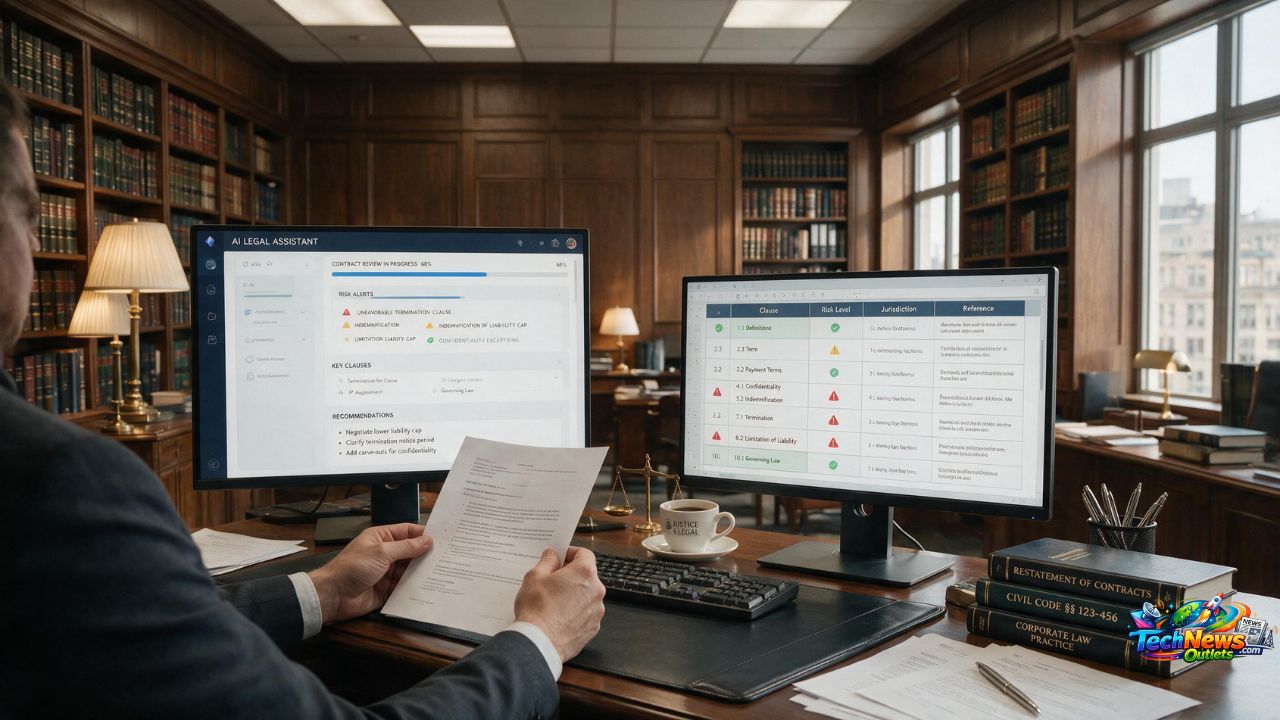
Contract review is a tedious but critical function within corporate law. Missing a single indemnity clause or liability limitation can cost a client millions. An AI legal assistant for lawyers uses optical character recognition and machine learning to scan hundreds of pages in seconds. The AI flags non-standard clauses, identifies missing provisions, and compares the document against a database of ideal contract templates. Therefore, attorneys can negotiate from a position of immediate, data-backed strength. Consequently, automated document review reduces human error and accelerates transactional timelines.
Due Diligence and E-Discovery Optimization in an AI legal assistant for lawyers
During mergers and acquisitions or large-scale litigation, the volume of electronically stored information is staggering. Manual e-discovery review is prohibitively expensive and prone to fatigue-related errors. An AI legal assistant for lawyers employs predictive coding and technology-assisted review to categorize documents by relevance and privilege. The AI learns from attorney coding decisions and applies that logic to the remaining document universe. Therefore, legal teams identify smoking gun evidence rapidly without reviewing every single file. Thus, predictive analytics fundamentally transform the economics of massive litigation.
How an AI legal assistant for lawyers Protects Client Confidentiality
Attorneys operate under strict ethical obligations regarding client confidentiality, primarily governed by rules like the American Bar Association Model Rule 1.6. Feeding sensitive client data into a public AI model poses a massive ethical and security risk. Recognizing this, developers built enterprise-grade legal AI platforms with isolated, secure environments. An AI legal assistant for lawyers operates within a closed-loop system where data is not used to train public models. Therefore, firms leverage AI capabilities without violating attorney-client privilege. Consequently, robust security architectures ensure ethical compliance in the age of machine learning.
Data Encryption and Zero-Data Retention Policies in AI legal assistant for lawyers
Top-tier legal AI vendors implement end-to-end encryption and strict zero-data retention policies. When an attorney uploads a contract for review, the system processes the data in memory and discards it immediately after generating the output. No client information is stored on the vendor servers. Furthermore, these platforms undergo rigorous third-party security audits, including SOC 2 Type II compliance, to guarantee data integrity. Therefore, law firms can confidently deploy these tools within their existing IT infrastructure. Thus, stringent security protocols make AI viable for sensitive legal work.
Overcoming Implementation Challenges for an AI legal assistant for lawyers
Adopting disruptive technology within a conservative industry presents distinct organizational hurdles. Many seasoned attorneys resist AI adoption, fearing it will replace their expertise or produce inaccurate results, known as hallucinations. Law firm leadership must manage this transition carefully, emphasizing that AI augments rather than replaces legal judgment. Therefore, successful implementation requires a cultural shift toward technological embrace, supported by comprehensive training programs.
Mitigating Hallucinations and Ensuring Citation Accuracy in an AI legal assistant for lawyers
Generative AI models occasionally hallucinate, inventing fake case citations or legal principles. This poses a severe risk in legal practice, where citing a non-existent precedent leads to sanctions and reputational damage. A specialized AI legal assistant for lawyers mitigates this risk through retrieval-augmented generation. Instead of freely generating text, the AI pulls verified information directly from a locked database of actual case law and provides clickable citations for every claim. Therefore, the attorney can instantly verify the AI output against the primary source. Consequently, RAG architecture eliminates the hallucination risk, making AI safe for courtroom and transactional use.
The Impact of an AI legal assistant for lawyers on Access to Justice
The high cost of legal services prevents many individuals and small businesses from obtaining legal representation. By drastically reducing the labor hours required for research and document preparation, AI has the potential to lower the cost of legal services. An AI legal assistant for lawyers enables firms to take on lower-margin, high-volume cases profitably. Therefore, the technology serves a dual purpose: increasing firm profitability while expanding access to justice for underrepresented populations. Consequently, AI acts as an equalizing force within the judicial system.
Scaling Pro Bono Efforts via AI legal assistant for lawyers
Many law firms commit to a certain number of pro bono hours annually. However, capacity constraints often limit their ability to take on complex pro bono matters. An AI legal assistant for lawyers lowers the resource barrier for these cases. By automating the research and drafting phases for pro bono asylum cases or tenant defense matters, firms can represent more clients without overwhelming their associates. Therefore, AI amplifies the societal impact of big law pro bono programs. Thus, technology enables a broader distribution of high-quality legal advocacy.
The Future of Legal Practice with an AI legal assistant for lawyers
The current generation of legal AI focuses on reactive tasks: summarizing documents, answering research queries, and flagging contract clauses. The next evolution involves predictive legal analytics and generative legal strategy. Future AI platforms will analyze the specific judge assigned to a case, cross-referencing their past rulings and settlement tendencies to recommend optimal litigation strategies. Therefore, AI will evolve from a research assistant to a strategic litigation co-pilot. Consequently, the practice of law will become highly data-driven at every decision point.
Predictive Analytics and Generative Strategy in AI legal assistant for lawyers
By analyzing decades of court transcripts, briefs, and judicial opinions, machine learning models will predict the likely outcome of a motion with high statistical accuracy. An AI legal assistant for lawyers will suggest the most persuasive legal arguments for a specific jurisdiction. Furthermore, generative AI will draft the initial briefs based on these predictive insights, which the human attorney will then refine and polish. Therefore, the synergy between human legal intuition and machine predictive power will redefine legal advocacy. Thus, embracing these advanced tools ensures law firms remain competitive in a rapidly evolving legal marketplace.
FAQs
1. What is an AI legal assistant for lawyers?
It is a specialized software platform that uses machine learning and natural language processing to automate legal research, contract review, and e-discovery tasks.
2. Can an AI legal assistant replace a human attorney?
No, AI augments attorney efficiency by handling repetitive tasks but cannot provide the strategic judgment, empathy, and courtroom advocacy required of a human lawyer.
3. How do AI legal tools handle client confidentiality?
Enterprise legal AI platforms use closed-loop systems, end-to-end encryption, and zero-data retention policies to ensure sensitive client data is never exposed or used to train public models.
4. Do AI legal assistants hallucinate case citations?
Generic AI models might, but specialized legal AI tools use retrieval-augmented generation to pull verified case law with clickable citations, preventing hallucinated precedents.
5. Is an AI legal assistant for lawyers useful for small firms?
Yes, it allows small firms to scale their operations, handle larger caseloads, and compete with bigger firms by drastically reducing the time spent on manual research.
6. How does AI impact the billable hour model?
AI compresses the time needed for tasks like document review, pushing firms toward value-based or flat-fee pricing models while maintaining high profit margins.
Conclusion
The integration of artificial intelligence into the legal sector represents a profound shift from manual labor to cognitive efficiency. Implementing an AI legal assistant for lawyers empowers firms to automate tedious research and document review while maintaining strict client confidentiality. By mitigating hallucination risks through verified databases and embracing predictive analytics, legal professionals elevate their strategic capabilities. Furthermore, this technology democratizes legal services by lowering costs and expanding access to justice. Ultimately, adopting an AI legal assistant for lawyers is no longer just an operational upgrade; it is a strategic necessity for law firms aiming to thrive in a modern, data-driven legal landscape.