What Qualifies as a Hazardous Property Condition: 7 Critical Legal Rules for Premises Liability Claims
Sustaining a catastrophic injury while walking through a commercial shopping mall, dining in a restaurant, navigating an apartment complex stairwell, or visiting a private residence triggers immediate medical distress and complex legal challenges. Understanding what qualifies as a hazardous property condition is the fundamental legal threshold for establishing negligence in personal injury and premises liability litigation. Property owners, commercial landlords, property management corporations, and business proprietors owe a legal duty of care to maintain reasonably safe environments for invited patrons and guests. However, an accidental slip, trip, or fall does not automatically establish financial or legal liability against a landowner. To secure compensation for medical expenses, surgical rehabilitation, lost wages, and permanent impairment, injured plaintiffs must prove that an unreasonably dangerous, defective, or neglected structural condition existed on the premises, that the landowner knew or should have known of its existence, and that their failure to remediate or warn directly caused the injury.
The Legal Foundations of Premises Liability and Landowner Duty of Care
Under American common law and state tort statutes, premises liability claims hinge on the legal classification of the visitor at the time the injury occurred. The legal duty a property possessor owes varies significantly depending on whether the injured person entered as an invitee, licensee, or trespasser.
The Three Traditional Visitor Classifications
- Public / Business Invitees: Individuals invited onto commercial premises for the direcproperty owner’s t or indirect financial benefit of th as retail grocery shoppers, hotel guests, gym members, or office clients). Landowners owe invitees the highest standard of legal care: they must actively inspect the property for hidden dangers, repair known defects within a reasonable timeframe, and provide clear warnings regarding non-obvious hazards.
- Licensees: Social guests entering private property for their own recreation or social purposes with the owner’s express or implied consent. Landowners owe licensees a duty to warn of known, concealed hazards that the guest is unlikely to discover on their own, but owners are generally not required to conduct continuous proactive property inspections for licensees.
- Trespassers: Individuals entering real property without legal right, permission, or invitation. Landowners generally owe no duty to maintain safe conditions for adult trespassers, except to refrain from willfully or wantonly inflicting intentional injury (such as setting concealed spring-loaded booby traps).
The “Attractive Nuisance” Doctrine for Minors
An essential statutory exception to trespasser rules applies to young children under the Attractive Nuisance Doctrine. If a landowner maintains an artificial, dangerous condition on their land that is likely to attract curious children who lack the cognitive maturity to comprehend the inherent danger—such as an unfenced swimming pool, an unlocked construction site, an abandoned refrigerator, or unguarded heavy machinery—the owner can be held liable for resulting injuries or drownings even if the child entered without permission.
Core Categories: What Qualifies as a Hazardous Property Condition?
A hazardous property condition is legally defined as any physical defect, mechanical malfunction, structural deterioration, or environmental contamination that creates an unreasonable, foreseeable risk of bodily harm to individuals lawfully exercising ordinary care on the property.
Transient Foreign Substances and Walking Surface Liquid Hazards
Wet, slippery floor surfaces represent the leading cause of preventable slip-and-fall injuries in commercial establishments:
- Uncleaned Liquid Spills: Puddled drinks, melted ice, leaking refrigerator coolant, or broken food jars left unaddressed in supermarket aisles.
- Wet Mopping Without Conspicuous Warnings: Custodial crews wet-mopping polished terrazzo, marble, or vinyl tile floors without deploying high-visibility yellow “Caution: Wet Floor” safety cones.
- Tracked Rainwater in Building Foyers: Failure of building management to deploy non-slip, moisture-absorbing entry mats during rainy weather, allowing smooth entrance tile lobbies to become hazardous water slicks.
Structural Walkway Defects, Trip Hazards, and Pavement Displacements
Pedestrians naturally expect walking paths to be continuous, uniform, and structurally stable:
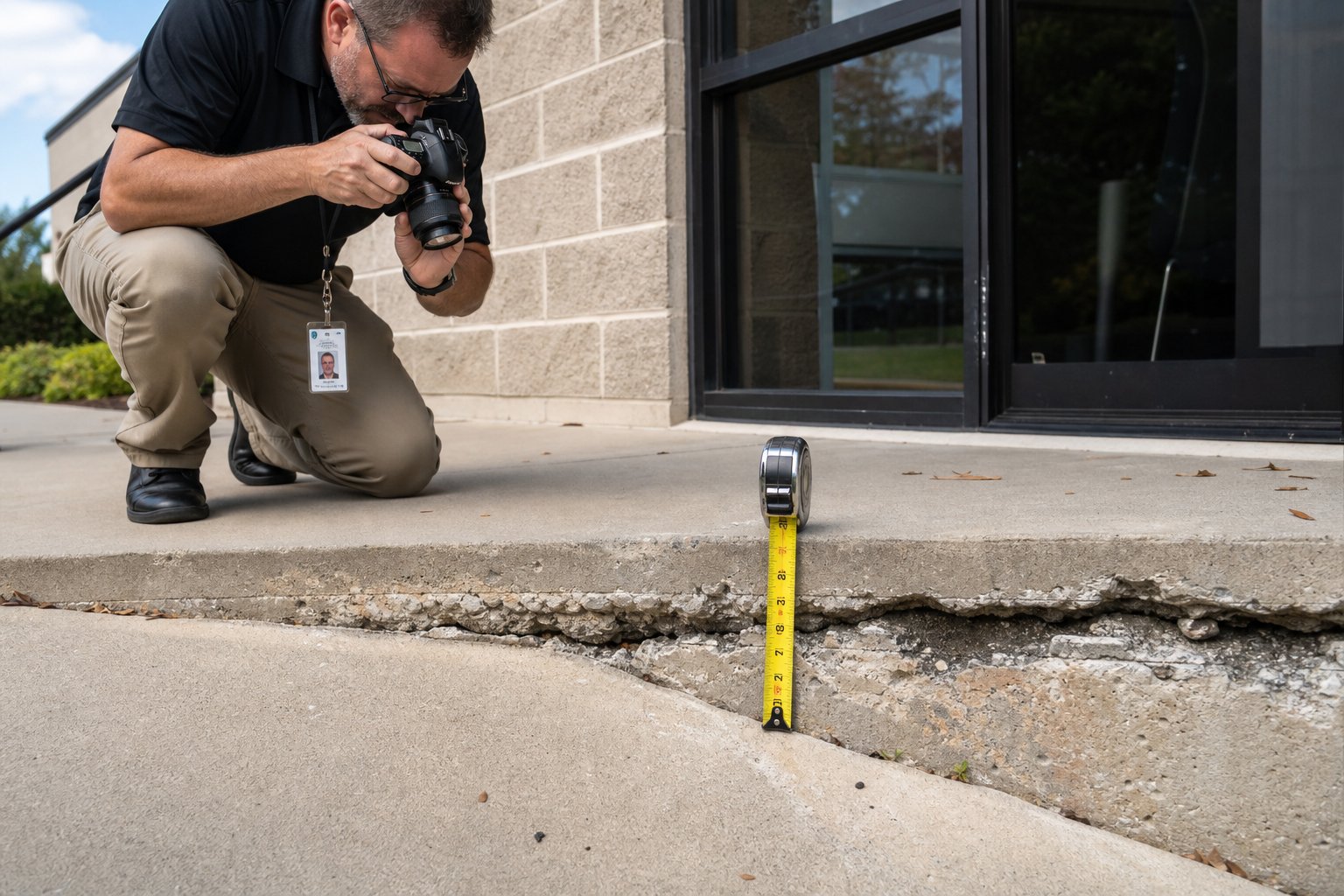
- Concrete Sidewalk Displacements: Tree root upheaval or soil subsidence causing a vertical elevation change greater than one-quarter to one-half inch between adjacent sidewalk slabs, creating severe trip-and-fall hazards.
- Broken Asphalt Potholes: Unrepaired depressions and crumbling asphalt in commercial parking lots and pedestrian crosswalks.
- Torn Carpeting and Buckled Floorboards: Wrinkled interior hallway carpeting, loose metal transition thresholds, or missing ceramic tiles in commercial corridors.
Stairwell Code Violations and Architectural Deficiencies
Staircases present immense gravitational injury risk; when stairs fail to comply with international building codes, devastating falls occur:
- Uneven Riser Heights and Tread Depths: Inconsistent step heights that disrupt the human brain’s unconscious muscular cadence during descent.
- Missing, Loose, or Defective Handrails: Staircases lacking continuous, securely anchored structural handrails capable of supporting at least two hundred pounds of downward and lateral force.
- Inadequate or Burned-Out Stairwell Illumination: Poor lighting that casts deep shadows over step edges, blinding descending pedestrians.
Inadequate Security and Violent Crime Facilitation
Premises liability extends beyond physical slip hazards to encompass negligent security claims:
- Unsecured Perimeter Doors: Broken automatic magnetic entry locks or prop-open exterior doors in apartment complexes that allow armed trespassers access to tenant hallways.
- Dark, Unlit Parking Structures: Failure to maintain adequate security lighting in underground parking garages with known histories of violent robberies.
- Inadequate Security Personnel: Disregarding recurring violent crime trends in nightclubs or shopping plazas without providing trained security guards or functional security cameras.
Common Hazardous Conditions Matrix
| Category of Hazard | Common Physical Manifestations | Relevant Regulatory / Building Code | Typical Responsible Parties |
|---|---|---|---|
| Slip Hazards | Spilled liquids, leaking coolers, wet wax | OSHA 1910.22 / ANSI A326.3 | Grocery stores, restaurants, cleaning vendors |
| Trip Defects | Sidewalk displacements >1/4″, potholes | ASTM F1637 / Municipal Sidewalk Codes | Commercial landlords, shopping centers, cities |
| Staircase Hazards | Broken handrails, uneven risers, dark steps | IBC Chapter 10 / NFPA Life Safety | Apartment property managers, office landlords |
| Inadequate Security | Broken gate locks, dark garages, zero guards | Restatement (Second) of Torts § 344 | Apartment complexes, hotels, parking structures |
| Structural Failures | Collapsing balconies, falling ceiling tiles | Local Housing & Building Codes | Commercial building owners, condo associations |
| Toxic Exposures | Open asbestos, black mold, chemical fumes | EPA Standards / Housing Quality Codes | Landlords, industrial warehouse operators |
Establishing Negligence: The Critical Burden of Notice
Demonstrating that a dangerous hazard existed is only half the legal battle. To establish liability against a commercial landowner, the plaintiff must prove that the property possessor had legal notice of the condition before the injury occurred.
Actual Notice vs. Constructive Notice
- Actual Notice: Direct, undeniable evidence proving the landowner or their employees knew the hazard existed. Examples include an employee reporting a broken stairwell light on a daily log, a security camera capturing an employee walking directly past a spilled liquid puddle without cleaning it, or prior written complaints sent by tenants regarding a broken security gate.
- Constructive Notice: Proof that the dangerous condition existed for a sufficient duration of time that a reasonably prudent property manager exercising ordinary diligence should have discovered and corrected it before the incident.
The “Time-and-Temperature” and Grocery Sweep Log Defense
In commercial slip-and-fall cases, proving constructive notice frequently depends on temporal physical evidence. For example, if a fallen banana peel in a produce aisle is bruised, black, and covered in shopping cart tire tracks, the physical degradation proves the item sat on the floor for an extended period rather than falling seconds prior. Conversely, commercial defense attorneys routinely produce electronic “sweep logs” showing employees inspected the aisle every fifteen minutes, attempting to prove the business exercised reasonable care.
Common Defenses Raised by Landowners in Liability Litigation
Commercial property insurance carriers deploy aggressive legal defenses designed to eliminate or reduce compensation in premises liability lawsuits.
The “Open and Obvious” Hazard Doctrine
Landowners frequently argue that a dangerous condition was so open, conspicuous, and obvious that any reasonable person exercising basic self-awareness should have seen and avoided it. In jurisdictions adhering to this rule, landowners owe no duty to warn of open and obvious hazards. However, modern legal frameworks recognize exceptions—such as when a patron is foreseeably distracted by merchandise displays or has no alternate safe route to access a public exit.
Comparative Negligence and Distracted Walking Allegations
Insurance adjusters routinely claim the injured plaintiff was comparatively negligent:
- Mobile Phone Distraction: Subpoenaing the plaintiff’s cellular phone records to argue they were actively text-messaging or looking at a screen when they tripped over an uneven sidewalk.
- Inappropriate Footwear: Claiming that high-heeled shoes or smooth-soled flip-flops contributed directly to the slip on a wet floor.
- Under comparative fault rules, if an injured party is found twenty percent responsible for their fall, their total damage compensation is reduced by that exact percentage.
Essential Evidence to Preserve Immediately Following an Incident
If you or a family member are injured due to a hazardous property condition, gathering immediate evidence is crucial before the property owner repairs the defect or erases digital footage:
- Step 1: Photograph and Measure the Hazard: Capture wide-angle and macro photos of the exact defect. Place an object (like a coin, shoe, or ruler) next to broken sidewalk cracks or stair risers to document height displacement. Photograph the presence or absence of warning cones.
- Step 2: File an Official Incident Report: Notify the property manager, store supervisor, or landlord immediately. Demand that they complete an official written incident report, and request a physical copy before leaving the premises.
- Step 3: Identify Eyewitnesses: Collect full names, phone numbers, and email addresses of neutral bystanders, shoppers, or employees who witnessed the fall or heard employees acknowledge the hazard.
- Step 4: Demand Video Preservation via Formal Spoliation Letter: Commercial surveillance systems automatically overwrite camera footage within fourteen to thirty days. Retaining a personal injury attorney allows them to issue an immediate formal spoliation letter demanding the commercial entity preserve all surveillance footage, sweep logs, and internal maintenance records.
- Step 5: Seek Immediate Medical Documentation: Visit an emergency department or orthopedic physician immediately; insurance companies argue that delays in medical treatment indicate the injury was minor or caused by an unrelated event.
Frequently Asked Questions About Hazardous Property Conditions
What qualifies as a hazardous property condition in a slip-and-fall lawsuit?
A hazardous condition is any unreasonable, dangerous physical defect—such as an uncleaned liquid spill, broken step, deep sidewalk displacement, or missing handrail—that creates a foreseeable risk of injury to lawful visitors.
How long does a store have to clean up a liquid spill before they are considered legally negligent?
The law does not define an exact minute threshold; rather, courts evaluate whether the spill remained on the floor longer than a reasonably prudent business would have allowed under ordinary inspection routines.
Can I sue my landlord if I was assaulted in an unlit apartment complex parking lot?
Yes, under negligent security premises liability law, landlords can be held liable if they failed to maintain adequate exterior lighting, working security gates, or reasonable security measures in an area with foreseeable crime.
What should I do if a store manager refuses to give me a copy of the incident report?
Do not argue; write down the manager’s name, document the date and time, take detailed photos of the hazard and your injuries, and contact an experienced premises liability attorney immediately.
What is the “open and obvious” defense in a premises liability case?
The open and obvious defense asserts that a hazard was so noticeable that an attentive visitor should have seen and avoided it, potentially shielding the landowner from liability.
Can a property owner be held liable for injuries caused by natural ice or snow accumulation?
In many states, property owners are given a reasonable grace period following the end of a winter storm to clear public walkways; however, creating unnatural snowmelt runoff that refreezes into black ice can trigger liability.
Conclusion
Determining what qualifies as a hazardous property condition is the cornerstone of holding negligent commercial corporations, property managers, and private landowners accountable for preventable, life-altering injuries. While business owners frequently prioritize operational speed and profits over routine maintenance, building codes and legal duty-of-care standards exist to protect the public from foreseeable harm. Proving premises liability demands swift investigative action, preserving transient liquid evidence, documenting structural code violations, establishing legal notice, and countering aggressive corporate defenses like the open-and-obvious doctrine. If you have suffered an injury due to an unaddressed property defect, understanding your legal rights and preserving critical on-site evidence ensures you can hold negligent property owners accountable and secure the comprehensive financial compensation needed to heal and rebuild your life.