Epoxy Garage Floor Coating: How to Get a Durable, Professional Finish
A properly installed epoxy garage floor coating can transform bare concrete into a more finished, cleanable surface while improving resistance to many forms of routine abrasion, staining, and chemical exposure. The final result, however, depends heavily on the concrete beneath it. Surface contamination, moisture vapor, cracks, weak concrete, previous sealers, inadequate profiling, incorrect mixing, and unsuitable application conditions can all contribute to premature coating problems. Understanding concrete evaluation, mechanical preparation, product selection, installation, curing, safety, and maintenance helps homeowners determine whether epoxy is suitable for their garage and how to compare professional coating systems accurately.
What Is Epoxy Garage Floor Coating?
Epoxy garage floor coating is a resin based flooring system applied to properly prepared concrete.
Many epoxy products use two primary components: a resin and a hardener. When combined in the specified proportions, the components react chemically and cure into a hard coating.
Garage systems can include a primer, epoxy body coat, decorative flakes or aggregate, and one or more protective topcoats.
Is Epoxy the Same as Garage Floor Paint?
No.
Products marketed as concrete or garage floor paint can use different chemistries and generally should not be assumed to provide the same characteristics as a two component epoxy system.
Some retail products also use phrases such as epoxy paint even though their composition and solids content can differ significantly from professional flooring products.
Epoxy Versus Other Garage Floor Coatings
Epoxy is only one category of resinous flooring.
Professional installers may also use polyaspartic, polyurethane, polyurea, or hybrid coating systems.
Each chemistry has different properties relating to cure time, ultraviolet stability, flexibility, application conditions, chemical resistance, and installation.
The best choice depends on the concrete, environment, expected use, and complete coating system.
7 Powerful Epoxy Garage Floor Coating Benefits and Considerations
Epoxy can offer practical advantages, but performance should be evaluated realistically. These seven factors explain where the system can perform well and what determines its success.
1. Epoxy Garage Floor Coating Creates a Durable Surface
A correctly specified epoxy coating can provide a hard surface capable of handling typical garage activities.
It can improve resistance to ordinary foot traffic, rolling vehicle tires, tools, and routine abrasion compared with untreated concrete.
Durability Depends on the Entire System
Performance varies according to:
• Epoxy formulation
• Concrete condition
• Surface profile
• Coating thickness
• Number of layers
• Topcoat
• Cure quality
• Vehicle use
• Chemical exposure
• Temperature
• Installation workmanship
The word epoxy alone does not establish durability.
Industrial Grade Is Not a Universal Specification
Marketing descriptions such as industrial grade or commercial grade do not necessarily identify a standardized performance level.
Compare measurable manufacturer specifications when possible.
Useful data can include abrasion resistance, adhesion testing, chemical resistance, solids content, application thickness, and intended service conditions.
2. Epoxy Garage Floor Coating Can Improve Appearance
One reason homeowners choose resinous flooring is the wide range of visual options.
The surface can be simple and uniform or highly decorative.
Common Design Choices
Options can include:
• Solid colors
• Decorative flakes
• Multicolor flake blends
• Quartz aggregate systems
• Metallic effects
• Gloss finishes
• Satin finishes
• Custom color combinations
Product availability varies by manufacturer and installer.
Decorative Flakes Have a Practical Role
Broadcast flakes can add visual texture and help make ordinary dirt or small imperfections less noticeable.
The amount of flake broadcast can range from light decorative coverage to a full broadcast system where the base coat is substantially covered.
The chosen topcoat needs to work with the decorative system.
Gloss Can Affect Visibility
High gloss surfaces reflect more light and can create a polished appearance.
However, gloss can also make dust, scratches, water spots, and surface imperfections more visible under certain lighting.
Homeowners should view actual completed floors before selecting the finish.
3. Preparation Is Critical for Epoxy Garage Floor Coating
Concrete preparation is one of the most important stages of the entire project.
An expensive coating applied to a contaminated or unsuitable surface can still lose adhesion.
The Concrete Must Be Clean and Sound
Before installation, the surface should be evaluated for:
• Oil
• Grease
• Existing coatings
• Sealers
• Curing compounds
• Tire residue
• Adhesive
• Weak surface material
• Cracks
• Spalling
• Moisture concerns
• Other contamination
Contaminants should be removed using methods compatible with the flooring system.
Mechanical Surface Preparation
Professional projects commonly use diamond grinding or shot blasting to remove weak surface material and create an appropriate concrete surface profile.
These methods provide more predictable preparation than relying solely on ordinary cleaning.
The exact profile should meet the coating manufacturer’s requirements.
What About Acid Etching?
Some consumer systems permit chemical etching under specified conditions.
However, acid treatment is not equivalent to mechanical profiling in every situation and can introduce safety, residue, neutralization, or disposal considerations.
Follow the specific coating manufacturer’s preparation requirements.
4. Moisture Testing Protects Epoxy Garage Floor Coating
Concrete can transmit moisture vapor from below even when its upper surface appears dry.
Excessive moisture movement can contribute to blistering, loss of adhesion, discoloration, or other coating problems depending on the system.
Where Does Concrete Moisture Come From?
Potential sources include:
• Ground moisture
• Inadequate vapor retarders
• Drainage problems
• Recent concrete placement
• Water intrusion
• Plumbing leaks
• Hydrostatic conditions
A coating should not be expected to solve active water problems automatically.
Professional Moisture Testing
Installers can use recognized test methods to evaluate concrete moisture conditions.
The appropriate method depends on the flooring system and project.
Manufacturer limits should determine whether the test results are acceptable.
A Plastic Sheet Test Has Limitations
Simple DIY moisture observations may identify obvious concerns but should not be treated as equivalent to professional quantitative testing.
When moisture risk is significant or a manufacturer requires specific testing, use the specified method.
5. Epoxy Garage Floor Coating Can Improve Cleanability
Bare concrete is porous and can trap dirt and spills.
A continuous coating provides a less porous finished surface that can generally be cleaned more easily.
Routine Garage Contaminants
Depending on formulation and topcoat, a garage coating may encounter:
• Motor oil
• Road dirt
• Mud
• Water
• Automotive fluids
• Household chemicals
• Deicing residues
• Tire debris
Resistance differs among products.
Chemical Resistant Does Not Mean Chemical Proof
A coating can resist some substances while being damaged by others.
Chemical concentration, exposure time, temperature, and cleanup speed all matter.
Clean spills promptly and consult the coating manufacturer’s chemical resistance data for unusual substances.
Beware of Solvents
Aggressive solvents can soften, discolor, or otherwise affect certain coatings.
Use only cleaning products recommended for the installed flooring system.
6. Epoxy Garage Floor Coating Can Add Traction When Designed Correctly
Smooth high gloss resin floors can become slippery, particularly when wet.
Traction should therefore be considered during system selection.
Anti Slip Additives
Compatible texture additives can be incorporated into or broadcast onto certain topcoat systems.
Options vary in particle size, material, and resulting texture.
More Texture Changes Cleaning
A highly textured surface can offer different traction characteristics but may collect dirt and be harder to mop.
The ideal texture balances use, cleaning preferences, wet conditions, and safety requirements.
Test Where Practical
A small sample can help homeowners understand the visual and tactile difference between smooth and textured finishes.
No coating should be marketed as impossible to slip on.
Footwear, contaminants, water, slope, and user behavior all influence slip risk.
7. Professional Epoxy Garage Floor Coating Requires Proper Curing
Epoxy changes from liquid components into a solid material through a chemical reaction.
Temperature, mixing, application, and time affect this curing process.
Pot Life Matters
Once resin and hardener are combined, installers have a limited working period.
This is often referred to as pot life.
Attempting to extend usable time by changing the specified mixing ratio can prevent proper curing and should not be done.
Cure Time Is Not Universal
Coatings can have different timelines for:
• Recoating
• Light foot traffic
• Moving furniture
• Vehicle traffic
• Full chemical resistance
Temperature and other conditions can influence these times.
Always follow the technical data sheet for the exact system.
How Professional Epoxy Garage Floor Coating Is Installed
A professional project is usually completed in multiple stages.
The actual sequence depends on the selected system and concrete condition.
Garage Floor Inspection
The installer begins by examining the slab.
This is the time to identify previous coatings, cracks, oil contamination, moisture concerns, spalling, joint conditions, and other problems.
Identify Existing Sealers
Some concrete sealers interfere with coating adhesion.
A professional should determine whether previous treatments need removal.
Inspect Concrete Strength
A coating needs a sound substrate.
Weak or deteriorated surface concrete should be addressed before coating.
Installing a strong coating over weak concrete can result in failure within the substrate itself.
Remove Garage Contents
The garage generally needs to be emptied before surface preparation begins.
Storage racks or permanently attached items may require special planning.
Protect Adjacent Areas
Grinding and coating operations can produce dust, noise, odors, and debris.
Professional installers should use appropriate dust collection, ventilation, masking, and protective methods.
Plan Vehicle Storage
Vehicles will need another location until the coating is ready for traffic.
The installer should provide a product specific return to service schedule.
Concrete Grinding and Profiling
The floor is mechanically prepared to remove contaminants and create the surface profile required by the coating.
Edges and corners need appropriate attention as well.
Dust Removal
After profiling, dust and debris need thorough removal before coating.
Fine dust left on the concrete can interfere with adhesion.
Final Surface Inspection
Any remaining contamination or defects should be addressed before the first coating layer is applied.
Preparation should not be rushed simply to meet a one day schedule.
Crack and Surface Repair
Cracks may require treatment before coating, but the repair method depends on the crack type.
Not Every Crack Is the Same
Concrete can develop:
• Shrinkage cracks
• Settlement related cracks
• Moving cracks
• Control joints
• Structural cracks
• Surface crazing
A coating can hide coloration but cannot prevent significant structural movement.
Moving Cracks Can Return
Rigid repair materials and coatings may crack again if the underlying slab continues moving.
Significant displacement or suspected structural problems deserve professional evaluation.
Applying Primer
Some coating systems use a dedicated primer.
The primer can promote adhesion or address particular substrate characteristics.
Moisture Mitigation Primers
Specialized epoxy moisture mitigation products are available for certain concrete conditions.
They should only be used when appropriate testing and manufacturer requirements support their use.
A moisture control coating is not a substitute for repairing active water intrusion or drainage problems.
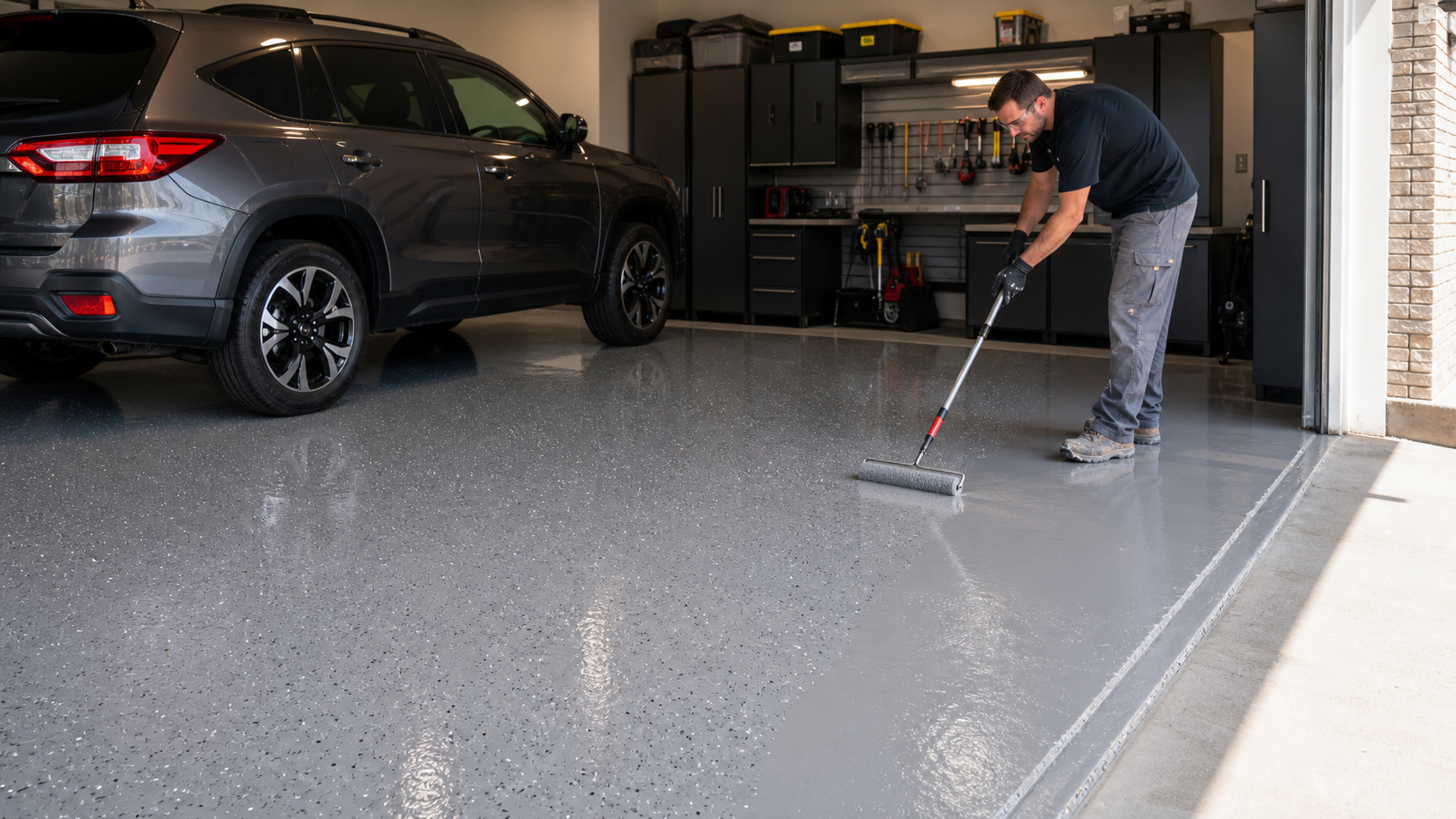
Applying the Epoxy Base Coat
The components are measured or combined according to manufacturer packaging and mixed thoroughly using the specified procedure.
Application may involve squeegees, rollers, brushes, or other professional tools.
Maintain Consistent Coverage
Coating thickness should follow manufacturer specifications.
Applying material too thinly can affect appearance and performance, while excessive thickness can create curing or application problems.
Work Within the Product Window
Installers need to account for pot life, floor temperature, air temperature, humidity, and other limitations.
Professional planning matters particularly on large garage floors.
Broadcasting Decorative Flakes
Flakes are applied into the wet base coat if the system calls for them.
Installers distribute material consistently across the surface.
Light Versus Full Broadcast
Light flake applications leave more base color visible.
Full broadcast systems use enough flake to substantially cover the wet coating.
Each creates a different appearance and system build.
Remove Excess Material
After the coating cures sufficiently, loose flakes may be removed and the surface scraped or prepared according to system requirements before topcoating.
Applying the Topcoat
The topcoat provides the final wear surface.
It may be epoxy, polyurethane, polyaspartic, or another compatible chemistry.
Why Topcoat Selection Matters
The finish can influence:
• Abrasion resistance
• UV performance
• Chemical resistance
• Gloss
• Texture
• Cleaning
• Overall appearance
The installer should explain why the proposed topcoat suits the garage.
Epoxy Garage Floor Coating and Sunlight
Some epoxy products can yellow or change appearance with ultraviolet exposure.
Garages that receive strong sunlight through open doors or windows need particular consideration.
UV Stable Topcoats
Installers may specify a more UV resistant topcoat where sunlight exposure is important.
No coating should be assumed completely unaffected by outdoor exposure unless supported by product documentation.
Consider the Garage Entrance
The first portion of the floor near a large garage door often receives much more sunlight than the rest.
Product selection should account for this uneven exposure.
Epoxy Garage Floor Coating and Hot Tires
Vehicle tires can become warm during driving and place localized pressure on a coating.
Some flooring failures are commonly described as hot tire pickup.
Proper Preparation Reduces Risk
Surface preparation, coating quality, cure, and system compatibility all influence resistance to tire related stress.
Do not park vehicles before the manufacturer approved cure period.
Product Formulation Matters
Ask professional installers whether the proposed system is designed specifically for automotive garage use.
Generic floor products may have different performance characteristics.
Epoxy Garage Floor Coating Over Old Paint
Applying epoxy directly over existing floor paint is not always appropriate.
The new system is only as secure as the material beneath it.
Test Existing Coating Condition
If old paint is poorly adhered, the new system can fail even if the new epoxy bonds strongly to that paint.
Removal to a suitable substrate is often preferable where existing coatings are questionable.
Follow Manufacturer Requirements
Some systems may permit application over specific sound existing coatings after appropriate preparation.
Others require removal.
Use the technical data for the exact new coating.
Epoxy Garage Floor Coating for New Concrete
Freshly placed concrete requires adequate curing and preparation before most coatings can be installed.
The required waiting period and moisture condition depend on the coating system.
Do Not Rely Only on Concrete Age
Even concrete that has existed for a specified number of days may contain more moisture than the coating permits.
Testing may still be appropriate.
Curing Compounds Can Affect Adhesion
Some curing products applied during concrete placement can interfere with subsequent coatings.
These materials may require mechanical removal before epoxy installation.
How Much Does Epoxy Garage Floor Coating Cost?
There is no universal installed price because flooring systems and slab conditions vary greatly.
A simple two car garage with sound concrete is different from a large garage requiring old coating removal, moisture mitigation, and extensive repairs.
Epoxy Garage Floor Coating Cost Factors
Pricing can depend on:
• Garage area
• Concrete condition
• Existing coatings
• Mechanical preparation
• Crack repair
• Moisture testing
• Moisture mitigation
• Number of coating layers
• Decorative flakes
• Topcoat chemistry
• Stairs and curbs
• Local labor rates
• Installation schedule
Obtain a site specific estimate for meaningful pricing.
Compare Systems, Not Just Square Foot Prices
One contractor may quote a simple coating while another proposes grinding, repairs, multiple layers, full flake broadcast, and a high performance topcoat.
Those bids do not represent equivalent work.
Ask for each layer and preparation step in writing.
DIY Epoxy Garage Floor Coating Versus Professional Installation
DIY kits can be appropriate for homeowners with suitable concrete, realistic expectations, and the ability to complete preparation correctly.
Professional systems can offer access to specialized grinding equipment and commercial coating products.
DIY Challenges
Common difficulties include:
• Insufficient surface preparation
• Moisture problems
• Short working time
• Uneven application
• Poor flake distribution
• Incorrect mixing
• Temperature issues
• Coating edges
• Managing cracks
The material application itself is often easier than the preparation.
Professional Advantages
Experienced installers can evaluate concrete, mechanically profile it, make compatible repairs, control dust, and apply multi layer systems efficiently.
Verify that the contractor’s proposal documents those steps rather than assuming every professional service includes them.
Safety During Epoxy Garage Floor Coating
Flooring products can contain chemicals that require careful handling.
Safety requirements depend on the formulation.
Read Safety Data Sheets
Installers should use manufacturer provided safety information regarding:
• Skin exposure
• Eye protection
• Ventilation
• Respiratory hazards
• Flammability
• Mixing
• Spill procedures
• Disposal
The absence of a strong odor does not automatically prove a product is harmless to inhale.
Ventilation Matters
Ventilation requirements vary by chemistry and building configuration.
Keep children and pets out of work areas until the product is ready for occupancy according to manufacturer guidance.
Maintaining Epoxy Garage Floor Coating
Routine maintenance is generally straightforward when compatible cleaning methods are used.
Remove abrasive debris before it is ground into the surface by tires and foot traffic.
Sweep or Vacuum Regularly
Sand, grit, and road debris can contribute to surface wear.
Regular removal helps protect the finish.
Mop as Needed
Use cleaners compatible with the coating.
Avoid assuming every heavy duty degreaser or solvent is suitable.
The installer or manufacturer should provide maintenance instructions.
Clean Chemical Spills Promptly
Even a chemically resistant surface can be affected by prolonged exposure to aggressive substances.
Prompt cleanup also reduces slip hazards.
Can Epoxy Garage Floor Coating Be Repaired?
Localized damage can sometimes be repaired.
The success and appearance of a repair depend on system, damage, age, color, and texture.
Scratches and Small Damage
Some surface marks may affect only the topcoat.
Deeper damage can require repairs through multiple coating layers.
Color Matching Can Be Difficult
Existing coatings can change slightly with age and exposure.
A repaired section may not blend perfectly, particularly on solid colored high gloss floors.
Flake patterns can make localized repairs less visually obvious.
How Long Does Epoxy Garage Floor Coating Last?
There is no responsible universal lifespan.
Service life depends on product quality, preparation, coating thickness, concrete moisture, traffic, UV exposure, chemicals, maintenance, and installation.
Signs a Floor Needs Attention
Watch for:
• Peeling
• Blistering
• Delamination
• Significant scratching
• Worn traffic areas
• Cracks
• Discoloration
• Loss of topcoat
Some problems can be repaired before full replacement is necessary.
Choosing an Epoxy Garage Floor Coating Contractor
Installer selection should focus on concrete preparation and system specifications rather than photographs alone.
A glossy finished floor cannot reveal how the concrete was prepared.
Questions to Ask
Consider asking:
• How will you prepare the concrete?
• Do you mechanically grind or blast the floor?
• Will you test for moisture?
• How will cracks be evaluated?
• Which exact coating products will you use?
• How many layers are included?
• What is the topcoat?
• When can vehicles return?
• What warranty is provided?
• What conditions are excluded from the warranty?
Detailed answers make estimates easier to compare.
Ask About Warranty Exclusions
A warranty may exclude moisture vapor, structural cracking, hydrostatic pressure, abuse, or other conditions.
Read the actual terms.
A lifetime marketing phrase should not be interpreted without reviewing what the document covers.
Common Epoxy Garage Floor Coating Mistakes
Most avoidable failures begin before the coating is poured.
Preparation shortcuts are particularly significant.
Coating Contaminated Concrete
Oil and old sealers can prevent adequate adhesion.
Cleaning and profiling need to address the actual contamination.
Ignoring Moisture
Moisture vapor can compromise some coating systems.
Testing is particularly important when the slab history or site conditions suggest risk.
Incorrect Mixing
Epoxy chemistry relies on specific component proportions.
Do not alter manufacturer mixing ratios to change cure speed or viscosity.
Parking Too Soon
A floor can feel hard before it has developed sufficient properties for vehicle traffic.
Follow the documented return to service time.
Frequently Asked Questions
What is epoxy garage floor coating?
Epoxy garage floor coating is a resin based system that chemically cures over properly prepared concrete to create a hard, continuous finished surface.
How long does epoxy garage floor coating last?
There is no universal lifespan. Concrete preparation, moisture, product quality, traffic, sunlight, installation, and maintenance all influence service life.
Is epoxy garage floor coating slippery?
Smooth coatings can become slippery when wet or contaminated. Compatible texture additives can modify traction, although no floor is completely slip proof.
Can epoxy garage floor coating cover concrete cracks?
It can cover appropriately repaired stable cracks, but it cannot prevent structural or moving cracks from returning. Significant cracking should be evaluated before coating.
How long before I can park on epoxy garage floor coating?
Vehicle return time varies by product, coating thickness, temperature, and system. Follow the exact manufacturer’s cure and return to service instructions.
Is professional epoxy garage floor coating worth it?
Professional installation can be valuable when mechanical preparation, moisture testing, concrete repairs, and a multilayer system are required. Value depends on the slab and desired performance.
Conclusion
A durable epoxy garage floor coating begins with concrete assessment and preparation rather than the decorative finish. Mechanical profiling, contamination removal, moisture evaluation, appropriate crack treatment, correct mixing, compatible coating layers, and full curing all influence long term performance. Comparing contractors by their preparation process and documented flooring system, rather than appearance or price alone, can help homeowners achieve a garage floor that is attractive, cleanable, and suited to everyday vehicle use.