Coffee Suppliers: How to Source Better Beans, Control Costs, and Build a Reliable Coffee Program
Choosing dependable coffee suppliers can influence almost every part of a cafe, restaurant, hotel, office, retail, or private label coffee program. Bean quality matters, but successful wholesale sourcing also depends on roast consistency, freshness, pricing, minimum orders, delivery reliability, equipment compatibility, staff training, traceability, certifications, and responsive support. Rather than selecting a supplier from tasting notes or price alone, businesses can evaluate the complete supply relationship to determine whether it supports both the coffee they want to serve and the economics of their operation.
What Are Coffee Suppliers?
Coffee suppliers are businesses that provide coffee products to other organizations or consumers.
The term encompasses several types of companies.
A coffee roaster may source green coffee, roast it, package it, and deliver finished beans directly to cafes. A distributor might carry products from several roasters alongside syrups, cups, equipment, and other hospitality supplies.
Green coffee importers and traders work at another part of the supply chain, connecting producing regions with roasters.
Private label suppliers may roast and package coffee under a customer’s own brand.
Understanding what type of supplier you need is an important first step because their services, minimum order quantities, expertise, and pricing models can differ considerably.
9 Powerful Tips for Choosing Coffee Suppliers
A reliable supply relationship needs to work beyond the initial tasting session. These nine considerations can help businesses evaluate suppliers more systematically.
1. Begin With Coffee Quality and Consistency
Coffee quality is important, but consistency is equally significant for commercial buyers.
Customers generally expect the drink they enjoyed last week to taste broadly similar when they return.
Ask suppliers how they manage roast consistency and quality control.
Professional roasters may use roast profiling, production records, sample roasting, cupping, physical measurements, or other quality assurance practices depending on their scale and business model.
No agricultural product is perfectly identical from harvest to harvest.
A strong supplier should be able to explain how seasonal coffee changes are managed while maintaining the intended flavor profile.
2. Match the Coffee to Your Customers
The most expensive or highest scored coffee is not automatically the best commercial choice.
A cafe serving milk based espresso drinks may want different roast characteristics from a filter focused specialty coffee shop.
Hotels, offices, bakeries, restaurants, and retailers can have different expectations again.
Define the target product before approaching suppliers.
Consider roast style, brewing methods, customer preferences, menu pricing, and whether you plan to offer a consistent house blend or frequently changing single origin coffees.
3. Ask About Roast Freshness
Roasting changes coffee chemically and physically.
Freshness influences aroma and flavor, but the idea that coffee must always be brewed immediately after roasting is overly simplistic.
Freshly roasted coffee releases carbon dioxide, and different brewing methods and coffees can benefit from different resting periods.
A supplier should provide roast dates or another transparent freshness system appropriate to the product.
Coffee Suppliers and Freshness Management
Businesses can preserve quality by coordinating ordering frequency with actual consumption.
Buying oversized quantities to obtain a slightly lower price can be counterproductive if beans remain stored for too long.
Estimate weekly usage and establish a delivery schedule that minimizes unnecessary inventory while maintaining enough stock to handle normal demand.
4. Compare Wholesale Pricing Properly
The lowest price per kilogram or pound does not necessarily create the lowest beverage cost.
Yield matters.
Different recipes use different doses, and waste from grinder adjustment, training, dialing in espresso, spills, or poor preparation can affect the true cost per drink.
Calculate the coffee cost based on the amount used in each beverage.
Then consider the value of services included with the supply arrangement.
5. Check Delivery Reliability
Running out of coffee can stop sales of one of a cafe’s core products.
Delivery performance therefore deserves serious attention.
Ask about ordering deadlines, standard delivery days, shipping methods, emergency orders, holiday schedules, and what happens when a particular coffee becomes temporarily unavailable.
Local roasters may offer direct delivery in certain areas, while national suppliers may rely on parcel or freight networks.
6. Evaluate Training and Technical Support
Some wholesale roasters provide barista training, recipe development, grinder setup, equipment recommendations, or ongoing quality checks.
These services can be valuable for businesses without an experienced coffee training team.
Clarify whether support is included or separately charged.
Training cannot compensate for poor equipment or inconsistent management, but it can help staff use the coffee correctly.
7. Understand Minimum Order Requirements
Wholesale arrangements can have minimum quantities for each order or delivery.
Minimums influence inventory and cash flow.
A small independent cafe should avoid committing to quantities far beyond realistic usage simply to access wholesale pricing.
Larger multi site operations may prioritize production capacity and consolidated delivery.
8. Investigate Traceability and Sourcing Claims
Coffee businesses increasingly make claims concerning origin, farmers, sustainability, ethics, and environmental performance.
These claims should be supported.
Ask suppliers what information they can provide about country, region, producer, cooperative, processing, importer, certification, or other supply chain characteristics relevant to the product.
9. Review the Complete Supplier Relationship
A supplier relationship includes communication, invoicing, ordering systems, issue resolution, replacements, seasonal changes, and technical support.
Great coffee becomes difficult to manage when service is unreliable.
Coffee Suppliers Evaluation Checklist
Before opening an account, compare:
• Coffee quality
• Roast consistency
• Available origins and blends
• Wholesale price
• Minimum order
• Delivery frequency
• Lead times
• Freshness information
• Training
• Technical support
• Equipment requirements
• Certifications
• Traceability
• Contract terms
• Payment terms
Comparing suppliers on the same criteria helps prevent a decision based on one attractive feature.
Different Types of Coffee Suppliers
The coffee supply chain includes several specialized business models.
Wholesale Coffee Roasters
Wholesale roasters supply roasted beans directly to cafes, restaurants, offices, and other businesses.
Some focus entirely on specialty coffee, while others offer broad commercial ranges.
Direct roaster relationships can provide access to detailed product knowledge and brewing support.
Coffee Distributors
Distributors can offer beans alongside other hospitality products.
This may simplify procurement by reducing the number of separate suppliers a business manages.
The tradeoff can be less direct interaction with the roaster in some arrangements.
Green Coffee Suppliers
Green coffee importers, exporters, brokers, and traders primarily serve roasting businesses.
They supply unroasted coffee in quantities ranging from smaller specialty lots to commercial container volumes.
Coffee Suppliers for Private Label Brands
Private label suppliers roast and package coffee that another company sells under its own branding.
Services can include:
• Blend development
• Roasting
• Grinding
• Packaging
• Label application
• Fulfillment
• Product development
Minimum quantities and customization options differ considerably.
How Coffee Suppliers Source Beans
Coffee begins as an agricultural product grown in producing countries across tropical regions.
The route from producer to roaster can involve cooperatives, mills, exporters, importers, traders, and direct commercial relationships.
Coffee Origin
Country names alone provide limited flavor information.
Region, altitude, variety, processing, harvest conditions, storage, roast, and brewing can all influence the final cup.
Two coffees from the same country can taste very different.
Processing Methods
Common coffee processing approaches include washed, natural, and honey processes, alongside numerous variations and controlled fermentation techniques.
Processing can influence flavor characteristics and physical properties of green coffee.
Roasters should understand how a coffee behaves rather than choosing it solely because a processing method is fashionable.
Seasonal Availability
Coffee harvest periods vary by country and region.
Certain coffees therefore have limited seasonal availability.
Coffee Suppliers and Seasonal Menu Planning
Businesses using rotating single origins can make seasonality part of their menu.
Operations requiring a consistent year round taste may benefit from blends whose individual components can change while the roaster aims to preserve a target flavor profile.
Ask suppliers how substitutions are managed.
Coffee Quality and Cupping
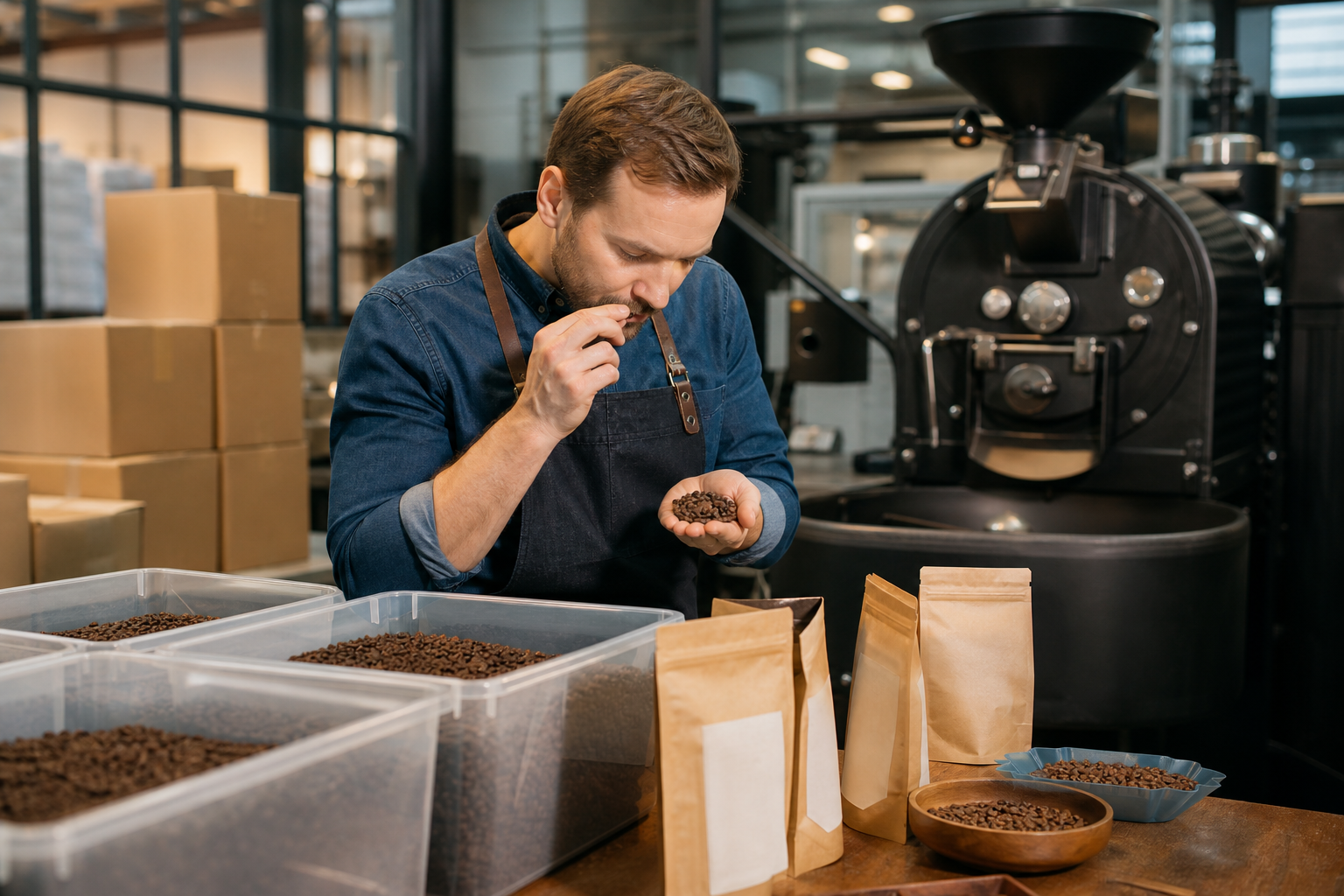
Professional coffee evaluation often uses cupping, a standardized tasting approach used to assess aroma and flavor characteristics.
Formal protocols can provide a common evaluation framework.
Taste Coffee in Your Actual Brewing System
A supplier cupping is useful, but cafes should also test coffee on their own espresso machines, grinders, batch brewers, or other equipment.
A coffee that tastes excellent during cupping may behave differently in the intended beverage.
Use Structured Tasting
Evaluate sweetness, acidity, bitterness, body, aftertaste, and general balance according to your target customer.
Avoid choosing solely on unusual flavor descriptions.
Comparing Samples From Coffee Suppliers
When possible, prepare samples under controlled and repeatable conditions.
Use the same:
• Grinder
• Water
• Brewing equipment
• Coffee dose
• Beverage recipe
• Cup size
• Milk where relevant
This creates a more useful commercial comparison.
Coffee Suppliers and Roast Levels
Terms such as light, medium, and dark roast do not have universal definitions.
One supplier’s medium roast can resemble another supplier’s darker or lighter product.
Light Roast Coffee
Lighter profiles are often used to emphasize certain origin and processing characteristics.
They can require careful brewing and may behave differently on espresso equipment.
Medium Roast Coffee
Medium roast is a broad category and can suit numerous brewing methods.
Because terminology is inconsistent, taste samples instead of relying only on labels.
Dark Roast Coffee
Darker roasting can produce stronger roast derived flavors and lower perceived origin distinction.
Some customer bases prefer this profile, especially in particular milk beverages or traditional coffee applications.
Choosing Roast Profiles From Coffee Suppliers
Ask suppliers for recommendations based on your:
• Brewing equipment
• Water
• Drink menu
• Customer preferences
• Milk usage
• Dose
• Desired flavor profile
A collaborative roaster can help optimize the coffee for its intended use.
Wholesale Coffee Pricing Explained
Wholesale coffee prices fluctuate because coffee is an agricultural commodity with significant supply chain complexity.
Weather, harvest size, quality, logistics, currency, labor, energy, packaging, and green coffee markets can all influence pricing.
Understand What the Price Includes
A wholesale bean price might include more than roasted coffee.
Some programs provide delivery, training, machine servicing, branded materials, equipment loans, or account management.
Others price those services separately.
Equipment Loan Agreements
Certain suppliers provide espresso machines or grinders under supply agreements.
This can reduce initial equipment spending but may involve minimum coffee purchases, longer contracts, or ownership restrictions.
Coffee Suppliers Contract Questions
Before accepting an equipment linked arrangement, establish:
• Who owns the equipment?
• Who pays for maintenance?
• Who handles emergency repairs?
• Is there a minimum purchase?
• How long is the agreement?
• Can coffee prices change?
• What happens if the business closes?
• What happens when the agreement ends?
Review significant commercial contracts professionally where appropriate.
Coffee Cost Per Cup
Calculating cost per beverage helps businesses compare coffees more accurately.
If a recipe uses a particular gram dose, the wholesale bean cost can be converted into a theoretical coffee cost for each drink.
Actual cost will be higher when waste is included.
Track Coffee Waste
Waste can come from:
• Dialing in grinders
• Incorrect drinks
• Purging
• Spills
• Training
• Stale batch coffee
• Overdosing
• Stock deterioration
Monitoring these areas can reveal savings that purchasing cheaper beans might not achieve.
Balance Margin and Product Quality
Coffee cost is only one part of drink pricing.
Labor, milk, cups, rent, utilities, card fees, waste, taxes, and overhead also matter.
Coffee Suppliers and Gross Margin Decisions
Do not change suppliers solely because another bean is marginally cheaper without testing yield, customer response, service, and workflow.
The complete beverage economics matter more than one ingredient price.
Specialty Coffee Suppliers
Specialty coffee suppliers typically focus on higher quality green coffee, careful roasting, traceability, and detailed flavor information.
The term specialty should be used with appropriate context rather than treated as a guarantee of quality.
Traceability
Traceability can range from country level information to specific farms, producers, lots, or processing stations.
More detailed traceability can help businesses communicate accurately about coffee origins.
Coffee Scoring
Professional sensory evaluation can include numerical scoring systems.
Scores are useful within their proper methodology but should not replace tasting coffee for its intended commercial application.
Is a Specialty Coffee Supplier Right for Your Business?
Specialty supply may suit businesses where coffee quality and origin are central to the customer proposition.
Other hospitality operations may prioritize consistency, broad appeal, high volume production, or integrated equipment support.
Choose according to business needs rather than terminology.
Sustainable and Ethical Coffee Suppliers
Sustainability in coffee involves environmental, social, and economic considerations across producing and consuming countries.
Simple marketing claims cannot capture this complexity.
Coffee Certifications
Depending on market and product, coffees may carry certifications associated with environmental, social, or organic production standards.
Examples can include Fairtrade, Rainforest Alliance, and certified organic programs.
Each certification has its own requirements.
One certification should not be assumed to verify every possible ethical or environmental claim.
Direct Trade Claims
Direct trade is used by some coffee companies to describe closer purchasing relationships.
It is not a single universal third party certification.
Ask suppliers to explain what direct trade means in their own business and what evidence supports associated claims.
Evaluating Sustainability Claims From Coffee Suppliers
Ask:
• What does the claim specifically mean?
• Is independent certification involved?
• Is producer information available?
• How is traceability documented?
• Does the claim apply to all coffees or selected products?
• What packaging is used?
• How is environmental impact measured?
Specific information is more meaningful than broad ethical branding.
Coffee Packaging and Freshness
Packaging helps protect roasted coffee from environmental conditions that accelerate quality changes.
Whole Bean vs Ground Coffee
Whole bean coffee generally preserves aroma differently from preground coffee because grinding dramatically increases surface area.
For businesses equipped with suitable grinders, whole bean supply is usually preferable for freshly prepared drinks.
Preground coffee can still be appropriate for certain operations where convenience and controlled portions are priorities.
One Way Valves
Many roasted coffee bags include one way degassing valves.
These allow gases released by freshly roasted coffee to escape while limiting external air entry when the packaging functions correctly.
Storage Conditions
Coffee is generally best protected from excessive heat, moisture, oxygen, light, and strong odors.
Storage Guidance From Coffee Suppliers
Ask the supplier for product specific shelf life and storage recommendations.
Rotate inventory using a consistent stock system and avoid storing more coffee than the business can reasonably use while quality remains satisfactory.
Coffee Suppliers for Cafes
Cafes typically need more than bags of beans.
Espresso Support
Ask whether the supplier helps establish espresso recipes and grinder settings when a new coffee is introduced.
Staff should understand how to adjust extraction as environmental conditions and coffee age change.
Barista Training
Training can cover grinder adjustment, espresso preparation, milk steaming, equipment cleaning, workflow, and basic sensory evaluation.
Training quality and frequency vary.
Choosing Coffee Suppliers for a New Cafe
A new cafe should consider supplier capabilities before purchasing equipment.
Coffee, grinder, espresso machine, water treatment, workflow, and projected volume are interconnected.
Supplier and independent equipment advice can help avoid mismatched purchases.
Coffee Suppliers for Restaurants and Hotels
Restaurants and hotels often prioritize reliability and ease of execution alongside flavor.
Match Coffee to Service Volume
A breakfast service preparing hundreds of drinks has different workflow requirements from a small fine dining restaurant.
Equipment and coffee should match peak demand.
Staff Turnover and Training
Hospitality businesses can experience regular staff changes.
A supplier offering repeatable training and clear brewing procedures may help maintain consistency.
Coffee Suppliers for Multiple Locations
Multi site operations should consider:
• Distribution coverage
• Centralized billing
• Roast consistency
• Equipment support
• Staff training
• Emergency deliveries
• Account reporting
• Scalability
Test the supplier’s ability to support expansion before signing a broad agreement.
Coffee Suppliers for Offices
Office coffee programs often emphasize convenience, reliability, and simple maintenance.
Solutions can include whole bean automatic machines, filter coffee, portioned systems, and other formats.
Employee numbers do not by themselves determine consumption.
Usage depends on workplace attendance, beverage preferences, meeting activity, and access to other coffee options.
Track real consumption before committing to large volumes.
Private Label Coffee Suppliers
Private label coffee allows retailers, hospitality businesses, gift brands, and ecommerce companies to sell coffee under their own identity.
Custom Blend Development
Some suppliers can develop a unique blend.
Others offer established coffees packaged with custom branding.
Bespoke formulation may require larger minimum orders.
Label Compliance
Coffee packaging can be subject to food labeling requirements depending on product and jurisdiction.
Businesses should ensure their label contains required information.
Questions for Private Label Coffee Suppliers
Ask about:
• Minimum orders
• Coffee origin
• Roast options
• Packaging sizes
• Label printing
• Lead times
• Shelf life
• Lot coding
• Food safety systems
• Traceability
• Fulfillment
• Reorder minimums
Clarify who is responsible for regulatory compliance.
Food Safety and Coffee Suppliers
Coffee businesses should source from suppliers operating appropriate food safety and traceability systems.
Requirements depend on jurisdiction and business type.
Allergen Considerations
Plain roasted coffee beans are different from flavored products or products manufactured around other ingredients.
Flavored coffee can introduce additional labeling and allergen considerations depending on formulation and manufacturing environment.
Product Recall Procedures
Commercial buyers should know how suppliers communicate safety or quality problems.
Traceable lot information can support targeted recalls.
Coffee Suppliers and Quality Documentation
Larger commercial customers may request documentation relating to food safety programs, product specifications, insurance, traceability, or certifications.
Requirements should be appropriate to the organization and risk.
Coffee Equipment and Supplier Relationships
Coffee quality depends heavily on equipment.
A premium coffee prepared through an unsuitable grinder or poorly maintained machine may produce disappointing drinks.
Grinder Quality
Espresso requires a grinder capable of consistent adjustment and output appropriate to business volume.
The grinder should not be treated as a secondary accessory.
Water Quality
Water chemistry affects coffee flavor and equipment scaling or corrosion.
Suitable water treatment depends on the local water supply and machine manufacturer requirements.
Technical Support From Coffee Suppliers
Ask whether suppliers provide:
• Equipment installation
• Preventive maintenance
• Emergency repair
• Grinder calibration
• Water testing
• Filter replacement
• Staff training
Establish which services are included and which are billed separately.
How to Test Coffee Suppliers Before Signing a Contract
Avoid making a long term commitment based entirely on a sales presentation.
Request coffee samples and test them under real business conditions.
Run a Practical Trial
Prepare the coffee using the equipment, recipes, milk, cups, and staff that will actually be involved.
Track extraction, waste, preparation speed, and taste.
Evaluate Service During the Trial
Notice communication speed, delivery accuracy, invoicing, and technical knowledge.
These qualities become important after the initial sales process is complete.
Coffee Suppliers Trial Checklist
During evaluation, review:
• Taste
• Consistency
• Ease of dialing in
• Customer suitability
• Bean cost
• Waste
• Delivery
• Support
• Packaging
• Training
• Ordering
• Invoice accuracy
Score suppliers consistently rather than relying on memory.
Common Coffee Supplier Mistakes
Selecting entirely by price is one of the most common errors.
Another is signing a long equipment contract before understanding minimum purchases and cancellation terms.
Avoid:
• Ordering excessive inventory
• Ignoring roast freshness
• Comparing beans without controlled tasting
• Forgetting equipment compatibility
• Accepting vague sourcing claims
• Overlooking delivery schedules
• Failing to calculate cost per drink
• Ignoring training requirements
• Relying on one tasting session
• Signing contracts without reviewing exit terms
A supplier should support the operational reality of the business, not just provide an attractive sample.
Frequently Asked Questions
How do I choose reliable coffee suppliers?
Compare coffee quality, consistency, wholesale pricing, freshness, minimum orders, delivery reliability, traceability, training, equipment support, and contract terms.
What do wholesale coffee suppliers charge?
Prices vary by coffee quality, origin, market conditions, roast, volume, packaging, services, and delivery. Request current quotations based on your expected usage.
How fresh should coffee from suppliers be?
Freshness requirements depend on coffee and brewing method. Ask for roast information and supplier guidance, then order quantities that can be used within an appropriate quality window.
Do coffee suppliers provide equipment?
Some suppliers sell, lease, loan, or service espresso machines and grinders. Equipment arrangements can involve purchase commitments or contracts, so review the terms carefully.
Can coffee suppliers create private label products?
Many roasters offer private label or contract roasting, with options for custom packaging, blends, labels, and fulfillment depending on minimum quantities.
Should I use local coffee suppliers?
Local suppliers can provide convenient delivery and direct support, but location alone does not determine quality. Compare coffee, service, pricing, capacity, and reliability.
Conclusion
Coffee suppliers influence product quality, costs, workflow, consistency, and customer experience, making supplier selection an important commercial decision. The strongest partnership combines coffee that suits your customers with dependable roasting, sensible order quantities, reliable delivery, clear sourcing information, and appropriate training or technical support. Testing suppliers under real operating conditions and reviewing the complete cost and contract can help build a coffee program that remains consistent as the business grows.