Worksite Hazards: 7 Powerful Ways to Prevent Serious Risks
Every construction site, warehouse, factory and industrial facility contains potential worksite hazards that can injure workers, damage equipment or interrupt business operations when they are not identified and controlled properly. Hazards can include falls, moving machinery, electricity, hazardous chemicals, excessive heat, poor ergonomics and unsafe work practices. Modern technologies such as sensors, computer vision and artificial intelligence are creating additional ways to identify risks, but effective workplace safety still begins with management leadership, worker participation, inspections, training and practical hazard controls.
The Occupational Safety and Health Administration recommends a proactive approach rather than waiting until an injury, illness or inspection reveals a problem. OSHA identifies ongoing hazard identification and assessment as a core part of an effective safety and health program.
This approach matters because workplaces continuously change.
New workers arrive, equipment is replaced, production processes change and temporary tasks create conditions that may not exist during normal operations.
A strong safety system therefore needs to identify both obvious hazards and risks that develop gradually.
This guide explains seven practical ways employers and workers can reduce workplace risks, including how emerging AI technology can support traditional safety programs.
What Are Worksite Hazards?
Worksite hazards are conditions, materials, equipment or work practices that can potentially cause injury, illness or other harm.
Some hazards are immediately visible.
An unprotected edge at height, damaged electrical cable or moving forklift may be relatively easy to recognise.
Other hazards can be more difficult to detect.
Examples include:
- Excessive noise
- Hazardous vapours
- Repetitive motion
- Heat exposure
- Poor equipment maintenance
- Worker fatigue
- Inadequate ventilation
- Unsafe workflow design
OSHA groups workplace hazards into categories that can include slips and falls, electrical risks, equipment operation, fire protection, ergonomics, workplace violence and emergency-preparedness problems. Health hazards may also involve chemicals, noise, heat, biological exposure and repetitive or physically demanding work.
Recognising these different risk categories helps safety managers avoid focusing only on dramatic accident hazards.
Why Worksite Hazard Identification Matters
A workplace cannot effectively control a danger that has never been identified.
OSHA states that failure to recognise existing or foreseeable hazards is frequently a root cause of workplace injuries, illnesses and incidents.
Effective hazard identification should therefore happen continuously rather than once per year.
Useful information can come from:
- Routine inspections
- Worker reports
- Equipment manuals
- Safety Data Sheets
- Near-miss reports
- Previous incident investigations
- Workers’ compensation data
- Maintenance records
- Job hazard analyses
- Exposure monitoring
The objective is to understand what could go wrong before a serious incident occurs.
7 Powerful Ways to Control Worksite Hazards
1. Conduct Regular Worksite Hazard Inspections
Routine inspections are one of the most effective methods for discovering unsafe conditions.
A safety inspection should not simply become a paperwork exercise.
Inspectors should physically observe how work is being performed.
They may need to evaluate:
- Walking surfaces
- Ladders
- Scaffolding
- Electrical equipment
- Machinery guarding
- Vehicle movement
- Housekeeping
- Chemical storage
- Emergency exits
- Personal protective equipment
OSHA recommends both initial and periodic inspections because workplace conditions can change and previously corrected hazards can return.
Look at How Work Is Actually Performed
Written procedures may describe one process while workers use another method in practice.
Safety inspections should therefore observe actual work.
Workers often understand practical risks better than anyone else because they interact with equipment and processes every day.
OSHA’s Safe + Sound program specifically encourages employers to involve workers in identifying hazards and developing solutions.
Correct Simple Hazards Immediately
Some problems do not require a long investigation.
Examples include:
- Materials blocking a walkway
- Damaged extension cords
- Missing warning signs
- Spilled liquids
- Improperly stored tools
OSHA recommends correcting straightforward hazards as they are identified when practical.
The key is not to allow a minor problem to remain simply because the next formal safety meeting is several weeks away.
2. Control Falls, Slips and Trips
Falls remain one of the most serious dangers on many worksites, particularly construction sites and facilities where workers operate above ground level.
Hazards can involve:
- Unprotected edges
- Roof work
- Scaffolds
- Ladders
- Openings
- Wet floors
- Cluttered walkways
- Uneven surfaces
The appropriate controls depend on the work environment.
Keep Work Areas Organised
Good housekeeping is a basic but important control.
Tools, hoses, materials and waste should not unnecessarily obstruct walking routes.
Spills should be cleaned promptly.
Temporary cables should be routed appropriately.
An organised workplace also makes other hazards easier to recognise.
Work at Height Requires Planning
Workers performing tasks above ground level may need appropriate guardrails, fall-restraint systems, fall-arrest systems or other controls depending on the task and applicable regulations.
Equipment must be suitable for the specific work.
A worker should not use an improvised platform when proper access equipment is required.
Inspect Ladders and Access Equipment
Ladders should be inspected for damage before use.
Workers should also receive training on correct positioning and safe use.
A ladder that appears simple can still become dangerous when it is placed on unstable ground or used for the wrong task.
3. Manage Machinery and Vehicle Hazards
Industrial workplaces frequently involve moving equipment.
Forklifts, trucks, conveyors, cranes and manufacturing machinery can create serious hazards when workers and equipment interact in the same space.
Risks can include:
- Struck-by incidents
- Crushing
- Entanglement
- Pinch points
- Unexpected machine startup
- Reversing vehicles
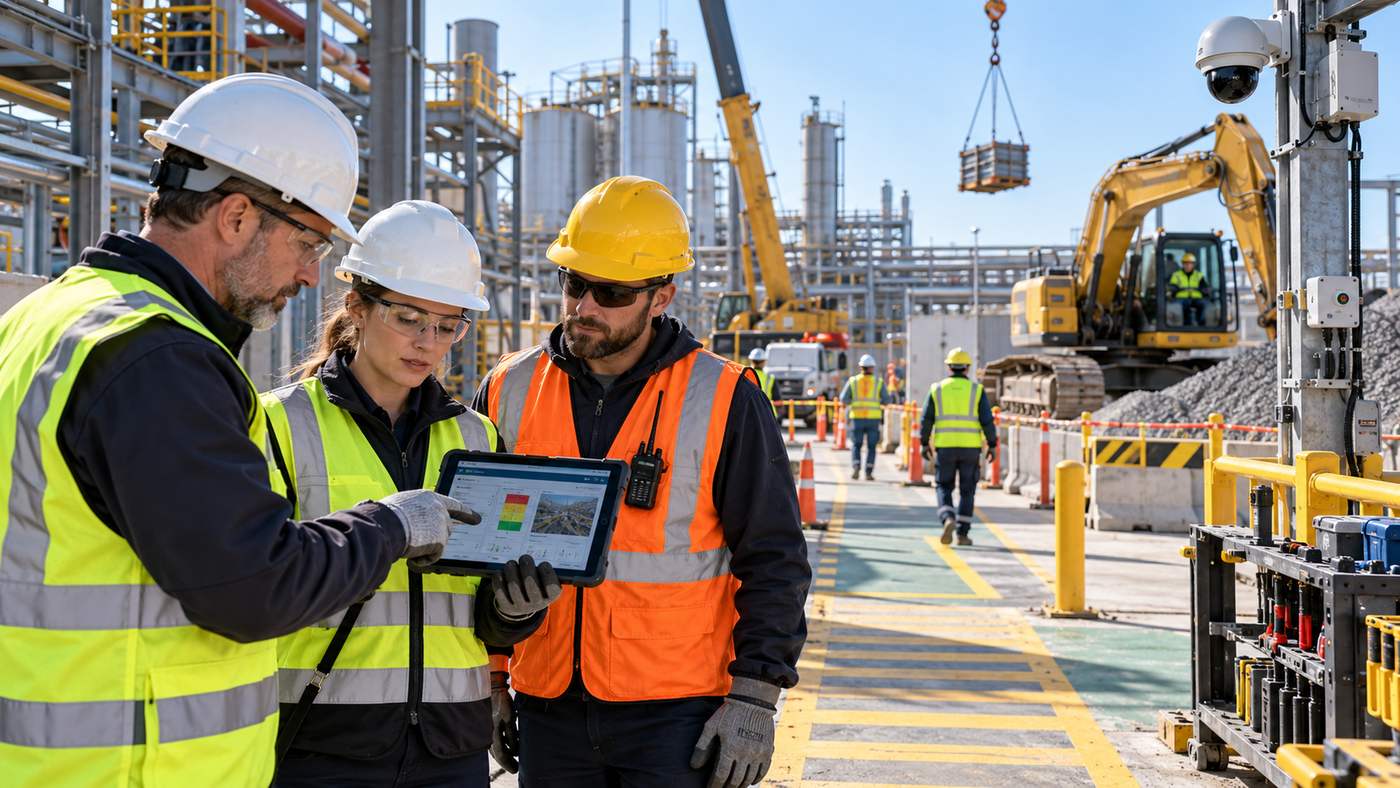
Separate Workers From Moving Equipment
Physical separation can be one of the strongest controls.
Facilities can use:
- Marked pedestrian lanes
- Barriers
- Designated vehicle routes
- Restricted operating areas
- Warning systems
The objective is to reduce unnecessary interaction between people and mobile equipment.
Maintain Machine Guards
Moving machine components should have appropriate guarding where required.
Workers should never remove guards simply because they slow down a process.
An unguarded rotating component or cutting surface can create severe injury risk.
Prevent Unexpected Startup
Maintenance can create additional hazards because employees may work directly around machinery.
Energy-control procedures such as lockout and tagout can be necessary to prevent equipment from starting unexpectedly.
The exact requirements depend on equipment and workplace conditions.
Safety procedures should therefore be developed for the actual machinery being serviced.
4. Control Electrical and Chemical Worksite Hazards
Electricity creates risks ranging from shock to burns and fire.
Chemical hazards can be equally serious, especially when exposure occurs repeatedly over time.
Electrical Safety
Common electrical problems can include:
- Damaged cords
- Exposed wiring
- Improper grounding
- Overloaded equipment
- Wet electrical areas
- Unauthorized repairs
Workers should report damaged electrical equipment immediately.
Temporary repairs should not become permanent solutions.
Qualified electrical work should be performed by appropriately trained personnel.
Chemical Hazard Identification
Employers should know which chemicals are present in the workplace.
OSHA recommends reviewing Safety Data Sheets and product labels when evaluating chemical risks.
Safety planning should consider:
- Inhalation
- Skin exposure
- Eye exposure
- Fire risk
- Chemical reactions
- Storage requirements
Some chemical hazards are difficult to detect because harmful vapours may be invisible or have little noticeable odour.
This is one reason specialised exposure monitoring can sometimes be necessary.
Ventilation Matters
Ventilation can reduce concentrations of airborne contaminants.
However, simply opening a window may not provide sufficient control for hazardous industrial chemicals.
Engineering controls should be designed around the actual exposure.
5. Use the Right Personal Protective Equipment
Personal protective equipment is an important safety measure, but it should not be the only control.
PPE can include:
- Safety helmets
- Protective eyewear
- Gloves
- Hearing protection
- Safety footwear
- High-visibility clothing
- Respirators
- Fall-protection equipment
OSHA construction rules require appropriate PPE to be provided, used and maintained where workplace hazards can cause injury through physical contact, inhalation or other exposure.
PPE Must Match the Hazard
Not every glove protects against every chemical.
Not every respirator protects against every airborne contaminant.
Safety equipment must be selected based on the specific hazard.
PPE Must Fit Properly
Poorly fitting equipment can reduce protection.
For example, oversized eye protection may move out of position, while poorly fitted respiratory protection can fail to create the intended seal.
Employers should make sure workers understand:
- When PPE is required
- How to wear it
- How to inspect it
- When it should be replaced
OSHA recommends training workers on both hazard recognition and correct PPE use.
6. Use Training and Worker Participation to Reduce Hazards
Safety rules have limited value if workers do not understand them.
Training should explain both what workers must do and why the procedure matters.
Useful training topics can include:
- Hazard recognition
- Emergency procedures
- Equipment operation
- PPE
- Chemical handling
- Reporting procedures
- Job-specific risks
OSHA recommends additional training when new equipment, materials, facilities or work organisation may introduce additional hazards.
Encourage Workers to Report Near Misses
A near miss is an event that could have caused injury but did not.
These events provide valuable information.
For example, if materials fall from a platform but nobody is standing underneath, the absence of injury does not mean the system worked properly.
The event should still be investigated.
OSHA recommends investigating close calls because they can reveal hazards that may cause future harm.
Avoid a Blame-Only Safety Culture
Workers may hide hazards if they believe reporting a mistake will automatically lead to punishment.
That does not mean serious misconduct should be ignored.
It means safety programs should focus on identifying underlying causes.
Was the procedure unclear?
Was training inadequate?
Was the equipment unsuitable?
Were workers under unrealistic time pressure?
Finding the real cause can help prevent repetition.
7. Use AI and Digital Technology to Identify Worksite Hazards
Technology is becoming an additional layer in workplace safety.
Artificial intelligence, connected sensors and computer vision systems can analyse information continuously and alert teams to conditions that might otherwise go unnoticed.
Potential applications include:
- PPE monitoring
- Restricted-zone detection
- Vehicle proximity alerts
- Equipment-condition monitoring
- Heat monitoring
- Fatigue indicators
- Predictive maintenance
- Safety trend analysis
These systems should support rather than replace experienced safety professionals.
AI Computer Vision
Computer vision systems can analyse video feeds to detect particular safety conditions.
For example, a system might identify when someone enters a restricted area or appears to be missing required PPE.
The advantage is scale.
A safety manager cannot physically watch every location simultaneously.
An automated system may help direct attention toward conditions requiring human review.
Predictive Maintenance
Equipment often provides warning signs before complete failure.
Connected monitoring systems can track factors such as:
- Temperature
- Vibration
- Pressure
- Operating hours
- Abnormal performance
AI models can analyse these patterns and potentially flag equipment that may require maintenance.
Predictive maintenance can therefore support both reliability and safety.
AI Does Not Eliminate Responsibility
Technology can make mistakes.
Cameras may miss an event.
Sensors can fail.
Algorithms can generate false alerts.
Employers should not treat AI output as a substitute for inspection, training or established safety controls.
The strongest approach combines technology with human judgement.
Worksite Hazards and the Hierarchy of Controls
One of the most useful safety concepts is the hierarchy of controls.
Instead of immediately giving workers more protective equipment, employers should consider whether the hazard can be removed or reduced at its source.
A typical hierarchy prioritises:
- Elimination
- Substitution
- Engineering controls
- Administrative controls
- Personal protective equipment
OSHA encourages employers to evaluate hazard-control options using this type of hierarchy.
Elimination
Remove the hazard entirely.
For example, redesigning a task so employees no longer need to work at height may eliminate a fall exposure.
Substitution
Replace something hazardous with a safer alternative.
A less hazardous chemical may sometimes replace a more dangerous one.
Engineering Controls
Physically isolate people from hazards.
Examples include:
- Machine guards
- Barriers
- Ventilation
- Guardrails
Administrative Controls
Change how work is performed.
Examples include:
- Procedures
- Scheduling
- Training
- Warning signs
- Restricted access
PPE
Protect the worker using equipment.
PPE is important but often depends heavily on correct individual use.
Whenever practical, higher-level controls should be considered first.
Heat as a Growing Worksite Hazard
Outdoor and indoor workers can be exposed to dangerous heat.
Risk can increase when workers:
- Perform heavy physical activity
- Wear protective clothing
- Work in direct sun
- Have limited air movement
- Are not acclimatised
Safety programs should consider environmental conditions and workload together.
Controls can include:
- Drinking water
- Rest breaks
- Shade
- Ventilation
- Acclimatisation
- Worker monitoring
Supervisors should also understand symptoms of heat illness and emergency response procedures.
Ergonomic Worksite Hazards
Not every workplace injury happens suddenly.
Repeated lifting, awkward postures and vibration can contribute to musculoskeletal problems over time.
Ergonomic hazards can involve:
- Heavy lifting
- Repetitive movement
- Work above shoulder height
- Forceful gripping
- Awkward bending
- Long periods in one posture
OSHA recommends examining these kinds of work activities when identifying health hazards.
Potential controls can include redesigning workstations, using lifting equipment or rotating particular tasks where appropriate.
Emergency and Nonroutine Worksite Hazards
Safety programs should not focus exclusively on normal operations.
Shutdowns, maintenance, storms, fires and other unusual situations can create different risks.
OSHA recommends identifying hazards associated with emergencies and nonroutine work as part of the hazard-assessment process.
Emergency planning may need to address:
- Fire
- Severe weather
- Chemical release
- Equipment failure
- Medical emergencies
- Power loss
Workers should know what actions to take before an emergency happens.
How Employers Can Build a Stronger Safety Program
An effective program requires more than one safety officer.
Management needs to provide resources and workers need meaningful ways to participate.
OSHA’s recommended approach includes seven core elements covering management leadership, worker participation, hazard identification, hazard prevention, education, program evaluation and coordination with other employers.
The program does not have to begin as a complicated system.
OSHA specifically notes that companies can begin with basic goals and improve their program over time.
The important point is consistency.
Inspections, worker reports, training and corrective actions should become normal parts of business operations.
Common Mistakes When Managing Worksite Hazards
Waiting for an Accident
A reactive approach addresses hazards only after someone has already been hurt.
Proactive inspections and near-miss reporting provide opportunities to act earlier.
Treating PPE as the Only Solution
PPE matters, but eliminating or isolating the hazard can offer stronger protection.
Ignoring Worker Feedback
Workers often see changing site conditions before managers do.
Failing to Review Changes
New machinery, materials or production methods can introduce new risks.
Incomplete Incident Investigations
Simply blaming the injured worker may fail to identify equipment, process or training problems that contributed to the incident.
Frequently Asked Questions
What are worksite hazards?
Worksite hazards are conditions, activities, equipment or exposures that can potentially cause worker injury or illness. Examples include falls, electricity, machinery, chemicals, heat and ergonomic risks.
How can employers identify worksite hazards?
Employers can use routine inspections, employee reports, job hazard analyses, incident investigations, near-miss reports, Safety Data Sheets and equipment-maintenance information.
What are the most common types of workplace hazards?
Common categories include slips and falls, electrical hazards, equipment operation, chemicals, noise, heat, ergonomics, fire hazards and inadequate emergency procedures.
Can AI help reduce workplace accidents?
AI can support workplace safety through computer vision, sensor analysis, predictive maintenance and automated alerts. It should complement rather than replace inspections, training and human safety oversight.
Why is PPE important for workplace safety?
PPE protects workers from hazards that cannot be completely eliminated through other controls. OSHA requires appropriate protective equipment when workplace conditions can cause injury or harmful exposure.
Why should near misses be investigated?
A near miss can reveal the same underlying hazard that might cause a serious injury in the future. OSHA recommends investigating close calls to identify root causes and prevent recurrence.
Conclusion
Worksite hazards cannot be eliminated simply by posting safety rules or providing protective equipment. Effective prevention requires ongoing inspections, worker participation, training, equipment maintenance and controls designed around actual workplace risks. Emerging AI and sensor technologies can provide useful additional visibility, but they work best when integrated into a strong human-led safety program. By identifying hazards before an incident occurs, organisations can protect workers while improving reliability and overall operations