Dinosaur Skeleton for Sale: How to Buy Fossils Legally, Safely and Responsibly
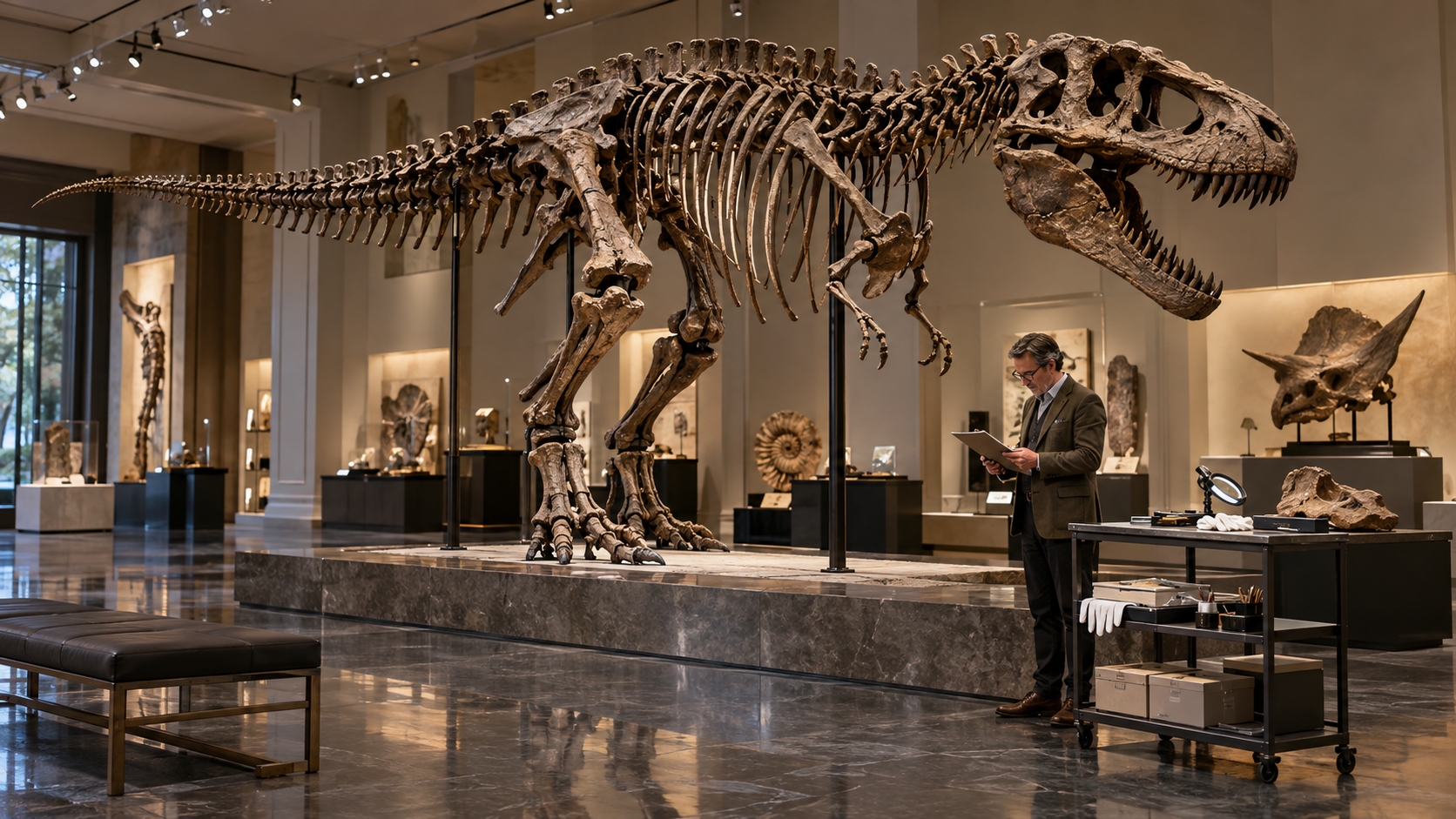
Finding a dinosaur skeleton for sale can be exciting for collectors, museums, educational institutions and businesses looking for an extraordinary natural history display, but purchasing a genuine fossil skeleton is far more complicated than buying an ordinary collectible. Dinosaur fossils can carry substantial scientific, cultural and financial value, and their legal status depends heavily on where they were discovered, who owned the land, whether excavation was authorised and whether the specimen was legally exported from its country of origin. Buyers therefore need to investigate provenance, authenticity, restoration, completeness and ownership documentation before considering price alone.
Complete or highly complete dinosaur skeletons are rare. Many mounted specimens on the commercial market contain a combination of original fossil material, restored sections and replica components.
That does not automatically make them unsuitable.
What matters is that the composition of the specimen is accurately disclosed and supported by reliable documentation.
This guide explains what buyers should check before purchasing a dinosaur fossil, how commercial fossil sales work and why legal provenance is one of the most important parts of the transaction.
Can You Legally Find a Dinosaur Skeleton for Sale?
Yes, genuine dinosaur fossils can legally enter private collections in some circumstances.
However, legality depends on where and how the fossil was collected.
In the United States, privately owned land is especially important to the commercial fossil market.
The National Park Service explains that fossils found on private property generally belong to the landowner, although permission is required before someone can enter the property and collect them. Fossils obtained from another person should also have documentation demonstrating that collection and transfer of ownership were lawful.
Fossils From U.S. Federal Lands Are Different
Commercial buyers should not assume that fossils collected from public land can legally be sold.
The Bureau of Land Management states that vertebrate fossils, including dinosaur remains, cannot be casually removed from BLM managed federal land. Collection requires an appropriate research permit, and fossils collected through that process remain public property and are deposited in museums, universities or other approved repositories.
Even common fossils that can sometimes be casually collected from BLM land are generally limited to noncommercial personal use.
National parks are even more restrictive. The National Park Service prohibits recreational or commercial collection of fossils within National Park System units.
This distinction makes provenance essential.
A legitimate seller should be able to explain where the dinosaur was discovered and demonstrate that the fossil legally entered private ownership.
7 Smart Tips When Evaluating a Dinosaur Skeleton for Sale
A spectacular mount can attract attention immediately, but visual impact is only one part of the purchase.
These seven areas deserve close attention.
1. Verify Legal Provenance Before Discussing Price
Provenance is the documented history of a specimen.
For dinosaur fossils, that history may include:
- Discovery location
- Land ownership
- Excavation permission
- Date of excavation
- Collector information
- Preparation records
- Previous owners
- Bills of sale
- Export licences
- Import documents
A buyer should be able to trace the fossil back through legitimate ownership.
The American Museum of Natural History advises buyers to obtain written proof that a seller holds full legal title and that a specimen was acquired in compliance with applicable local, state, federal and international laws. It also recommends permanently retaining invoices, bills of sale and ownership records.
Ask Where the Fossil Was Excavated
The answer should be specific enough to establish legal history.
A description such as North America is not sufficient for a major fossil transaction.
The seller should ideally document the country, region, land ownership and legal basis for excavation.
For U.S. specimens, confirming whether the fossil originated on private rather than protected federal land can be particularly important.
Why Provenance Affects Value
Good documentation does more than reduce legal risk.
It also preserves scientific context.
A fossil with reliable locality information can provide more meaningful information about geological age, formation and associated organisms.
A fossil whose origin has been lost may still look impressive but can have reduced scientific usefulness.
2. Confirm How Much of the Skeleton Is Genuine Fossil
A mounted dinosaur skeleton may not consist entirely of original fossil bone.
This is normal within both museum and commercial displays.
Missing bones may be reconstructed using casts based on corresponding bones from the same individual, another specimen of the same species or scientifically informed modelling.
Ask for a Fossil Bone Map
For a major purchase, request documentation showing which parts are:
- Original fossil
- Restored original fossil
- Replica
- Sculpted reconstruction
- Composite material from another individual
This is sometimes represented as a skeletal diagram with different colours indicating original and reconstructed elements.
The percentage of genuine bone can significantly influence scientific importance and market value.
Completeness Can Be Defined in Different Ways
Be careful with statements such as 80 percent complete.
A seller may calculate completeness using:
- Number of individual bones
- Percentage of visible skeleton
- Estimated skeletal mass
- Scientifically important elements
These methods can produce different results.
Ask exactly how the percentage was calculated.
Composite Skeletons Need Clear Disclosure
Some mounted skeletons contain bones from more than one individual.
A composite mount is not automatically fraudulent.
It becomes problematic when the composition is not disclosed.
The catalogue or purchase agreement should clearly describe whether all original fossil material belongs to one dinosaur.
3. Examine Restoration and Preparation Quality
Fossils normally require professional preparation after excavation.
Rock matrix may need to be removed carefully, cracks stabilised and fragile sections consolidated.
Some fossil bones arrive at preparation laboratories in numerous fragments.
Restoration Is Normal
Repairing cracks or rebuilding small missing sections can be necessary for preservation and display.
The important issue is transparency.
Ask which materials were used during preparation.
Common conservation work can include:
- Adhesives
- Consolidants
- Gap fillers
- Sculpted missing sections
- Removable restoration materials
Extensive reconstruction should be clearly identified.
Poor Preparation Can Permanently Damage Fossils
Aggressive grinding, overpainting or excessive restoration can obscure original surface details.
That can reduce both scientific and collector value.
For significant specimens, consider obtaining an independent opinion from a qualified palaeontologist, fossil preparator or natural history conservator before purchase.
4. Research the Species Behind the Dinosaur Skeleton for Sale
Not every dinosaur skeleton has the same rarity or market significance.
Several factors influence desirability.
These may include:
- Species
- Geological age
- Completeness
- Skull preservation
- Articulation
- Pathology
- Scientific importance
- Display size
- Provenance
Large theropods and iconic herbivores often receive significant public attention, but smaller dinosaurs can also be scientifically important.
The Skull Can Be Particularly Important
A well preserved skull may contain diagnostic features that help palaeontologists identify a specimen more confidently.
When evaluating a skeleton, ask whether the skull belongs to the same individual as the rest of the mount.
If part of the skull is reconstructed, request clear documentation.
Avoid Relying Only on a Seller’s Species Name
Dinosaur classification changes as scientific research develops.
A commercial name should ideally be supported by anatomical assessment and geological information.
Rare or unusual identifications deserve independent expert review.
5. Understand the Real Dinosaur Fossil Market
Dinosaur fossils appear through private dealers, specialist galleries and major auction houses.
At the upper end of the market, prices can reach millions of dollars.
Sotheby’s natural history department has offered full and partial dinosaur fossils including Stegosaurus, Ceratosaurus and Gorgosaurus specimens, demonstrating that major dinosaur material is part of the established international auction market.
However, auction estimates should not be treated as universal pricing benchmarks.
What Determines Dinosaur Skeleton Prices?
Major variables include:
- Species
- Percentage of original bone
- Completeness
- Skull quality
- Fossil condition
- Size
- Preparation
- Documentation
- Legal provenance
- Scientific interest
- Exhibition history
- Market demand
A small partial specimen may be far less expensive than a largely complete mounted skeleton.
Do Not Assume Bigger Means More Valuable
Size is visually impressive, but quality and rarity can matter more.
A well documented smaller skeleton with excellent anatomical preservation may be more significant than a larger specimen containing extensive reconstruction.
Buyers should compare fossil content rather than display dimensions alone.
6. Check Export and Import Requirements
Fossil ownership laws vary dramatically between countries.
A fossil that can legally be privately owned in one jurisdiction may be protected cultural or scientific property elsewhere.
This becomes especially important when fossils cross borders.
UNESCO’s 1970 Convention includes rare collections and specimens of palaeontological interest within categories of cultural property that countries can protect against illicit import, export and ownership transfer.
Country of Origin Matters
Some countries restrict or prohibit permanent export of important fossils.
Others may require:
- Export permits
- Cultural property certificates
- Government approval
- Customs declarations
Never assume that possession of a fossil in another country proves it was legally exported.
Ask for the original export records where applicable.
Imported Fossils Need a Paper Trail
A strong international provenance file may contain:
- Export licence
- Customs paperwork
- Import declaration
- Dealer invoice
- Previous ownership documentation
- Collection records
For an expensive cross border purchase, specialist legal advice may be worthwhile.
Laws can change, and regulations depend on both origin and destination.
7. Plan Transportation, Mounting and Conservation Before Purchase
A dinosaur skeleton is not an ordinary decorative object.
Large mounts can be several metres long and weigh substantial amounts once their support structure is included.
Before buying, determine how the specimen will reach its final location.
Professional Mounting Matters
A mounted skeleton commonly requires a custom metal armature.
The support should:
- Hold bones securely
- Avoid unnecessary pressure
- Allow safe removal where practical
- Follow plausible anatomy
- Support the specimen’s weight
A poorly engineered mount can damage fragile fossil material.
Check the Building
Large skeletons may require assessment of:
- Ceiling height
- Door dimensions
- Floor loading
- Stair access
- Display platform
- Emergency routes
- Lighting
- Humidity
- Security
Measure the final room before committing to the specimen.
Insurance Should Reflect Replacement Difficulty
A significant dinosaur skeleton may be effectively irreplaceable.
Specialist fine art, museum or collectible insurance may therefore be more appropriate than ordinary household coverage.
Ask the insurer whether transport, installation and temporary storage are also covered.
Original Dinosaur Skeleton vs Museum Quality Replica
Not every buyer needs original fossil material.
High quality replicas can offer important advantages.
A replica may be preferable for:
- Schools
- Museums with interactive displays
- Restaurants
- Hotels
- Offices
- Exhibition venues
- Film production
- Private décor
Modern casts can reproduce fine anatomical details while reducing concerns about damaging scientifically valuable material.
The National Park Service itself notes that high quality casts can substitute for original fossils when specimens need to be shared for education or display.
Benefits of Replica Skeletons
Replicas can be:
- Less expensive
- Lighter
- Easier to transport
- Easier to replace
- Safer for public interaction
- Available for species rarely found commercially
They can also display a fully complete anatomy even when known fossils of that species are incomplete.
Ask Whether a Listing Is Fossil or Replica
Some online listings use phrases such as museum quality dinosaur skeleton without clearly stating whether the bones are original.
Read descriptions carefully.
Useful terms to clarify include:
- Authentic
- Cast
- Replica
- Reproduction
- Composite
- Restored
- Original fossil
A professional seller should clearly distinguish them.
Scientific Concerns Around Commercial Fossil Sales
The commercial fossil market is legal in certain circumstances, but it is also debated within palaeontology.
The Society of Vertebrate Paleontology has expressed concern that scientifically significant vertebrate fossils sold privately may become unavailable for research.
The American Museum of Natural History references this concern in its fossil acquisition guidance and recommends strong provenance checks whenever fossils are purchased.
Private Ownership and Scientific Access Can Coexist
Some private collectors cooperate with researchers and museums.
Owners may:
- Allow scientific study
- Loan specimens to exhibitions
- Provide high resolution scans
- Donate fossils later
- Arrange long term museum loans
Buyers interested in scientifically significant specimens can discuss research access before completing a transaction.
How to Authenticate a Dinosaur Skeleton for Sale
Authentication normally involves several layers of evidence.
A specialist may inspect:
- Bone texture
- Geological matrix
- Anatomy
- Restoration
- Adhesives
- Surface coatings
- Documentation
More sophisticated examinations may use imaging or laboratory techniques where justified.
Documentation Should Match the Fossil
A certificate alone does not guarantee authenticity.
The physical specimen should correspond with the documents describing it.
Serial numbers, mount diagrams, photographs and preparation records can help maintain that connection.
Independent Inspection Is Valuable
For major transactions, the specialist evaluating the fossil should ideally be independent of the seller.
An expert can assess:
- Species identification
- Original bone percentage
- Reconstruction
- Condition
- Scientific importance
This creates a more informed buying decision.
Questions to Ask a Dinosaur Fossil Dealer
Before committing to a purchase, ask:
- Where was the specimen discovered?
- Who owned the land?
- Who excavated it?
- When was it excavated?
- What percentage is original fossil?
- Is it one individual or a composite?
- Which bones are replicas?
- What restoration has been performed?
- Can legal title be documented?
- Was the specimen exported legally?
- Are export documents available?
- Who prepared the fossil?
- Has a palaeontologist examined it?
- What mounting system is included?
Answers should be supported with documentation when possible.
Red Flags When Buying Dinosaur Fossils
Some situations justify additional caution.
Missing Provenance
A valuable vertebrate fossil with no meaningful excavation or ownership history can create substantial risk.
Vague Origin
Descriptions such as found somewhere in Asia or from an old collection are not adequate provenance for an important specimen.
No Export Documentation
International fossils should be accompanied by documentation appropriate to the country of origin and the period of export.
Unclear Restoration
If a seller cannot identify what is original and what has been reconstructed, independent examination is advisable.
Pressure to Purchase Quickly
A genuine high value fossil should withstand detailed due diligence.
Legal documentation and scientific assessment should not be skipped because of sales pressure.
Caring for a Dinosaur Skeleton After Purchase
Fossils are stone like, but they are not indestructible.
Environmental changes can affect fossil material, adhesives and restoration.
Maintain a Stable Environment
Avoid extreme fluctuations in:
- Temperature
- Humidity
- Direct sunlight
- Moisture
The appropriate environment depends partly on the fossil’s mineral composition and preparation materials.
Keep Records With the Specimen
Never separate the skeleton from its documentation.
Maintain digital and physical copies of:
- Provenance
- Photographs
- Bone maps
- Conservation reports
- Purchase agreement
- Insurance valuation
- Export records
Future scientific and financial value can depend on these records.
Frequently Asked Questions
Is it legal to find a dinosaur skeleton for sale?
Yes, dinosaur fossils can legally be sold in some jurisdictions when they were lawfully collected and privately owned. Fossils taken from protected public lands or illegally exported may not be legally saleable.
Can you own a real dinosaur skeleton in the United States?
Private ownership can be legal when a fossil was lawfully collected from private property or otherwise legally acquired. Dinosaur fossils collected from U.S. federal lands under research permits remain public property.
How much does a real dinosaur skeleton cost?
Prices vary enormously based on species, completeness, original fossil percentage, skull preservation, provenance and demand. Major specimens offered through international auction houses can reach multimillion dollar valuations.
Are dinosaur skeletons for sale usually completely original?
Not always. Many mounted skeletons contain restored sections, casts or replica bones. Buyers should request a detailed map showing original and reconstructed material.
What paperwork should come with a dinosaur skeleton for sale?
Important records may include landowner permission, excavation documentation, ownership history, bills of sale, fossil preparation records and international export or import permits where applicable.
Is a dinosaur skeleton replica better for display?
For many schools, businesses and public displays, a high quality replica can be more practical because it is generally less expensive, easier to transport and avoids placing original scientific material at risk.
Conclusion
Finding a dinosaur skeleton for sale can open the door to owning an extraordinary piece of natural history, but a responsible purchase requires far more than evaluating appearance or price. Legal provenance, original fossil content, restoration quality, scientific identification and export documentation should all be verified before ownership changes hands. Buyers who conduct careful due diligence and preserve the specimen’s documentation can protect both their investment and the scientific story carried by the fossil.