Yard Drainage Systems: 7 Proven Secrets to Stop Standing Water, Protect Your Foundation, and Prevent Lawn Flooding
Torrential seasonal rainstorms, poor landscape grading, non-porous clay subsoils, and concentrated roof downspout discharges can quickly transform beautiful suburban lawns into soggy, mosquito-infested swamps. Installing engineered yard drainage systems provides homeowners with a permanent hydrological defense that captures, redirects, and safely evacuates excess surface runoff and subsurface groundwater before it compromises structural property investments. When unmanaged storm runoff pools against residential foundation footings, hydrostatic pressure builds until water penetrates basement walls, buckles concrete crawl space slabs, triggers toxic indoor mold growth, and drowns expensive landscape plantings. Rather than dealing with soggy turf and recurrent muddy paw prints, implementing a comprehensive yard drainage strategy—combining gravel-encased French drains, high-capacity surface catch basins, dry wells, and buried solid downspout conductor lines—safeguards real estate equity, restores functional outdoor living spaces, and eliminates chronic standing water for decades to come.
The Soil Mechanics and Hydrological Physics of Yard Flooding
Managing stormwater runoff requires an understanding of basic civil hydrology and soil physics. Water always follows the path of least mechanical resistance, governed by gravity, soil percolation rates, and hydraulic gradient slopes.
The Physics of Hydrostatic Pressure Against Home Foundations
When stormwater pools around the perimeter of a residential dwelling, the surrounding soil becomes saturated to its liquid limit:
- Volume Expansion in Expansive Clays: Dense clay soils expand significantly when wet, exerting immense lateral hydrostatic pressure against concrete foundation walls. Over time, this pressure causes structural masonry cracking, horizontal bowing, and water weeping through foundation cold joints.
- Foundation Undermining and Soil Subsidence: Conversely, pooling water flowing beneath concrete driveways, patio pavers, and walkway slabs washes away sandy base aggregates, creating subterranean voids that cause concrete slabs to crack, tilt, and collapse.
Surface Runoff vs. Subsurface Groundwater Saturation
Homeowners frequently fail to distinguish between the two distinct forms of yard drainage problems:
- Surface Runoff (Sheet Flow): High-velocity rainwater that cannot infiltrate compacted turf or impervious surfaces fast enough, pooling in low-lying surface depressions and turning backyards into standing ponds during intense cloudbursts.
- Subsurface Groundwater Saturation: Water that infiltrates the upper topsoil but encounters an impermeable subterranean clay or hardpan layer several feet down. This water table rises toward the surface, keeping grass spongy and muddy for days or weeks after the rain has stopped.
Core Engineered Yard Drainage System Solutions
Resolving complex residential water issues requires matching the specific drainage solution to the hydraulic nature of the water problem.
1. The Perforated French Drain (Subsurface Groundwater Evacuation)
The French drain represents the gold standard for lowering high water tables and eliminating spongy, soggy lawn conditions:
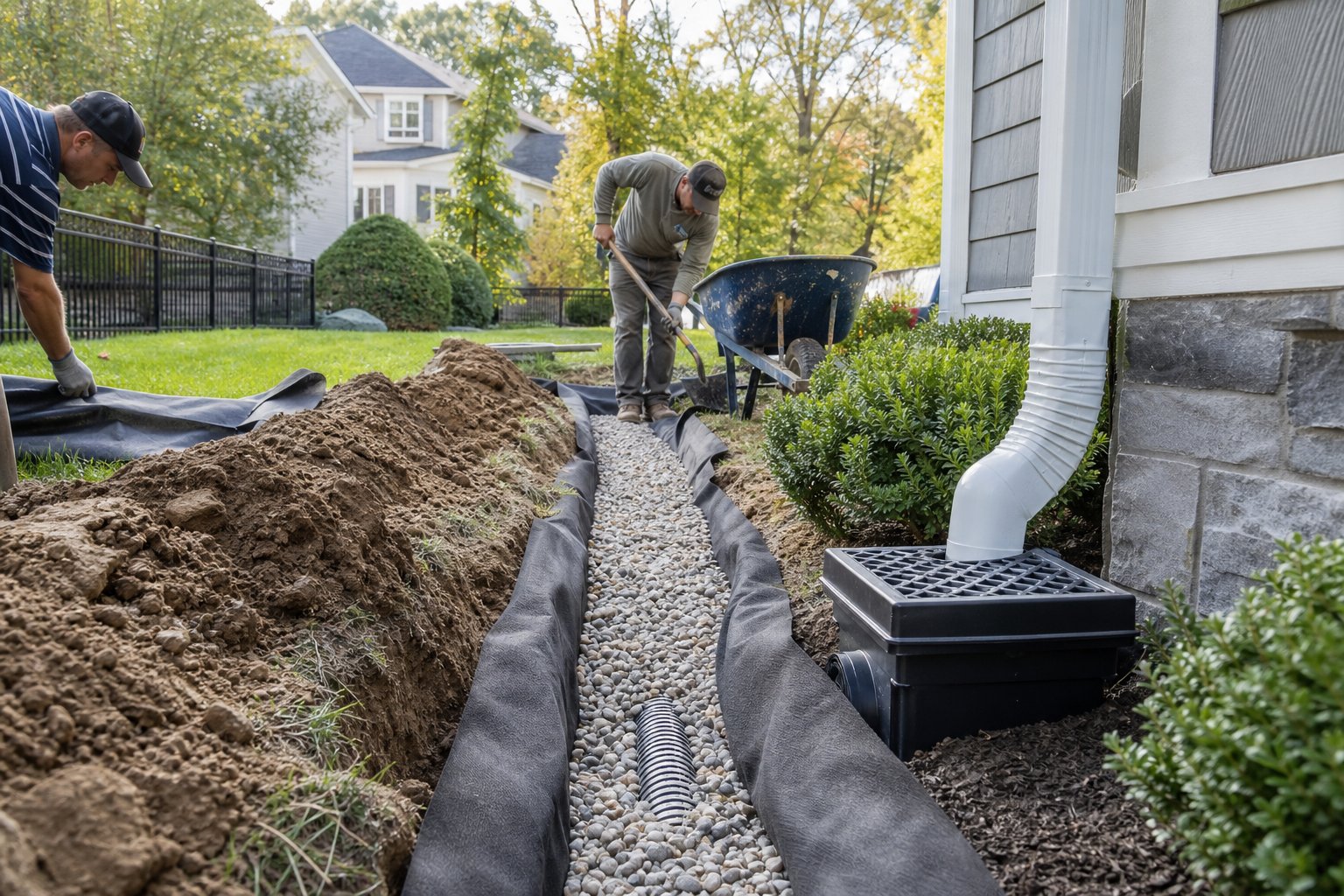
- The Trench Architecture: An eighteen-to-twenty-four-inch deep trench excavated with a continuous downward slope (minimum one percent grade, or one inch of drop per ten feet of horizontal run).
- Non-Woven Geotextile Filter Fabric: The entire trench is lined with high-flow non-woven needle-punched geotextile fabric that allows water to enter while blocking silt, clay particles, and sand from entering and clogging the system.
- Perforated SDR-35 or Corrugated Pipe: A heavy-duty four-inch perforated drainage pipe is laid with the holes facing downward into a two-inch bed of washed crushed river gravel (three-quarter-inch stone).
- The Gravitational Siphon Dynamic: Water enters through the top gravel bed, filters through the stone, enters the pipe holes from below, and flows rapidly away through the smooth pipe interior, carrying subsurface water away from the yard.
2. Surface Catch Basins and Drop Inlets (Surface Sheet-Flow Capture)
For capturing high volumes of surface water pooling in low-lying yard depressions or along the edges of concrete patios:
- Heavy-Duty Polymer Catch Basins: Sunk flush with the finished lawn grade, fitted with decorative slotted or pedestrian-rated brass or plastic grates that catch flowing runoff while trapping leaves, pine needles, and large organic debris in an easily cleanable internal sediment trap.
- Smooth-Wall Solid PVC Drainage Piping: Connected to buried, solid four-inch Schedule 40 or SDR-35 PVC pipe that evacuates high-velocity water away without allowing roots to penetrate or dirt to collect.
3. Buried Gutter Downspout, Conductor Lines
The single largest source of foundation flooding on residential properties is roof runoff. A typical 2,000-square-foot roof sheds roughly 1,250 gallons of water for every one inch of rainfall:
- Eliminating Splash Blocks: Relying on cheap plastic splash blocks dumps thousands of gallons of concentrated water directly next to the home’s foundation footings.
- Hard-Piped Underground Discharges: Professional drainage contractors connect all vertical gutter downspouts directly into buried four-inch solid PVC conductor lines, transporting massive roof water volumes thirty to one hundred feet away from the home into municipal storm drains, dry wells, or daylight pop-up emitters.
4. Swales and Berms (Natural Passive Landscape Sculpting)
When site topography allows, creating subtle, contoured earth swales provides a low-cost, natural method for redirecting water:
- Contoured Drainage Swales: Broad, shallow vegetative depressions lined with river rocks or deep-rooting turf that guide sheet-flow runoff around the perimeter of the home toward approved drainage easements.
Drainage System Comparison and Specification Matrix
| Drainage Architecture | Primary Water Target | Key Materials Required | Optimal Soil Environment | Primary Property Protection |
|---|---|---|---|---|
| Perforated French Drain | Subsurface water table & soggy turf | Perforated pipe, 3/4″ gravel, filter fabric | Heavy clay, poor percolation soils | Prevents spongy turf & basement seepage |
| Surface Catch Basin | Rapid pooling surface sheet-flow | 12″x12″ basin, grate, solid PVC pipe | Low-lying depressions, patio edges | Stops surface ponds & lawn washouts |
| Buried Downspout Line | Roof downspout discharge volume | 4″ Solid Schedule 40 PVC or SDR-35 | All soil types and roof configurations | Protects foundation walls from water pressure |
| Dry Well Retention Basin | Storing & percolating excess water | 50-Gal perforated drum + gravel pit | Sandy loam, high percolation rates | Retains stormwater on-site; avoids street runoff |
| Pop-Up Relief Emitter | Point-of-discharge water daylighting | Spring-loaded pop-up relief valve | Sloping lawns toward street/curb | Flushes water cleanly onto lawn or swale |
| Linear Channel / Trench Drain | Driveways, garage doors, pool decks | Narrow polymer channel + metal grate | Impervious concrete or paver boundaries | Stops garage flooding & pool deck washouts |
Terminal Water Discharge: Where Does the Water Go?
A common failure in amateur drainage projects is capturing water effectively without planning where to discharge it. Drainage systems cannot dump water onto neighboring properties without violating civil drainage laws.
Pop-Up Relief Emitters and Gravity Daylighting
- Gravity Daylighting: If the yard features a natural downward slope toward a street curb, drainage swale, or wooded retention ditch, the solid discharge pipe simply exits into the open air through a protective rodent screen.
- Spring-Loaded Pop-Up Emitters: In flat yards, the pipe terminates into a flush-mounted pop-up relief valve. When water fills the pipe under hydrostatic pressure, the green lid pops up, releasing water smoothly across the lawn before closing flat so lawnmowers can ride over it safely.
Subterranean Dry Wells (Infiltration Basins)
In municipalities where building codes prohibit discharging stormwater into municipal gutters or street storm sewers:
- Heavy-Capacity Plastic Dry Wells: Large modular polyethylene tanks (typically fifty to one hundred gallons capacity) buried in a deep gravel bed underground.
- Slow Soil Percolation: The dry well holds sudden storm surges, allowing collected water to percolate naturally into the surrounding subterranean water table over twenty-four to forty-eight hours without flooding the surface lawn.
Essential Installation Rules: Avoiding Costly DIY Drainage Mistakes
A poorly designed drainage system will silt up and fail within two to three years. Adhering to professional installation standards guarantees a lifetime of trouble-free operation:
- Always Use Non-Woven Geotextile Fabric: Never wrap only the perforated pipe in a fabric “sock.” Instead, line the entire excavated dirt trench with wide geotextile fabric, fill it with gravel and pipe, and fold the fabric over the top like a burrito. This keeps the gravel matrix clean and prevents dirt from migrating into the stone.
- Avoid Flimsy Corrugated Thin-Wall Pipe: Thin black corrugated flexible pipe crushes easily under lawnmowers, develops dips and valleys that hold standing water, and has internal ridges that trap silt and leaves. Professional contractors utilize smooth-interior solid and perforated PVC pipe (SDR-35 or Schedule 40) that can be easily cleaned with a mechanical snake or pressure jetter.
- Maintain a Verifiable Slope: Always use an optical builder’s transit level, laser level, or digital torpedo level to verify a continuous downward slope of at least one inch every ten feet. Water will not flow uphill.
Frequently Asked Questions About Yard Drainage Systems
How do I know if I need a French drain or a surface catch basin?
If your lawn stays spongy, soft, and muddy for days after rain, you need a French drain to capture subsurface groundwater; if water pools rapidly on top of the lawn or patio in puddles during storms, you need a surface catch basin.
How deep should a residential French drain be dug?
A standard residential French drain is typically excavated eighteen to twenty-four inches deep and ten to twelve inches wide to intercept both surface runoff and shallow groundwater tables.
Can tree roots clog underground yard drainage pipes?
Yes; thirsty tree roots can infiltrate perforated pipes or loose pipe joints seeking water. Using rigid, glued PVC pipes and installing root barriers near mature trees prevents root blockages.
Will a yard drainage system eliminate water leaking into my basement?
Yes; redirecting roof downspout water thirty feet away from the house and installing an exterior French drain relieves hydrostatic pressure against basement walls, stopping leaks at the source.
Can I discharge my yard drainage system onto my neighbor’s property?
No; under standard civil drainage law and municipal stormwater codes, property owners are legally prohibited from channeling and discharging concentrated stormwater onto adjacent private land.
What maintenance is required for an underground yard drainage system?
Inspect and clean out surface catch basin grates of leaves after heavy storms, and flush the system with a garden hose once a year to clear any fine sediment buildup.
Conclusion
A waterlogged, soggy lawn is not an inevitable natural condition—it is an engineering challenge that can be solved permanently with properly designed yard drainage systems. By analyzing your property’s topography, soil percolation rates, and roof runoff volumes, you can implement an integrated water management strategy that redirects water away from your living spaces. Combining gravel-encased French drains to lower high groundwater tables with buried PVC downspout lines and surface catch basins protects your foundation from structural settling and eliminates mosquito breeding grounds. Investing in professional, code-compliant yard drainage transforms swampy lawns into pristine, usable outdoor living spaces, protects your family’s health, and preserves the structural integrity of your home for decades to come come