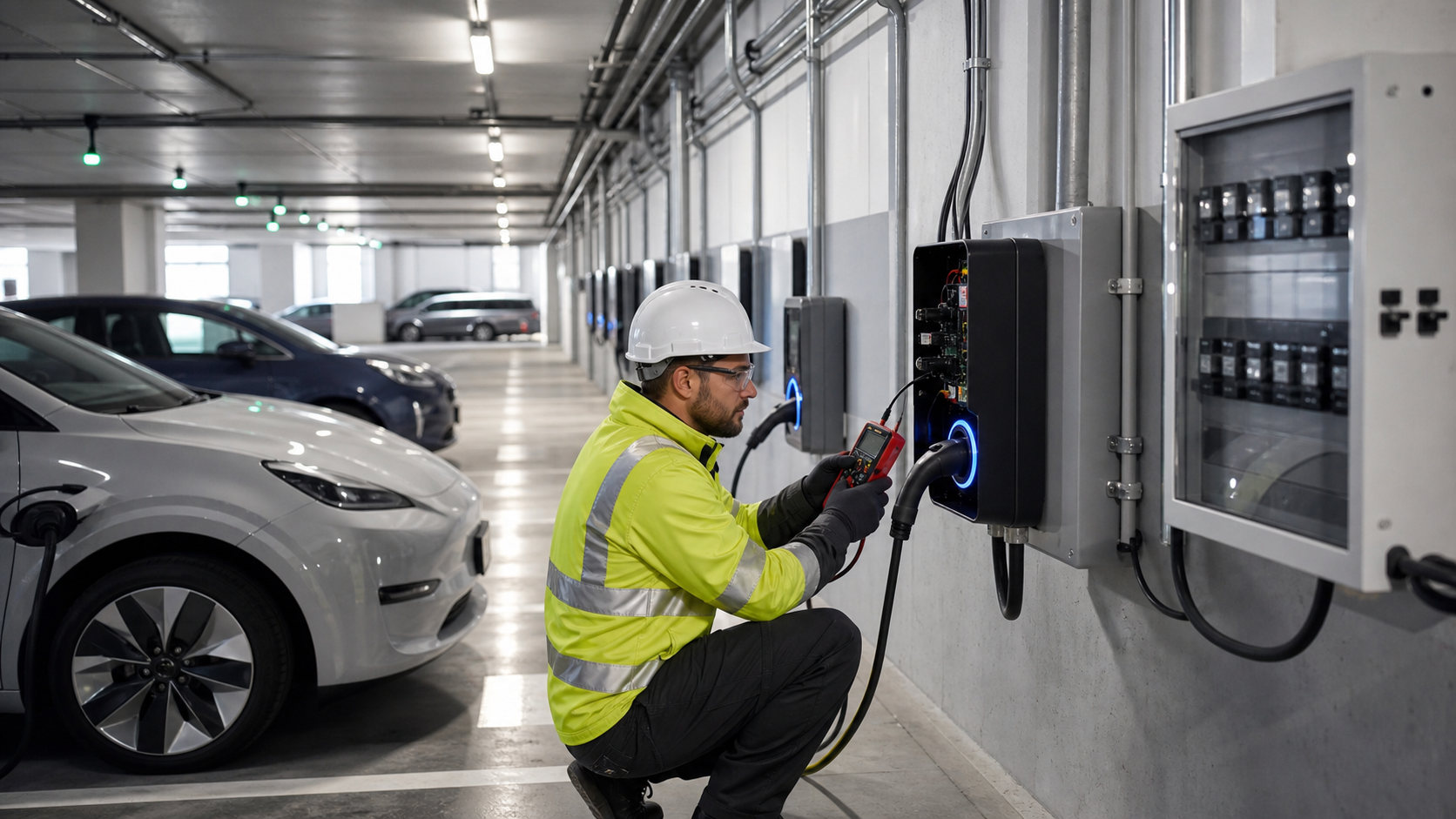
Apartment EV Charger Installation: A Complete Guide for Residents and Property Owners
Planning an apartment EV charger installation requires more coordination than installing a charger at many single family homes because the parking space, electrical infrastructure and utility account may be shared among multiple residents. A successful project usually begins with a site assessment covering parking ownership, available electrical capacity, cable routes, metering, permits, accessibility and future charging demand. Property managers and apartment owners should also consider smart load management, user billing, charger access and expansion before selecting hardware, because a scalable design can be more valuable than simply adding one high powered charger.
Electric vehicle ownership presents a specific challenge for apartment residents. Drivers frequently want to charge where their cars spend the longest period of time, but they may not own the electrical panel or even the parking space.
Condominiums and apartment buildings add further questions. Who pays for electricity? Who owns the charger? What happens when a resident moves? Can ten additional chargers be installed later without rebuilding the system?
Answering these questions before construction can prevent expensive modifications afterward.
This guide covers charger types, electrical capacity, installation costs, billing, permits, safety, load management and practical planning for multifamily residential charging.
What Is Apartment EV Charger Installation?
Apartment EV charging installation is the process of adding electric vehicle supply equipment to a multifamily residential property.
The project can serve one assigned parking space, several residents or an entire communal parking facility.
Installation typically involves more than mounting a charger on a wall.
Depending on the property, contractors may need to install new electrical circuits, protective equipment, cable containment, network connectivity, metering or upgraded distribution infrastructure.
How Apartment EV Charging Works
An EV charging point supplies electrical power safely to a compatible vehicle through dedicated charging equipment.
The vehicle itself contains electronics that control battery charging. The wall mounted or pedestal charging equipment communicates with the vehicle and provides appropriate electrical protection and control.
Available charging speed is influenced by the electrical supply, charger rating and the vehicle’s onboard charging capability.
Apartment Charging Versus Home Charging
In a detached home, the charger can often connect relatively directly to the homeowner’s electrical installation.
Apartment projects can involve long distances between electrical distribution equipment and parking spaces.
They can also involve landlords, building owners, homeowners associations, strata bodies, utilities and multiple residents.
Why Apartment EV Charger Installation Needs Early Planning
Installing one charger without considering future demand can create problems when additional residents buy electric vehicles.
A broader site plan can identify future cable routes, electrical capacity and load management requirements before individual chargers multiply.
This does not mean every parking space needs a charger immediately. Infrastructure can sometimes be designed for staged expansion.
7 Powerful Benefits of Apartment EV Charger Installation
Multifamily charging can benefit both residents and property stakeholders when systems are designed correctly.
1. Convenient Overnight Charging
Residential charging allows drivers to connect their vehicle while it is already parked.
Many vehicles remain stationary overnight for several hours, which can reduce the need for extremely high charging power.
Actual charging requirements depend on daily mileage, battery capacity and vehicle efficiency.
2. Reduced Dependence on Public Chargers
Residents without home charging may rely heavily on public infrastructure.
On site charging gives eligible users another option.
Public rapid chargers can remain valuable for longer journeys or situations where faster charging is necessary.
3. Property Amenity for EV Drivers
Charging infrastructure can become a useful apartment amenity as electric vehicle adoption grows.
Its value depends on local demand, pricing and availability.
Property owners should avoid assuming that chargers automatically produce a specific increase in property value or rental income without supporting local market evidence.
4. Shared Infrastructure
A well designed system can allow multiple chargers to use common electrical and communications infrastructure.
This can be more practical than every resident independently arranging incompatible installations.
Standardized building requirements can also simplify maintenance.
5. Smart Energy Management
Networked chargers can adjust charging power according to site conditions.
Instead of allowing every vehicle to demand maximum power simultaneously, a system can distribute available capacity across connected vehicles.
This is often called load management or load balancing.
6. User Specific Billing
Shared buildings need a practical way to assign electricity and service costs.
Networked charging platforms can record usage by individual users where supported.
Billing arrangements need to comply with applicable utility, metering, consumer and taxation requirements.
7. Future Ready Parking Infrastructure
Installing cable pathways, electrical capacity or other enabling infrastructure during major construction can simplify later charger additions.
Retrofitting finished concrete garages repeatedly can be expensive and disruptive.
Apartment EV Charger Installation Site Assessment
A professional assessment should occur before equipment is purchased.
Review Parking Arrangements
Determine whether spaces are assigned, deeded, leased, communal or managed through another arrangement.
Ownership and parking rights can affect who must approve installations.
The charger location should also account for how vehicles park and where charging ports are located.
Inspect Electrical Infrastructure
A qualified electrical professional should examine relevant distribution boards, transformers, feeders and other supply equipment.
The assessment should determine both current demand and available capacity.
Simply seeing an unused circuit breaker position does not prove that enough electrical capacity exists.
Plan Cable Routes
Cable distance can significantly influence installation cost.
Routes may pass through walls, ceilings, service rooms, outdoor areas or multiple building levels.
Fire compartment penetrations and other building systems may require particular treatment.
Apartment EV Charger Installation for Underground Parking
Underground garages can create additional considerations involving communications, long cable routes, ventilation, fire safety arrangements and physical charger protection.
Local building, electrical and fire requirements must be considered.
A specialist site assessment is therefore particularly useful in large parking structures.
Choosing the Right Apartment EV Charger
The highest powered unit is not automatically the best choice.
Level 1 Charging
In markets using this terminology, Level 1 generally refers to charging from a lower power standard household supply.
It can be relatively slow.
For some low mileage drivers, long overnight parking periods can still make modest charging rates useful.
Level 2 Charging
Level 2 describes higher power AC charging in North American terminology.
Equivalent AC charging arrangements in other countries use different electrical standards and terminology.
This category is widely used for residential and workplace installations.
DC Fast Charging
DC fast chargers provide substantially higher power and are most commonly associated with public or commercial charging.
Their electrical and infrastructure requirements can be considerable.
They are not generally necessary for ordinary overnight apartment parking.
Best Charger Power for Apartment EV Charger Installation
Start with how much energy vehicles actually need to recover overnight.
A car parked for many hours may not need maximum available AC power.
Lower per vehicle charging rates combined with intelligent load management can sometimes support more residents using the same building capacity.
Understanding Electrical Capacity
Electrical capacity is often the central technical constraint.
Building Peak Demand
Apartment buildings already support lifts, lighting, heating, cooling, water systems and residential electricity use.
EV charging adds another load.
Engineers may need to assess peak demand rather than simply adding charger nameplate ratings together.
Dedicated EV Electrical Infrastructure
Larger projects can use dedicated distribution equipment for charging.
This can simplify future additions and provide clearer segregation of EV loads.
The appropriate design depends on building size and local electrical standards.
Utility Coordination
Some projects require involvement from the electricity utility.
Large charger deployments may affect service capacity or require infrastructure upgrades.
Begin utility discussions early if substantial new demand is anticipated.
Load Management for Apartment EV Chargers
Dynamic load management can monitor available electrical capacity and adjust charging accordingly.
For example, charging power can be reduced during periods of heavy building demand and increased when additional capacity becomes available.
System design should ensure that controls fail safely and remain compatible with the electrical installation.
Smart EV Charging in Apartment Buildings
A smart charger includes connectivity that enables management beyond simple power delivery.
Access Control
Apartment chargers should not necessarily be available to anyone who enters a parking facility.
Authentication can use applications, RFID cards or other supported methods.
Charging Schedules
Charging can potentially be scheduled for particular periods.
This may help residents use time dependent tariffs where available.
Tariff structures vary by utility and jurisdiction.
Remote Monitoring
Property managers can monitor charger availability, faults and usage through supported platforms.
This can simplify maintenance in buildings with numerous units.
Network Requirements for Apartment EV Charger Installation
Underground parking may have weak cellular or WiFi coverage.
Installers should assess connectivity rather than assuming wireless communication will work.
Wired networking, cellular gateways or dedicated building networks may be appropriate depending on system architecture.
EV Charger Billing for Apartment Residents
Electricity accounting needs to be planned before chargers become operational.
Individual Metering
Dedicated meters may track energy used by specific charging circuits where appropriate.
Metering requirements depend on how electricity is resold or allocated.
Networked Billing
Charging platforms can measure individual sessions and associate them with user accounts.
Property managers can then use those records within an agreed billing system.
Flat Monthly Fees
A fixed fee is simple but may not reflect actual usage.
One resident could consume much more electricity than another.
It can also become difficult to set a fair rate when energy prices change.
Fair Billing for Apartment EV Charger Installation
Choose a billing approach that is transparent and legally appropriate.
Residents should understand electricity charges, network fees and any administrative costs before using the service.
Where energy resale is regulated, property operators should obtain appropriate regulatory or legal guidance.
Apartment EV Charger Installation Costs
Costs vary widely because multifamily properties have very different infrastructure.
A simple installation near an electrical panel and a multi level garage retrofit are not comparable.
What Affects Installation Cost?
Major factors include:
• Charger hardware
• Cable distance
• Electrical capacity
• Distribution equipment
• Trenching or conduit
• Wall and floor penetrations
• Load management
• Networking
• Billing software
• Permits
• Labor
• Utility upgrades
• Future expansion infrastructure
The charger itself can represent only one portion of project cost.
Cost of Long Cable Runs
Copper conductors and installation labor can become significant when parking spaces are far from electrical equipment.
Voltage drop and conductor sizing must also be addressed through proper electrical design.
Electrical Upgrade Costs
If existing capacity is insufficient, additional distribution or utility work may be necessary.
This can substantially change project economics.
Getting an Apartment EV Charger Installation Quote
Request an itemized proposal based on an actual site assessment.
The quotation should identify equipment, electrical work, networking, commissioning and any excluded utility or building work.
For larger installations, compare designs rather than charger prices alone.
Permits and Building Approval
Approval requirements vary by jurisdiction.
Electrical Permits
Many locations require electrical permits and inspection for EV charging installations.
Qualified installers should understand applicable local procedures.
Landlord or Building Permission
Tenants usually cannot make significant permanent electrical changes without appropriate authorization.
Condominium or strata properties may also require association approval.
Planning and Building Requirements
Some projects can trigger additional requirements related to accessibility, fire separation, parking design or other building regulations.
Legal Rules for Apartment EV Charger Installation
Some jurisdictions have enacted right to charge or similar rules limiting how certain residential charging requests can be refused.
These laws vary considerably and contain conditions.
Residents should check current local legislation rather than assuming such rights exist everywhere.
Electrical Safety for Apartment EV Charging
EV charging can operate at substantial power for extended periods.
Correct installation is essential.
Dedicated Electrical Protection
Charging equipment should use the circuit protection required by applicable electrical standards, charger specifications and local rules.
Requirements vary by charging equipment and jurisdiction.
Cable Management
Loose charging cables can create trip hazards or be damaged by vehicles.
Wall mounted holders, retractors or other cable management systems can improve safety.
Physical Protection
Chargers installed near moving vehicles may need bollards or other protection.
Parking layouts should minimize impact risks.
Why Qualified Apartment EV Charger Installation Matters
Improvised adapters, extension arrangements and unauthorized electrical modifications can create fire and shock hazards.
Permanent charging infrastructure should be designed and installed by appropriately licensed or qualified electrical professionals according to local rules.
Fire Safety and EV Charging
Fire safety planning should consider the entire parking environment rather than focusing only on the charger.
Follow Local Fire Codes
Fire requirements vary by building type and jurisdiction.
Property managers should coordinate with relevant professionals when installations affect fire rated construction, evacuation routes or protection systems.
Maintain Access
Chargers and cables should not obstruct required walkways, exits or fire equipment.
Damaged Equipment
A charger with exposed conductors, impact damage or other serious defects should be removed from use and assessed by a qualified professional.
The same applies to visibly damaged charging connectors and cables.
Apartment EV Chargers for Renters
Renters face different approval challenges from property owners.
Start With the Landlord or Property Manager
Provide information about the desired charger, parking space and proposed installation.
Do not arrange permanent electrical work before obtaining required approval.
Clarify Ownership
Establish who owns the charger after installation.
If the resident pays for it, determine whether it can be removed when the tenancy ends.
Agree on Electricity Charges
The method for measuring and paying charging electricity should be documented.
This avoids disputes later.
Apartment EV Charger Installation Agreements
Written agreements can address ownership, installation costs, maintenance, insurance, access and removal.
Complex arrangements may benefit from legal review.
Verbal permission alone can leave important questions unresolved.
EV Charging for Condominiums and HOAs
Condominium installations need collective planning.
Create a Building Policy
A consistent policy can establish approved equipment, installer requirements, cable routes and responsibilities.
Without standards, independent installations can become difficult to manage.
Plan for Multiple Vehicles
Do not assess the first request as though it will remain the only charger permanently.
Estimate future adoption.
Decide Who Owns Infrastructure
Shared distribution equipment might belong to the association while individual chargers belong to residents.
Document responsibilities clearly.
Retrofitting an Existing Apartment Building
Older properties were rarely designed around electric vehicle charging.
Conduct an Infrastructure Study
Evaluate service capacity, distribution equipment and parking layout.
The study can identify both immediate opportunities and longer term constraints.
Install Enabling Infrastructure
Even if only several chargers are initially required, installing common cable pathways can simplify expansion.
Phase the Project
Large deployments do not necessarily need to happen at once.
A phased plan can align investment with resident demand while preserving a coherent technical design.
Future Proofing Apartment EV Charger Installation
Future proofing does not mean overspending on unused hardware.
It means designing pathways, electrical architecture, networking and management systems so new chargers can be added without repeatedly rebuilding earlier work.
Open or interoperable systems can also reduce unnecessary vendor dependence where practical.
New Apartment Construction and EV Readiness
New construction provides the best opportunity to prepare for future charging.
Install Cable Pathways Early
Running conduit before walls and ceilings are finished can be less disruptive than retrofitting later.
Allocate Electrical Capacity
Designers can consider expected EV load during initial electrical planning.
This allows transformers and distribution systems to be evaluated before construction.
Consider Accessibility
Charging infrastructure should consider accessible parking and applicable accessibility requirements.
Local rules determine the exact obligations.
Maintaining Apartment EV Chargers
Chargers require less mechanical maintenance than fuel dispensers but still need management.
Visual Inspections
Check cables, connectors, mounting hardware and housings for visible damage.
High use communal chargers may require more frequent attention.
Software Updates
Networked equipment can receive firmware and security updates.
Property operators should understand who is responsible for applying them.
Repair Procedures
Residents should know how to report a faulty charger.
Clear support arrangements reduce downtime.
Cybersecurity for Smart Apartment EV Charger Installation
Connected chargers are networked devices and should be managed accordingly.
Use secure credentials, supported firmware and appropriate network architecture.
For larger deployments, property operators should evaluate vendor security practices before purchasing equipment.
Incentives and EV Charging Grants
Governments and utilities in some locations offer rebates, grants or tax incentives for residential charging infrastructure.
Programs change frequently.
Eligibility can depend on property type, equipment certification, installer qualifications and application timing.
Do not purchase equipment solely because an old article mentions a subsidy.
Check current information from government agencies or utilities before making financial decisions.
Choosing an Apartment EV Charger Installer
Multifamily charging experience is especially useful.
Verify Electrical Credentials
Check licensing or professional registration required in your jurisdiction.
Official regulatory databases are preferable to marketing claims.
Ask About Load Management
An installer proposing numerous apartment chargers should be able to explain how building capacity will be protected.
Check Networking Experience
Large smart charging systems combine electrical and information technology requirements.
Ask who configures and supports the charger network after installation.
Request References
For larger projects, request examples of comparable multifamily work.
Ask how the system was designed for expansion.
Questions Before Apartment EV Charger Installation
Ask prospective installers:
• How much electrical capacity is available?
• Is load management needed?
• Which charger power level is appropriate?
• How will usage be billed?
• How will users authenticate?
• What permits are required?
• Does the utility need to be involved?
• What connectivity does the system require?
• Who maintains the chargers?
• How can additional chargers be added later?
• What equipment warranties apply?
• What happens if the charging network provider changes?
These questions expose long term considerations before construction begins.
Common Apartment EV Charging Mistakes
Avoiding early mistakes can significantly improve a project.
Installing One Charger Without a Site Plan
An isolated installation may use valuable electrical capacity or an awkward cable route that complicates future expansion.
Choosing Maximum Power Automatically
Higher charging power requires greater capacity.
For overnight residential parking, moderate shared charging may sometimes support more users more economically.
Ignoring Billing
An electrically functional charger can still create administrative disputes if nobody decides who pays for energy.
Locking Into a Closed System
Vendor specific platforms can be convenient but may create dependence.
Understand hardware compatibility, data access and what happens if software services change.
Apartment EV Charger Installation Without Load Management
Unmanaged charging can require infrastructure sized for high simultaneous demand.
Smart charging may reduce peak requirements in suitable buildings, although technical design must account for expected usage and reliability.
An electrical engineer or experienced charging designer can model the appropriate solution.
Frequently Asked Questions
Can I install an EV charger at an apartment?
Often yes, but installation may require landlord, condominium or property management approval, electrical capacity assessment, permits and compliance with local regulations.
How much does apartment EV charger installation cost?
Cost varies according to cable distance, charger hardware, electrical capacity, permits, networking, load management and any required utility or distribution upgrades.
Who pays for apartment EV charging electricity?
The arrangement depends on the property. Electricity can be individually metered, tracked through a networked charger or allocated using another legally appropriate billing method.
Do apartment EV chargers need load management?
Not always, but load management can be valuable when multiple chargers share limited electrical capacity or a building expects future EV growth.
What type of EV charger is best for apartments?
AC charging is often well suited to long residential parking periods. The ideal power level depends on vehicles, parking duration, electrical capacity and local standards.
Do apartment EV chargers require permits?
Many jurisdictions require electrical permits or inspections, while building, landlord or association approvals may also apply. Requirements should be checked locally.
Conclusion
Apartment EV charger installation is most successful when treated as an infrastructure project rather than simply a charger purchase. Property owners and residents should assess electrical capacity, parking arrangements, cable routes, billing, permits and future demand before choosing hardware. Smart load management can make limited building capacity more useful as additional electric vehicles arrive. With qualified electrical design, clear ownership rules and a scalable charging strategy, apartment buildings can provide convenient residential EV charging while avoiding costly infrastructure decisions that restrict future expansion.