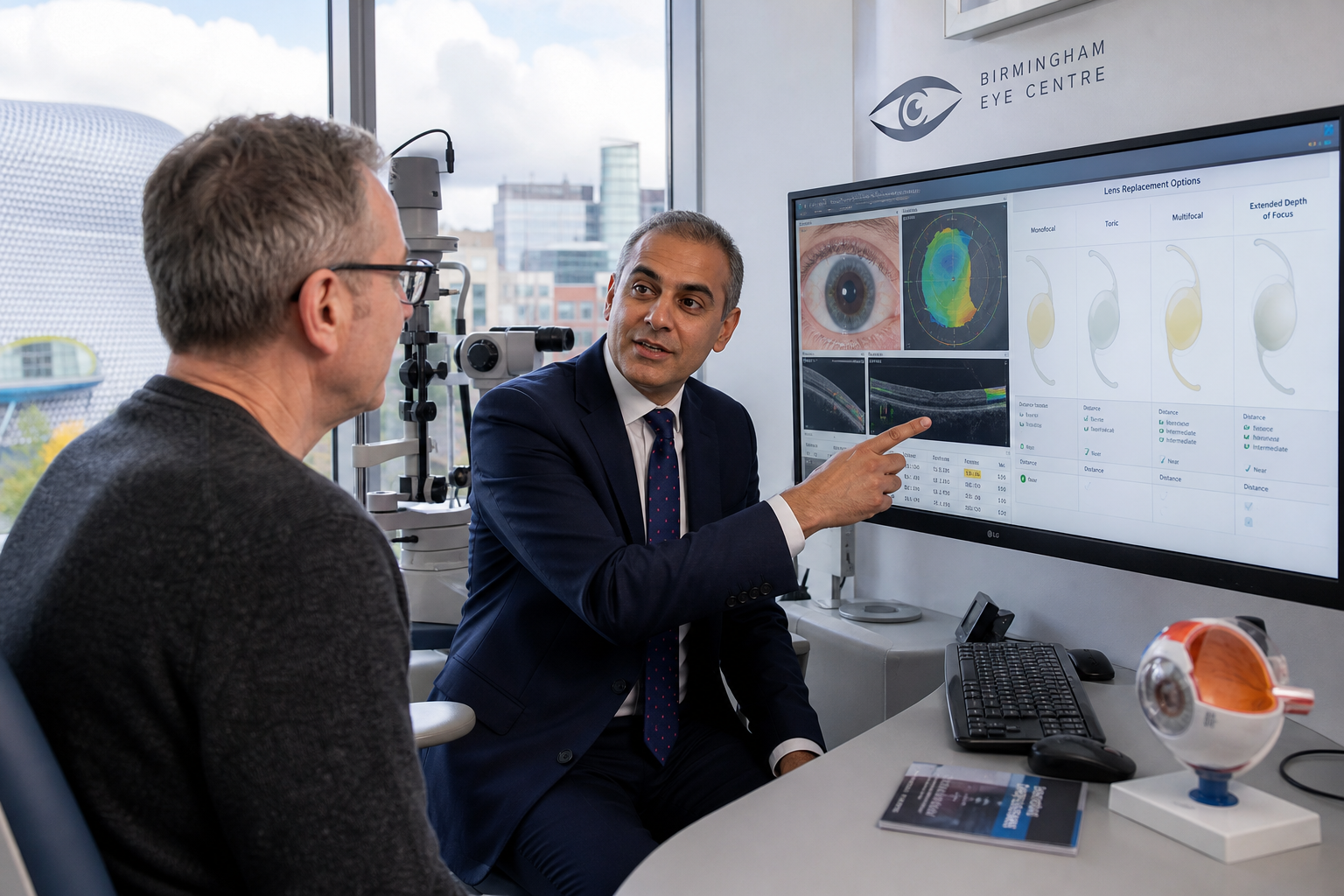
Lens Replacement in Birmingham: 9 Things to Know Before Choosing Surgery
People considering lens replacement in Birmingham are often looking for greater freedom from glasses, treatment for cataracts or a solution to age related changes in near vision. Lens replacement surgery removes the natural lens inside the eye and replaces it with an artificial intraocular lens. The same basic surgical technique is used in cataract surgery, although refractive lens exchange is generally performed to reduce dependence on glasses rather than because a visually significant cataract must be removed. A detailed eye examination is essential because suitability, expected vision, lens selection and surgical risk vary considerably between individuals.
What Is Lens Replacement in Birmingham?
Lens replacement surgery involves removing the eye’s natural crystalline lens and replacing it with a clear artificial intraocular lens, commonly called an IOL.
When the natural lens has become cloudy because of cataract, the operation is called cataract surgery.
When a clear or relatively clear natural lens is removed primarily to reduce dependence on glasses or contact lenses, the procedure is usually called refractive lens exchange or RLE.
The Royal College of Ophthalmologists describes refractive lens exchange as surgery that replaces the natural lens with an artificial lens to reduce dependence on spectacles or contact lenses.
Although the goals can differ, cataract surgery and refractive lens exchange use closely related surgical techniques.
How the Procedure Changes Vision
The natural lens helps focus incoming light onto the retina.
An artificial lens is selected according to measurements of the eye and the visual goal discussed with the surgeon.
Different artificial lenses can be designed to prioritise:
• Distance vision
• Near vision
• Intermediate vision
• Correction of astigmatism
• A broader range of focus
No lens can guarantee perfect vision at every distance, and some people continue to need glasses after surgery.
Lens Replacement Is Not the Same as Laser Eye Surgery
Laser vision correction reshapes the cornea at the front of the eye.
Lens replacement surgery works inside the eye by removing the natural lens.
The Royal College of Ophthalmologists lists laser vision correction, phakic lens implantation and refractive lens exchange as separate approaches to vision correction.
The appropriate option depends on factors such as age, prescription, corneal health, lens condition and overall eye health.
1. Understand Why You Are Considering Lens Replacement
The first step is identifying the reason for surgery.
Two people asking about lens replacement in Birmingham may have completely different clinical needs.
Cataract Related Lens Replacement
A cataract develops when the natural lens becomes cloudy.
Symptoms may include:
• Blurred vision
• Difficulty seeing at night
• Increased glare
• Halos around lights
• Faded colours
• Frequent changes in spectacle prescription
The NHS states that cataract surgery is the only way to remove a cataract and that surgery may be recommended when cataracts are interfering with everyday life.
Refractive Lens Exchange
Someone without a significant cataract may consider refractive lens exchange to reduce reliance on glasses.
It may be discussed particularly in people whose age or prescription makes other forms of vision correction less suitable.
The Royal College of Ophthalmologists advises that patients should understand treatment alternatives, costs, potential complications and aftercare before deciding on refractive surgery.
Cosmetic Convenience Should Not Replace Medical Assessment
Wanting freedom from glasses is a reasonable goal, but it does not mean surgery is automatically appropriate.
Lens replacement is an intraocular operation.
A surgeon should assess whether the expected visual benefit justifies the individual risks.
2. A Detailed Eye Assessment Is Essential
Before lens replacement in Birmingham, a clinic should perform a thorough eye assessment rather than relying only on your glasses prescription.
Measurements help determine both suitability and the artificial lens power.
Eye Measurements
Testing may include:
• Visual acuity
• Refraction
• Corneal measurements
• Eye pressure
• Retinal assessment
• Pupil evaluation
• Biometry
• Optical coherence tomography when appropriate
• Assessment for cataract or other eye disease
Birmingham and Midland Eye Centre explains that patients undergoing cataract surgery have measurements taken to calculate the implant required for the eye. This process is known as biometry.
Why Accurate Measurements Matter
The surgeon uses measurements to estimate the IOL power most likely to produce the intended focus.
Even with modern calculations, the final prescription cannot be guaranteed exactly.
The NHS identifies under correction or over correction as possible outcomes of lens surgery.
Tell the Surgeon About Previous Eye Surgery
Previous procedures such as LASIK or other corneal laser surgery can affect lens calculations.
Also tell the clinic about:
• Glaucoma
• Retinal disease
• Diabetes
• Previous eye injuries
• Dry eye
• Previous retinal surgery
• Current medication
• Significant medical conditions
Bring Realistic Visual Goals to the Consultation
Tell the surgeon what activities matter most.
For example:
“I drive frequently at night.”
“I spend most of the day using a computer.”
“I want to reduce my dependence on reading glasses.”
“I play sport without glasses.”
These details can influence the discussion about lens type.
3. Know the Main Types of Replacement Lenses
Selecting an artificial lens is one of the most important parts of the process.
There is no single best IOL for every person.
Monofocal Lenses
A monofocal lens generally provides one primary focus.
Many patients choose distance vision as the target and use reading glasses for close work.
NHS cataract services commonly use monofocal lenses. Imperial College Healthcare NHS Trust explains that these lenses are normally designed to improve either distance or near vision rather than both.
Toric Lenses
Toric lenses are designed to reduce certain types of corneal astigmatism.
Suitability depends on eye measurements and the amount and type of astigmatism.
A toric lens still needs to be selected according to the individual’s overall visual goals.
Multifocal and Trifocal Lenses
Multifocal and trifocal lenses are intended to provide more than one range of focus.
They may reduce dependence on glasses for some activities.
However, they can also produce optical effects such as glare or halos, particularly around lights at night.
This means someone who frequently drives after dark may weigh lens options differently from someone whose main goal is reading without glasses.
Extended Depth of Focus Lenses
Extended depth of focus lenses are intended to increase the usable range of vision while maintaining a particular visual profile.
Results and tradeoffs vary between lens designs.
The surgeon should explain what level of near, intermediate and distance vision can realistically be expected.
Premium Does Not Automatically Mean Better
A lens with more focusing zones is not automatically the best choice.
The most suitable IOL depends on the patient’s eyes, lifestyle and tolerance for optical side effects.
4. Lens Replacement Can Reduce Dependence on Glasses
One of the main reasons people investigate lens replacement in Birmingham is the possibility of using spectacles less often.
However, reducing dependence on glasses is different from guaranteeing complete spectacle independence.
What Determines the Result?
Visual outcome can be influenced by:
• Lens choice
• Eye measurements
• Astigmatism
• Retinal health
• Corneal health
• Healing response
• Existing eye conditions
• Final refractive result
Even after technically successful surgery, some people still prefer glasses for particular activities.
Reading Vision Changes With Lens Choice
A monofocal lens targeted for distance may provide excellent distance focus while leaving reading glasses necessary.
A multifocal or other presbyopia correcting design may provide a wider range but introduces different optical compromises.
The decision should be based on informed consent rather than advertising promises.
Glasses May Still Improve Vision
Imperial College Healthcare notes that patients may still require spectacles after cataract surgery regardless of which lens type is implanted.
This is an important expectation to discuss before elective surgery.
5. Understand How Lens Replacement Surgery Is Performed
The procedure is usually performed as day surgery.
Patients normally return home on the same day.
What Happens During Surgery?
The NHS describes cataract surgery as involving a small opening at the front of the eye, removal of the natural lens and placement of a clear artificial lens inside the lens capsule.
A typical procedure involves:
• Dilating the pupil
• Numbing the eye
• Making a small incision
• Breaking up and removing the natural lens
• Inserting the artificial lens
• Checking the position of the implant
The exact surgical technique can vary.
Local Anaesthetic Is Common
Lens replacement is commonly carried out under local anaesthetic.
Patients are usually awake but should not feel surgical pain.
They may notice lights, movement, pressure or changing visual sensations during the procedure.
How Long Does Surgery Take?
The NHS states that cataract surgery commonly takes around 20 to 45 minutes.
The total time at the clinic will be longer because preparation and postoperative checks are also required.
Do Not Drive Yourself Home
Patients should arrange transport after surgery.
The NHS specifically advises not driving home on the day of cataract surgery.
6. Recovery Is Usually Progressive Rather Than Instant
Some people notice an improvement quickly, while others experience blurred or fluctuating vision during early healing.
Recovery depends on the individual eye and the type of surgery performed.
Common Early Experiences
The NHS lists possible temporary effects after lens surgery including:
• Blurred vision
• Glare
• Halos
• Starbursts
• Sore or dry feeling eyes
• Redness
These often improve with healing, although the duration can vary.
Eye Drops Are Usually Important
Patients are commonly given postoperative drops.
These may be used to control inflammation and reduce infection risk.
Use them exactly as instructed.
Protect the Eye During Recovery
Your surgeon may advise you to avoid rubbing the eye and may place temporary restrictions on certain activities.
Birmingham and Midland Eye Centre advises patients after cataract surgery not to rub or press on the operated eye and to continue prescribed drops as instructed.
Returning to Driving
Do not assume that feeling comfortable means you are immediately safe to drive.
You should meet the required vision standard and follow the advice provided by your surgical team.
Vision Can Continue to Settle
A final glasses prescription is usually assessed after the eye has had time to heal.
The exact timing should be determined by the clinician managing your postoperative care.
7. Lens Replacement Surgery Has Risks
Lens replacement can provide substantial visual benefit, but it is still an operation inside the eye.
A trustworthy consultation should discuss risks clearly.
Possible Complications
The NHS identifies complications that can include:
• Retinal detachment
• Serious permanent loss of vision
• Need for additional surgery
• Under correction or over correction
• Movement or replacement of the implanted lens
• Posterior capsule opacification
• Other procedure specific complications
Other recognised complications of cataract surgery can include infection, raised eye pressure, corneal swelling and retinal swelling.
Posterior Capsule Opacification
Some people later develop cloudiness behind the artificial lens.
This is known as posterior capsule opacification.
It is not the cataract growing back because the natural lens has already been removed.
It can often be treated with a short YAG laser procedure.
Birmingham and Midland Eye Centre provides YAG laser treatment for posterior capsule opacification following cataract surgery.
Retinal Risk Requires Individual Discussion
The risk profile is not identical for every patient.
People with particular eye shapes, retinal histories or prescriptions may require additional discussion about retinal complications.
Ask for Risks in Numbers Where Possible
Instead of accepting phrases such as “very safe,” ask:
“What are the important complications?”
“How frequently do they occur in people like me?”
“What would happen if one occurred?”
“What is your clinic’s process for emergency postoperative care?”
Clear answers help support informed consent.
8. Know When to Seek Urgent Help After Surgery
Most recovery symptoms are mild, but some changes require rapid assessment.
Do not wait for a routine follow up if serious symptoms develop.
Warning Symptoms
Seek urgent advice if you experience:
• Sudden loss or significant worsening of vision
• Increasing severe eye pain
• A sudden increase in floaters
• Flashes of light
• A dark curtain or shadow in your vision
• Significant redness with worsening vision
• Symptoms your surgical team specifically warned you about
The NHS advises urgent assessment for sudden floaters, flashes, a curtain or shadow across vision, or sudden blurred vision because these can indicate a retinal problem.
Birmingham Emergency Eye Care
Birmingham and Midland Eye Centre provides emergency eye services for serious sight threatening conditions and eye injuries. Its current published service information lists an eye emergency department with daily opening hours, with local hospital A&E used out of hours.
Patients who have recently undergone surgery should also follow the emergency contact instructions supplied by their own clinic.
Keep Your Aftercare Number Accessible
Store the clinic’s emergency contact details before surgery rather than trying to search for them when experiencing a problem.
9. Choosing a Provider for Lens Replacement in Birmingham Requires More Than Comparing Prices
Elective eye surgery should not be chosen solely on promotional pricing.
The consultation, surgeon, diagnostic assessment, lens choice and aftercare are all important.
Ask Who Will Perform the Surgery
You should know which ophthalmic surgeon will operate and have an opportunity to discuss the procedure with an appropriately qualified professional.
The Royal College of Ophthalmologists provides specific standards and patient information to support informed decision making in refractive surgery.
Ask About Aftercare
Important questions include:
• Who sees me after surgery?
• How many follow up appointments are included?
• What happens if vision does not meet the intended target?
• Who do I contact at night or at weekends?
• Are additional procedures included or charged separately?
• What happens if an implanted lens needs adjustment?
Understand the Full Cost
Private lens replacement costs can vary according to provider and lens technology.
Rather than comparing headline prices alone, establish whether the quoted fee includes:
• Consultation
• Diagnostic testing
• Surgery
• Artificial lens
• Medication
• Follow up appointments
• Additional corrective procedures
• Treatment of complications
• Surgery on one eye or both eyes
Avoid Pressure to Book Immediately
Lens replacement for refractive reasons is normally elective.
You should have enough information and time to consider the benefits, alternatives and risks before deciding.
Cataract Surgery and Lens Replacement in Birmingham Are Not Always the Same Pathway
Someone with cataracts affecting everyday life may be considered for NHS cataract treatment.
Someone seeking lens replacement primarily to reduce spectacle dependence is usually discussing elective refractive surgery.
NHS Cataract Care in Birmingham
NHS Birmingham and Solihull publishes information about cataract pathways and local providers.
Its eye health information includes Birmingham and Midland Eye Centre and other providers delivering cataract services in the region.
Eligibility and referral arrangements should be confirmed using current NHS guidance because local pathways can change.
Private Refractive Lens Exchange
Refractive lens exchange for the purpose of reducing glasses dependence is generally provided privately.
A consultation should establish whether RLE is preferable to alternatives such as continuing with spectacles, contact lenses, laser vision correction or phakic lens implantation.
Who May Be Suitable for Lens Replacement Surgery?
Suitability cannot be determined from age or glasses prescription alone.
An ophthalmic assessment is necessary.
People Commonly Considering the Procedure
Potential candidates may include people who:
• Have cataracts affecting vision
• Have age related loss of near focusing ability
• Have significant long or short sight
• Want less dependence on glasses
• Are not well suited to certain corneal laser procedures
The Royal College of Ophthalmologists notes that RLE is one of several refractive options and encourages patients to compare alternatives with their surgeon.
Some Eye Conditions May Affect Suitability
Conditions involving the retina, cornea, optic nerve or other parts of the eye may influence whether surgery is advisable and what visual improvement can reasonably be expected.
This is why a thorough examination matters.
Lens Replacement Versus Laser Eye Surgery
Both procedures can reduce dependence on glasses, but they work differently.
Laser Vision Correction
Laser treatment reshapes the cornea.
The natural lens remains inside the eye.
This can be appropriate for many younger patients with suitable corneas and stable prescriptions.
Lens Replacement Surgery
Lens replacement removes the natural lens permanently.
This also removes the possibility of developing a cataract in that natural lens later because it is no longer present.
However, the operation enters the eye and has a different risk profile from corneal laser surgery.
Which Is Better?
Neither procedure is universally better.
The correct question is which option offers the most appropriate balance of benefit and risk for your eyes.
Lens Replacement Versus Phakic Lens Implantation
A phakic intraocular lens is an artificial lens placed inside the eye while leaving the natural lens intact.
The Royal College of Ophthalmologists lists it as another surgical option for vision correction.
Why Keeping the Natural Lens Can Matter
In younger people, the natural lens still provides some ability to change focus between distances.
Removing it eliminates this natural accommodation.
For this reason, age and near focusing ability are important parts of the surgical discussion.
Questions to Ask Before Lens Replacement in Birmingham
A high quality consultation should give you enough information to make your own decision.
Consider asking:
• Why are you recommending lens replacement for me?
• What alternatives are available?
• Which IOL are you recommending and why?
• What distance will be targeted?
• Will I still need reading glasses?
• What night vision effects might occur?
• What are my individual risks?
• Who will perform the operation?
• How many similar procedures does the surgeon perform?
• What happens if the final prescription is not as expected?
• What postoperative care is included?
• Who handles emergency problems?
• What is the full cost?
The Royal College of Ophthalmologists specifically provides a refractive surgery checklist to help patients discuss treatment choice, cost, complications and aftercare.
Preparing for Lens Replacement Surgery
Follow the instructions provided by your own surgical team.
Preparation may involve measurements, eye drops or temporary changes to contact lens use.
Medication and Medical History
Tell the team about all medications you take.
Do not stop prescription medicines unless a qualified clinician specifically advises you to do so.
Arrange Transport
You will need someone to take you home or another safe transport arrangement.
Plan for Recovery
Arrange enough time away from activities that may be restricted after surgery.
Your surgeon should explain when you can resume:
• Work
• Driving
• Exercise
• Swimming
• Eye makeup
• Other activities relevant to you
Frequently Asked Questions
What is lens replacement in Birmingham?
Lens replacement in Birmingham refers to surgery in which the natural eye lens is removed and replaced with an artificial intraocular lens, either for cataract treatment or refractive vision correction.
Is lens replacement the same as cataract surgery?
The surgical principles are closely related. Cataract surgery removes a cloudy natural lens, while refractive lens exchange can replace a clearer lens primarily to reduce dependence on glasses.
Can lens replacement eliminate the need for glasses?
It can reduce dependence on glasses, but complete spectacle independence cannot be guaranteed. The result depends on lens choice, eye measurements, eye health and individual healing.
What types of lenses are available for lens replacement?
Options may include monofocal, toric, multifocal, trifocal and extended depth of focus lenses. The most appropriate choice depends on the patient’s eyes and visual priorities.
How long does lens replacement surgery take?
The NHS states that cataract lens replacement surgery commonly takes around 20 to 45 minutes, although preparation and postoperative care make the total clinic visit longer.
Is lens replacement surgery risky?
All intraocular surgery carries risks. Possible complications include infection, retinal detachment, optical side effects, refractive error and, rarely, serious loss of vision. A surgeon should explain your individual risk before treatment.
Conclusion
Lens replacement in Birmingham can provide effective visual correction for appropriately selected patients, whether surgery is being considered for cataracts or to reduce dependence on glasses. The most important decisions involve confirming suitability, selecting the right artificial lens, understanding realistic visual outcomes and discussing surgical risks and aftercare. A thorough consultation with an appropriately qualified ophthalmic surgeon allows you to compare lens replacement with other options and make an informed decision based on your own eyes, lifestyle and priorities.