Stout Conveyors: How the TC-50 Changes Construction Material Placement
Stout Conveyors is a Colorado-based construction equipment manufacturer focused on compact, towable telescoping conveyor systems for moving and placing materials such as aggregate, dirt, topsoil and concrete. The company’s best-known machine, the TC-50, is designed to provide contractors with substantial horizontal reach and material-placement capacity without requiring the footprint of larger conveyor systems commonly used on major commercial and civil construction projects.
Stout Conveyors LLC identifies itself as a construction-equipment company headquartered in Montrose, Colorado and founded in 2018. Its company profile describes the business as specializing in towable telescoping conveyors for material placement, backfilling, concrete work, slab preparation and civil construction.
The current TC-50 specification sheet shows how the concept has developed into a specialized material-handling platform. Depending on configuration, the machine provides an operating placement distance from approximately 10 to 60 feet, with material slinging distances of up to about 70 feet for the standard TC-50 and 80 feet for the higher-powered TC-50 MAX.
Its compact and mobile design makes the system particularly relevant where contractors need to place large quantities of material but have limited access for traditional equipment.
This guide explains seven major benefits of the Stout Conveyors system and what contractors should understand before considering a telescoping conveyor for their operation.
What Are Stout Conveyors?
Stout Conveyors manufactures mobile material-placement equipment for construction projects.
The company’s primary product family centers on the TC-50 telescoping conveyor.
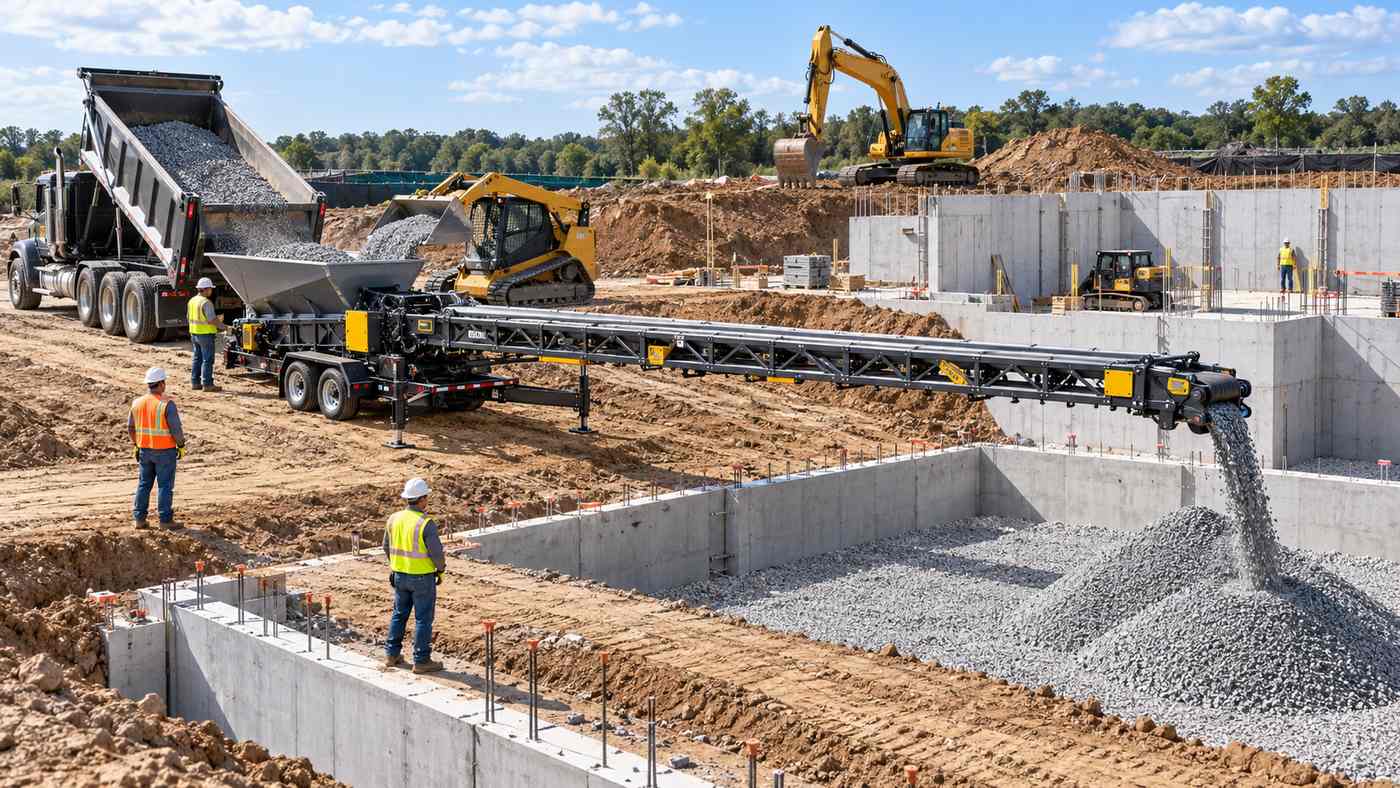
The equipment is intended to move materials from a hopper through a feed conveyor and onto a telescoping primary conveyor that can position or sling material into hard-to-access areas.
Potential applications include:
- Foundation backfill
- Slab preparation
- Aggregate placement
- Concrete placement
- Topsoil placement
- Retaining-wall work
- Civil construction
- Residential development
- Commercial construction
The company describes its objective as providing a compact alternative to larger conveyor systems while maintaining high production capability.
1. The TC-50 Provides Long Telescoping Reach
Reach is one of the most important advantages of a telescoping conveyor.
The current TC-50 specification sheet lists more than 50 feet of horizontal telescoping reach, with a normal operating placement range extending from approximately 10 feet to 60 feet.
That reach allows contractors to move material beyond areas where a dump truck or loader can safely or practically travel.
Why Reach Matters
Construction sites frequently contain obstacles such as:
- Foundation walls
- Excavations
- Finished landscaping
- Existing buildings
- Utility trenches
- Retaining walls
Traditional placement methods may require material to be dumped at one location and moved several additional times.
A telescoping conveyor can potentially reduce these intermediate handling steps.
Slinging Distance
The TC-50 specification sheet currently lists approximately:
TC-50: up to 70 feet slinging distance
TC-50 MAX: up to 80 feet slinging distance
Slinging allows material to travel beyond the end of the conveyor in suitable applications.
Actual achievable placement will depend on material, belt speed, machine setup and jobsite conditions.
Contractors should therefore treat published maximums as equipment capabilities rather than guarantees for every material.
2. Stout Conveyors Can Handle Multiple Construction Materials
Another major advantage is material versatility.
The current TC-50 feed hopper is designed to handle several common construction materials.
The manufacturer lists compatibility with:
- Aggregate
- Dirt
- Topsoil
- Concrete
The current specification indicates that the hopper can accommodate aggregate up to approximately 4 inches minus and concrete with slump up to approximately 6 inches.
Aggregate Placement
Aggregate is needed throughout construction for:
- Foundations
- Drainage
- Slab bases
- Utility work
- Retaining walls
Moving stone manually or repeatedly with skid steers can require substantial labor.
A conveyor provides a continuous placement method.
Dirt and Topsoil
The same general platform can also move lighter materials such as:
- Fill soil
- Topsoil
- Certain landscaping materials
This can expand the machine’s use beyond structural concrete work.
Concrete Placement
Concrete handling can be particularly valuable when access is difficult.
The machine can help position suitable concrete mixes into foundation or structural areas where direct truck access is restricted.
Concrete characteristics must remain within the manufacturer’s operating specifications.
3. The TC-50 Is Designed for High Material-Placement Capacity
Production rate matters because construction equipment is often evaluated by how much labor and machine time it can replace.
The current TC-50 specification sheet reports a maximum observed performance of approximately 1.7 cubic yards per minute, or 100 cubic yards per hour.
That figure represents observed maximum performance rather than a guaranteed production rate for every job.
Real-world output can vary according to:
- Material type
- Moisture
- Feed consistency
- Conveyor angle
- Operator technique
- Site access
- Supporting equipment
Why Continuous Flow Matters
A well-supplied conveyor can keep material moving continuously.
This reduces the start-and-stop cycle associated with individual buckets.
For example, conventional backfill might involve:
Truck → pile → loader → skid steer → final placement
A conveyor system may allow a shorter path:
Truck → hopper → final placement
Every avoided handling step can potentially reduce:
- Labor
- Fuel
- Equipment hours
- Ground disturbance
The actual savings depend on the site.
4. Stout Conveyors Uses a Compact Towable Design
Large material conveyors can be difficult to mobilize.
The Stout concept is built around a trailer-mounted chassis.
That allows the machine to be transported between jobsites without requiring the same type of mobilization as some larger material-placement systems.
The company’s LinkedIn profile describes the TC platform as a compact towable conveyor intended to reach jobsites and work areas that larger conveyor equipment may not easily access.
Compact Equipment Can Be Valuable in Urban Construction
Space is increasingly limited on many projects.
Examples include:
- Urban infill
- Residential foundations
- Remodels
- Tight commercial sites
- Existing neighborhoods
A compact footprint can help contractors operate without occupying excessive staging space.
Low Operating Height
The current TC-50 specification lists a low operating height of approximately 9 feet.
That can be useful where overhead clearance is limited.
However, contractors must still inspect each site for:
- Power lines
- Trees
- Building structures
- Temporary utilities
- Other overhead hazards
A compact machine does not eliminate the need for proper site planning.
5. Remote Controls Improve Placement Precision
Material placement requires constant adjustment.
The TC-50 specification sheet lists a remote-control system using proportional controls for fine machine operation.
It also lists redundant manual controls at the operator station.
Variable Belt Speed
Both the feed and primary belts provide variable-speed control.
The specification sheet lists:
0–100% variable belt speed
for both systems.
This allows operators to adjust flow based on:
- Material
- Placement location
- Required production rate
Independent Control
Independent feed and primary conveyor speeds can be useful because the amount of material entering the system may need to differ from the discharge velocity.
For example, controlled placement close to the machine may need different settings than longer slinging.
Manual Backup
Redundant manual controls can provide another operating interface when needed.
Operators should use controls only according to the manufacturer training and operating manual.
6. The Hopper Can Be Fed by Common Construction Equipment
Material-placement equipment is most productive when supporting machines can feed it efficiently.
Stout’s current specification describes a hopper sized for several common sources, including:
- Dump trucks
- Skid steers
- Loaders
Dual Hopper Vibrators
The feed hopper also includes dual vibrators intended to help keep material moving.
Material bridging can reduce conveyor productivity.
Vibration can help maintain more consistent flow when operating with compatible aggregate or soil.
Feed Conveyor
The TC-50 uses an approximately 18-inch feed belt with a vulcanized splice.
The manufacturer describes a single-hydraulic actuation arrangement for transitioning the feed system between transport and operating positions.
Primary Conveyor
The main conveyor uses an approximately 14-inch belt, also with a vulcanized splice.
The current specifications also list:
- Tungsten-carbide scraper system
- Troughing-frame belt design
- UHMW rails
These features are intended to support material control and reduce maintenance associated with some conventional roller arrangements.
7. Stout Conveyors Can Reduce Repeated Material Handling
The most important economic argument for a conveyor is not the machine itself.
It is the number of material-handling steps the machine can potentially eliminate.
Consider foundation backfill.
A conventional process could require:
- Dump truck unload
- Excavator repositioning
- Skid-steer transport
- Manual spreading
A conveyor can potentially move material directly from a central feed point to the placement area.
Reduced Equipment Traffic
Fewer machines moving around the excavation may reduce:
- Congestion
- Surface damage
- Equipment conflicts
This can be useful on restricted jobsites.
Reduced Manual Handling
Continuous mechanical material placement can also reduce reliance on workers manually moving large quantities of aggregate.
The exact labor benefit will depend on crew structure and jobsite design.
Repeatable Placement
Remote operation and variable-speed control allow the operator to adjust where and how material is discharged.
This can improve consistency during:
- Backfill
- Slab preparation
- Aggregate bedding
TC-50 vs TC-50 MAX
Stout currently lists two principal performance configurations in its specification sheet.
TC-50
The standard machine currently lists:
Engine: 74-horsepower CAT diesel
Operating placement: approximately 10–60 feet
Slinging distance: approximately 70 feet
TC-50 MAX
The MAX configuration currently lists:
Engine: 135-horsepower CAT diesel
Operating placement: approximately 10–60 feet
Slinging distance: approximately 80 feet
The appropriate choice depends on the contractor’s application.
A company performing high-volume long-distance material placement may benefit from the higher-powered configuration.
A smaller contractor may not require the additional capacity.
Engine and Power System
The TC-50 specification currently identifies a Tier 4 CAT diesel engine as the power source.
Diesel power means the conveyor does not need a large external electrical supply for normal operation.
This can make the equipment useful on:
- New construction sites
- Remote sites
- Early-stage projects
where electrical infrastructure may not yet be available.
Chassis Design
The machine uses an all-steel chassis with expanded-metal decking.
The manufacturer emphasizes service access around:
- Engine
- Controls
- Hydraulic lines
- Fuel routing
Service accessibility can matter significantly in construction equipment because downtime directly affects productivity.
The current chassis specification also lists an electric-over-hydraulic braking system.
Operators and owners should follow all manufacturer transport requirements regarding:
- Tow vehicle rating
- Braking
- Hitching
- Road transport
Where Stout Conveyors Are Used
The equipment is particularly suited to projects involving large amounts of material in constrained areas.
Foundation Backfill
After foundation walls are completed, contractors often need to fill material around the structure.
A telescoping conveyor can reach over walls or across excavated areas.
Slab Preparation
Gravel bases beneath concrete slabs need to be spread to the correct depth.
Conveyor placement can reduce the number of skid-steer trips across the prepared site.
Retaining Walls
Aggregate is frequently needed behind retaining walls for drainage and structural backfill.
A conveyor can place material beyond walls where loader access is limited.
Utility Work
Material may need to be placed along trenches or around buried infrastructure.
Concrete Placement
Suitable concrete can be conveyed into locations where a ready-mix truck cannot directly discharge.
Conveyor Safety Is Essential
Powered conveyors create serious hazards if they are operated incorrectly.
OSHA’s construction conveyor standard requires means for stopping the motor or engine at the operator station, audible warning before startup and safeguards against unintended restarting after emergency stops.
OSHA also requires conveyors to be rendered inoperable and appropriately tagged during repairs when maintenance activity could expose employees to hazards.
Stay Clear of Moving Components
Potential conveyor hazards can include:
- Pinch points
- Belts
- Rollers
- Pulleys
- Material discharge
Only trained and authorized personnel should operate or service powered conveyor equipment.
Never Ride the Conveyor
Powered material conveyors are not personnel transportation systems.
OSHA guidance specifically prohibits employees from riding material-handling conveyors.
Lockout During Maintenance
Jams or maintenance tasks can expose workers to stored energy and unexpected movement.
Follow:
- Manufacturer procedures
- Employer lockout/tagout program
- Applicable OSHA requirements
before servicing equipment.
Planning a Job Around a Telescoping Conveyor
A conveyor delivers the strongest productivity benefit when the entire site is planned around continuous material flow.
Consider:
- Truck access
- Hopper position
- Conveyor reach
- Placement sequence
- Crew communication
- Escape routes
Keep the Hopper Supplied
A high-capacity conveyor cannot maintain production if material delivery is inconsistent.
Truck timing and loader availability may become the production bottleneck rather than the conveyor.
Plan Material Placement Sequence
Determine where material should be placed first.
For example, foundation backfill may need to proceed evenly around structural walls rather than filling one area excessively.
The construction engineer and site supervisor should determine placement requirements.
When a Stout Conveyor May Make Sense
The TC-50 concept can be particularly attractive when a contractor repeatedly performs:
- Foundation work
- Concrete installation
- Aggregate placement
- Earthwork
- Retaining-wall construction
The economic case becomes stronger when one machine can replace several stages of material handling across many projects.
When a Larger Conveyor May Be Better
The TC-50 is intentionally compact.
Some large infrastructure projects may require equipment with:
- Greater reach
- Higher sustained production
- Larger aggregate capacity
- Specialized configurations
Equipment should always be selected around the job rather than assuming that one machine suits every construction project.
Renting vs Owning Construction Conveyors
Contractors considering a specialized conveyor should compare ownership with rental availability.
Ownership May Make Sense When
- The equipment will be used frequently
- Similar jobs occur throughout the year
- The contractor can maintain the machine
- Transportation can be managed internally
Rental May Make Sense When
- Conveyor jobs are occasional
- Contractors want to test productivity first
- Capital needs to remain available
Availability and commercial terms depend on the region and current dealer or manufacturer programs.
About Stout Conveyors LLC
Stout Conveyors LLC is based in Montrose, Colorado.
Its LinkedIn company profile lists:
Founded: 2018
Industry: Construction
Specialty: Towable telescoping conveyor systems
A 2023 interview with company founder Jon Fike described the TC-50 as a trailer-mounted conveyor designed to place material at long reach while reducing the number of machines and workers needed to repeatedly handle jobsite material.
The current manufacturer contact information lists Montrose, Colorado as its business location.
Questions to Ask Before Buying Stout Conveyors Equipment
Before investing in a conveyor, contractors should ask:
- What materials will I primarily move?
- What production rate can I realistically achieve?
- Which TC-50 configuration matches my work?
- What is the transport weight?
- What towing requirements apply?
- What operator training is provided?
- What maintenance schedule is required?
- How are replacement parts supplied?
- What warranty applies?
- Is demonstration equipment available?
A demonstration on material similar to your normal work can provide more useful information than specifications alone.
Frequently Asked Questions
What are Stout Conveyors?
Stout Conveyors is a Colorado construction-equipment manufacturer specializing in compact towable telescoping conveyor systems for moving concrete, aggregate, dirt and other construction materials.
How far can the Stout TC-50 conveyor reach?
The current TC-50 specification lists approximately 50-plus feet of horizontal telescoping reach and a placement range of roughly 10–60 feet. The standard TC-50 lists up to about 70 feet of slinging distance, while the TC-50 MAX lists approximately 80 feet.
How much material can a Stout conveyor move?
The manufacturer currently reports maximum observed performance of approximately 1.7 cubic yards per minute, equivalent to about 100 cubic yards per hour. Actual production varies with the material and jobsite.
Can Stout Conveyors move concrete?
Yes. The current TC-50 specification lists concrete up to approximately 6-inch slump among compatible hopper materials, alongside aggregate, dirt and topsoil.
What engine does the TC-50 use?
The current specification lists a Tier 4 CAT diesel engine. The standard TC-50 is listed with 74 horsepower, while the TC-50 MAX is listed with 135 horsepower.
Where is Stout Conveyors located?
Stout Conveyors LLC is headquartered in Montrose, Colorado, and its company profile lists the business as founded in 2018.
Conclusion
Stout Conveyors offers contractors a compact approach to high-volume construction material placement through its towable TC-50 telescoping conveyor platform. The system combines approximately 50-plus feet of telescoping reach, variable belt control and the ability to handle aggregate, soil and suitable concrete while remaining mobile enough for constrained jobsites. For contractors frequently performing foundations, slab preparation, backfill and civil work, reducing repeated material handling can translate into meaningful improvements in labor and equipment utilization. The final decision should still be based on actual material, production requirements, site conditions, transport needs and safe operating procedures