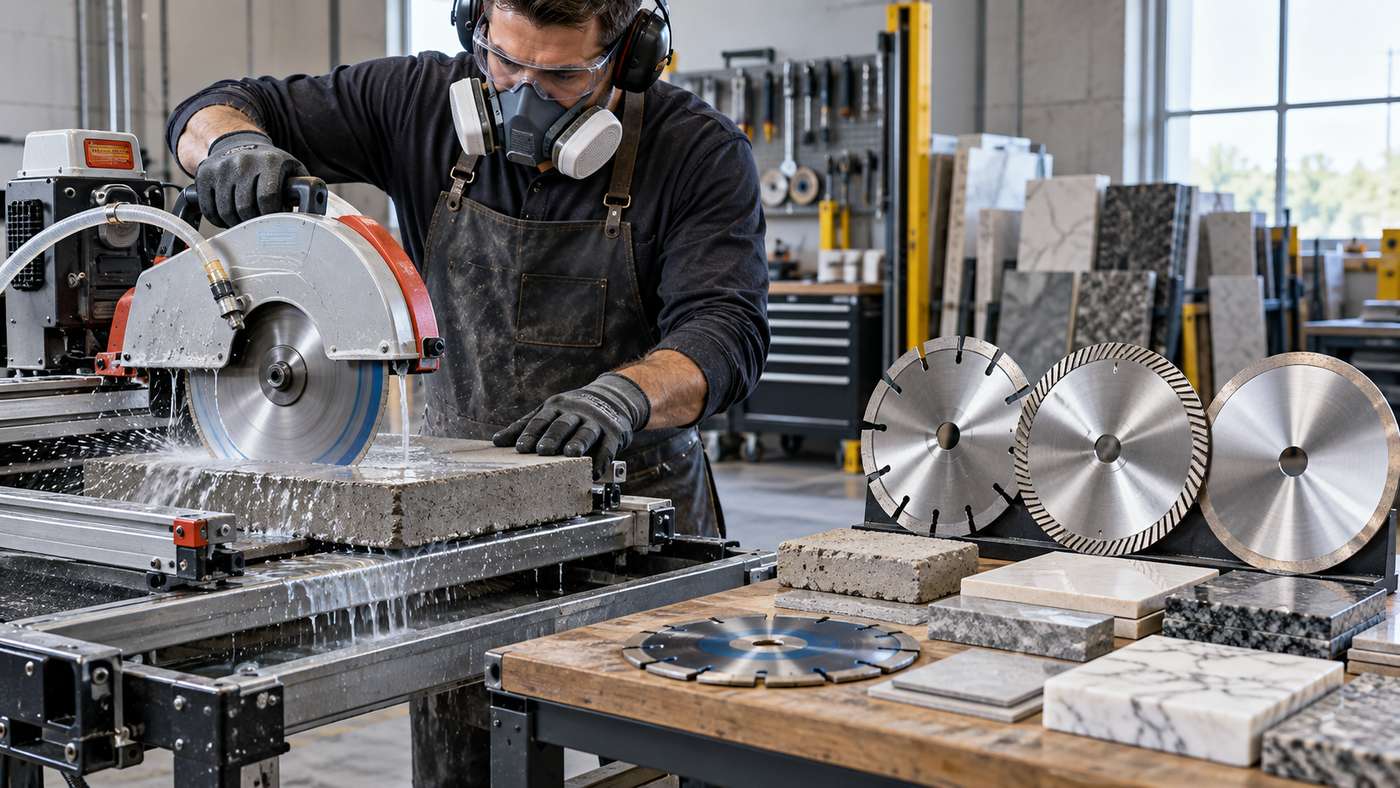
Diamond Blade: How to Choose the Right Blade for Concrete, Tile and Stone
A diamond blade is one of the most useful cutting tools for working with hard and abrasive materials such as concrete, masonry, brick, tile, porcelain and natural stone. Instead of relying on conventional saw teeth, these blades use diamond-containing cutting segments or rims around a steel core to abrade and remove extremely hard material. Choosing the correct blade can improve cutting speed, edge quality and service life while reducing unnecessary downtime and material damage.
The linked Benchmark Abrasives collection currently includes general-purpose segmented and turbo blades, premium laser-welded blades, crack-chaser and tuck-point products, demolition and rescue blades, tile and stone blades, and diamond grinding cup wheels. The company positions these products for construction, masonry, concrete repair, demolition and stone-working applications.
But not every diamond blade should be used on every material.
A blade designed to cut reinforced concrete has different priorities from one designed to create a clean edge in porcelain tile. Similarly, a crack-chasing blade is intended for repair preparation rather than ordinary straight cutting.
Understanding blade style, diameter, arbor, bond and wet-or-dry rating is therefore essential before starting work.
What Is a Diamond Blade?
A diamond blade is a circular cutting tool with industrial diamond abrasive incorporated into its cutting edge.
The main components typically include:
- Steel core
- Diamond-containing cutting rim or segments
- Bond material holding the diamond abrasive
- Arbor hole for mounting the blade
During cutting, exposed diamond particles abrade the workpiece.
As the cutting edge wears, additional abrasive material becomes exposed.
This allows the blade to continue cutting materials that would quickly damage many conventional blades.
Benchmark Abrasives describes diamond blades as tools with diamonds fixed along the blade edge for cutting hard and abrasive materials such as concrete, asphalt, tile and stone.
What Materials Can a Diamond Blade Cut?
The correct blade may be suitable for materials such as:
- Concrete
- Reinforced concrete
- Brick
- Concrete block
- Pavers
- Ceramic tile
- Porcelain tile
- Granite
- Natural stone
- Masonry
Some specialty demolition products are designed for broader mixed-material applications.
However, users should always follow the blade manufacturer’s application rating.
A blade that physically fits the saw is not automatically suitable for the material being cut.
1. Choose the Correct Diamond Blade Style
Blade rim design has a major influence on cutting behavior.
Three common configurations are:
- Segmented
- Turbo
- Continuous rim
Specialty designs are also available for repair, demolition and grinding.
Segmented Diamond Blades
Segmented blades have visible spaces, or gullets, between cutting segments.
These gaps help with:
- Debris removal
- Cooling
- Fast cutting
Segmented blades are widely used for demanding masonry and concrete work.
Benchmark Abrasives currently offers general-purpose segmented blades in multiple diameters, including 4-inch and 7-inch options, with products identified for wet or dry use depending on the individual blade.
When Segmented Blades Make Sense
They are commonly suited to jobs involving:
- Concrete
- Block
- Brick
- General masonry
Their priority is usually efficient cutting rather than producing the smoothest possible decorative edge.
Turbo Diamond Blades
Turbo blades use a continuous or nearly continuous rim with serrated or patterned geometry.
This design aims to combine:
- Relatively fast cutting
- Controlled debris removal
- Smoother edges than aggressive segmented blades
Benchmark Abrasives currently lists a 7-inch premium turbo blade among its general-purpose diamond products.
Turbo blades can be useful for contractors who want one blade to handle a broad range of masonry or stone tasks while maintaining a reasonably clean cut.
Continuous-Rim Diamond Blades
Continuous-rim blades generally prioritize edge quality.
They are often used for:
- Ceramic tile
- Porcelain
- Certain natural stones
The absence of large open segments can help minimize chipping on fragile finished surfaces.
These blades are commonly associated with wet tile saws, although users should follow the specific manufacturer’s instructions.
Specialty Diamond Blades
Some projects require a purpose-built cutting profile rather than a standard general-purpose blade.
Benchmark’s collection includes separate categories for:
- Premium laser-welded blades
- Crack chaser and tuck-point blades
- Demolition and rescue blades
- Tile and stone blades
Selecting a specialty blade for the intended task can produce better results than forcing one universal blade to perform every operation.
2. Match the Diamond Blade to the Material
One of the biggest mistakes is choosing a blade only by diameter.
The material matters just as much.
Concrete
Concrete is highly abrasive.
A concrete blade must cope with:
- Cement matrix
- Sand
- Aggregate
Reinforced concrete adds steel reinforcement, creating an even more demanding application.
For heavy concrete work, manufacturers may use stronger segment attachment methods such as laser welding.
Benchmark categorizes premium laser-welded diamond blades as heavy-duty products intended for dense materials including reinforced concrete and asphalt.
Asphalt
Asphalt differs from cured concrete.
It can be softer but extremely abrasive.
A blade designed specifically for asphalt may use a different bond and segment structure to manage that wear.
Do not assume every concrete blade is optimized for asphalt.
Brick and Block
Brick and concrete block are common masonry materials.
A general-purpose segmented or turbo blade may work well when the blade manufacturer lists these applications.
Porcelain Tile
Porcelain is hard and can chip easily.
For visible tile work, edge quality becomes especially important.
A blade specifically rated for tile and porcelain is generally preferable to an aggressive concrete blade.
Benchmark maintains a dedicated tile-and-stone blade category for this reason.
Granite and Natural Stone
Stone can vary significantly in hardness and mineral composition.
A blade suitable for granite should be specifically rated for that application.
Trying to cut expensive stone with an inappropriate blade can increase:
- Chipping
- Heat
- Blade wear
- Material waste
The safest approach is always to confirm the manufacturer’s application chart.
3. Understand Segments, Bond and Diamond Exposure
The diamonds themselves are only part of how a blade works.
The bond that holds them is equally important.
As the blade cuts, bond material gradually wears and exposes new diamond particles.
Hard Materials and Blade Bond
A harder workpiece can require a bond designed to release worn abrasive at an appropriate rate.
If the bond does not wear correctly, the cutting edge may become glazed and cutting performance can decrease.
Abrasive Materials
Highly abrasive materials can wear the bond more rapidly.
That means blade design must balance:
- Cutting speed
- Abrasive exposure
- Segment life
This is one reason manufacturers create application-specific products.
Segment Height
Diamond blades are commonly advertised with a segment or rim height.
Benchmark’s current collection includes several products using approximately 10 mm segment heights, including segmented general-purpose and crack-chaser products.
Segment height is useful information, but it should not be treated as the only measure of blade quality.
Blade performance also depends on:
- Diamond concentration
- Diamond quality
- Bond design
- Core construction
- Segment attachment
- Correct operating speed
4. Compare Wet and Dry Cutting
Some diamond blades are rated for dry cutting.
Others require water.
Some are rated for both.
Never assume the correct operating method.
Check the blade and saw instructions before use.
Wet Cutting
Water can provide several benefits.
It can:
- Cool the cutting area
- Reduce dust
- Flush debris from the cut
Dust control is particularly important when cutting silica-containing materials such as concrete, brick, block, stone and tile.
OSHA states that applying water to a saw blade when cutting silica-containing materials can substantially reduce the amount of airborne dust produced.
For stationary masonry saws, OSHA identifies continuous water delivery to the blade as an effective engineering control for reducing respirable crystalline silica exposure.
Water Must Reach the Cutting Area
Simply having water nearby is not enough.
OSHA says water delivery should continuously feed the blade and adequately wet the cutting area when that method is being used as a silica control on stationary masonry saws.
Dry Cutting
Some blades are specifically rated for dry use.
Dry cutting can be convenient where water is impractical.
However, dry cutting silica-containing material can create significant airborne dust.
Workers must follow applicable dust-control requirements and the saw and blade manufacturer’s instructions.
If a blade is labeled for wet cutting only, do not operate it dry.
5. Check Blade Diameter, Arbor and Speed Compatibility
A diamond blade must physically and mechanically match the saw.
Before installation, verify:
- Blade diameter
- Arbor size
- Maximum RPM
- Saw type
- Blade rotation direction
- Wet or dry rating
Blade Diameter
Common sizes include:
- 4 inch
- 4-1/2 inch
- 7 inch
- Larger masonry-saw diameters
Benchmark currently lists products including 4-inch, 4-1/2-inch and 7-inch diamond blades in its collection.
Never install a blade larger than the tool is designed to accept.
Arbor Size
The center hole must match the saw spindle or approved mounting system.
For example, Benchmark’s current listings include products using arbor configurations such as:
- 5/8 inch
- 7/8 to 5/8 inch
- 5/8-11 threaded connections on certain grinding cup wheels
Do not improvise an unsafe mounting arrangement.
Maximum RPM
The blade’s rated maximum speed must be appropriate for the tool.
Never operate a cutting blade above the manufacturer’s rated speed.
Excessive rotational speed can increase the risk of blade failure.
Guarding
Saw guards are important protection against contact and flying debris.
OSHA requires appropriate guarding for masonry saws and many abrasive-wheel operations.
Never remove a guard simply to gain additional cutting depth.
6. Use Specialty Blades for Repair and Demolition
Not every diamond product is intended to make ordinary straight cuts.
Specialty blades can perform specific repair operations.
Crack Chaser Diamond Blades
Crack-chaser blades are used when preparing cracks in concrete for repair.
Their shape can help widen or clean the crack so repair material can be applied more effectively.
Benchmark’s current collection includes:
- 4-inch crack chaser blade
- 4-1/2-inch crack chaser blade
- 7-inch crack chaser blade
The smaller listed models use beveled edges and are specifically described for concrete repair.
Crack Chasing Is Not Ordinary Cutting
A crack-chasing operation is designed to follow and prepare an existing crack.
Do not choose such a blade simply because it has the same diameter as a standard cutting blade.
Tuck Point Blades
Tuck-pointing applications involve removing old mortar from masonry joints so the joints can be repaired.
A purpose-built tuck-point blade is generally wider and more suited to mortar removal than a thin tile-cutting blade.
Demolition and Rescue Blades
Demolition work can involve unpredictable materials.
Benchmark categorizes certain diamond blades specifically for demolition and rescue applications where cutting may involve hard or obstructive materials.
These products should still be used only within the manufacturer’s listed material and tool ratings.
Diamond Grinding Cup Wheels
Grinding cup wheels are related diamond tools but are not ordinary cutting blades.
They are used for surface work such as:
- Grinding concrete
- Leveling masonry
- Removing surface irregularities
- Preparing surfaces
Benchmark currently lists 4-1/2-inch and 7-inch threaded T-type diamond grinding cup wheels.
Choose a cutting blade when cutting and a grinding cup wheel when grinding.
7. Follow Diamond Blade Safety Practices
Diamond blades operate at high rotational speeds.
Incorrect installation, damaged blades or unsuitable materials can create serious hazards.
Inspect the Blade Before Use
Check for:
- Cracks
- Damaged segments
- Warping
- Excessive wear
- Damaged arbor
OSHA’s stationary masonry-saw guidance specifically advises inspecting the blade before use for condition and excessive wear.
Never continue using a visibly damaged blade.
Use the Correct Guard
Keep the tool’s approved blade guard installed and positioned correctly.
OSHA’s masonry-saw rules specifically address guarding and retention of blade fragments because broken pieces can be thrown at high speed.
Wear Appropriate PPE
Depending on the task, appropriate protection can include:
- Safety glasses
- Face protection
- Hearing protection
- Protective footwear
- Appropriate respiratory protection where required
PPE does not replace engineering controls such as wet cutting or local dust extraction.
Control Silica Dust
Cutting concrete, stone, brick, block and many tiles can release respirable crystalline silica.
OSHA warns that prolonged inhalation can cause irreversible lung damage.
Use the required dust-control method for the equipment and application.
Do Not Force the Blade
Allow the tool and cutting edge to work at the appropriate feed rate.
Excessive pressure can increase:
- Heat
- Blade stress
- Poor cut quality
Follow the saw and blade manufacturer’s instructions.
General-Purpose Diamond Blades
General-purpose blades are intended to provide versatility across multiple common construction materials.
Benchmark’s current general-purpose collection includes segmented and turbo blade options.
These can be convenient for:
- Contractors
- Remodelers
- Masonry crews
- Maintenance teams
However, “general purpose” does not mean “every material.”
For high-value porcelain, specialized stone or heavy reinforced concrete, a material-specific blade may perform better.
Laser-Welded Diamond Blades
In a laser-welded blade, the diamond segments are attached to the steel core through laser welding.
This construction is commonly associated with demanding concrete and masonry applications.
Benchmark positions its premium laser-welded category for heavy-duty work including reinforced concrete and other dense materials.
This type of blade can be a useful choice where:
- High heat is generated
- The work is demanding
- Segment attachment strength is especially important
Always confirm the exact application rating of the individual blade.
Vacuum-Brazed Diamond Blades
Vacuum-brazed blades use diamond abrasive bonded to the blade surface using a brazing process.
Benchmark currently lists a 4-1/2-inch vacuum-brazed demolition blade in its collection.
These blades can be useful in specialized demolition applications.
However, their construction and expected service life differ from traditional segmented sintered blades.
The correct choice depends on material and task.
Diamond Blade for Tile
Tile projects prioritize finish quality.
The most important factors include:
- Chip control
- Stable blade rotation
- Correct water flow
- Proper feed rate
- Blade suitability for the tile material
Porcelain can be considerably harder than ordinary ceramic tile.
If the project involves expensive finished tile, use a blade specifically identified for porcelain or tile rather than relying on an aggressive concrete blade.
Benchmark maintains a dedicated Tile & Stone Diamond Blades category for precision applications.
Diamond Blade for Concrete
Concrete cutting emphasizes:
- Durability
- Heat management
- Abrasive resistance
- Cutting speed
The correct blade should match whether the concrete is:
- Cured
- Reinforced
- Highly abrasive
Rebar can significantly increase cutting demands.
Do not assume that every concrete-rated blade is suitable for heavy reinforced concrete.
Check the application information before use.
How Long Does a Diamond Blade Last?
There is no single lifespan.
Blade life depends on:
- Material hardness
- Material abrasiveness
- Blade bond
- Diamond concentration
- Cutting depth
- Cooling
- Operator technique
- Tool condition
A blade used occasionally on tile may have a completely different service life from the same-diameter blade working continuously on concrete.
Signs a Blade May Need Attention
Possible signs include:
- Slower cutting
- Excessive vibration
- Visible segment damage
- Uneven wear
- Poor cut quality
Stop immediately if the blade appears cracked, warped or structurally damaged.
How to Choose a Diamond Blade From Benchmark Abrasives
The linked Benchmark Abrasives collection organizes products by application, which can make selection easier. Current categories include premium laser-welded, crack-chaser and tuck-point, diamond cup wheels, demolition and rescue, general-purpose sintered, and tile-and-stone products.
A practical selection process is:
Step 1: Identify the Material
Determine whether you are cutting:
- Concrete
- Asphalt
- Brick
- Tile
- Stone
- Mixed demolition material
Step 2: Identify the Tool
Check:
- Diameter
- Arbor
- RPM
- Wet or dry capability
Step 3: Decide the Finish Requirement
Ask whether your priority is:
- Fast removal
- Smooth finished edge
- Crack preparation
- Mortar removal
- Surface grinding
Step 4: Confirm Manufacturer Compatibility
Read the individual blade specification before purchase and installation.
That step is more reliable than choosing solely by blade appearance.
Common Diamond Blade Buying Mistakes
Choosing Only by Diameter
Two 7-inch blades can have completely different intended applications.
Using a Concrete Blade for Finished Tile
An aggressive blade may increase chipping.
Ignoring Arbor Size
The blade must mount correctly to the tool.
Ignoring Maximum RPM
Blade and tool speed ratings must be compatible.
Using Wet-Only Blades Dry
Follow the manufacturer’s wet-or-dry instructions.
Ignoring Silica Dust
Concrete and masonry cutting can create hazardous respirable crystalline silica.
Removing the Blade Guard
A guard is an important safety feature and should not be removed for convenience.
Frequently Asked Questions
What is a diamond blade used for?
A diamond blade is used to cut hard or abrasive materials such as concrete, brick, block, tile and natural stone. The exact materials depend on the blade’s design and manufacturer rating.
What is the difference between segmented and turbo diamond blades?
Segmented blades use separated cutting segments for cooling and aggressive debris removal, while turbo blades use a patterned continuous-style rim that can provide a balance between speed and smoother edge quality.
Can a diamond blade cut porcelain tile?
Yes, but use a blade specifically rated for porcelain or tile to reduce chipping and improve finish quality. Benchmark Abrasives maintains a dedicated tile-and-stone blade category.
Should a diamond blade be used wet or dry?
It depends on the individual blade and saw. Some blades are rated wet or dry, while others require a specific method. For silica-containing masonry, OSHA identifies properly implemented wet cutting as an important dust-control method.
What is a crack-chaser diamond blade?
A crack-chaser blade is designed to widen and prepare cracks in concrete before repair. Benchmark currently offers crack-chaser products in several diameters for concrete repair applications.
How do I know which diamond blade to buy?
Match the blade to the material, tool diameter, arbor size, RPM, wet-or-dry requirement and desired finish. Always check the manufacturer’s individual product specifications before installing the blade.
Conclusion
A diamond blade performs best when its design matches both the material and the cutting task. Segmented blades can provide aggressive performance on masonry, turbo styles balance speed with edge quality, while dedicated tile-and-stone blades prioritize cleaner finished cuts. Specialty crack-chaser, demolition and grinding products should be used only for their intended applications. Before cutting, confirm diameter, arbor, RPM and wet-or-dry compatibility, keep the proper guard installed and use appropriate silica-dust controls and PPE. Choosing correctly improves cutting performance while making the job safer and more efficient