Thermal Construction Board: 7 Benefits for Tiling and Insulation
A thermal construction board is a lightweight insulated building board commonly used as a stable background for tiles, plaster and selected renders. Modern versions typically combine a rigid extruded-polystyrene insulation core with reinforcing mesh and a cementitious surface, creating a board that is light enough to handle easily while also providing thermal insulation, moisture resistance and a durable tile-ready face. Manufacturers commonly use these boards in bathrooms, wetrooms, kitchens, floors, walls, ceilings and underfloor-heating installations.
The product is also widely called a thermal tile backer board.
That name helps explain its main function.
It replaces or supplements conventional substrates in areas where builders need several properties at the same time, including:
- A suitable tiling surface
- Thermal insulation
- Moisture resistance
- Low weight
- Dimensional stability
The correct board and installation system still depend on the specific project.
Thickness, fixings, joint treatment, waterproofing details and load requirements should always follow the manufacturer’s technical instructions.
This guide explains seven important advantages of thermal construction boards and how to choose and install them correctly.
What Is a Thermal Construction Board?
A thermal construction board is a rigid insulated panel designed for use in tiling and other construction applications.
A typical board contains:
- Extruded polystyrene core
- Reinforcing mesh
- Cement-based coating
Tilemaster describes its Delta Thermal Construction Board as an extruded-polystyrene core reinforced with glass-fibre mesh and a flexible cement-based mortar coating.
Larsen similarly describes its thermal board as using a high-density extruded-polystyrene core with a factory-applied reinforced cement coating.
This combination is useful because each layer performs a different job.
Insulating Core
The foam core reduces heat transfer and keeps the panel light.
Reinforcing Layer
The reinforcement helps improve surface strength.
Cementitious Coating
The outer coating creates a hard, tile-compatible surface while improving impact resistance.
The finished panel is therefore very different from ordinary exposed foam insulation.
1. Thermal Construction Board Provides Useful Insulation
Thermal performance is one of the main reasons these boards are used.
Extruded polystyrene, commonly abbreviated XPS, has low thermal conductivity compared with dense building materials such as concrete or screed.
The board creates an insulating layer between the finished surface and the colder structure underneath.
This can be particularly beneficial on:
- Concrete floors
- External-facing walls
- Cold masonry
- Bathroom floors
PolyFab Coatings & Systems describes one of its thermal construction boards as having an insulating foam core with a thermal conductivity of approximately 0.031 W/mK.
Actual thermal values vary between products.
Always use the declared value in the technical data sheet for the specific board being installed.
Thickness Affects Insulation
A thicker insulating board generally provides greater thermal resistance than a thinner version of the same material.
Tilemaster currently lists board thicknesses ranging from:
- 6 mm
- 10 mm
- 12.5 mm
- 20 mm
- 30 mm
- 40 mm
- 50 mm
- 60 mm
- 70 mm
with a standard board size of approximately 1200 × 600 mm.
Different thicknesses are useful for different applications.
Thin boards are commonly selected when floor height is limited.
Thicker boards can provide greater insulation where buildup height permits.
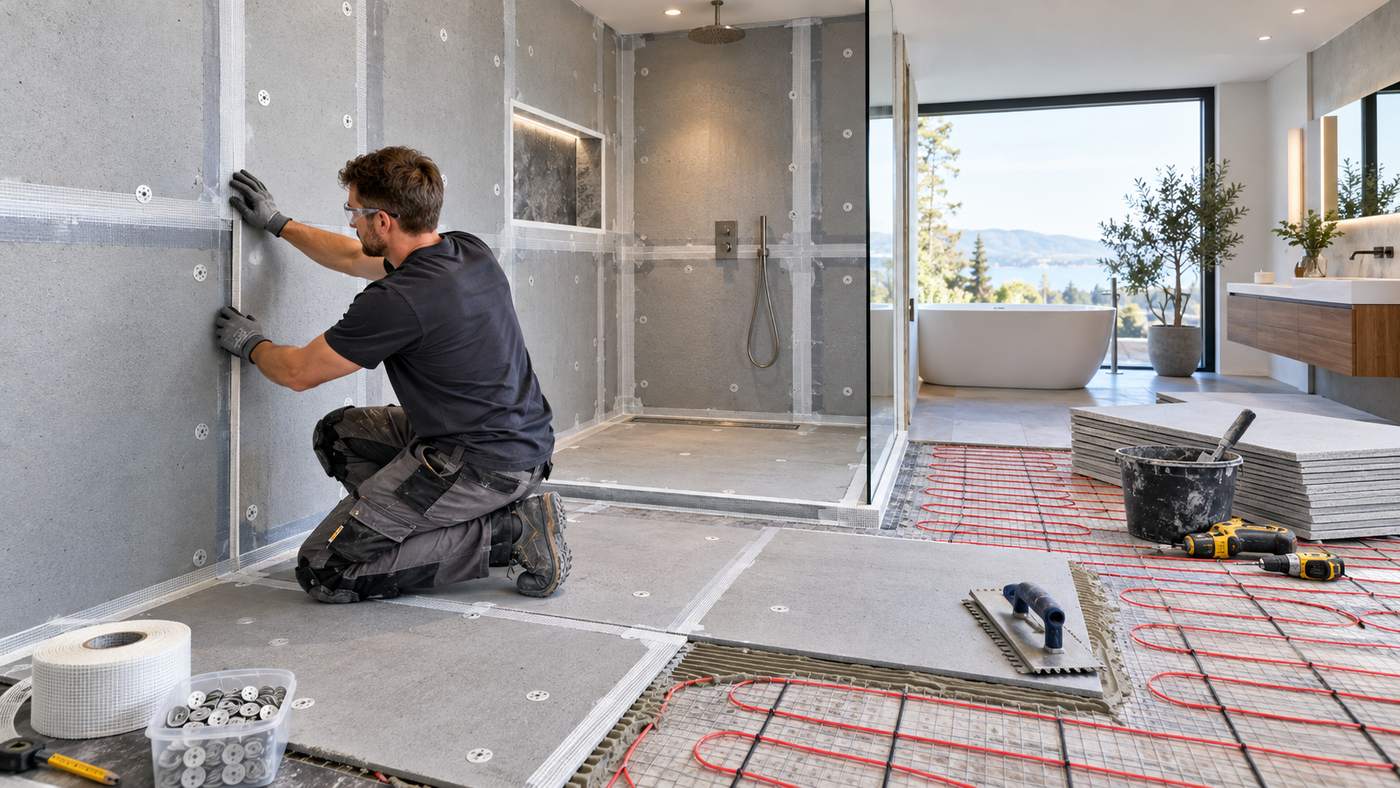
2. Thermal Construction Board Works Well With Underfloor Heating
One of the most popular applications is below electric underfloor-heating systems.
Without insulation, some heat produced by the heating cable or mat can travel downward into the structural floor.
An insulating tile backer board helps reduce this downward heat transfer.
Tilemaster specifically identifies its thermal construction boards as suitable and useful beneath electric underfloor-heating systems.
Why Insulation Matters Under Heating
Consider an electric heating mat installed directly over a cold concrete slab.
When the system starts:
- Heat travels upward toward the tiles.
- Some heat also travels downward into the slab.
- The large slab can absorb significant energy.
Installing insulation beneath the heating system helps separate the heated surface from the cold structural substrate.
This can help the finished floor respond more efficiently.
Does a Thermal Board Make the Floor Instantly Warm?
Not necessarily.
Heating performance still depends on:
- Heating-system output
- Insulation thickness
- Floor finish
- Room heat loss
- Thermostat settings
The board improves the construction buildup, but it cannot compensate for an incorrectly sized heating system.
3. It Can Be Used in Bathrooms and Wet Areas
Bathrooms require substrates that can tolerate moisture.
Traditional untreated plasterboard or timber-based materials may not be appropriate in continuously wet areas without additional protection.
Thermal construction boards are often selected because the core and surface system offer strong moisture resistance.
Larsen describes its board as waterproof and specifically suitable for bathrooms and kitchens where walls and floors are exposed to moisture.
Tilemaster similarly describes its board as suitable for wet areas and even prolonged or permanent water exposure when installed using the specified system.
Common Wetroom Applications
The boards can be used around:
- Walk-in showers
- Baths
- Bathroom walls
- Bathroom floors
- Wetroom enclosures
However, simply fixing boards to a wall does not automatically make the entire installation waterproof.
Joints, corners, penetrations and fixings must also be treated correctly.
4. Thermal Construction Board Creates a Tile-Ready Surface
A tiled finish needs a stable substrate.
Tiles should not be installed over surfaces that are:
- Weak
- Highly flexible
- Contaminated
- Unstable
The cement-coated surface of a thermal board is designed to accept compatible tile adhesives directly.
Larsen states that tiles can be installed directly onto its board once the boards, joints, corners and fixings have been correctly treated.
Suitable Tile Types
Depending on the board system and adhesive specification, these substrates may support:
- Ceramic tiles
- Porcelain tiles
- Natural stone
The correct adhesive should be selected according to:
- Tile material
- Tile size
- Substrate
- Location
Large-format porcelain and natural stone may require different installation products from lightweight ceramic tiles.
Tile Weight Matters
Wall installations need particular attention to load.
Larsen currently states that its board can support wall tiling loads of up to 80 kg/m², including tile adhesive, when correctly installed.
That figure is product-specific.
Do not assume every thermal board has the same capacity.
Check the technical documentation before installing unusually heavy tiles or stone.
5. Lightweight Boards Are Easier to Handle
Construction boards need to be moved, measured, cut and fitted.
A cement-based sheet can be relatively heavy.
Foam-core thermal boards offer a much lower weight while retaining a hard outer surface.
That makes them attractive for:
- Bathroom renovations
- Upstairs projects
- Restricted-access rooms
- Ceiling applications
Larsen and Tilemaster both identify low weight and easy handling as major advantages of these board systems.
Easy Cutting
Many thermal boards can be cut with relatively simple appropriate tools.
This is useful around:
- Pipe penetrations
- Corners
- Niches
- Bathroom fixtures
Always follow the manufacturer’s cutting and safety instructions.
The reinforcing cement layer can generate dust when cut, so appropriate dust-control methods and personal protective equipment may be necessary.
6. Thermal Construction Board Can Be Used on Walls and Floors
Thermal tile backer boards are not limited to one orientation.
Larsen lists applications on:
- Walls
- Floors
- Ceilings
- Countertops
Tilemaster also describes its thermal boards as multipurpose construction products.
Wall Installation
Boards may be installed over suitable:
- Masonry
- Timber framing
- Existing construction substrates
The exact fixing method depends on the substrate.
Floor Installation
On floors, the board must be fully supported according to the manufacturer’s system.
A tile finish cannot tolerate excessive movement.
Floor installation may require:
- Adhesive bedding
- Mechanical fixings
- Joint treatment
depending on the substrate and product.
Ceiling Installation
Lightweight construction can make some boards suitable for ceiling applications.
However, ceiling installations need secure mechanical fixing and must follow the manufacturer’s specified fixing pattern.
7. It Can Improve Sound and Surface Performance
Thermal construction boards can provide secondary performance benefits beyond insulation.
Larsen currently states that its thermal board can provide sound reduction of up to 19 dB in appropriate constructions.
The cementitious coating also improves impact resistance compared with exposed foam insulation.
Tilemaster specifically highlights the coating’s impact resistance and durability for construction environments.
This is important because a tile substrate needs to survive:
- Site handling
- Fixing
- Tiling
- Normal service
without easily crushing or breaking.
Thermal Construction Board vs Standard Insulation Board
Although both can contain rigid foam, they are not necessarily interchangeable.
Standard Insulation Board
Ordinary insulation board is mainly designed to reduce heat transfer.
Its surface may not be intended to directly support tiles.
Thermal Construction Board
A thermal construction board combines insulation with a reinforced cementitious surface.
That makes it more suitable for:
- Tiling
- Wetrooms
- Underfloor heating
where both insulation and substrate strength are required.
Do not install tiles directly onto generic insulation unless that product is specifically approved for the intended finish.
Thermal Construction Board vs Cement Backer Board
Cement backer boards are also commonly used beneath tiles.
However, their construction differs.
Cement Backer Board
Typically:
- Dense
- Strong
- Moisture resistant
- Relatively heavy
Thermal insulation may be limited.
Thermal Board
Typically:
- Lightweight
- Insulating
- Cement coated
- Tile ready
The better product depends on the job.
If the main priority is a thin, exceptionally dense substrate, cement board may be appropriate.
If insulation and underfloor-heating efficiency are priorities, a thermal construction board may be more suitable.
Thermal Construction Board vs Plasterboard
Standard plasterboard is widely used on interior walls.
However, wet tiling applications place different demands on the substrate.
A thermal tile backer board can provide advantages including:
- Better moisture performance
- Thermal insulation
- Higher suitability for wetroom systems
The correct choice still depends on the location and system specification.
Where Can Thermal Construction Board Be Used?
Common applications include:
Bathrooms
Used behind tiled shower and bath areas.
Wetrooms
Can form part of a waterproof tiled wetroom system.
Kitchens
Useful where tiled surfaces may experience regular moisture.
Underfloor Heating
Provides insulation beneath heating systems.
Floors
Creates a stable tiled substrate over suitable prepared structures.
Walls
Used beneath ceramic, porcelain or stone finishes.
Countertops
Some systems can be used to create tile-ready countertop substrates.
How to Install Thermal Construction Board
Installation depends heavily on the underlying surface.
Always follow the manufacturer’s instructions.
A typical installation process may involve:
- Preparing the substrate
- Measuring and cutting boards
- Bedding or mechanically fixing boards
- Treating fixings
- Sealing joints
- Reinforcing corners
- Installing heating if required
- Tiling
Step 1: Check the Substrate
The background should generally be:
- Stable
- Clean
- Suitable for fixing
Loose material should be removed.
Step 2: Cut the Board
Measure carefully before cutting.
Dry-fit pieces around corners and pipe penetrations before final fixing.
Step 3: Fix the Board
The method depends on whether the board is being installed onto:
- Masonry
- Timber
- Floor substrate
Manufacturers provide specific mechanical fixings, washers and adhesives for different installations.
Step 4: Treat Joints and Fixings
Wetroom performance depends heavily on detailing.
Joints may need:
- Waterproof tape
- Sealing compound
- Reinforcing material
Fixing penetrations may also require sealing.
Step 5: Tile the Surface
Once the board system is correctly installed and waterproofing details are completed, compatible tile adhesive can be applied.
Larsen notes that priming is generally not necessary before tiling its thermal board.
Again, this is manufacturer-specific.
Choosing the Right Board Thickness
Thickness affects:
- Insulation
- Floor height
- Wall buildup
- Cost
6 mm Boards
Useful where buildup height must remain minimal.
10–12.5 mm Boards
Common for general tiling and underfloor-heating applications.
20 mm and Thicker
Useful when additional thermal resistance is required and sufficient installation space is available.
Tilemaster currently offers versions up to 70 mm thick.
The thickest available board is not automatically the best choice.
Door thresholds, sanitary fixtures and finished floor levels must all be considered.
Thermal Conductivity Explained
Thermal conductivity is commonly expressed as:
W/mK
A lower number indicates that less heat passes through the material under standardized conditions.
For example, the VipaBoard system cited by its manufacturer lists an insulating core thermal conductivity of approximately 0.031 W/mK.
However, conductivity alone does not tell you the thermal resistance of the whole installation.
Thickness also matters.
A thicker layer of the same insulation provides greater resistance to heat flow.
Is Thermal Construction Board Waterproof?
Many products are manufactured with waterproof or highly water-resistant cores and coatings.
However, the board and the finished wetroom system are not necessarily the same thing.
Potential water-entry points include:
- Board joints
- Screw holes
- Corners
- Pipe penetrations
These areas must be treated using the manufacturer-approved waterproofing system.
This distinction is important.
A waterproof board installed with unsealed joints can still allow moisture to move behind the finish.
Can You Tile Directly Onto Thermal Construction Board?
Usually yes, when using a board specifically designed as a tile backer and installed according to the manufacturer’s instructions.
Larsen states that tiles can be fixed directly to its board after correct treatment of joints, corners and fixings.
Check:
- Tile weight
- Adhesive compatibility
- Board fixing
- Waterproofing requirements
before starting.
Can It Be Plastered?
Some thermal boards can accept plaster or rendering systems.
Tilemaster describes its products as suitable backgrounds for tile, plaster and synthetic render.
However, the required primer, reinforcement or coating can vary.
Use the manufacturer’s installation system rather than treating every cement-coated board identically.
Can Thermal Construction Board Be Used Outdoors?
Some specialist products are approved for external applications.
PolyFab’s VipaBoard, for example, is described as suitable for a broad range of applications including exterior facades.
This does not mean every thermal construction board is suitable outdoors.
Exterior exposure introduces additional requirements involving:
- Weather resistance
- Wind loads
- Freeze-thaw conditions
- Compatible finishes
Check the product’s declared application before installation.
Common Installation Mistakes
Leaving Joints Untreated
Water resistance depends on the completed system.
Using Too Few Fixings
Insufficient fixing can allow movement.
Installing Over an Unstable Floor
A board cannot compensate for a badly moving substrate.
Choosing the Wrong Thickness
Insufficient thickness may reduce thermal performance, while excessive thickness can cause floor-level problems.
Ignoring Tile Weight
Heavy wall tiles require confirmation that the substrate and fixing system can support them.
Using Incompatible Adhesive
Tile adhesive should be suitable for both the tile and board.
How to Choose a Thermal Construction Board
Before buying, compare:
- Core material
- Thermal conductivity
- Board thickness
- Tile load
- Water performance
- Application approvals
- Fixing system
- Available technical support
Avoid choosing purely by price.
Two boards of the same thickness may have different:
- Surface coatings
- Strength
- Testing
- Installation requirements
The Tile & Stone Journal has noted that thermal construction boards are now widely referred to as thermal tile backer boards and that manufacturer testing, compliance and technical support can be important differentiators.
Frequently Asked Questions
What is a thermal construction board?
A thermal construction board is an insulated tile backer panel typically made from an XPS foam core with reinforced cementitious surfaces, providing insulation, moisture resistance and a stable surface for tiling.
Is thermal construction board good for underfloor heating?
Yes. Its insulating core can reduce heat loss into the structural floor, which is why manufacturers commonly recommend thermal boards beneath electric underfloor-heating systems.
Can thermal construction board be used in a shower?
Many products are specifically designed for bathrooms and wet areas. Joints, corners and fixings still need to be waterproofed according to the manufacturer’s installation system.
Can I tile directly onto thermal construction board?
Yes, compatible tiles can generally be applied directly after the boards are securely installed and joints and penetrations have been treated correctly.
What thickness thermal construction board should I use?
The correct thickness depends on required insulation, substrate type and available buildup height. Current products range from thin 6 mm boards to substantially thicker insulation panels.
Is thermal construction board better than cement board?
Neither is universally better. Thermal construction board provides insulation with a tile-ready surface, while conventional cement board may be preferred when thermal insulation is not a priority. The correct choice depends on the project.
Conclusion
Thermal construction board combines several useful construction functions in one lightweight panel: insulation, moisture resistance and a reinforced tile-ready surface. It is especially valuable in bathrooms, wetrooms and underfloor-heating installations where builders need both thermal efficiency and a reliable tiling substrate. Board thickness, fixing method, waterproof joint treatment and tile loading must still be selected carefully. When installed as a complete manufacturer-approved system, thermal construction board can provide a practical foundation for durable tiled walls and floors