Industrial Evaporative Air Cooler: 7 Powerful Strategies for Efficient Warehouse and Factory Cooling
Maintaining comfortable temperatures inside large industrial buildings can be challenging, particularly during hot summer months. Manufacturing plants, distribution centres, workshops, and logistics facilities often contain machinery, storage racks, production equipment, and extensive open spaces that generate or retain heat. Installing an industrial evaporative air cooler can provide an effective cooling option for suitable facilities by using water evaporation and controlled airflow to reduce supply-air temperature without relying on a conventional refrigeration cycle.
Unlike traditional air conditioning systems that use mechanical refrigeration, evaporative coolers take advantage of the natural cooling effect that occurs when water evaporates into moving air.
This process can be particularly effective in hot, relatively dry environments where the difference between dry-bulb and wet-bulb temperatures provides significant cooling potential.
However, not every industrial environment is equally suitable.
A warehouse in Arizona may experience different cooling performance from a similar facility in humid Florida. Internal heat loads, ventilation requirements, equipment layout, water quality, and worker activity also affect results.
Industrial facility managers should therefore consider the entire building environment before investing in cooling equipment.
A properly designed system can improve local working conditions, provide fresh outdoor air, and potentially reduce electricity consumption compared with certain mechanically refrigerated cooling arrangements.
However, inappropriate sizing, insufficient exhaust ventilation, poor water management, or neglected maintenance can significantly reduce these advantages.
This guide explores seven essential strategies for choosing and operating industrial evaporative cooling equipment, explains the technology, and outlines practical approaches to improving cooling performance, energy efficiency, and workplace conditions.
What Is an Industrial Evaporative Air Cooler?
An industrial evaporative air cooler is a commercial cooling device that uses the evaporation of water to lower air temperature.
It is designed for applications requiring greater airflow or wider coverage than typical small residential evaporative coolers.
These systems may serve warehouses, manufacturing plants, industrial workshops, loading areas, and other commercial environments.
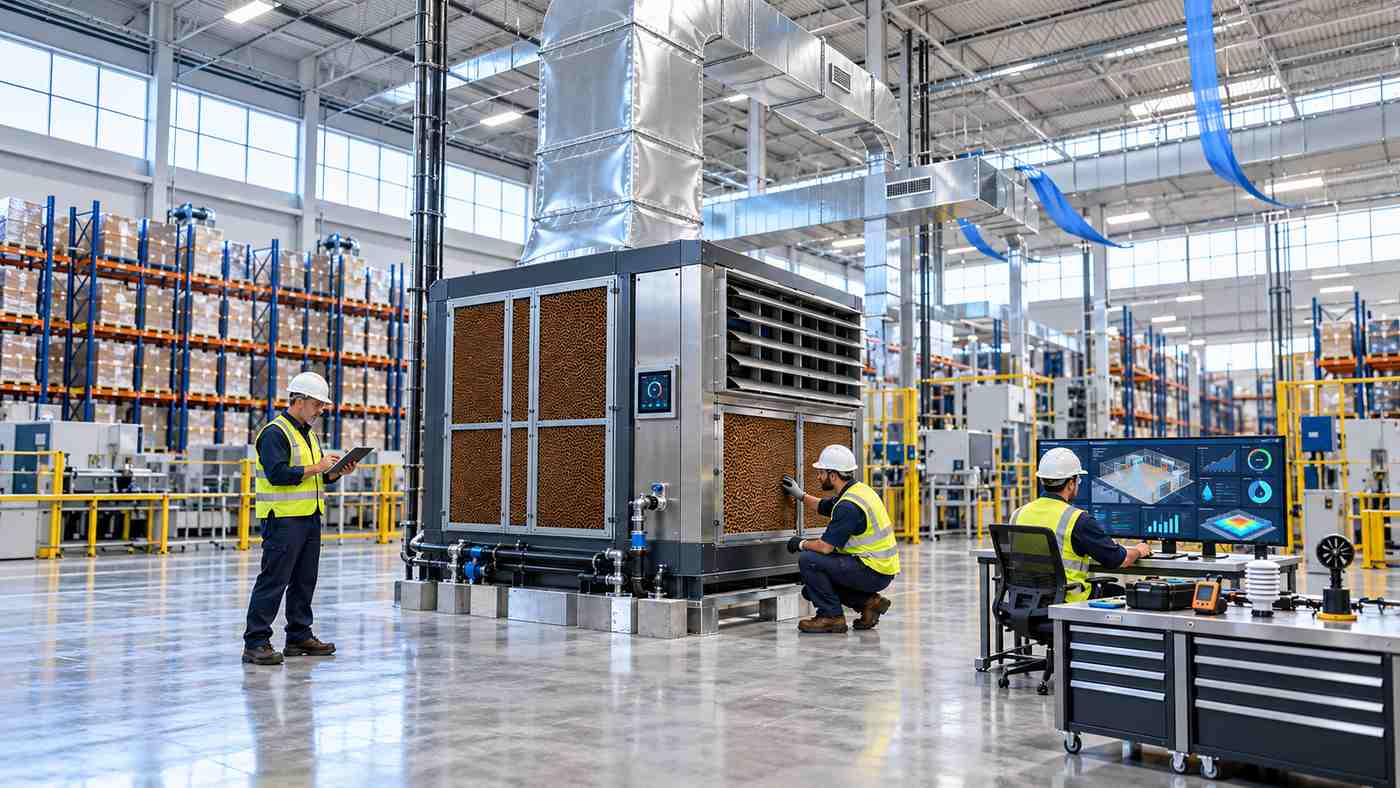
Many industrial units contain a powerful fan, wetted cooling media, water distribution components, a reservoir or drainage arrangement, and an electrical control system.
Air moves across the wet media, and some water evaporates.
The evaporation absorbs heat from the moving air, reducing its dry-bulb temperature.
The resulting air can then be delivered to an occupied workspace through suitable outlets or ductwork.
How Does Evaporative Cooling Work?
Evaporative cooling is based on heat transfer associated with the conversion of liquid water into water vapour.
When relatively dry air passes across wet cooling media, some water evaporates into the airstream.
This process reduces the air’s dry-bulb temperature while increasing its moisture content.
The cooler air can then be directed toward the intended industrial area.
However, the amount of cooling depends heavily on incoming air conditions.
When outdoor air is already humid, its remaining evaporation potential is smaller.
The cooling performance is therefore more limited.
Main Components of an Industrial Evaporative Cooler
A typical industrial cooling unit may contain several important components.
Cooling Pads
Cooling pads provide a large wetted surface across which air can pass.
They are often made from specially structured cellulose or other suitable materials.
Honeycomb-style cooling media are common in many commercial systems.
Their condition affects airflow, water distribution, and cooling performance.
Industrial Fan
The fan moves air through the equipment and into the facility.
Its capacity must be appropriate for the pressure resistance of the cooling pads, ductwork, and air distribution system.
Water Distribution System
A pump or controlled water supply distributes water across the cooling media.
Correct distribution helps maintain effective wetting without unnecessary carryover.
Water Reservoir and Drainage
Some systems recirculate water using a reservoir, while others use different supply and drainage arrangements.
Drainage and water quality management are important for hygiene and performance.
Electronic Controls
Modern units may include fan-speed adjustment, temperature monitoring, humidity sensors, operating schedules, and fault indicators.
The capabilities vary by model.
7 Essential Strategies for Choosing an Industrial Evaporative Air Cooler
Selecting industrial cooling equipment requires understanding the building, the working environment, and the cooling performance needed.
The following seven strategies provide a practical framework for making informed decisions.
1. Evaluate Local Climate and Humidity Conditions
Climate is one of the most important factors affecting evaporative cooling.
A system that performs effectively in one city may deliver a smaller temperature reduction in another.
Understand Dry-Bulb and Wet-Bulb Temperatures
Dry-bulb temperature is the ordinary air temperature measured by an appropriate thermometer.
Wet-bulb temperature reflects the combined influence of air temperature and moisture on evaporative cooling potential.
The difference between these temperatures is important.
A larger difference generally indicates greater potential for direct evaporative cooling.
ASHRAE identifies the entering air’s wet-bulb temperature as a key limitation on direct evaporative cooling performance.
Why Dry Climates Are Particularly Suitable
Hot, relatively dry regions often provide favourable operating conditions.
For example, industrial facilities in parts of Arizona, Nevada, New Mexico, and inland California may experience substantial evaporative cooling potential during certain periods.
However, the actual performance varies with weather, building design, and equipment.
A site-specific assessment should use representative local design conditions.
How Humidity Affects Cooling
When air already contains substantial moisture, additional evaporation becomes more difficult.
The direct cooler may produce a smaller temperature reduction.
It also adds moisture to the supply air.
This can create concerns in facilities containing humidity-sensitive goods, materials, or processes.
For humid locations, indirect evaporative cooling or a hybrid system may be more appropriate.
Consider Seasonal Conditions
Cooling requirements change throughout the year.
A system that performs well during dry spring weather may deliver different results during humid summer conditions.
Facility managers should evaluate typical conditions and periods of extreme heat.
Equipment selection should not be based solely on the best possible weather scenario.
Review the Industrial Process
Some processes require narrow humidity limits.
Examples may include certain manufacturing, storage, electronics, and material-handling operations.
The cooling system should support product and process requirements as well as worker comfort.
2. Choose the Correct Cooling Capacity and Airflow
Industrial cooling equipment is frequently promoted using airflow capacity.
However, selecting a unit based solely on the highest advertised airflow number can lead to poor results.
Understanding CFM
Cubic feet per minute, abbreviated CFM, describes volumetric airflow.
Industrial evaporative coolers may be rated for different airflow capacities.
However, airflow alone does not determine cooling performance.
The entering air conditions, cooling media, fan characteristics, ductwork, and building heat loads must also be considered.
Assess Warehouse Dimensions
Begin by measuring the facility’s floor area and ceiling height.
A warehouse with high ceilings may require a different distribution strategy from a low-ceiling production facility.
However, building volume alone is not sufficient for determining equipment capacity.
The cooling design must account for the people and processes occupying the building.
Evaluate Internal Heat Sources
Manufacturing machinery, ovens, motors, lighting, and other equipment can produce significant heat.
Some facilities also experience heat gain through roofs, walls, and doors.
These factors influence the amount of cooling required.
A professional load assessment helps establish realistic expectations.
Consider Air Changes
Air changes per hour describe how frequently an equivalent volume of air is supplied or replaced over an hour.
This measurement can be useful for certain ventilation calculations.
However, there is no single air-change rate suitable for every industrial evaporative cooling installation.
The appropriate rate depends on the application, heat load, ventilation needs, and air distribution design.
Account for Static Pressure
Fans must overcome resistance from cooling pads, ducts, filters, dampers, and other components.
A fan’s advertised maximum airflow may not represent the airflow delivered after installation.
Review the manufacturer’s performance information at the intended operating conditions.
Avoid Oversizing and Undersizing
An undersized system may not provide sufficient airflow to the occupied area.
An oversized or poorly controlled system may create unnecessary noise, energy use, water consumption, or uncomfortable drafts.
Correct sizing should be based on engineering rather than guesswork.
3. Compare Direct and Indirect Evaporative Cooling Systems
Industrial evaporative cooling equipment is available in different configurations.
Understanding the differences helps businesses choose a system appropriate for their environment.
Direct Evaporative Cooling
Direct systems pass air through wetted cooling media.
The air becomes cooler while its moisture content increases.
This method is often suitable for industrial applications requiring substantial outdoor-air supply.
It may also be useful for targeted cooling in certain hot work environments.
However, added humidity must be considered.
Indirect Evaporative Cooling
Indirect systems cool one airstream using evaporative heat transfer occurring in another airstream.
A heat exchanger separates the primary supply air from the wetted secondary side.
This allows cooling without directly adding moisture to the primary supply air.
ASHRAE describes indirect evaporative cooling as a useful approach for reducing cooling loads in a range of climates.
Two-Stage Evaporative Cooling
Some systems combine indirect and direct stages.
The indirect stage first reduces the air temperature.
The direct stage then provides additional cooling.
This arrangement can produce lower supply temperatures than a comparable direct-only system under appropriate conditions.
However, system complexity and costs can increase.
Hybrid Cooling Solutions
An industrial facility may combine evaporative cooling with mechanical refrigeration.
For example, evaporative equipment may precool incoming outdoor air before a conventional cooling stage.
This can reduce the demand placed on the refrigeration equipment under suitable conditions.
Actual savings depend on climate, controls, operating schedules, and system design.
Which Technology Is Better?
The answer depends on the application.
Direct cooling may be attractive for large, ventilated spaces in dry climates.
Indirect systems may be preferable where additional humidity is undesirable.
Hybrid systems may suit operations requiring more precise temperature control.
An experienced HVAC engineer can compare options using the facility’s actual conditions.
4. Design Proper Industrial Ventilation and Air Distribution
Cooling equipment cannot perform effectively if the air is distributed incorrectly.
Ventilation is particularly important for direct evaporative cooling because the system introduces moisture into the air.
Importance of Fresh-Air Supply
Many direct evaporative coolers operate using outdoor air.
The cooled supply air must move through the facility in an appropriate way.
Simply placing a large cooler in an enclosed room does not guarantee effective cooling.
The system needs a suitable air movement and exhaust strategy.
Provide Adequate Exhaust
When outdoor air enters a building, displaced indoor air needs a suitable exit path.
This may involve designed exhaust openings, mechanical exhaust fans, or other engineered arrangements.
Insufficient exhaust can reduce the performance of the cooling system.
It may also allow humidity to accumulate.
Avoid Short-Circuiting Airflow
Short-circuiting occurs when supply air exits the building or returns toward the intake without adequately serving the intended occupied area.
Poor equipment placement can contribute to this problem.
Air outlets should be positioned according to the working layout.
Use Directional Airflow Where Appropriate
Industrial air distribution may involve adjustable louvres, ducts, diffusers, or local discharge outlets.
These components help direct cooled air toward workers or process areas.
However, the system should avoid creating unnecessarily strong drafts.
Consider Spot Cooling
Not every facility needs uniform cooling across its entire volume.
Spot cooling concentrates cooler air in selected working areas.
For example, a factory may prioritise occupied production stations rather than unused space near the ceiling.
ASHRAE identifies both area cooling and spot cooling as valid industrial evaporative cooling applications.
Coordinate Cooling With Other Ventilation Systems
Industrial facilities may also have exhaust systems for dust, fumes, heat, or other process-related contaminants.
An evaporative cooler should not interfere with required local exhaust or hazardous-material ventilation.
The complete system must maintain appropriate airflow relationships.
Professional coordination is particularly important where process ventilation is safety-critical.
5. Evaluate Water Consumption, Water Quality, and Maintenance
Evaporative cooling relies on water.
Although it may reduce electricity demand compared with certain refrigeration-based systems, water consumption introduces an important operating consideration.
Understand Water Use
Water is consumed through evaporation and may also be lost through drainage, bleed-off, or maintenance.
The amount depends on cooling load, air conditions, equipment design, and operating schedule.
A large industrial system may have substantially different water requirements from a small portable cooler.
Consider Local Water Availability
Facilities in arid regions may benefit from evaporative cooling performance while also facing water conservation concerns.
This creates an important tradeoff.
Businesses should compare electricity savings with water consumption and local water costs.
Manage Mineral Buildup
Water contains dissolved minerals.
As water evaporates, minerals remain behind.
Over time, deposits can accumulate on cooling pads and equipment.
The US Department of Energy notes that scale and mineral deposits can restrict airflow and reduce evaporative cooler performance.
Appropriate water management is therefore essential.
Inspect Cooling Pads
Cooling media may accumulate dust, mineral deposits, or biological material.
Pads should be inspected and replaced according to their condition and manufacturer instructions.
Damaged or obstructed media can reduce performance.
Maintain Water Distribution
The water system should distribute water evenly across the cooling media.
Blocked distribution passages, malfunctioning pumps, and damaged connections may reduce effectiveness.
Qualified technicians should inspect these components during scheduled maintenance.
Consider Microbial Risks
Water-containing equipment requires appropriate hygiene controls.
The CDC identifies evaporative air coolers among devices that may support Legionella growth when water is not properly managed.
Facility managers should follow manufacturer instructions and assess the need for a water management programme.
This may include controlling stagnation, sediment, biofilm, and other relevant conditions.
Avoid Improvised Chemical Treatment
Water treatment products must be suitable for the specific equipment and application.
Do not add arbitrary disinfectants, household cleaners, or other chemicals to a cooler.
Incorrect treatment may damage equipment or create exposure risks.
Use qualified guidance and approved procedures.
6. Compare Energy Efficiency and Long-Term Operating Costs
Electricity consumption is an important consideration for industrial cooling.
Large manufacturing and warehouse facilities may operate cooling equipment for extended periods.
Even relatively small differences in system performance can influence operating expenses.
Why Evaporative Cooling Can Use Less Electricity
A direct evaporative cooler typically uses electricity primarily for its fan, water pump, and controls.
It does not require the conventional vapour-compression refrigeration cycle used in many air conditioners.
This can reduce electrical demand under suitable conditions.
However, comparisons should involve systems providing reasonably equivalent useful cooling.
Understand the Limits of Energy Savings
A warehouse with extensive fresh-air requirements may benefit from an appropriately designed evaporative system.
However, a humidity-sensitive facility may still need mechanical refrigeration or dehumidification.
The total energy result depends on the complete system.
There is no universal electricity-saving percentage applicable to every industrial installation.
Compare Initial Equipment Costs
Purchase costs may include the cooling unit, structural supports, water connections, electrical work, ductwork, and controls.
Installation complexity can affect the total project expense.
A low equipment price does not necessarily mean a low installed cost.
Include Water and Maintenance Expenses
Operating costs should include electricity, water, maintenance labour, replacement cooling pads, pump servicing, and other consumables.
Certain systems may also require water treatment or more detailed monitoring.
These expenses should be considered in an ownership-cost analysis.
Use Lifecycle Cost Analysis
Lifecycle cost analysis compares the total expected costs over an appropriate period.
It can include initial capital spending, annual operation, maintenance, replacement components, and eventual decommissioning.
The assumptions should be realistic and relevant to the facility.
Measure Actual Performance
A system may provide promising results during initial commissioning but perform differently after months of operation.
Facility managers should monitor relevant temperatures, humidity, water use, electricity consumption, and maintenance needs.
These measurements can help determine whether the system is meeting its objectives.
7. Prioritise Worker Comfort and Workplace Heat Safety
One of the most important reasons to improve industrial cooling is to support safer working conditions.
Warehouses and manufacturing facilities can expose workers to heat from outdoor conditions, equipment, and physically demanding tasks.
Understand Heat Stress
Heat stress results from the combined effect of environmental conditions, physical activity, clothing, and individual factors.
Air temperature alone does not fully describe the risk.
Humidity, radiant heat, air movement, and workload also matter.
An evaporative cooler may reduce local air temperature, but workplace heat risk must still be assessed.
Follow OSHA Heat Safety Guidance
The Occupational Safety and Health Administration recommends engineering controls and appropriate work practices to reduce heat-related hazards.
Relevant measures include improved ventilation, suitable cooling systems, rest breaks, access to drinking water, and worker acclimatisation.
OSHA also recommends training employees to recognise heat illness symptoms.
Cooling equipment should form part of a broader prevention programme.
Recognise the Importance of Humidity
Direct evaporative cooling increases air moisture.
In certain conditions, additional humidity can affect the body’s ability to lose heat through sweating.
This means cooler dry-bulb air does not automatically eliminate heat stress.
Facility managers should evaluate the combined conditions experienced by workers.
Use Appropriate Environmental Monitoring
Temperature and humidity measurements can help describe workplace conditions.
For occupational heat assessments, wet-bulb globe temperature measurements or other suitable methods may be appropriate.
The correct approach depends on the work environment.
Monitoring should support decisions about cooling, breaks, and other protective measures.
Provide Suitable Rest Areas
Workers may need access to cooler recovery areas during periods of significant heat exposure.
A cooled break room can provide important protection when the main industrial workspace cannot be maintained at comfortable temperatures.
Establish an Emergency Response Plan
Workers and supervisors should understand how to respond to suspected heat-related illness.
Confusion, collapse, or other serious symptoms may indicate an emergency.
Appropriate first aid and emergency medical assistance should be arranged promptly.
Do Not Treat Air Cooling as a Complete Safety Solution
An industrial evaporative air cooler can be one useful engineering control.
However, worker safety also depends on hydration, workload, acclimatisation, rest, training, and the assessment of site-specific hazards.
Common Applications of Industrial Evaporative Cooling
Industrial evaporative systems are used in a variety of facilities.
However, each application has different cooling and ventilation requirements.
Warehouse and Distribution Centres
Warehouses can have large interior volumes, high storage racks, and extensive loading areas.
Cooling may be directed toward occupied picking, packing, or assembly stations.
The design should account for changing doors, airflow paths, and forklift operations.
Manufacturing Plants
Manufacturing equipment may generate substantial internal heat.
Evaporative cooling can help provide cooler supply air where suitable.
However, process heat and exhaust requirements should be evaluated.
Metalworking Facilities
Certain metalworking operations involve high temperatures and physically demanding work.
Spot cooling may support workers in selected areas.
The equipment must not interfere with required fume extraction or other safety controls.
Textile Manufacturing
Textile facilities can have particular temperature and humidity requirements.
Direct evaporative cooling may be useful in certain applications where added moisture supports the process.
However, process specifications must guide the final design.
Industrial Workshops
Large workshops may use portable or fixed cooling units where conventional whole-building refrigeration is impractical.
The selected arrangement should reflect available ventilation and workplace conditions.
Agricultural and Food-Related Facilities
Some agricultural and food processing environments use evaporative technology for suitable cooling applications.
However, facilities must consider hygiene, humidity, product protection, and regulatory requirements.
Cooling arrangements should not introduce contamination risks.
Industrial Evaporative Air Cooler vs. Traditional Air Conditioning
Both technologies reduce air temperature, but they use different operating principles.
Cooling Method
Evaporative cooling uses water evaporation to absorb heat.
Conventional air conditioning typically uses a refrigeration cycle to transfer heat from the conditioned space.
Humidity Control
Direct evaporative cooling adds moisture to the air.
A conventional air-conditioning system may remove moisture under suitable operating conditions.
This difference can strongly influence system selection.
Electrical Consumption
Evaporative systems may use less electrical energy for comparable useful cooling in appropriate applications.
However, the actual result depends on climate and system design.
Water Requirements
Evaporative cooling consumes water.
Conventional air conditioning usually does not require water evaporation at the point of use for the same basic refrigeration process, although some commercial systems use cooling towers.
Temperature Control
Mechanical refrigeration can provide more precise cooling across a wider range of outdoor humidity conditions.
Direct evaporative cooling is constrained by the incoming air’s wet-bulb temperature.
Best Applications
Evaporative cooling may be attractive for large, ventilated facilities in suitable climates.
Conventional air conditioning may be preferable for tightly controlled indoor environments.
Hybrid arrangements can sometimes provide benefits from both technologies.
How to Install an Industrial Evaporative Cooling System
Installation requires coordination among HVAC designers, electrical professionals, mechanical installers, and facility management.
Assess the Building
Review dimensions, internal heat sources, ventilation requirements, worker locations, and relevant equipment.
Select an Appropriate Location
The cooler should receive suitable intake air and provide an effective distribution path.
Air intakes must be protected against nearby pollution sources where applicable.
Plan Water Connections
The water supply should meet equipment requirements.
Drainage and overflow arrangements also need proper design.
Complete Electrical Installation
Electrical connections should comply with applicable regulations.
Qualified professionals should handle installation and electrical testing.
Integrate Ventilation
Supply and exhaust systems must work together.
The design should avoid unwanted pressure imbalances and interference with other ventilation systems.
Commission the Equipment
Commissioning may include checking airflow, fan performance, water distribution, drainage, controls, and operating conditions.
Record initial measurements for future comparison.
Train Maintenance Personnel
The facility team should understand normal operation, inspection intervals, cleaning procedures, and fault reporting.
Industrial Evaporative Cooler Maintenance Checklist
Regular maintenance supports reliable performance.
The exact schedule depends on equipment design, water conditions, and operating hours.
Inspect Cooling Media
Look for mineral buildup, damage, blockage, and deterioration.
Follow manufacturer recommendations for cleaning or replacement.
Check Water Distribution
Confirm that water reaches the intended cooling surfaces.
Inspect pumps and associated components for faults.
Maintain the Water System
Manage sediment, deposits, and stagnant water according to the applicable procedures.
Inspect Fans and Motors
Check for unusual noise, vibration, or operating problems.
Electrical and mechanical servicing should be performed by qualified personnel.
Review Drainage
Ensure that drainage components are functioning correctly.
Blocked drains can create maintenance and hygiene concerns.
Test Controls and Sensors
Verify that operating controls provide reasonable readings and responses.
Faulty sensors may affect system operation.
Maintain Documentation
Record inspections, cleaning, component replacement, and significant equipment faults.
These records help identify recurring issues.
How Much Does an Industrial Evaporative Air Cooler Cost?
Industrial evaporative cooler pricing depends on equipment size, technology, manufacturing quality, and installation requirements.
There is no single purchase price appropriate for every commercial facility.
Equipment Size
Higher-capacity units may require larger fans, housings, cooling media, and structural supports.
However, equipment cost does not increase in a perfectly proportional way with airflow.
Cooling Technology
Direct, indirect, and two-stage systems can have different equipment and engineering costs.
More complex systems may require additional heat exchangers and controls.
Building Modifications
Installation may involve structural supports, ductwork, roof openings, water piping, exhaust systems, and electrical connections.
These items can significantly affect project cost.
Operating Expenses
Businesses should account for electricity, water, maintenance, and replacement parts.
Water treatment or more detailed hygiene controls may also be necessary.
Request a Detailed Quotation
A professional quotation should describe the proposed equipment, airflow performance, intended design conditions, installation responsibilities, and important exclusions.
It should also explain assumptions about temperature reduction and ventilation.
An estimate that promises a precise cooling result without reviewing the facility deserves careful scrutiny.
Common Industrial Evaporative Cooling Problems
Even well-designed systems can develop operating problems.
Insufficient Cooling
Potential causes include high incoming humidity, dirty cooling pads, insufficient water distribution, or inadequate airflow.
The actual conditions should be measured.
Excessive Humidity
Direct systems can introduce too much moisture when ventilation is insufficient or the application is unsuitable.
The design and controls may need review.
Unusual Equipment Noise
Noise can indicate fan, bearing, motor, or vibration problems.
Qualified maintenance personnel should investigate.
Mineral Deposits
Hard water can contribute to scale buildup.
Water management and suitable maintenance can help reduce the problem.
Uneven Cooling
Poor air distribution can leave some areas noticeably warmer than others.
Outlet positioning, airflow balancing, and warehouse obstructions may contribute.
Water Leakage
Leaking connections or reservoir problems should be addressed promptly.
Water should not be allowed to contact unsuitable electrical equipment or create slip hazards.
How to Choose the Best Industrial Evaporative Air Cooler
A suitable purchasing decision begins with the facility’s actual needs.
Determine whether the objective is spot cooling, area cooling, or broader ventilation improvement.
Review local dry-bulb and wet-bulb design conditions.
Assess humidity sensitivity, building heat loads, and the required supply-air distribution.
Compare direct, indirect, and hybrid technologies.
Evaluate equipment performance at realistic operating conditions rather than maximum advertised figures alone.
Consider water consumption and maintenance requirements.
Review the manufacturer’s performance documentation, service support, and replacement-part availability.
Where possible, request an engineering proposal showing expected temperature, humidity, airflow, and operating costs.
The best industrial evaporative air cooler is not necessarily the largest or most expensive model.
It is the system that addresses the facility’s cooling objectives while remaining compatible with building operations, worker safety, and long-term maintenance capabilities.
The Future of Industrial Evaporative Cooling Technology
Industrial cooling technology continues to evolve as businesses seek better control of energy consumption, operational costs, and workplace conditions.
Advanced Cooling Media
Manufacturers continue developing cooling media intended to provide suitable surface area, airflow characteristics, and durability.
Performance should be evaluated using appropriate testing.
Improved Electronic Controls
Modern control systems can coordinate fans, water circulation, operating schedules, and environmental monitoring.
Effective control may reduce unnecessary operation.
Integration With Building Management Systems
Some industrial coolers can communicate with building management systems.
This allows facilities to coordinate cooling with other mechanical equipment.
However, compatibility and commissioning remain important.
Hybrid Cooling Arrangements
Combining evaporative cooling with mechanical refrigeration can expand the range of usable operating conditions.
The appropriate configuration depends on building requirements.
More Detailed Water Monitoring
Water use and quality are increasingly important considerations.
Monitoring systems can help identify abnormal consumption or maintenance needs.
Greater Focus on Worker Heat Protection
Industrial facility managers are paying more attention to heat exposure and suitable environmental controls.
The future of industrial cooling will likely involve combining efficient equipment with better monitoring and worker protection programmes.
Frequently Asked Questions
1. What is an industrial evaporative air cooler?
An industrial evaporative air cooler is a commercial cooling device that uses water evaporation and airflow to reduce air temperature in suitable warehouses, factories, and other industrial facilities.
2. How does an industrial evaporative air cooler work?
Air passes across wetted cooling media, causing water to evaporate and lower the air’s dry-bulb temperature. Direct systems also increase the air’s moisture content.
3. Is evaporative cooling effective in humid climates?
Direct evaporative cooling is generally less effective when humidity is high. Indirect or hybrid systems may provide better results depending on operating requirements.
4. Does an industrial evaporative air cooler use less electricity than air conditioning?
It can use less electricity in suitable applications because direct evaporative cooling does not require a conventional refrigeration compressor. Actual savings depend on the complete system.
5. How often should industrial evaporative cooling pads be replaced?
Replacement frequency depends on water quality, operating hours, pad material, and maintenance. Follow the manufacturer’s instructions and replace damaged or heavily obstructed media.
6. Can industrial evaporative coolers reduce warehouse heat stress?
They can help reduce heat exposure under suitable conditions, but they are not a complete safety solution. Employers must also consider humidity, workload, hydration, breaks, acclimatisation, and other controls.
Conclusion
An industrial evaporative air cooler can provide a practical cooling solution for warehouses, manufacturing plants, and commercial facilities where the climate and operational requirements are suitable. Proper equipment sizing, effective ventilation, appropriate water management, and consistent maintenance are essential for dependable performance. Businesses should compare direct, indirect, and hybrid cooling technologies while evaluating energy use, worker comfort, and long-term operating costs. With professional design and responsible operation, evaporative cooling can become an effective component of a comprehensive industrial HVAC strategy