Decorative Concrete of Austin: 7 Best Flooring Ideas
Concrete has moved far beyond its traditional role as a purely structural building material. In contemporary homes, restaurants, offices, retail stores, showrooms, and entertainment spaces, concrete floors can become an intentional architectural feature with rich colors, exposed aggregate, smooth finishes, and distinctive patterns. Property owners researching Decorative Concrete of Austin – Polished & Stained Concrete are often looking for ways to transform ordinary slabs into durable, visually distinctive surfaces that complement both modern and traditional interiors.
Austin’s architecture is particularly well suited to decorative concrete. Industrial-inspired interiors, contemporary homes, rustic Texas designs, and minimalist commercial spaces can all make use of polished or stained floors. Existing concrete slabs may sometimes be refinished rather than covered with another flooring material, although suitability depends on slab condition, previous coatings, moisture, repairs, contamination, and the final appearance desired.
Polishing and staining are also very different processes. Polishing mechanically refines the concrete surface using progressively finer abrasives, while staining introduces color through compatible products and application techniques. The two approaches can sometimes be combined to create sophisticated results.
This guide covers seven important design ideas, the differences between polished and stained concrete, preparation requirements, maintenance, costs, and practical considerations for choosing a decorative concrete contractor in Austin.
Note: Specific services, warranties, products, pricing, and service areas associated with Decorative Concrete of Austin should be verified directly with the company. Product performance depends on substrate condition, installation, maintenance, and intended use.
What Is Decorative Concrete of Austin – Polished & Stained Concrete?
Decorative Concrete of Austin – Polished & Stained Concrete refers to professional decorative concrete services focused on turning functional concrete slabs into finished architectural surfaces.
Depending on a contractor’s capabilities, decorative concrete services may include:
- Concrete polishing.
- Concrete staining.
- Surface preparation.
- Decorative coloring.
- Concrete sealing.
- Existing-floor refinishing.
- Commercial concrete finishes.
- Residential flooring.
Before selecting any finish, the existing slab should be evaluated to determine what results are realistically achievable.
Polished Concrete vs. Stained Concrete
Although the terms are sometimes used together, they describe different processes.
Polished Concrete
Polishing mechanically grinds and refines the concrete using specialized equipment and abrasives.
Depending on the process, the finished surface can range from relatively understated to highly reflective.
Polishing may also expose different amounts of aggregate within the slab.
Stained Concrete
Staining changes the floor’s color.
Different staining technologies can create appearances ranging from subtle earth tones to more consistent contemporary colors.
Because concrete naturally varies, stained results can have tonal variation rather than looking identical to factory-produced flooring.
Why Austin Property Owners Choose Decorative Concrete
Decorative concrete offers a combination of visual flexibility and durability.
Potential benefits include:
- Distinctive appearance.
- Compatibility with modern architecture.
- Long service potential.
- Relatively straightforward cleaning.
- Custom color options.
- Use of an existing slab where suitable.
The actual performance depends heavily on surface preparation and installation quality.
1. Natural Polished Concrete
One of the most timeless approaches is allowing the concrete itself to become the visual feature.
Natural polished concrete can highlight:
- Aggregate.
- Subtle color variation.
- Original slab character.
- Architectural simplicity.
This approach works especially well in modern and industrial-inspired interiors.
Rather than trying to make concrete resemble another material, the design celebrates its natural appearance.
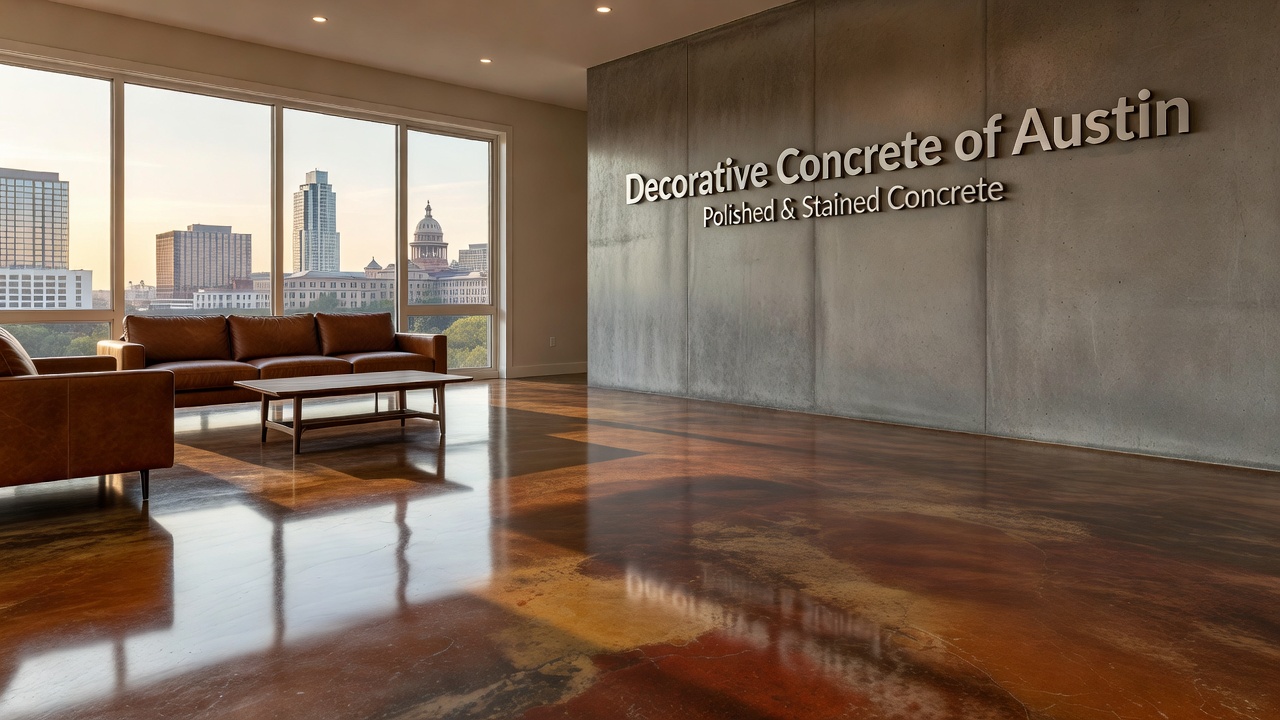
2. Warm Stained Concrete for Texas-Inspired Interiors
Austin homes often incorporate warm colors, natural woods, stone, leather, and other materials inspired by the Texas landscape.
Stained concrete can complement this aesthetic with shades such as:
- Brown.
- Amber.
- Tan.
- Terracotta-inspired tones.
- Warm gray.
Actual stain results depend on the product and underlying concrete.
Always review physical samples or test areas when color accuracy is important.
3. Polished Concrete for Modern Commercial Spaces
Polished concrete is frequently considered for commercial environments because it can support a clean architectural aesthetic.
Applications may include:
- Retail stores.
- Restaurants.
- Offices.
- Galleries.
- Showrooms.
- Hospitality spaces.
Commercial floors must also account for pedestrian traffic, maintenance requirements, slip resistance, and operating conditions.
A decorative concrete contractor should recommend a system appropriate for the specific environment rather than focusing only on appearance.
4. Stained Concrete with Decorative Patterns
Color does not necessarily need to cover an entire slab uniformly.
Decorative layouts can potentially incorporate:
- Borders.
- Geometric divisions.
- Multiple colors.
- Saw-cut patterns.
- Custom design elements.
These details can make large concrete areas visually more interesting.
Complex designs require careful planning because lines and patterns must coordinate with room dimensions and existing slab conditions.
5. Exposed Aggregate Polished Floors
Concrete contains sand and stone aggregate that can become increasingly visible as the surface is mechanically ground.
Different levels of aggregate exposure create very different appearances.
A lightly refined surface may reveal limited aggregate, while deeper grinding can expose larger stone.
The existing slab determines what aggregate is available to reveal.
Because the original concrete was not always poured with decorative exposure in mind, contractors should evaluate realistic expectations before grinding begins.
6. Minimalist Gray Concrete
Neutral gray concrete remains popular because it pairs easily with many materials and colors.
A gray decorative floor can complement:
- White walls.
- Black metal.
- Natural wood.
- Colorful furniture.
- Contemporary cabinetry.
The result can feel warm or cool depending on lighting, aggregate, wall colors, and surrounding finishes.
7. Combined Staining and Polishing
Some projects may combine coloration and mechanically refined finishes to create a more customized appearance.
However, not every stain or coloring product is compatible with every polishing process.
The contractor should select materials and sequencing based on the desired outcome and manufacturer’s system requirements.
Surface Preparation: The Most Important Step
The finished floor is only as reliable as the surface beneath it.
Before applying a stain, sealer, or polishing system, contractors may need to address:
- Existing coatings.
- Adhesive residue.
- Oil contamination.
- Paint.
- Surface damage.
- Cracks.
- Uneven areas.
Preparation methods can involve grinding, cleaning, stripping, or other professional processes.
Cutting corners during preparation can compromise appearance and durability.
Can Existing Concrete Be Polished?
Often, but not always.
An existing slab may be a good candidate if its condition is compatible with the desired finish.
Factors include:
- Structural condition.
- Previous flooring adhesives.
- Cracking.
- Patches.
- Surface contamination.
- Moisture.
Older slabs can sometimes produce particularly interesting floors because repairs and natural variations become part of the final character.
If a uniform appearance is the goal, extensive existing imperfections may require a different strategy.
Concrete Cracks and Decorative Flooring
Cracks are common in concrete.
Some can be repaired or visually minimized, but contractors should avoid promising that a repaired crack will become completely invisible or never move again.
The appropriate treatment depends on:
- Crack type.
- Width.
- Movement.
- Structural conditions.
- Desired finish.
Potential structural concerns should be evaluated by appropriately qualified professionals.
Moisture Testing
Moisture can influence some flooring systems, coatings, and sealers.
Before applying certain decorative finishes over concrete, moisture conditions may need to be evaluated.
This is especially important when:
- Previous flooring failed.
- The slab is below grade.
- Moisture staining is visible.
- A coating system is being considered.
Testing methods and acceptable limits depend on the product and installation system.
Gloss Levels for Polished Concrete
Polished concrete does not need to resemble a mirror.
Different finish levels can create:
Low-Sheen Floors
Subtle and restrained.
Medium-Sheen Floors
Balanced reflectivity that works in many residential and commercial interiors.
Higher-Gloss Floors
More dramatic light reflection and visual impact.
Gloss level should be selected according to aesthetics, maintenance expectations, lighting, and functional requirements.
Slip Resistance and Safety
A visually polished surface should still be appropriate for its environment.
Slip risk depends on:
- Surface finish.
- Contaminants.
- Water.
- Cleaning products.
- Footwear.
- Application area.
Bathrooms, kitchens, restaurants, exterior areas, and commercial environments may require particular attention.
Discuss applicable slip-resistance requirements with the contractor.
Decorative Concrete for Residential Spaces
Decorative Concrete of Austin – Polished & Stained Concrete approaches can work in several areas of a home.
Potential applications include:
- Living rooms.
- Kitchens.
- Home offices.
- Basements where suitable.
- Hallways.
- Entertainment spaces.
Continuous flooring can visually connect open-plan rooms and reduce transitions between materials.
Decorative Concrete for Businesses
Commercial customers often prioritize durability and maintenance alongside appearance.
Restaurants may want a warm stained finish, while technology companies might prefer minimalist polished concrete.
Retailers may use flooring as part of the overall brand environment.
The system should be selected around expected traffic and operational demands.
Cleaning Polished and Stained Concrete
Maintenance instructions depend on the finish and protective products used.
General care may include:
- Removing abrasive dirt.
- Dust mopping.
- Using appropriate pH-compatible cleaners.
- Cleaning spills promptly.
- Following contractor or manufacturer guidance.
Avoid assuming that any household chemical is safe for decorative concrete.
Acidic or aggressive cleaners may damage certain finishes.
Does Decorative Concrete Need Sealing?
Some stained concrete systems require protective sealers, while polished concrete can involve different treatment approaches.
Sealer selection may affect:
- Appearance.
- Stain resistance.
- Maintenance.
- Slip characteristics.
- Reapplication requirements.
Ask the contractor exactly what protection is being applied and how it should be maintained.
Decorative Concrete Costs in Austin
There is no universal price.
Costs vary according to:
- Square footage.
- Existing slab condition.
- Surface preparation.
- Polishing level.
- Aggregate exposure.
- Stain complexity.
- Repairs.
- Decorative patterns.
- Site accessibility.
A straightforward open floor can cost substantially less to finish than a small but heavily damaged slab requiring extensive adhesive removal and repair.
Obtain a written site-specific estimate.
What Should an Estimate Include?
When comparing contractors, ask for clear specifications.
A proposal should ideally identify:
- Surface preparation.
- Repair assumptions.
- Finish type.
- Color system.
- Polishing level.
- Protective treatments.
- Approximate timeline.
- Maintenance requirements.
- Warranty terms.
This makes it easier to compare bids on an equivalent basis.
How Long Does Installation Take?
Project duration depends on area, condition, design complexity, and curing or drying requirements associated with the selected products.
The process may involve:
- Site preparation.
- Coating removal.
- Grinding.
- Repairs.
- Staining.
- Polishing.
- Sealing.
- Final curing.
Ask when furniture and normal foot traffic can safely return rather than assuming the floor is ready immediately after contractors leave.
Choosing a Decorative Concrete Contractor
Experience is particularly important because decorative concrete involves judgment as well as equipment.
When considering Decorative Concrete of Austin or another contractor, review:
Portfolio
Look at completed projects resembling your desired finish.
Sample Expectations
Ask how the proposed system may look on your particular slab.
Preparation Methods
Understand how old coatings and defects will be handled.
Product Information
Ask what stains, densifiers, sealers, or other materials are planned.
References
Recent customer feedback can provide useful insight into workmanship and communication.
Questions to Ask Before Starting
Ask:
- Is my existing slab suitable?
- How will cracks be treated?
- What color variation should I expect?
- Which areas will show patches?
- What maintenance is required?
- How long before the floor can be used?
- What does the warranty cover?
Decorative concrete is naturally variable, so clear expectations are particularly important.
Common Mistakes to Avoid
One mistake is choosing a finish entirely from edited photographs.
Lighting and image processing can make concrete look very different online.
Other mistakes include:
- Ignoring slab condition.
- Expecting complete color uniformity.
- Skipping moisture considerations.
- Using inappropriate cleaners.
- Choosing gloss without considering functionality.
A physical sample or test area can be valuable.
Sustainability Considerations
Finishing an existing structural concrete slab may reduce the need to add another floor covering, depending on the project.
Potential sustainability considerations include:
- Existing-material reuse.
- Long service life.
- Reduced replacement frequency.
- Low-maintenance finishes.
Environmental performance depends on the complete system, including chemicals, coatings, equipment, and maintenance—not simply the fact that the floor is concrete.
Decorative Concrete Trends in Austin
Austin interiors frequently combine modern architecture with organic materials.
Current design directions include:
- Warm neutral stains.
- Matte and satin finishes.
- Natural aggregate exposure.
- Minimalist gray surfaces.
- Large uninterrupted floors.
- Concrete paired with wood and metal.
Timeless results generally come from selecting finishes that complement the building rather than chasing a temporary trend.
AI and Decorative Concrete Design
AI visualization tools can help homeowners explore colors and design concepts before construction.
A photograph of an existing room can be used to generate conceptual views showing different floor colors or finish styles.
However, AI cannot accurately predict how a real slab will react to stain or what aggregate grinding will reveal.
Final decisions should be based on physical inspection, contractor expertise, and appropriate samples.
Conclusion
Decorative Concrete of Austin – Polished & Stained Concrete represents an approach to flooring that turns ordinary concrete into a purposeful architectural finish through mechanical polishing, color, thoughtful preparation, and professional craftsmanship. Polished floors can showcase natural aggregate and create a clean contemporary appearance, while staining can introduce warm, expressive colors suited to Austin’s diverse residential and commercial design styles. Successful results depend heavily on the existing slab, moisture conditions, previous coatings, cracks, preparation methods, and realistic expectations about natural variation. Before beginning a project, property owners should compare contractor experience, review physical samples, understand maintenance requirements, and obtain a detailed written scope. When designed and installed appropriately, decorative concrete can provide a distinctive floor that complements both modern and traditionally inspired spaces.
FAQs
What is Decorative Concrete of Austin – Polished & Stained Concrete?
Decorative Concrete of Austin – Polished & Stained Concrete refers to decorative flooring services that use polishing, staining, or related techniques to transform concrete slabs into finished architectural surfaces. Specific company services should be confirmed directly.
What is the difference between stained and polished concrete?
Staining primarily introduces color, while polishing mechanically refines the concrete surface using progressively finer abrasives. Some projects may combine compatible processes.
Can old concrete floors be polished?
Many existing slabs can be polished, but suitability depends on condition, cracks, repairs, previous adhesives, coatings, contamination, and the desired appearance.
How long does polished concrete last?
Service life varies according to slab condition, installation quality, traffic, environment, and maintenance. Properly installed and maintained concrete finishes can provide long-term service.
Is decorative concrete easy to clean?
Many polished and stained floors are relatively straightforward to maintain, but cleaning products and methods should follow the contractor’s and product manufacturer’s recommendations.
How much does Decorative Concrete of Austin – Polished & Stained Concrete cost?
Pricing depends on project size, slab condition, preparation, repairs, finish level, coloring, aggregate exposure, and design complexity. A site-specific written estimate provides the most reliable cost information.