Industrial Shorts: A Complete Guide to Work Shorts Built for Australian Conditions
Anyone who works outdoors in Australia learns quickly that the clothes they wear are tools as much as anything in their kit. In summer heat, long work pants become a liability, yet shorts that are simply cut-down casual wear fail within weeks of real use. This is the gap that industrial shorts are built to fill. A proper pair of industrial work shorts combines the breathability of a short with the durability, pocketing, and reinforcement of a work pant, so a tradie, warehouse worker, or outdoor labourer stays cool without sacrificing what the job requires. This guide explains what makes industrial shorts different from ordinary shorts, the fabrics and features that matter, the brands worth knowing, and how to choose a pair that survives Australian conditions.
What Makes Industrial Shorts Different From Ordinary Shorts
At a glance, work shorts can look like casual cargo shorts, but the differences are structural and they show up quickly under real use.
The fabric is the first difference. Industrial shorts are made from heavier, harder-wearing cloth, usually cotton drill, canvas, or ripstop, measured in GSM, the grams per square metre that indicate fabric weight. A casual short might be a light twill that frays and fades in months; a work short is typically a 250 to 300 GSM fabric built to survive abrasion, tools, and repeated washing.
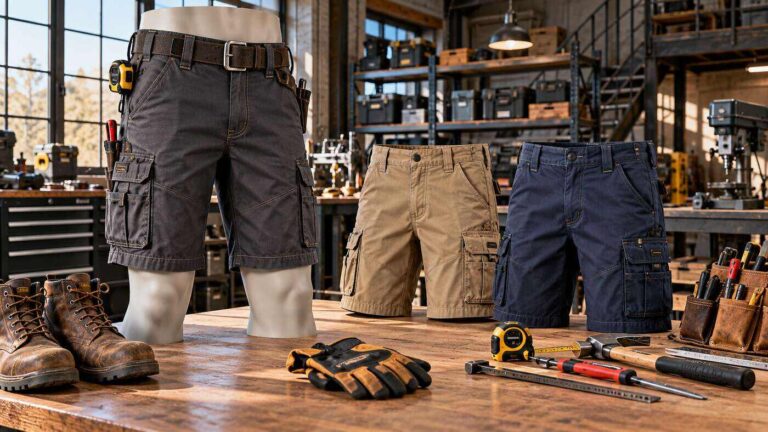
The construction is the second difference. Work shorts are reinforced where work shorts fail: double-layered pocket bags, bar-tacked stress points, abrasion panels on high-wear zones, and heavier stitching throughout. The pockets are built to carry, with ruler pockets, phone pockets, and cargo pockets positioned to be reached while working rather than while sitting.
The third difference is fit for movement. The best industrial shorts incorporate stretch, either a small percentage of elastane woven into the fabric or dedicated stretch panels, so the short moves with the wearer when kneeling, climbing, or crouching. A short that fits standing but binds when squatting is not a work short, whatever its label says.
The Fabrics and Features That Matter
Buying industrial shorts is really an exercise in reading specifications, and a few terms cover most of what you need to know.
Cotton drill and canvas are the traditional workhorses. Cotton drill, often a 265 to 280 GSM cloth with a small elastane content, is breathable and hardwearing, and it is the foundation of most quality work shorts. Canvas is heavier and tougher again, the choice for abrasive, heavy-duty environments where the extra weight is worth the extra life.
Ripstop is woven with a reinforcing grid that stops small tears from spreading, and it is the fabric of choice for work that involves snags and sharp edges. Stretch ripstop, which combines that tear resistance with elastane or spandex for movement, has become the standard for trades that combine mobility with durability, and several brands now blend recycled fibres such as REPREVE polyester into their ripstop fabrics.
Cordura is the name that signals serious reinforcement. A Cordura overlay on the high-stress areas, knees, pockets, and hem, adds abrasion resistance where shorts wear first without making the whole garment stiff. If a pair of industrial shorts lists Cordura on stress points, it is engineered for longevity rather than appearance.
The pocket layout is the final spec to read. A useful work short has angled side pockets, back patch pockets, a ruler or tool pocket, and a phone pocket, with the cargo pocket placed so it does not swing into the work. The difference between a well-designed pocket layout and a decorative one is felt within the first hour on a ladder.
Stretch and Comfort in the Heat
The reason shorts exist in the first place is temperature, and the best industrial shorts are designed for exactly the conditions that make long pants unbearable.
The Australian summer drives this design. Fabrics chosen for work shorts tend to balance weight against breathability, heavy enough to last but open enough to move air, and the stretch content that has become standard in recent years is as much a comfort feature as a durability one. A short with four-way stretch and an elasticated waistband, increasingly common in the category, stays comfortable through a full shift of movement in a way a rigid, fixed-waist short cannot.
It is worth noting that stretch and durability were once opposing qualities, and the reason they now coexist is technical: modern workwear fabrics engineer the stretch into the weave or into dedicated panels, while keeping the load-bearing areas, the pockets and abrasion zones, rigid enough to hold up. When you see a work short that is both stretchy and Cordura-reinforced, you are looking at that engineering, and it is the clearest signal of a modern, well-designed product.
Brands Worth Knowing in Industrial Shorts
The Australian workwear market has a defined set of brands that dominate industrial shorts, and each has a distinct character.
KingGee and Hard Yakka are the heritage names, the brands most Australian workers have worn at some point, built on decades of workwear manufacturing and trusted for consistent, no-nonsense durability. They are the safe, familiar choices, and their ranges cover the full spectrum from basic drill shorts to reinforced cargo styles.
Bisley has become the specification leader in the mid-market, and its FLX&MOVE range is a good example of the modern work short: four-way stretch fabrics, Cordura on high-stress areas, and elastic waistbands across cargo and utility styles. Bisley’s range is where the stretch-and-durability engineering described above is most visible at a reasonable price.
FXD occupies the workwear-as-lifestyle position, with technical fabrics, stretch ripstop, and DURA500 reinforced canvas panels, and its shorts are as common on a building site as they are outside one. The brand’s strength is combining genuine work specifications with a modern fit and finish.
Anthem and CAT round out the picture, with Anthem positioning versatile shorts that move between work and life, and CAT bringing the industrial credibility of the Caterpillar name, including shorter-length options designed for tool belts and mobility.
A Practical Range: IWW Industrial Workwear and Safety
For buyers in Australia, IWW, trading as Industrial Workwear and Safety, is a specialist retailer that carries these brands in one place. Its men’s shorts collection spans KingGee, Hard Yakka, FXD, Bisley, Anthem, CAT, and more, available both in-store and online.
The range illustrates the category well. The FXD Stretch Cargo Work Short, at $79.95, pairs a soft-touch cotton body with DURA500 nylon and polyurethane canvas abrasion panels and a stretch back yoke. The Bisley FLX&MOVE Stretch Short, at $69.95, uses 100 percent cotton duck canvas with contrast stretch canvas on the hip and back, while the elastic-waist versions of the same range, from $52.95 to $64.95, add four-way stretch and Cordura at the stress points. The Bisley Stretch Cotton Drill Utility Short, from $44.95, is the entry point, and the CAT Short Haul Short, at $64.95, offers a shorter five-inch inseam with wide belt loops for a tool belt. All prices are in Australian dollars as listed on the site at the time of writing.
This spread of prices and specifications is itself the useful thing about shopping a specialist retailer: the category runs from a $45 utility short to an $80 reinforced cargo short, and the differences between them, in fabric weight, stretch, and reinforcement, are exactly the differences this guide has described.
How to Choose the Right Pair
Choosing industrial shorts is a matter of matching the specification to the job rather than following brand loyalty or price alone.
For hot, active work, prioritise stretch and breathability. A four-way stretch ripstop or a drill with elastane, with an elasticated waistband, will be the most comfortable over a full shift of movement, and the lighter weights in the range are the place to look.
For abrasive or heavy work, prioritise reinforcement and fabric weight. Look for Cordura panels or DURA500-style overlays on the knees and pockets, a heavier GSM canvas or drill, and check that the pocket bags are double-layered, because pockets fail before fabric does.
For tool-heavy work, read the pocket layout carefully. A ruler pocket, a phone pocket, and cargo pockets that sit well with a tool belt are worth more than extra branding, and a short with wide belt loops that accommodates a tool belt is a practical detail that matters on site.
Finally, size for the way you work, not the way you stand. The right pair should allow a full squat and a comfortable kneel without binding at the waist or pulling at the seat, which is where the stretch content and the cut genuinely earn their place.
Caring for Industrial Shorts
Durability is partly a matter of care, and work shorts repay a little attention.
Wash them according to the fabric, not on the harshest setting out of habit, because high heat and aggressive cycles degrade the elastane that gives modern work shorts their stretch. Fasten the pockets and turn the shorts inside out to protect the surface and the reinforced panels. Avoid fabric softeners on technical or stretch fabrics, since they can interfere with moisture handling and the finish on abrasion panels.
Most importantly, retire them when they actually fail. The reinforcement panels and double-stitched seams extend a work short’s life considerably, but once the fabric tears through or the stretch gives out, the short has stopped being protective clothing and started being a liability, and the honest lifespan of industrial shorts is measured in hard seasons rather than years.
Conclusion
Industrial shorts are one of those purchases where spending a little more, and reading the specification, pays off immediately and repeatedly. A pair built from a proper work fabric, with stretch where it is needed and reinforcement where it wears, keeps a worker cool and protected through an Australian summer in a way that neither long pants nor casual shorts can match. The brands that dominate the category, KingGee, Hard Yakka, Bisley, FXD, Anthem, and CAT, each bring a distinct strength, and a specialist retailer such as IWW puts them side by side so the differences in fabric, stretch, and price are easy to compare. Match the specification to the job, size for movement rather than appearance, and look after them with a little care, and a good pair of industrial shorts will earn its cost many times over before it is retired.
Frequently Asked Questions
1. What are industrial shorts?
Industrial shorts are durable work shorts made from heavy fabrics like cotton drill, canvas, or ripstop, with reinforced pockets and stretch panels designed for trade and labour work.
2. What is the best fabric for work shorts?
Cotton drill and canvas are the classic choices, while stretch ripstop and Cordura-reinforced panels offer the best combination of mobility and abrasion resistance.
3. What brands make the best industrial shorts in Australia?
KingGee, Hard Yakka, Bisley, FXD, Anthem, and CAT are the leading brands, all stocked by specialist retailers such as IWW Industrial Workwear and Safety.
4. How much do industrial shorts cost in Australia?
Prices in the IWW range run from about $45 for a utility short to around $80 for reinforced stretch cargo shorts, with most pairs falling between $50 and $75.
5. Are stretch work shorts as durable as rigid ones?
Yes, modern stretch shorts use four-way stretch fabrics and rigid reinforcement panels on high-wear areas, combining mobility with the durability of traditional workwear.
6. How do I choose the right work shorts for my job?
Match the specification to the work: stretch and breathability for hot active jobs, Cordura and heavier GSM fabrics for abrasive work, and a practical pocket layout for tool-heavy trades.