Vacuum Casting Service: 9 Essential Benefits for Flawless Prototypes
Turning a digital model into a handful of production-grade parts once demanded lengthy tooling and a long wait. Vacuum casting service providers closed that gap by casting polyurethane inside soft silicone molds, delivering prototypes that look and behave like molded products within days.
This method sits between single-piece additive printing and full-scale injection molding, and it has become the standard bridge for teams that need a short run of faithful, testable parts before committing to mass production. The advantages below explain why experienced teams treat the technique as a deliberate step rather than a shortcut.
What a Vacuum Casting Service Produces
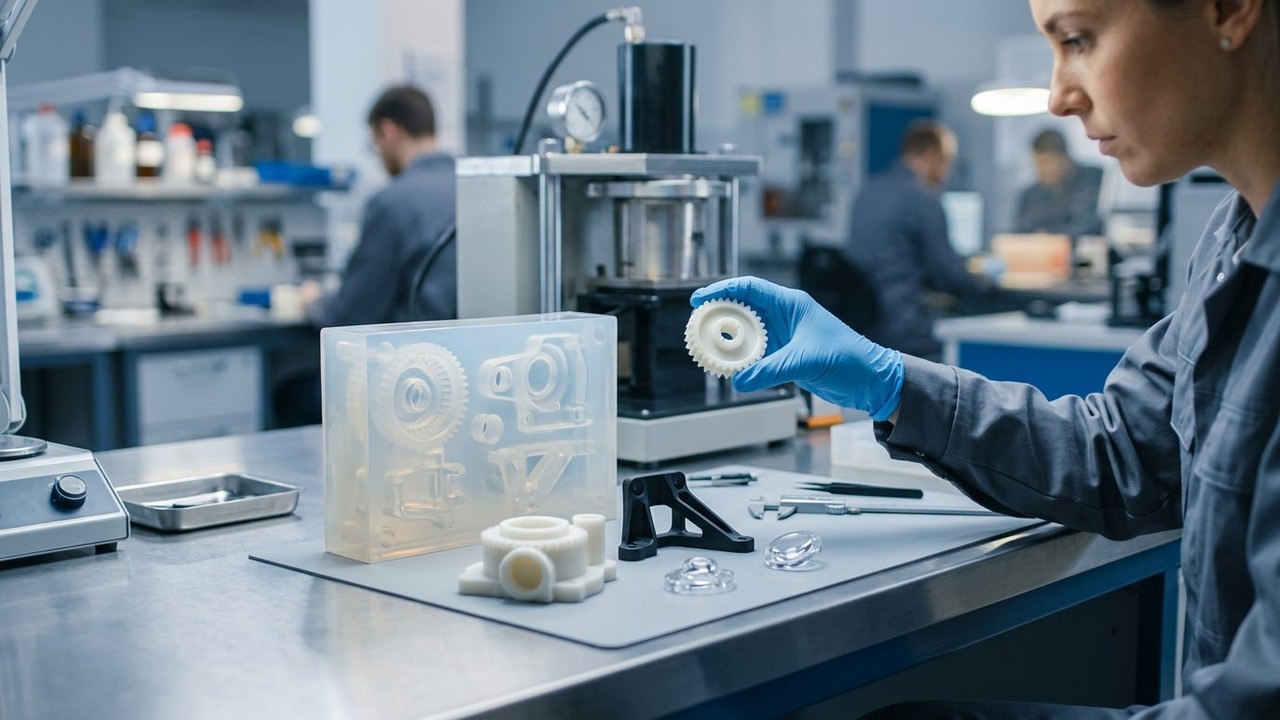
A vacuum casting service converts a master pattern into multiple copies using a flexible mold and degassed liquid resin. The result is a part with smooth surfaces, accurate details, and mechanical properties far closer to production plastic than most printed parts can offer.
How the Process Works
The workflow begins with a master model, usually machined or printed, which is encased in liquid silicone. Once the silicone cures, the master is removed to leave a cavity, and a dual-component polyurethane resin is poured in under vacuum to eliminate bubbles. After curing, the part is trimmed and finished to match the master’s surface.
Materials That Mimic Production Plastics
Casting resins reproduce the feel of ABS, polycarbonate, polypropylene, nylon, and rubber, from water-clear transparency to soft elastomers. Hardness spans Shore A 25 for flexible parts to Shore D 85 for rigid housings, and colors can be matched to exact reference swatches.
Why a Vacuum Casting Service Beats Additive Printing
A printed part is quick but rarely convincing; a vacuum casting service delivers the material behavior, surface quality, and repeatability that a single printed sample cannot. Teams choose it when a prototype must survive drop tests, seal properly, or sit in a customer’s hands during a sales review.
When It Outperforms Printing
Choose casting when the part needs production-like strength, clear optics, rubber-like flex, or a finish free of layer lines. Choose printing when only a rough form is required in the shortest possible time.
When It Defers Injection Molding
Molding pays off at high volumes, but committing to steel tooling too early locks in risk. A vacuum casting service lets a team validate fit, feel, and function on a short run upfront, then move to molding with confidence.
Nine Essential Benefits for Flawless Prototypes
These distinct advantages explain why the technique keeps winning projects across automotive, medical, consumer electronics, and industrial design.
Production-Grade Accuracy
Cast parts hold tolerances within 0.3 percent of nominal size, which is tight enough for snap fits, sealing surfaces, and assembly checks.
Faithful Material Behavior
Resins mimic the stiffness, impact resistance, and heat deflection of real thermoplastics, with heat-resistant grades that withstand temperatures near 120 degrees Celsius.
Fast Initial Parts
Parts typically arrive in as few as five days, and a complete short run can ship within two weeks.
Remarkable Detail and Finish
Fine textures, logos, and crisp edges transfer from the master into every copy, so a cast part can pass for a production unit at a glance.
Repeatable Short Runs
A single silicone mold reliably yields 20 accurate casts, and production runs can reach 200 pieces when several molds run in parallel.
True Transparency and Color
Water-clear, UV-stable resins recreate lenses and windows, while tinted and opaque options match brand colors across a full batch.
Overmolding in a Single Part
Soft grips can be cast directly onto rigid shells, replicating dual-shot molding without any secondary assembly.
Lightweight and Durable Structures
Hollow sections, living hinges, and walls as thin as 2 millimeters come out clean, so weight-sensitive designs stay honest.
Design Freedom Between Revisions
Because silicone molds are quick to replace, a team can iterate a design several times in the same window that a metal tool would still be in progress, without any added delay or tooling risk.
Choosing a Reliable Partner
A quality vacuum casting service hinges on process control as much as equipment. The details below separate dependable suppliers from the rest.
What to Send
Provide a STEP or similar solid model, the target material or a reference sample, the required finish, and the expected quantity. Clear inputs cut the back-and-forth that delays a quote.
Questions to Ask
Confirm the supplier’s tolerance standards, how many molds they run per order, and whether they inspect every batch before shipment.
Warning Signs
Be cautious when a provider quotes lead times without seeing the geometry, or cannot show samples of similar parts they have cast.
Mistakes That Compromise Cast Parts
The single most common error is skipping the master-pattern quality check, since every defect in the master transfers into the mold. Undersized venting traps air and leaves bubbles, while overly thin walls sag before the resin cures. Another frequent slip is testing only one color, which hides how pigments change shrinkage. Catching these early keeps a short run from becoming a long delay.
Conclusion
A vacuum casting service turns a single master into a small fleet of production-like parts, fast enough to keep a development timeline moving and precise enough to trust for real testing. From faithful materials and clear optics to repeatable short runs, these benefits above explain why the method remains the bridge between a printed idea and a molded product. Teams that choose a careful partner, send clean inputs, and respect these few known pitfalls get prototypes that do more than sit on a shelf; they get parts that derisk the next big decision. For anyone standing between concept and mass production, casting is the step that makes the remainder of the journey safer.