Overnight Truck Parking: 7 Proven Tips to Find the Safest Spot Every Time
For every commercial driver navigating the demanding realities of life on the road, finding safe and reliable overnight truck parking is one of the most pressing daily challenges in an already demanding profession. Federal hours of service regulations require commercial drivers to take mandatory rest periods, making the ability to locate secure, legal, and comfortable overnight parking not simply a matter of convenience but a genuine operational and legal necessity. With truck parking shortages affecting highways and freight corridors across the United States, knowing exactly how to find, evaluate, and secure the best available overnight parking option every night can mean the difference between a compliant, safe rest and a stressful, potentially dangerous situation. This guide delivers everything drivers and fleet operators need to approach overnight truck parking with confidence and consistency.
Understanding the Overnight Truck Parking Crisis in America
The United States is facing a well-documented and worsening truck parking shortage that affects hundreds of thousands of commercial drivers every single day. According to the Federal Highway Administration and various industry studies conducted by the American Transportation Research Institute, the ratio of available truck parking spaces to the number of commercial vehicles requiring them falls far short of what the industry needs. This imbalance creates ripple effects that impact driver safety, regulatory compliance, cargo security, and the overall efficiency of the national freight network.
How the Parking Shortage Developed Over Time
The truck parking shortage did not emerge overnight. It developed gradually over decades as freight volumes grew significantly while available parking infrastructure failed to keep pace. Urban sprawl consumed land previously available for truck stops and commercial parking facilities. Zoning restrictions in many municipalities made it increasingly difficult to develop new truck parking facilities near freight-dense areas. The result is a chronic deficit of safe overnight parking that forces drivers to make difficult and sometimes dangerous choices about where to rest.
The Real Cost of Inadequate Overnight Parking
When adequate overnight truck parking is unavailable, the costs are borne across multiple dimensions. Drivers experience elevated stress, fatigue, and safety risk when they cannot locate compliant parking within required timeframes. Cargo theft incidents increase significantly when trucks are parked in unsecured or unauthorized locations. Fleet operators face compliance exposure, driver turnover, and operational inefficiencies tied directly to parking unavailability. Understanding these costs underscores why finding reliable overnight parking solutions deserves serious attention and proactive planning.
Federal Hours of Service Regulations and Overnight Parking
The Federal Motor Carrier Safety Administration enforces hours of service regulations that directly govern when and how long commercial drivers must rest. These regulations make overnight parking a legal requirement rather than an optional activity, and understanding them is fundamental to appreciating why quality parking infrastructure matters so profoundly to the trucking industry.
Key Hours of Service Requirements Drivers Must Know
Commercial drivers operating property-carrying vehicles are generally required to take a minimum 10-hour off-duty period after 11 hours of driving within a 14-hour on-duty window. The 30-minute rest break requirement further necessitates access to safe parking at predictable intervals throughout the driving day. Failing to comply with these regulations due to an inability to find legal parking carries serious consequences including fines, out-of-service orders, and points against a driver’s safety record.
How Parking Availability Affects Hours of Service Compliance
A driver who cannot locate overnight truck parking within a reasonable distance of their planned stopping point may be forced to continue driving beyond compliant hours to reach an available facility. This creates a deeply problematic regulatory bind where the absence of parking infrastructure directly contributes to hours of service violations. Proactive route planning that incorporates parking availability data is the most effective way to prevent this scenario from occurring.
7 Proven Tips to Find the Safest Overnight Truck Parking Every Time
The following seven tips represent a comprehensive, experience-informed approach to locating and securing overnight truck parking that prioritizes safety, compliance, and operational efficiency.
Tip 1: Plan Your Parking Before You Begin Your Route
The single most effective strategy for securing quality overnight truck parking is to identify your planned stopping location before your driving day begins rather than searching for options as fatigue and time pressure mount. Review your route, calculate your expected driving hours, and identify two or three viable overnight parking options along your path. Having backup options identified in advance eliminates the stress and safety risk of searching for parking while tired and running short on available driving hours.
Using Route Planning Tools That Include Parking Data
Modern route planning tools designed specifically for commercial vehicles incorporate truck parking location data, capacity information, and user reviews directly into the navigation experience. Platforms such as PC Miler, ProMiles, and commercial GPS systems from Garmin and Rand McNally allow drivers to identify and plan for overnight parking stops as an integrated part of the overall route. Using these tools consistently transforms overnight parking from a reactive crisis into a predictable, manageable part of daily operations.
Tip 2: Prioritize Facilities With Verified Security Infrastructure
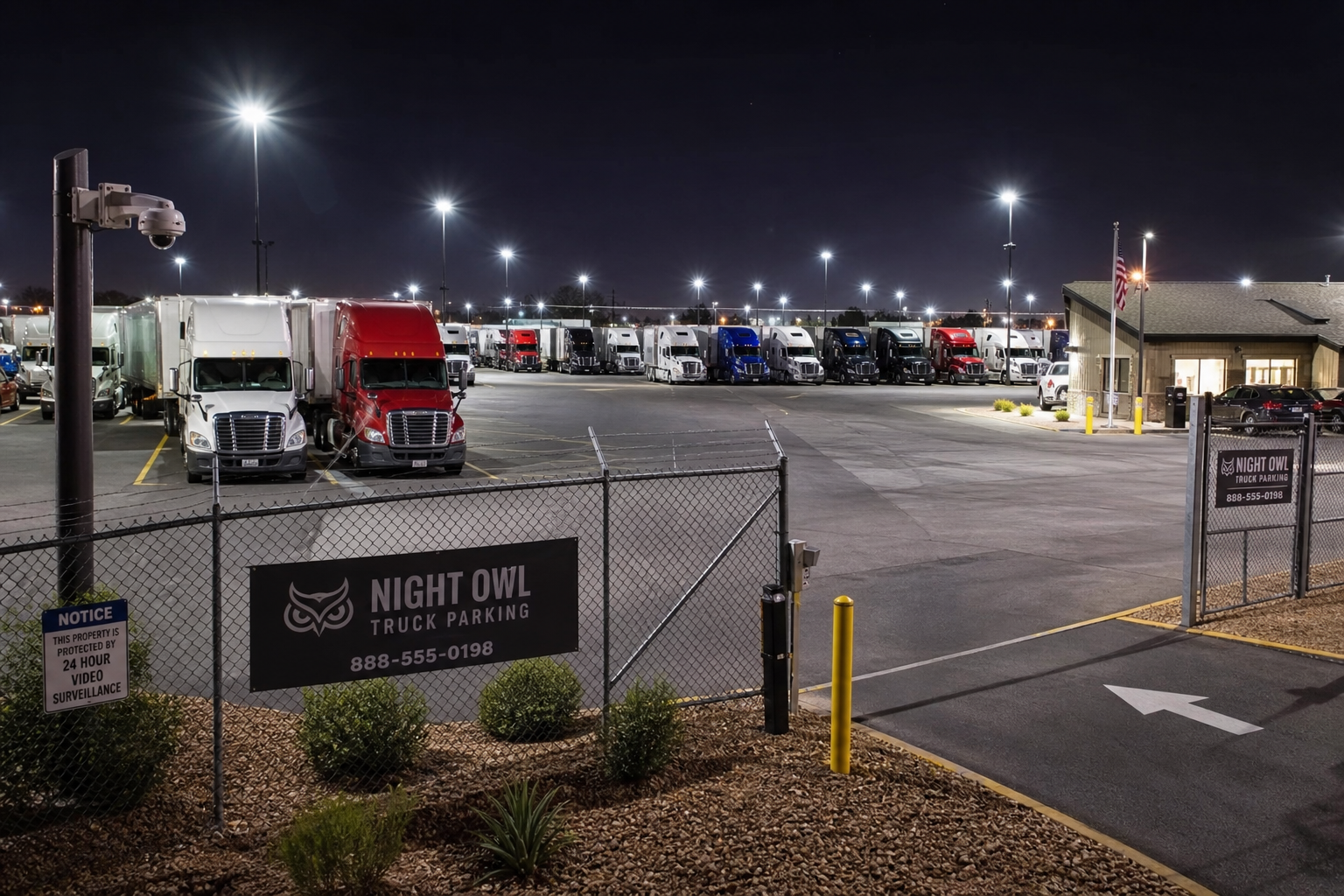
Not all overnight truck parking locations offer the same level of security, and the differences matter enormously when your vehicle and cargo represent hundreds of thousands of dollars in assets. When evaluating an overnight parking facility, look specifically for perimeter fencing that fully encloses the lot, controlled gate access that limits entry to authorized vehicles, comprehensive video surveillance covering the entire parking area, adequate lighting throughout the facility for nighttime visibility, and ideally an on-site or remotely monitored security presence.
Why Cargo Theft Risk Spikes During Overnight Hours
The overnight hours represent the highest-risk period for cargo theft in the commercial trucking industry. Thieves specifically target unsecured or poorly lit parking locations during nighttime hours when driver awareness is lowest and law enforcement presence is reduced. Facilities that invest seriously in security infrastructure provide a meaningful deterrent to theft and give drivers the peace of mind they need to rest properly and return to driving refreshed and alert.
Tip 3: Leverage Truck Parking Apps and Real-Time Availability Data
Technology has fundamentally changed the way drivers locate overnight truck parking. A growing ecosystem of dedicated applications provides real-time parking availability data, user-generated reviews, pricing information, and amenity details for facilities across the country. Using these tools effectively can save significant time and dramatically improve the quality of parking decisions made under time pressure.
Top Truck Parking Applications Worth Using
Several applications have established themselves as particularly valuable resources for drivers seeking overnight parking. Trucker Path provides crowdsourced parking availability data and user reviews for thousands of locations nationwide. Truck Park offers real-time space availability and reservation capabilities at participating facilities. DAT One integrates parking information with load board and freight matching functionality for owner-operators. Pilots Flying J and Love’s Travel Stops applications allow drivers to check amenity availability and reserve parking at their respective networks of truck stops in advance.
Tip 4: Reserve Parking in Advance Whenever Possible
The ability to reserve overnight truck parking in advance is an increasingly available option at many commercial facilities and major truck stop chains. Pre-reservation eliminates the uncertainty of arriving at a planned location only to find it at full capacity. Pilots Flying J, Love’s Travel Stops, and an expanding network of independent commercial parking facilities offer reservation systems through their websites and mobile applications. For drivers operating in high-demand freight corridors or during peak shipping seasons, advance reservation is not merely convenient but often essential.
When Advance Reservation Is Most Critical
Advance parking reservation becomes most critical during peak freight seasons including the months leading up to major holidays, during severe weather events when drivers congregate in safe locations, and in freight-dense regions where parking demand consistently exceeds available capacity. Drivers who establish the habit of reserving parking in advance as a standard practice rather than an exceptional measure experience significantly fewer parking-related disruptions to their operational schedules.
Tip 5: Know the Difference Between Parking Location Types
Overnight truck parking is available across several distinct categories of location, each with different characteristics in terms of security, amenities, cost, and reliability. Understanding these distinctions helps drivers make informed choices that match their specific needs on any given night.
Commercial Truck Stops and Travel Plazas
Major truck stop chains such as Pilots Flying J, Love’s Travel Stops, TA and Petro Stopping Centers, and Flying J represent the most widely available and consistently reliable overnight parking option across the national highway network. These facilities typically offer paved, well-lit parking areas, driver amenities including showers and restaurants, fuel availability, and in many cases advance reservation capabilities. They represent a known and dependable standard of quality for overnight parking.
Private Commercial Truck Parking Facilities
Independent commercial truck parking facilities offer an alternative to major chain truck stops, often with competitive pricing and in some cases superior security infrastructure. These facilities are particularly valuable in urban and industrial areas where major truck stop chains are less prevalent. Quality varies significantly between independent operators, making thorough research including review of security features and user feedback essential before choosing an unfamiliar private facility.
Rest Areas and Public Parking Locations
State-operated rest areas along interstate highways provide a no-cost overnight parking option that many drivers utilize regularly. While rest areas offer convenience and legal compliance, they vary considerably in terms of lighting, security, and available space. Rest areas in high-traffic corridors can fill to capacity during peak hours, making them an unreliable primary option. They are best treated as a backup resource rather than a primary overnight parking strategy.
Tip 6: Evaluate Driver Amenities and Facility Conditions
The quality of a driver’s rest period directly affects their alertness, safety, and performance during subsequent driving hours. Overnight parking facilities that offer quality driver amenities support better rest and contribute meaningfully to overall driver well-being and road safety. When evaluating overnight parking options, consider the availability and cleanliness of restroom and shower facilities, proximity to food and beverage options, Wi-Fi connectivity, laundry facilities for extended trips, and the overall maintenance standard of the parking area itself.
Tip 7: Build a Personal Database of Reliable Overnight Locations
Experienced commercial drivers develop over time a personal knowledge base of reliable overnight parking locations along their most frequently traveled routes. Systematically building and maintaining this knowledge base, whether through notes, saved locations in navigation apps, or participation in driver community forums, creates a personal resource of proven parking options that can be accessed quickly under time pressure. Sharing this knowledge with fellow drivers through apps and forums contributes to a collective resource that benefits the entire professional driving community.
Safety Practices for Overnight Truck Parking
Selecting a secure facility is only one component of overnight parking safety. Drivers also bear responsibility for following sound personal safety practices that further reduce risk during overnight rest periods.
Personal Security Measures Every Driver Should Follow
Upon arriving at an overnight parking facility, drivers should conduct a brief visual assessment of the surrounding area and the condition of adjacent vehicles. Park in well-lit areas with good sightlines whenever possible. Ensure all cab doors are locked and any sleeper berth curtains are drawn. Do not leave valuable items visible through cab windows. Report any suspicious activity observed in the parking area to facility management or local law enforcement promptly.
Protecting Your Cargo During Overnight Stops
High-value cargo requires additional security precautions during overnight parking stops. Use trailer door locks and king pin locks as secondary security measures beyond the facility’s own infrastructure. Consider cargo tracking technology that provides real-time alerts if the trailer is moved without authorization. Avoid discussing the nature or value of your cargo in public areas of truck stops or rest facilities where conversations can be overheard by individuals with criminal intent.
The Role of Technology in Solving the Overnight Parking Crisis
Technology is playing an increasingly significant role in addressing the structural truck parking shortage through improved information availability, reservation systems, and smart parking infrastructure development.
Smart Parking Systems and IoT Integration
An emerging generation of smart parking facilities uses Internet of Things sensors to monitor space availability in real time and transmit that data to driver-facing applications and fleet management platforms. These systems eliminate the guesswork from parking searches by providing accurate, up-to-the-minute availability data that drivers and dispatchers can act on with confidence. As adoption of smart parking technology grows, the efficiency of the overall truck parking ecosystem improves for every participant.
The Future of Overnight Truck Parking Infrastructure
Industry advocacy organizations, state departments of transportation, and private investors are increasingly focused on expanding overnight truck parking capacity through new facility development, conversion of underutilized commercial properties, and integration of truck parking into freight-oriented development projects. Federal infrastructure funding allocated through recent legislation includes provisions specifically targeting truck parking expansion, signaling a growing recognition at the policy level of the parking shortage as a genuine infrastructure challenge with real safety implications.
Frequently Asked Questions
Why is overnight truck parking so difficult to find in the United States?
Freight volumes have grown significantly faster than parking infrastructure, and zoning restrictions in many areas have limited the development of new truck parking facilities near high-demand freight corridors.
Can I reserve overnight truck parking in advance?
Yes, major truck stop chains including Pilots Flying J and Love’s Travel Stops offer advance reservation systems through their apps and websites, and an increasing number of independent facilities offer similar options.
Is it legal to park a commercial truck overnight at a rest area?
Most state-operated rest areas permit overnight truck parking, though time limits vary by state and some locations restrict parking duration, so checking state-specific regulations before relying on a rest area is advisable.
What security features should I look for in an overnight truck parking facility?
Prioritize facilities with perimeter fencing, controlled gate access, 24-hour video surveillance, adequate lighting throughout the lot, and either on-site or remotely monitored security personnel.
How do hours of service regulations affect overnight parking decisions?
Drivers must complete a minimum 10-hour off-duty period after 11 hours of driving, making access to legal overnight parking within reach before hours expire a regulatory requirement rather than a choice.
What are the best apps for finding overnight truck parking?
Trucker Path, Truck Park, DAT One, and the dedicated apps offered by Pilots Flying J and Love’s Travel Stops are among the most reliable and widely used platforms for locating overnight parking.
Conclusion
Overnight truck parking is a fundamental operational challenge that deserves the same level of serious planning and professional attention as any other critical aspect of commercial trucking. By planning ahead, prioritizing security, leveraging technology, understanding the types of facilities available, and building a reliable personal database of proven locations, drivers and fleet operators can consistently secure overnight parking that is safe, compliant, and conducive to genuine rest. In an industry where driver well-being and cargo security are directly tied to the quality of overnight parking decisions, a proactive and informed approach is not simply good practice but an essential professional standard.