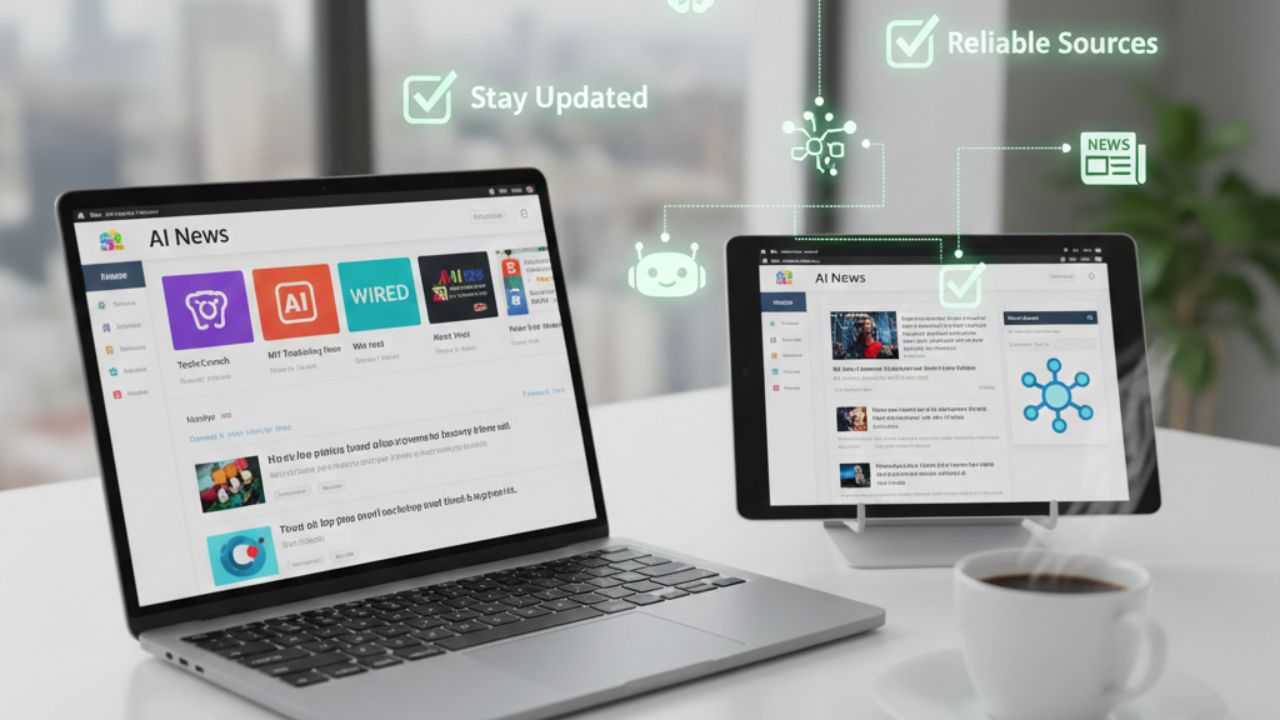
Best AI News for Beginners: Where to Start (No Hype)
AI news moves fast—and a lot of it is hype. Headlines promise “breakthroughs,” demos look magical, and product marketing often gets reported like science. If you’re new to AI, the goal isn’t to chase every model announcement. The goal is to build a small stack of sources that teaches you what’s real, what’s early, and what matters.
This guide gives you a beginner-friendly AI news setup for 2026: daily scanning, weekly deep reading, and a simple checklist to avoid hype. For more AI sources, you can browse our AI Tech News Outlets hub or the main tech news outlets directory.
Quick answer: the beginner AI stack (3 sources)
Start with just three sources:
1) MIT Technology Review — research-driven AI context (weekly depth)
2) VentureBeat — AI industry and enterprise adoption (daily signal)
3) Ars Technica — readable technical explainers (as needed)
Optional add-on for broader impact and culture: WIRED. Optional discovery layer: Hacker News (with filters).
Why beginners need a small AI news stack
Beginners often follow too many AI feeds and end up confused. A small stack works because:
• You learn core concepts through repetition
• You see patterns (benchmarks, limitations, evaluation gaps)
• You develop a hype filter over time
Start small. Expand only when you feel a clear gap.
Best AI news sources for beginners (no hype)
MIT Technology Review (research-driven context)
MIT Technology Review is one of the best beginner sources because it helps you understand what’s real beyond launch-day marketing. It often frames AI stories with research context, limitations, and long-term trends. Read it weekly—don’t try to read everything daily.
VentureBeat (industry and enterprise adoption signal)
VentureBeat is useful when you want to know what companies are actually doing with AI: products, platforms, adoption trends, and vendor moves. For beginners, it’s a good daily signal layer—just remember that industry coverage can still carry marketing angles.
Ars Technica (technical explainers that stay readable)
Ars Technica is great when AI stories get technical. It often explains how systems work and why a claim matters, in language that’s still approachable. Use it as your ‘explain it to me’ layer.
Optional sources once you’re comfortable
WIRED (impact, policy, and tech culture)
WIRED is helpful for understanding AI’s broader impact: privacy, policy, labor, misinformation, and cultural effects. It’s a strong weekly depth source, not a daily scan.
Axios (briefings layer)
Axios can help you skim major tech/business changes quickly. It’s not AI-only, but it’s useful when you want fast awareness before reading deeper.
Hacker News (discovery layer—use with filters)
Hacker News can surface interesting papers, tools, and debates early, but it can also waste time. Use it as discovery, and verify big claims via primary sources.
The no-hype checklist: how to judge AI headlines
Before you believe or share an AI claim, ask:
1) Is this a research result, a demo, or a real product?
2) Are there benchmarks or evaluations (not just screenshots)?
3) What are the limitations and failure cases?
4) Is there third-party verification?
5) Is the improvement meaningful or cherry-picked?
If the story has no primary evidence, treat it as ‘unconfirmed’ or ‘marketing’ until proven.
Two common beginner traps
• Demo trap: a polished demo video that hides failure cases.
• Benchmark trap: a new score without explaining evaluation setup or real-world usefulness.
Choose your AI news stack by role
If you’re learning AI (student/beginner)
Use MIT Technology Review for context and Ars Technica for explainers. Avoid overload: one weekly deep read is better than daily scrolling.
If you work in business or product
Use VentureBeat for industry adoption and vendor movement, plus MIT Technology Review for grounding and long-term context.
If you build with AI tools
Add the Software Development category and Data Science & Analytics hubs for more tooling and research signal, and keep one enterprise context layer via Enterprise IT when AI decisions intersect with infrastructure and cost.
A simple beginner routine (10 minutes)
Daily (5–8 minutes)
1) Scan VentureBeat headlines.
2) Open only one story that affects your work or learning goals.
3) If the story is technical, read an Ars Technica explainer instead of chasing social posts.
Weekly (30–45 minutes)
1) Read 1–2 MIT Technology Review pieces fully.
2) Write a one-line takeaway for each.
3) Pick one concept to learn (example: ‘fine-tuning’ or ‘evaluation’).
4) Unsubscribe from any source that feels like pure hype.
Explore more AI sources on TechNewsOutlets.com
Browse the AI Tech News Outlets category for more curated sources. You can also explore the full Outlets directory or return to the main tech news outlets hub.
FAQs
How many AI sources should a beginner follow?
Start with 2–3 sources. One industry signal source, one research-context source, and one explainer source is enough.
How do I avoid AI hype?
Prefer sources that explain limitations and link to primary evidence. Don’t trust demo videos alone. Cross-check big claims and look for third-party evaluation.
Do I need to read AI news every day?
No. Many beginners do better with a short scan a few times per week and one weekly deep read. Consistency matters more than volume.
Conclusion
For beginners, the best AI news setup is small and grounded: an industry signal source, a research-context source, and an explainer source. Start with VentureBeat + MIT Technology Review + Ars Technica, follow a simple routine, and use the no-hype checklist before believing big claims.

As an author, Nicai de Guzman focuses on helping readers quickly identify trusted and high-quality tech news platforms, making it easier for developers, entrepreneurs, students, and tech enthusiasts to stay informed without information overload. Through careful research and categorization, the goal is to provide clear, accurate, and up-to-date resources for the global tech community.