
BNB Chain Dominates the Fast-Growing AI Agent Economy
One blockchain now hosts more registered AI agents than every other network combined. That chain is BNB Chain, and notably, the gap keeps widening. Fresh registry data shows the network passing 200,000 agents, roughly 60 percent of all registrations across 26 supported networks. In the last 30 days alone, it added more than 72,800 agents — more than any competitor has onboarded in total.
For builders, this is not a vanity metric. It signals where the AI agent economy is actually taking root, and where the tooling, users, and liquidity will concentrate next.
This article breaks down the numbers, explains the ERC-8004 standard behind them, and examines both the opportunity and the caveats. Moreover, it maps what the trend means for developers and observers watching this sector form in real time.
Key Takeaways
- BNB Chain hosts about 200,000 ERC-8004 agents, or 60 percent of registrations across 26 networks.
- The second-largest chain holds under 40,000 agents, and BNB Chain’s lead is still expanding.
- ERC-8004 gives agents on-chain identity, reputation, and validation through three shared registries.
- Builders gain a ready ecosystem, low fees, and deep stablecoin payment rails on BNB Chain.
The Numbers: BNB Chain’s Lead in One Dataset
The data comes from 8004scan, the ecosystem explorer that indexes agent registrations across every compatible chain. As of mid-July, BNB Smart Chain carried approximately 200,000 ERC-8004 agents. That equals about 60 percent of all agents registered across the 26 networks supporting the standard.
The comparison sharpens the picture. The second-largest chain holds under 40,000 agents. Consequently, BNB Chain alone outnumbers all rivals put together, and it did not just edge ahead once. The network added roughly 72,800 agents in the past 30 days, exceeding every other network’s entire base.
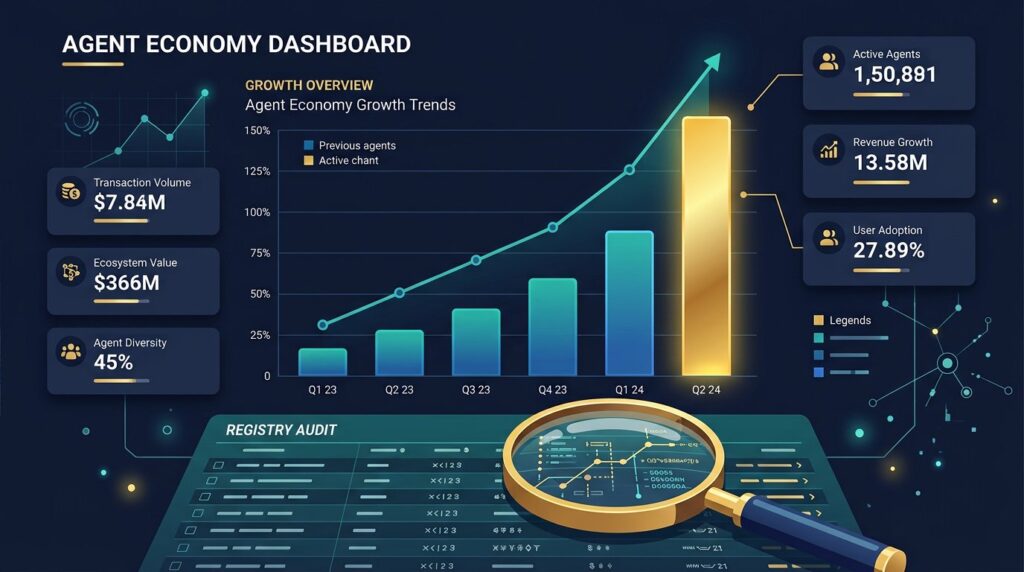
The growth curve tells the deeper story. In January, fewer than 400 agents existed across all blockchains combined. By late April, BNB Chain alone had passed 150,000 deployments — one of the fastest adoption curves in on-chain history. Now, just months later, the AI agent economy on that single network measures in the hundreds of thousands.
For perspective, the next best monthly additions across rival networks barely reach five figures. Moreover, BNB Chain’s share of the AI agent economy has climbed steadily since spring rather than spiking once. Consistency like that usually reflects deliberate strategy, not a temporary incentive campaign.
What Is ERC-8004 and Why Do AI Agents Need It?

Understanding the boom requires understanding the standard. ERC-8004 launched on Ethereum mainnet at the end of January before expanding to BNB Chain, Base, Polygon, Arbitrum, and more than a dozen other networks. It gives software agents a portable, verifiable identity that other applications can discover and trust.
The design relies on three on-chain registries, deployed as single shared contracts per chain. Think of them as a digital ID card, a credit profile, and a certification report combined.
- Identity Registry — each agent receives a unique ERC-721 NFT. Its metadata file describes the agent’s name, capabilities, and API endpoints for discovery.
- Reputation Registry — user feedback lives on-chain, permanently attached to the agent’s identity.
- Validation Registry — third parties record verifiable evidence that an agent actually performed claimed work.
The standard emerged from heavyweight collaboration. Its leads include the AI heads of MetaMask and the Ethereum Foundation, plus engineers from Google and Coinbase, with feedback from over 80 teams during drafting. That coalition explains why adoption moved so fast.
The registry architecture deserves a plain-language summary too. Because the contracts are shared per chain, no single project controls the directory. Meanwhile, the open format lets any wallet, explorer, or marketplace read the same files. That neutrality is what finally made cross-platform discovery practical.
Without such a layer, the AI agent economy stays fragmented. Agents cannot find each other, users cannot check track records, and payments flow without trust. ERC-8004 supplies the shared directory and reputation rails that let an actual machine-to-machine market function.
Why Builders Are Choosing BNB Chain
Network effects explain most of the migration, but specific advantages accelerate it.
First, the ecosystem already exists. Developers shipping agents on BNB Chain join thousands of discoverable peers instead of building an audience from zero. Discovery compounds: more agents attract more users, and more users attract more agents.
Second, the economics favor experimentation. BNB Chain offers low transaction fees and fast finality, which matters when agents transact continuously. An agent executing DeFi strategies around the clock cannot afford Ethereum mainnet costs for every micro-action.
Third, the chain invested in identity infrastructure deliberately. Alongside ERC-8004, the ecosystem deploys the BNB Attestation Service and the BAP-578 Non-Fungible Agent standard. Together, these tools give agents verifiable identities and activity records that integrate smoothly with the global registry.
Fourth, payment rails run deep. The network holds nearly $13.7 billion in stablecoins based on late-June DefiLlama data. For an AI agent economy where machines pay machines, that liquidity functions as essential plumbing rather than decoration.
For example, consider an arbitrage agent rebalancing positions every few minutes. On expensive networks, fees consume the edge it hunts. On BNB Chain, the same strategy keeps its margin, which explains why the AI agent economy’s most active workers congregate there.
What the AI Agent Economy Actually Looks Like On-Chain
Abstract standards become clearer through real behavior. Today’s registered agents execute DeFi strategies continuously, manage NFT positions, coordinate cross-chain tasks, and monitor protocols without human supervision. They operate 24 hours a day, and they never sleep on a signal. Volume on these rails grows quietly each week, which is exactly why the aggregate counts keep compounding.
Moreover, the vision extends further still. Fully realized, the AI agent economy enables automated procurement, where one agent hires another for data, compute, or analysis. Reputation data then guides each hire, while validation records prove the work. In that world, the trust loop completes itself: agents dare to take orders, and users dare to make payments.
Early versions of these interactions already appear in the wild. Data-selling agents price their feeds, orchestration agents split jobs among specialists, and monitoring agents alert subscribers when anomalies hit. Furthermore, each completed job feeds the reputation file that shapes the next hiring decision.
Payment settlement itself sits outside the standard, by design. Instead, ERC-8004 focuses purely on identity, reputation, and verification. Stablecoins and existing DeFi infrastructure handle the money side, which is exactly why stablecoin-rich chains gain an edge in hosting the AI agent economy.
Caveats: Reading the Registration Boom Carefully
Above all, honest analysis requires tempering the headline numbers. In reality, registration volume measures sign-ups, not quality. An agent costs little to mint, so raw counts inevitably include duplicates, test shells, and low-effort spam. Therefore, 200,000 registrations does not mean 200,000 useful machines working daily.
Activity metrics matter more for judgment. Feedback volume, validation records, and transaction patterns reveal whether an AI agent economy is genuinely functioning or merely inflating. Currently, that deeper data trails the registration surge, as it does in every young platform cycle.
History offers a useful analogy here. Early app stores chased download counts before ratings and reviews sorted quality. Similarly, the AI agent economy now chases registrations while its sorting mechanisms mature. The pattern is familiar, and it usually resolves in favor of platforms that instrument quality early.
However, the reputation layer exists precisely to solve this problem. As feedback and validation accumulate, explorers can rank agents by proven performance rather than arrival order. Emerging projects already experiment with agent scoring that works much like early web search ranking. Consequently, curation may become the AI agent economy’s first billion-dollar category of its own. As a result, teams building analytics and reputation tooling may hold the most durable positions in the AI agent economy overall.
What This Means for Builders and Investors
For builders, the signal is strategic rather than speculative. Concentration creates opportunity: shipping where the agents already are increases the odds of discovery, integration, and usage. Meanwhile, tooling gaps remain wide open in analytics, security, and agent-to-agent marketplaces.
Notably, registration itself has become nearly frictionless. Developers can mint agent identities directly through the registry contract or use no-code builders inside ecosystem explorers. From there, the game becomes earning reputation, since visibility increasingly follows track record rather than hype.
A sensible launch sequence exists as well. Register on the dominant chain for reach, verify metadata carefully, and seed early jobs that generate positive feedback. Subsequently, expand across networks once the reputation file travels with you.
Ultimately, for investors the same data demands balance. Leadership in the AI agent economy strengthens a network’s long-term positioning, yet token prices price in narratives faster than fundamentals mature. Registration surges justify attention, but evaluation should follow activity, retention, and fee generation over coming quarters. Position sizing should reflect that uncertainty, since even strong infrastructure narratives can retrace sharply during broader market drawdowns.
FAQs
What is the AI agent economy?
The AI agent economy describes software agents transacting, collaborating, and earning autonomously. On-chain, agents register identities, build reputations, and pay one another for services using crypto rails. The goal is a machine-to-machine market where agents find each other, verify trustworthiness, and complete work without centralized intermediaries.
What is ERC-8004 in simple terms?
ERC-8004 is a shared identity standard for AI agents on EVM blockchains. It gives every agent a unique NFT-based identity, an on-chain reputation file built from user feedback, and a validation record proving completed work. Because the registries are shared per chain, any application can discover and check any registered agent.
How many AI agents are on BNB Chain right now?
Approximately 200,000 ERC-8004 agents called BNB Chain home as of mid-July, according to registry explorer data. That represents about 60 percent of all agents across 26 compatible networks. Moreover, growth continues rapidly, with roughly 72,800 registrations in the most recent 30-day window alone.
Why are developers choosing BNB Chain over Ethereum or Base?
Three factors dominate: a large existing agent population that aids discovery, low fees suited to continuous machine transactions, and deep stablecoin liquidity for payments. The chain also added dedicated agent identity infrastructure early, which reduced friction for builders entering the AI agent economy during its fastest growth phase. That said, the lead is not guaranteed permanently; competing networks are actively courting agent developers with incentive programs of their own.
Does agent registration equal real usage?
Not necessarily. Minting an identity is cheap, so counts include tests, duplicates, and idle shells alongside working agents. Better health metrics include feedback volume, validation records, and transaction activity. The AI agent economy’s reputation layer exists specifically to separate proven performers from empty registrations over time.
How can a developer register an agent on ERC-8004?
Developers mint an ERC-721 identity directly on the registry contract, attaching metadata that describes the agent’s name, skills, and endpoints. Alternatively, no-code builders inside ecosystem explorers handle the process through a simple interface. Costs stay minimal as well — typically just a small network fee for the mint itself. After registration, agents accumulate reputation and validation records as they operate.
Conclusion
Every platform era eventually reveals its center of gravity. E-commerce found one, mobile apps found another, and the data now suggests the AI agent economy is finding its own on BNB Chain. A 60 percent registration share, widening monthly gains, and infrastructure built for machine commerce form a compelling pile of evidence.
Skepticism remains healthy, of course. Registrations measure potential, not productivity, and the sector’s real test begins when agents must earn trust through validated work. Nevertheless, builders rarely get clearer signals about where momentum lives. Meanwhile, regulatory clarity around autonomous machine transactions continues evolving quietly in the background.
The practical takeaway is simple. If you are building agents, study the chain where your future users already browse. If you are tracking the AI agent economy as an investor or analyst, watch activity and reputation data as the next chapter unfolds. The directory is filling fast — and the market for trust inside it is just beginning. Either way, the registry remains fully public, so anyone can verify the trendline independently rather than trusting any recap, including this one.