Commercial Roof Maintenance Plans: A Complete Guide to Protecting Your Roof
A commercial roof is one of the largest and most overlooked assets on a building, and the pattern that shortens its life is almost always the same: minor problems left unaddressed until they become major ones. A small crack, a clogged drain, or a failing seam costs little to fix when caught early and a great deal when discovered by a leak. Commercial roof maintenance plans exist to break that pattern, replacing reactive repairs with scheduled care that extends the roof’s life and protects the building beneath it. This guide explains what a maintenance plan includes, why it matters, what it costs, and how Integrity Pro Roofing approaches commercial roof maintenance in Denver.
Why Maintenance Is the Cheapest Part of Roof Ownership
The economics of roof care are counterintuitive at first and obvious once understood: the cheapest dollar spent on a roof is the one spent before something fails.
Commercial roofs fail gradually, not suddenly. Water ponds in a low spot, a seam opens slightly, a drain clogs, and each of these small failures compounds the others until the roof leaks, and by the time water is visible inside the building, the damage beneath the membrane is already extensive. The repair at that point involves more than the visible problem, because the insulation and structure below may be saturated.
A maintenance plan catches these problems at the small stage, when a repair is measured in minutes and dollars rather than days and thousands. This is why roofing professionals consistently describe maintenance as the highest-value service they offer: it converts a large, unpredictable expense into a small, scheduled one, and it extends the life of the roof itself, which delays the largest expense of all, replacement.
There is also a warranty dimension. Many roof warranties require regular inspection and maintenance as a condition of coverage, and a documented maintenance history protects the owner’s ability to claim if a defect appears. A maintenance plan is therefore not only good practice; it is part of keeping the roof’s warranty enforceable.
What a Commercial Roof Maintenance Plan Includes
The structure of a maintenance plan is consistent across the industry, and understanding it sets the right expectations.
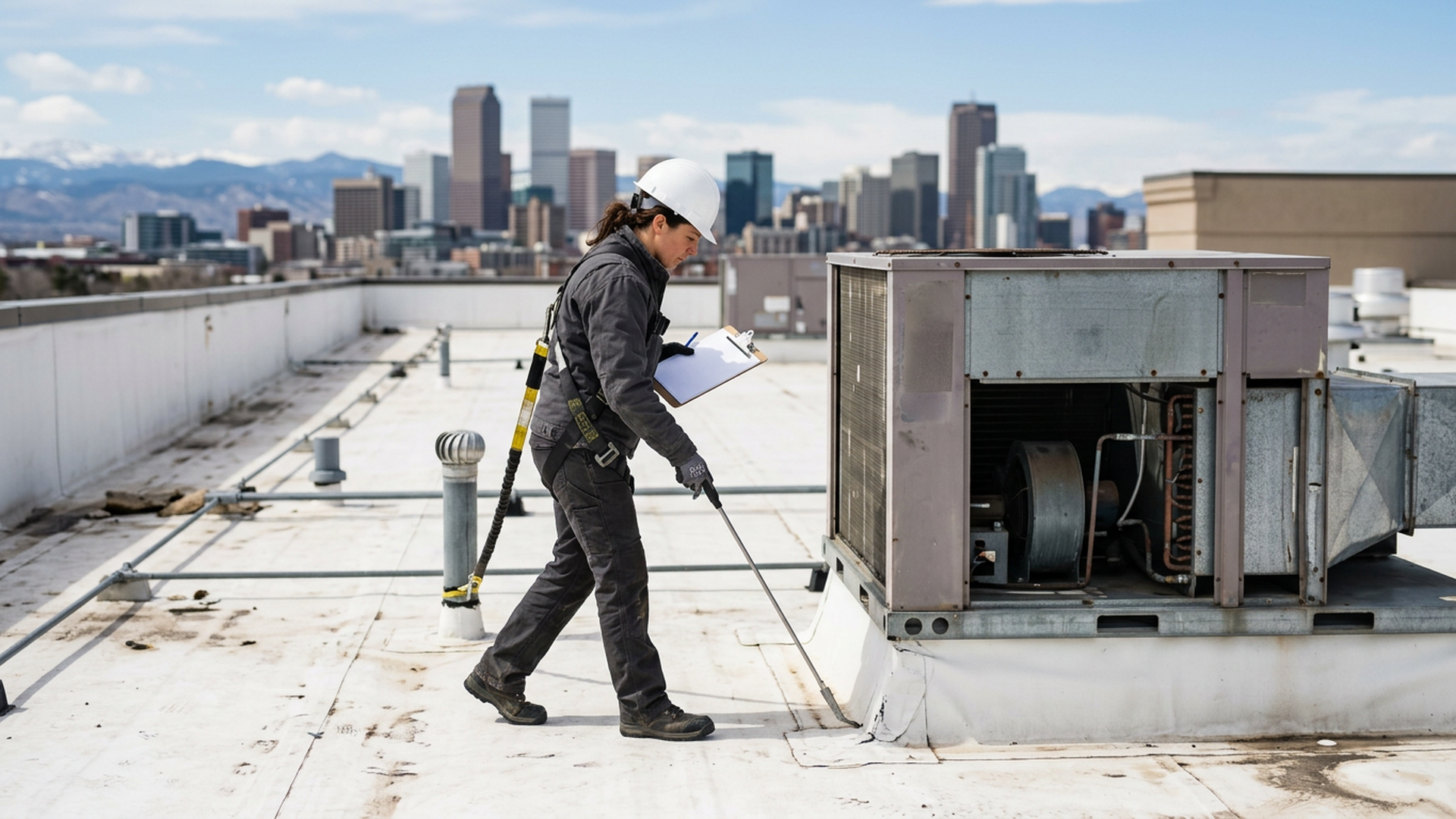
The foundation is inspection. A thorough inspection assesses the roof’s condition and remaining life, and it looks for the specific problems that shorten that life: standing water that indicates poor drainage, cracks and missing parts in the membrane, and areas of moisture that suggest water has already penetrated. This inspection is not a glance from ground level; it is a walk of the roof surface, because the problems are rarely visible from below.
The second element is the touch-up work. After the inspection, the maintenance team addresses the small issues found, unclogging gutters and drains, repairing damaged flashing, sealing minor cracks, and correcting the problems that would otherwise grow. This is the part of the plan that actually extends the roof’s life, because every issue fixed early is a leak prevented.
The third element is recommendation and planning. At the end of the cycle, the roofer reports on the roof’s remaining service life and recommends a schedule for ongoing care, so the owner knows where the roof stands and what it will need next. This forward-looking piece is what turns maintenance from a series of repairs into a managed asset.
What Maintenance Plans Cost
The cost question has a satisfying answer in this category, because the economics are unusually favourable.
Integrity Pro Roofing prices its commercial roof maintenance plan at $147 per year, which includes two scheduled full roof inspections. To put that figure in perspective, it is a small fraction of what a single emergency repair or a premature roof replacement costs, and it is the kind of number that makes the decision easy once the economics are clear. The plan is available whether the company installed the roof or is maintaining an existing roof, which means the benefit is not limited to new clients.
The broader point applies regardless of the specific provider: maintenance is priced as a small recurring cost precisely because the alternative, unplanned repair and shortened roof life, is so much larger. For a building owner, the annual plan is the cheapest form of insurance the roof can have.
Which Roofs Benefit From Maintenance Plans
Maintenance is not limited to one roof type, and understanding the range matters for owners of older or specialised systems.
The plan applies to the full range of commercial roofing: flat roofs, PVC roofs, TPO roofs, EPDM roofs, metal roofs, built-up roofing, and modified bitumen. Each of these has its own failure modes, PVC and TPO at the seams, EPDM at the joints and around penetrations, metal at the fasteners and seams, built-up and modified bitumen at the flashings and edges, and each benefits from inspection by someone who knows what to look for on that specific system.
The common thread is that every commercial roof deteriorates from the details, not the field, and the details are exactly what a maintenance inspection examines. A plan that covers the roof’s specific type is worth more than a generic walk-through, which is why a roofer’s experience with the relevant systems matters.
Why Denver’s Conditions Demand Maintenance
The climate in Denver adds its own pressures to commercial roofs, and a local maintenance provider understands them.
Denver’s weather is hard on roofing: intense sun and UV exposure through the high-altitude summers, freeze-thaw cycles through the winter that expand and contract the roof’s materials, hail that can damage membranes and flashings, and the occasional heavy snow load. Each of these conditions creates specific wear patterns, and the failure modes are learned through years of local work rather than from a national template.
This is why local experience matters in roof maintenance. A Denver roofer knows which roofs suffer from hail, where ice dams form, and how the region’s rapid temperature swings stress the seams and flashings, and that knowledge shapes what the inspection looks for. Integrity Pro Roofing has served Denver for more than eight years, and its maintenance plans reflect that local understanding.
The Business Case for Building Owners
For a building owner or facility manager, the maintenance decision is a business decision, and the business case is straightforward.
An unplanned roof failure is not just a repair bill; it is business interruption, damage to contents and operations, tenant complaints, and sometimes liability. A roof that fails during business hours over a production area or a tenant space costs far more than the roof repair itself. A maintenance plan reduces the probability of that interruption, and it does so at a cost that is trivial against the risk it mitigates.
There is also the asset value argument. A commercial roof is a depreciating asset with a known service life, and the maintenance plan is what keeps it reaching that service life, or exceeding it, rather than failing early. For an owner planning capital expenditure, knowing the roof will last its full term changes the budgeting picture, and the documentation a maintenance plan provides is part of that planning.
How Integrity Pro Roofing Approaches Maintenance
For Denver building owners, Integrity Pro Roofing is a commercial roofing company whose maintenance offering reflects the structure described above, and it has served the area for more than eight years.
The company’s maintenance plan is priced at $147 per year and includes two scheduled full roof inspections, with the inspection covering water run-off, cracks and missing parts, and areas of moisture. After the inspection, the company performs the touch-up repairs identified, and it reports on the roof’s remaining service life with recommendations for ongoing care. The plan is offered both for roofs the company has installed and for existing roofs, and it spans flat, PVC, TPO, EPDM, metal, built-up, and modified bitumen systems.
The company also installs new commercial roofs and offers commercial roof repair, which means a building owner can take the full lifecycle, installation, maintenance, and repair, through a single accountable provider. It offers free estimates and free inspections, and it frames its service around communication and completing work promptly. For owners evaluating the option, the sensible step is a free assessment of the roof’s current condition.
Building a Maintenance Habit That Pays
The final piece of the picture is habit, because a maintenance plan only pays if it is sustained, and the scheduling is what makes it work.
The twice-yearly inspection rhythm that most plans follow is deliberate: it catches seasonal damage, hail in summer, ice and snow in winter, shortly after it occurs, while it is still small. Keeping that schedule, and keeping the documentation from each visit, is what turns the plan into a continuous record of the roof’s health and what preserves the warranty position over time.
For the building owner, the discipline is simple and the return is compounding. Each scheduled inspection prevents problems that would otherwise grow, each documented visit protects the warranty, and each year of maintenance adds to the roof’s life. It is the rare maintenance expense that pays for itself many times over, and the only requirement is to begin.
Conclusion
In conclusion, commercial roof maintenance plans are the most cost-effective decision a building owner can make about their roof, converting unpredictable repairs into scheduled care and extending the roof’s life at a fraction of the cost of early replacement. A plan built on inspection, touch-up, and recommendation catches the small failures, a clogged drain, a failing seam, a hairline crack, before they become leaks, and it protects the warranty that covers the roof’s larger risks. In a climate like Denver’s, where sun, hail, and freeze-thaw cycles accelerate wear, the twice-yearly rhythm of a local provider is exactly the care the roof needs. For Denver building owners, Integrity Pro Roofing’s $147 annual plan, with two full inspections and the repairs they surface, represents the model working as intended, and the first step is a free assessment of the roof’s current condition.
Frequently Asked Questions
1. What is included in a commercial roof maintenance plan?
A typical plan includes scheduled full roof inspections, touch-up repairs for issues found, and recommendations for ongoing care and remaining service life.
2. How much does a commercial roof maintenance plan cost?
Integrity Pro Roofing’s plan costs $147 per year and includes two scheduled full roof inspections.
3. Why is roof maintenance important for a commercial building?
Maintenance catches small problems before they become leaks, extends the roof’s life, protects the warranty, and prevents business interruption from unexpected failures.
4. Which roof types benefit from a maintenance plan?
Flat, PVC, TPO, EPDM, metal, built-up, and modified bitumen roofs all benefit, each with its own failure points that inspections target.
5. Can a maintenance plan be used on an existing roof?
Yes, maintenance plans typically apply whether the company installed the roof or is maintaining an existing one.
6. How often should a commercial roof be inspected?
Twice a year is the standard rhythm, catching seasonal damage shortly after it occurs while repairs are still small.