Commercial Roof Repair in Texas: 7 Essential Strategies to Prevent Costly Facility Damage, Structural Leaks, and Unplanned Downtime
Commercial property owners, facility managers, and industrial asset supervisors across the Lone Star State face some of the most aggressive environmental challenges in the United States. Arranging prompt and specialized commercial roof repair in Texas is vital to preserving building envelope integrity, protecting interior inventory, and safeguarding ongoing business operations. The Texas climate subjects industrial facilities, distribution centers, retail strips, and corporate campuses to extreme weather swings—ranging from triple-digit summer heatwaves and intense ultraviolet radiation to sudden severe spring hail, gale-force tornado-adjacent winds, and torrential Gulf Coast hurricane deluges. Neglecting minor membrane tears, failing flashing details, or persistent ponding water can rapidly transform small, manageable maintenance concerns into catastrophic structural leaks, extensive insulation rot, electrical hazards, and exorbitant emergency downtime. Implementing proactive diagnostic maintenance and partnering with certified commercial roofing professionals ensures your investment remains resilient year-round.
The Unique Environmental Forces Driving Texas Commercial Roof Degradation
Operating commercial real estate in Texas requires an engineering-minded appreciation of regional climate stressors. Unlike temperate environments where seasonal transitions occur gradually, Texas weather patterns deliver severe thermal and mechanical stresses to low-slope and flat roofing assemblies.
1. Intense Thermal Cycling and Extreme UV Radiation
Summers across North, Central, and South Texas regularly exceed 100°F for consecutive weeks, pushing rooftop surface temperatures to 160°F or higher on dark membranes:
- Thermal Shock: The drastic temperature difference between afternoon baking heat and sudden cooling night breezes—or abrupt thunderstorm downpours—causes recurring expansion and contraction cycles known as thermal shock.
- Seam and Fastener Fatigue: Over time, constant thermal movement loosens mechanical fasteners, pulls perimeter base flashings away from parapet walls, and places intense shear stress on welded or adhesive membrane seams.
- Ultraviolet Degradation: Solar UV radiation accelerates polymer breakdown and dries out asphalt binders, leading to embrittlement, alligatoring on modified bitumen, and surface chalking on older rubber single-ply systems.
2. Severe Hailstorms and Tornadic Wind Shear
The central Interstate 35 corridor—spanning Dallas-Fort Worth, Waco, Austin, and San Antonio—sits squarely in America’s “Hail Alley”:
- Impact Fractures: Large hail impacts can crush underlying polyisocyanurate (polyiso) insulation boards, puncture single-ply membranes, crack brittle modified bitumen cap sheets, and dent metal standing seams.
- Wind Uplift Pressures: Violent storm squalls create massive aerodynamic negative pressure (uplift) at building corners and perimeter edges, tearing mechanically attached membranes or delaminating fully adhered assemblies if edge metal terminations are loose.
3. Torrential Rainfall and Ponding Water Accumulation
Texas storm fronts often dump inches of rain within a few hours. When internal drainage systems, scuppers, or roof slopes are compromised, standing water poses severe risks:
- Definition of Ponding Water: According to the National Roofing Contractors Association (NRCA), water remaining on a low-slope roof surface 48 hours after precipitation qualifies as ponding water.
- Weight Hazards and Membrane Deterioration: Ponding adds immense structural dead load to the roof deck, accelerates biological algae and fungal growth, softens adhesives, and magnifies solar UV rays like a magnifying glass, accelerating chemical breakdown.
Common Commercial Roofing Systems in Texas and Their Failure Points
Commercial facilities across Texas utilize diverse low-slope and steep-slope systems, each presenting distinct repair requirements and vulnerability profiles.
Thermoplastic Polyolefin (TPO) Membranes
TPO represents the most popular commercial single-ply choice across Texas due to its solar reflectivity and energy efficiency:
- Primary Advantages: High solar reflectance index (SRI) ratings dramatically cut cooling loads on massive warehouse distribution hubs in places like Houston and Dallas.
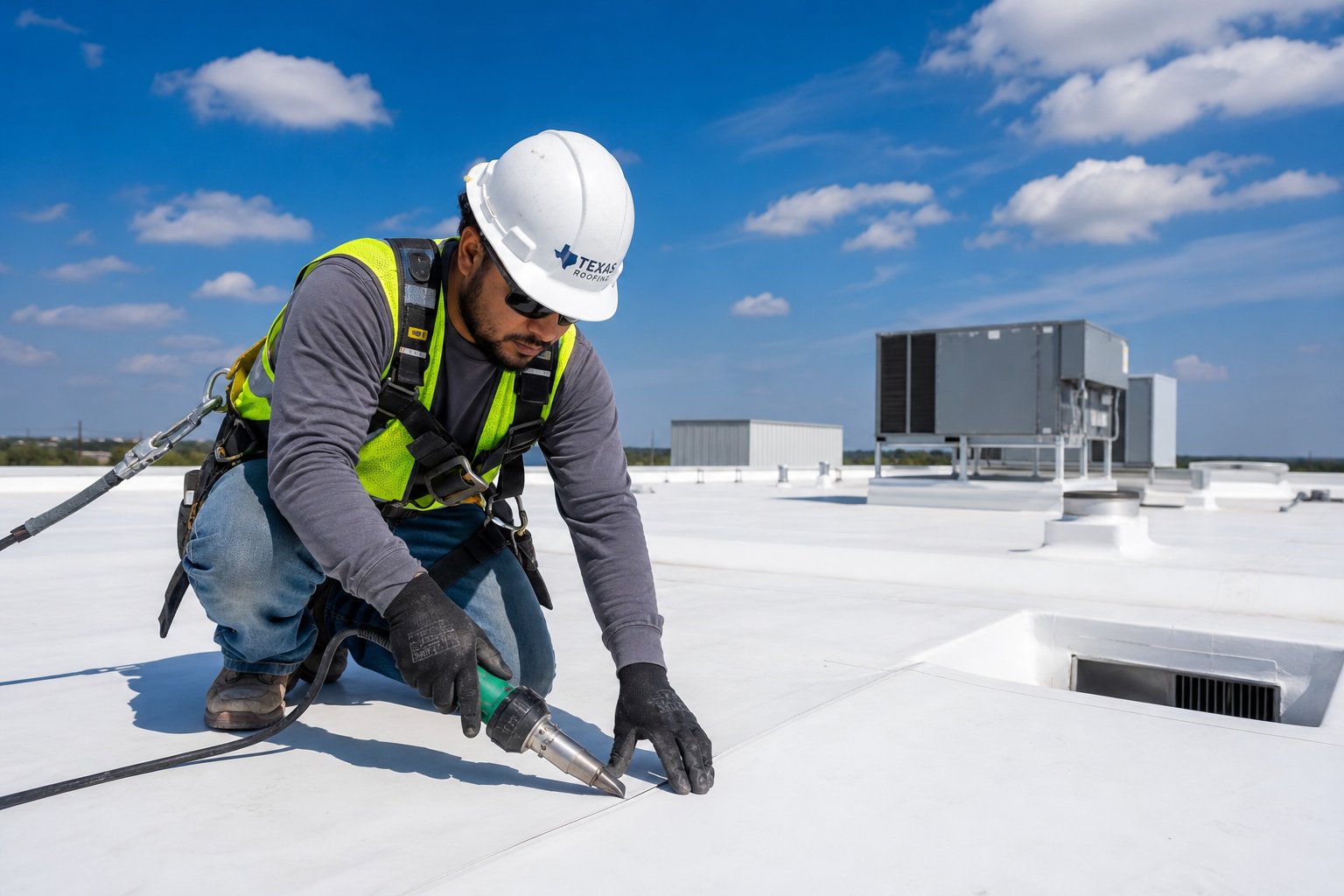
- Common Failure Modes: Micro-fissures in early-generation or sub-par membranes, heat-welded seam delamination caused by improper installer iron calibration, and puncture damage from rooftop HVAC technician foot traffic.
Ethylene Propylene Diene Monomer (EPDM) Rubber
Known for its exceptional tensile strength and flexibility, EPDM is a durable synthetic elastomer used in various industrial environments:
- Common Failure Modes: Shrinkage over long decades, pulling away from curbs, failure of cured adhesive tape seams due to standing water exposure, and damage from grease or petroleum byproduct exhausts if installed near commercial restaurant vents.
Modified Bitumen (Mod-Bit) and Built-Up Roofing (BUR)
Multi-ply asphalt systems provide redundant, multi-layered defense against foot traffic and mechanical impacts:
- Common Failure Modes: Blistering caused by entrapped moisture between plies, cap sheet granule loss exposing raw bitumen to UV oxidation, open laps along roll edges, and cracking around parapet wall flashings.
Standing Seam Metal Roofing
Prevalent on agricultural barndominiums, manufacturing plants, and contemporary corporate facilities:
- Common Failure Modes: Backed-out fastener screws with rotted neoprene sealing washers, corrosion at cut panel edges, and failure of sealant tapes in standing seam ribs or transition trim flashings.
Commercial Roofing System Repair Diagnostic Guide
| Roofing System Type | Common Vulnerability in Texas | Typical Repair Methodology | Life Expectancy with Maintenance | Energy Efficiency Rating |
|---|---|---|---|---|
| Single-Ply TPO | Seam separation, hail punctures | Hot-air welded patch, target patches | 20 to 25+ Years | Exceptional (Cool Roof Certified) |
| Single-Ply EPDM | Seam tape degradation, edge shrinkage | Primed EPDM splice tape, cured cover strips | 25 to 30 Years | Low to Moderate (Requires Coating) |
| Modified Bitumen | Surface blistering, flashing cracks | Cold-applied mastic, torch-applied patches | 15 to 20 Years | Moderate (Depends on Granule Color) |
| Built-Up Roof (BUR) | Alligatoring, gravel scouring, leaks | Mastic, fiberglass fabric, flood coat | 20 to 25 Years | Moderate (Gravel Surface) |
| Standing Seam Metal | Fastener backing, oxidation, seal failure | Fastener replacement, elastomeric coatings | 30 to 45+ Years | High (Reflective Factory Paints) |
Diagnosing Commercial Roof Leaks: Advanced Non-Destructive Testing
Finding the true source of an active ceiling drip inside a 100,000-square-foot warehouse is rarely as simple as looking directly overhead. Water travels sideways across steel decking flutes, structural purlins, and insulation board joints before descending. Professional commercial roofing contractors rely on advanced diagnostic technology.
Infrared Thermal Imaging Moisture Surveys
- Mechanics of Thermal Scans: Wet polyisocyanurate or fiberglass insulation retains heat absorbed during daytime hours significantly longer than dry insulation.
- The Nighttime Scan Process: Certified thermographers inspect the roof membrane after dusk using forward-looking infrared (FLIR) cameras to pinpoint exact boundaries of trapped subsurface moisture with pinpoint precision.
- Financial Benefit: Instead of needlessly tearing off hundreds of squares of dry roofing, contractors perform surgical cut-and-replace repairs strictly on the compromised wet insulation zones, saving tens of thousands of dollars.
Electronic Leak Detection (ELD) and High-Voltage Spark Testing
- ELD High-Voltage Spark & Low-Voltage Vector Mapping: These non-destructive methods utilize electrical currents to detect microscopic breaches, pinholes, and punctures across single-ply membranes that are completely invisible to the naked eye.
- Post-Installation Quality Control: Often utilized immediately following new installations or major restorations to certify membrane watertightness prior to signing off on manufacturer warranties.
Restoration vs. Replacement: The Value of Fluid-Applied Coatings
When a commercial roof exhibits widespread weathering or multiple minor leaks but retains structurally sound, dry underlying insulation, a complete tear-off is rarely the most cost-effective path. High-performance roof restoration coatings provide an exceptional alternative.
High-Solids Silicone and Elastomeric Acrylic Coatings
- Monolithic Seamless Protection: Fluid-applied silicone coatings cure into a seamless, rubber-like monolithic barrier that completely encapsulates old seams, flashings, fasteners, and penetrations.
- Permanent Ponding Water Resistance: High-solids 100% silicone does not soften, crack, or wash away under ponding water, making it an ideal protective layer for aging flat commercial substrates.
- Dramatic Utility Savings: White reflective coatings reflect up to 88% of solar thermal energy, drastically reducing rooftop surface temperatures and slashing summer air conditioning energy costs for building occupants.
- Tax and Expense Advantages: Under Section 179 of the IRS tax code, qualifying roof maintenance and restoration expenditures can often be expensed immediately in the year incurred rather than capitalized over decades.
Developing a Proactive Commercial Roof Asset Management Plan
The most expensive roof repair is an emergency roof repair executed during an ongoing storm. A proactive asset management program preserves building value and maximizes manufacturer warranty coverage.
Biannual Scheduled Inspections
- Spring & Autumn Protocols: Schedule comprehensive professional inspections every spring (prior to the severe hail and thunderstorm season) and every autumn (before winter freezes and following intense summer heat fatigue).
- Post-Storm Evaluations: Always order immediate documentation inspections following verified severe hail, tornadoes, or gale-force wind events in your county to verify hail impact depth and initiate timely insurance filings.
Routine Maintenance Housekeeping Checklist
- Clear Drainage Pathways: Regularly remove dead leaves, blown trash, silt, and construction debris from internal drains, gravel guards, downspouts, and overflow scuppers.
- HVAC Contractor Protocol: Enforce strict safety and rooftop protocols for HVAC, electrical, and refrigeration technicians. The majority of commercial membrane punctures occur when third-party trades drop heavy tools, drag metal access panels, or walk carelessly over unpadded membrane sections.
- Walkway Pad Installation: Install heavy-gauge rubber walkway pads from roof access hatches directly to all mechanical equipment curbs to isolate foot traffic wear.
Frequently Asked Questions About Commercial Roof Repair in Texas
How quickly should ponding water on a flat commercial roof be addressed?
Ponding water that lingers more than 48 hours after rain must be addressed promptly, as it weakens seams, degrades coatings, and adds dangerous structural dead weight to your roof deck.
What are the earliest warning signs that a commercial roof needs professional repair?
Early warning signs include unexplained indoor ceiling water stains, musty odors, rust streaks along decking screws, blistering membrane surfaces, separated seams, and sudden spikes in facility cooling utility costs.
Can a damaged commercial roof be repaired rather than completely replaced?
Yes, if less than 25% of the underlying insulation is moisture-saturated and the structural deck remains sound, localized repairs and fluid-applied restorative coatings offer a durable, cost-effective alternative to complete replacement.
How does Texas hail damage impact commercial roofing warranties?
Standard manufacturer material warranties typically exclude “Acts of God” like hail impacts; however, prompt professional documentation and repairs are mandatory to prevent leaks that could void your remaining warranty coverage.
How often should a commercial roof in Texas undergo professional inspection?
Commercial roofs should undergo certified professional inspections at least twice a year—typically in early spring and late fall—as well as immediately following any major hailstorm or high-wind event.
What is the advantage of silicone roof restoration coatings over traditional reroofing?
Silicone coatings create a seamless, watertight barrier over your existing roof without the high cost, building disruption, and landfill waste of a complete tear-off, while reflecting extreme solar heat to lower cooling costs.
Conclusion
Sustaining a resilient building envelope requires a strategic, vigilant approach to facility maintenance. Arranging professional commercial roof repair in Texas ensures that your commercial warehouse, manufacturing facility, medical center, or retail complex remains fully protected against the harshest regional weather extremes. By leveraging advanced diagnostic tools like infrared moisture thermography, conducting disciplined biannual inspections, resolving minor seam and flashing vulnerabilities before storms strike, and investing in high-reflectance restoration coatings, facility managers can effectively double the service life of their commercial roofing systems. Protecting your facility today safeguards your interior assets, shields your balance sheet from emergency capital outlays, and guarantees continuous, uninterrupted business operations for years to come.