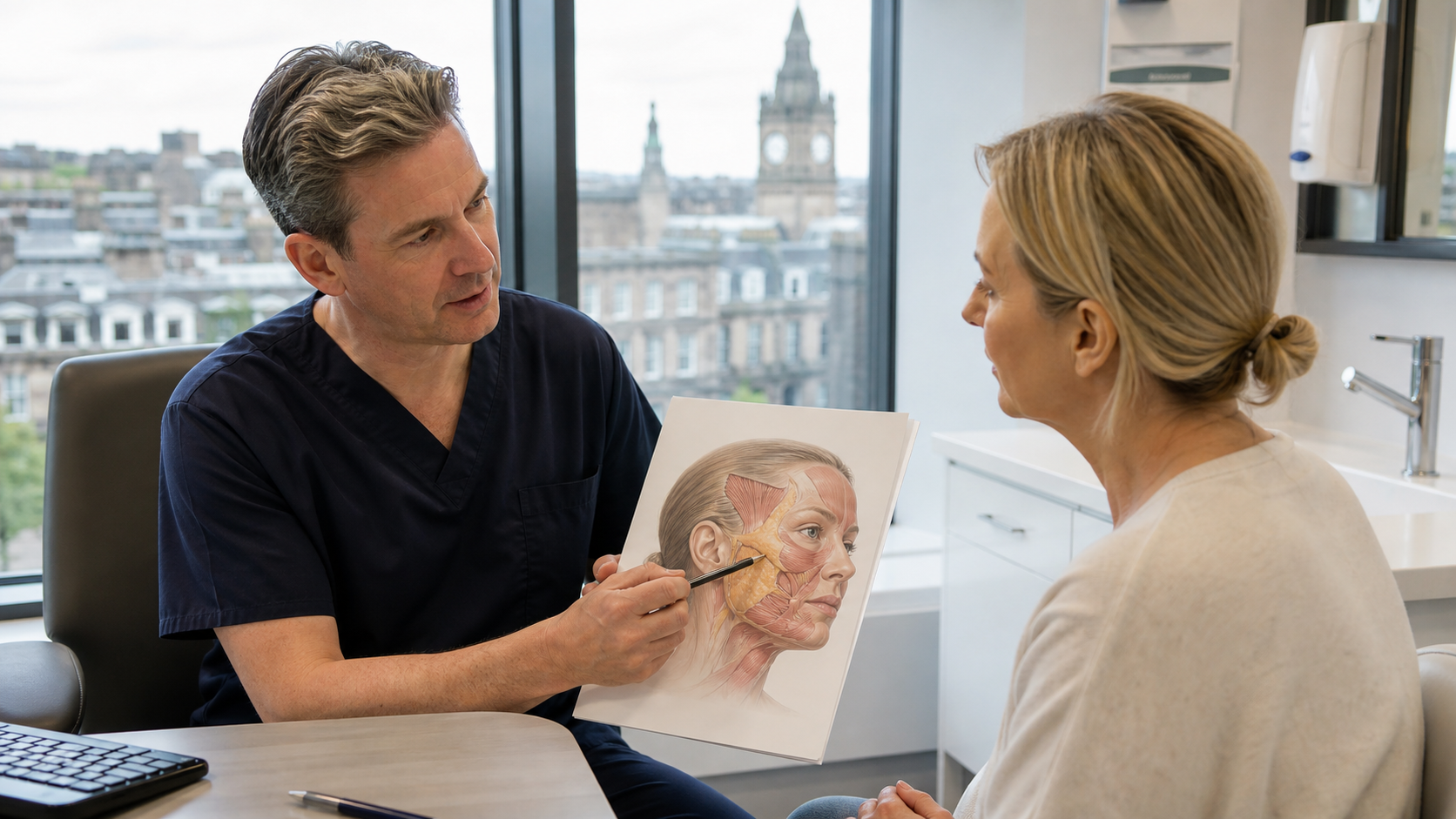
Full Facelift in Glasgow: Surgery, Costs, Recovery, and Choosing a Qualified Surgeon
Considering a full facelift in Glasgow involves much more than comparing before and after photographs or choosing a clinic based on price. A facelift, medically known as rhytidectomy, is an operation intended to reposition and reshape selected facial and neck tissues to address age related changes such as lower facial laxity, jowling, and loss of definition. The exact operation can differ significantly between surgeons and patients, and the term full facelift has no single universally standardised technical meaning. Anyone considering surgery in Glasgow should understand the proposed technique, surgeon’s credentials, hospital or clinic arrangements, anaesthesia, risks, recovery, aftercare, and complete financial commitment before consenting to treatment.
What Is a Full Facelift in Glasgow?
A full facelift generally refers to a comprehensive surgical approach to facial rejuvenation, often concentrating on the lower face and jawline and sometimes incorporating neck surgery. However, clinics can use the phrase differently.
A facelift does not automatically include eyelid surgery, a brow lift, fat transfer, skin resurfacing, or other cosmetic procedures.
The surgeon should specify precisely what their proposed operation includes.
What Can a Full Facelift Address?
Depending on anatomy and surgical plan, facelift surgery can address concerns such as:
• Jowling around the jaw
• Lower facial tissue laxity
• Loss of jawline definition
• Certain folds and contours affected by facial ageing
• Loose neck tissues when neck treatment is included
• Changes in facial soft tissue position
The operation cannot stop the biological ageing process.
What Does a Facelift Not Treat Well?
A facelift primarily addresses tissue position and laxity. It is not necessarily the best procedure for every cosmetic concern.
Fine surface lines, pigmentation, sun damage, certain scars, and skin texture may respond better to other appropriately selected treatments.
Volume loss can also require separate consideration.
Full Facelift Does Not Mean a Completely Different Face
Modern facial surgery generally aims to create an appropriate result for the patient’s anatomy rather than erase every sign of ageing.
The realistic objective and expected degree of change should be discussed during consultation.
7 Powerful Full Facelift in Glasgow Safety Insights
Cosmetic surgery is elective, but it remains surgery. These seven considerations can help prospective patients evaluate providers and treatment plans more carefully.
1. Choose a Properly Qualified Full Facelift Surgeon in Glasgow
In the UK, anyone considering facelift surgery should verify the surgeon’s professional credentials through official sources.
Doctors practising in the UK must be appropriately registered with the General Medical Council.
Check the GMC Register
The GMC medical register allows patients to confirm a doctor’s registration and relevant specialist information.
For cosmetic facial surgery, patients can ask about the surgeon’s specialist training and experience specifically performing facelifts.
Look Beyond the Title Cosmetic Surgeon
Marketing terminology alone does not establish specialist surgical training.
Ask:
• What specialist training has the surgeon completed?
• Are they on the relevant GMC Specialist Register?
• How frequently do they perform facelift surgery?
• Which facelift techniques do they routinely use?
• Where will the operation take place?
• Who provides anaesthesia?
Credentials should be independently verifiable.
Professional Memberships
Membership of recognised professional organisations can provide additional information about a surgeon’s background.
In the UK, organisations such as the British Association of Plastic, Reconstructive and Aesthetic Surgeons and the British Association of Aesthetic Plastic Surgeons are relevant to cosmetic plastic surgery.
Professional membership should complement rather than replace GMC verification.
2. Understand What Your Full Facelift in Glasgow Actually Includes
Full facelift is not a precise technical procedure name.
One clinic’s package can be significantly different from another’s.
Facelift Techniques Vary
A surgeon may discuss approaches involving:
• Skin repositioning
• SMAS treatment
• Deep plane techniques
• Neck contouring
• Fat management
• Other tissue specific methods
The best approach depends on individual anatomy, goals, previous surgery, health, and the surgeon’s clinical judgement.
What Is the SMAS?
SMAS stands for superficial musculoaponeurotic system, a layer of facial tissue relevant to many facelift techniques.
Contemporary operations may manipulate this layer in different ways rather than relying only on skin tightening.
Deep Plane Facelift
A deep plane facelift is a particular surgical approach involving dissection and repositioning at deeper anatomical levels.
It is frequently promoted online, but the name alone does not guarantee a superior outcome for every patient.
Surgeon experience, appropriate patient selection, anatomy, technique, and postoperative care all matter.
3. Have a Detailed Consultation Before Facelift Surgery
A consultation should be a medical assessment, not merely a sales appointment.
The surgeon needs to determine whether surgery is appropriate and whether expectations are realistic.
Medical History Matters
Be prepared to discuss:
• Medical conditions
• Previous operations
• Prescription medicines
• Over the counter medicines
• Supplements
• Allergies
• Smoking and nicotine use
• Alcohol use
• Previous facial procedures
• Anaesthesia history
• Healing or scarring problems
Provide complete and accurate information.
Discuss Your Goals Specifically
Statements such as wanting to “look younger” can mean different things.
Identify which features concern you most and ask what the operation is realistically expected to change.
A Good Consultation Can End With No Surgery
An ethical surgeon may recommend delaying surgery, choosing a different procedure, or not undergoing cosmetic treatment.
Not being offered an operation can be an appropriate medical outcome.
4. Understand Full Facelift Risks Before Consenting
Every surgical facelift carries risks.
A surgeon should discuss risks relevant to the planned procedure and individual patient.
Possible Facelift Complications
These can include:
• Bleeding
• Haematoma
• Infection
• Scarring
• Temporary or persistent altered sensation
• Delayed wound healing
• Skin compromise
• Hairline changes
• Asymmetry
• Anaesthetic complications
• Unsatisfactory cosmetic outcome
Other procedure specific complications are possible.
Facial Nerve Injury
Facial nerves are important anatomical structures during facelift surgery.
Nerve injury can affect facial movement, with outcomes ranging from temporary weakness to less common persistent problems.
A surgeon should explain the risk in the context of the planned procedure.
Haematoma Requires Prompt Attention
A haematoma is a collection of blood and is a recognised complication after facelift surgery.
Rapid swelling, significant pain, or other concerning postoperative changes require prompt communication with the surgical team according to the discharge instructions.
5. Plan Full Facelift Recovery Realistically
Recovery does not occur overnight.
Swelling and bruising are common after facial surgery, and the appearance changes as healing progresses.
Early Recovery
Patients may experience:
• Swelling
• Bruising
• Tightness
• Numbness
• Incision discomfort
• Temporary facial asymmetry from swelling
• Fatigue
The exact pattern varies.
Returning to Work
There is no universal point when every patient is ready to return to work.
The operation, individual healing, type of employment, visible bruising, and comfort all influence timing.
Social Recovery and Medical Recovery Are Different
Someone can feel well enough for normal light daily activities while still having visible swelling.
Likewise, a person who looks significantly better may still have internal healing underway.
Follow the surgeon’s restrictions rather than judging recovery purely by appearance.
Final Results Take Time
Facial tissues can continue settling after obvious bruising has resolved.
Do not judge the definitive result during the earliest stages of healing.
Your surgeon should explain the expected recovery timeline for the specific technique.
6. Compare Full Facelift in Glasgow Costs Carefully
There is no universal Glasgow facelift price.
Costs depend on procedure scope, surgeon, anaesthesia, facility, hospital stay, neck treatment, additional procedures, and aftercare.
What Should a Facelift Quote Include?
Ask whether the price covers:
• Surgeon fees
• Anaesthetist fees
• Hospital or theatre charges
• Preoperative assessment
• Prescribed postoperative care
• Follow up appointments
• Dressings
• Overnight stay when required
• Treatment of routine postoperative concerns
• Revision policy
Written pricing reduces misunderstandings.
Do Not Choose Surgery on Price Alone
Surgical skill, facility standards, medical oversight, aftercare, and complication management deserve greater weight than the cheapest quoted package.
Ask About Revision Costs
No surgeon can guarantee perfect symmetry or satisfaction.
Ask what happens if revision surgery is considered appropriate, including which fees are or are not covered.
7. Verify the Glasgow Facility and Aftercare Arrangements
The surgeon is only one part of safe operative care.
The procedure should take place in an appropriately regulated healthcare setting.
Healthcare Improvement Scotland
Independent healthcare services in Scotland can fall under regulation by Healthcare Improvement Scotland.
Patients can check applicable regulatory information for the clinic or hospital providing treatment.
Ask Where the Operation Will Take Place
Confirm:
• Facility name
• Regulation status
• Anaesthesia arrangements
• Recovery facilities
• Overnight arrangements if required
• Emergency procedures
• How complications are managed
• Who can be contacted after hours
This information should be available before you commit to surgery.
Aftercare Should Be Local and Accessible
Postoperative follow up is part of surgical treatment.
A patient recovering in Glasgow should know where they will be assessed if a wound, swelling, infection, bleeding, or other concern develops after discharge.
Who May Be Suitable for a Full Facelift in Glasgow?
Suitability is individual.
A patient’s age alone does not determine whether a facelift is appropriate.
Anatomy Matters More Than a Number
Surgical assessment considers skin and tissue laxity, facial structure, neck anatomy, overall health, expectations, and previous procedures.
Two people of the same age may receive entirely different recommendations.
General Health
Elective surgery places physiological demands on the body.
Medical conditions may require optimisation or additional evaluation before surgery.
Smoking and Nicotine
Nicotine can impair blood flow and wound healing, which is particularly relevant to procedures involving skin flaps.
Patients should disclose smoking, vaping, nicotine replacement, and other nicotine exposure to their surgeon.
Follow the surgeon’s specific preoperative instructions.
Full Facelift in Glasgow and Neck Lift Surgery
Facial and neck ageing often occur together.
For some patients, treating the lower face without addressing significant neck laxity can produce an imbalanced result.
What Does a Neck Lift Address?
Depending on anatomy, neck surgery may address:
• Loose skin
• Platysma related changes
• Selected fat deposits
• Loss of jaw and neck definition
The operation is individualised.
Is a Neck Lift Included?
Never assume it is.
Ask whether the quoted full facelift includes neck treatment and exactly what will be done.
Full Facelift Versus Mini Facelift
The term mini facelift is also not completely standardised.
It generally refers to a less extensive surgical procedure intended for selected patients.
Mini Facelift
Potential candidates may have more limited lower facial laxity and require a smaller intervention.
The exact incisions and tissue treatment vary.
Full Facelift
A more extensive procedure can address broader facial ageing patterns and may involve more substantial tissue repositioning.
Smaller Surgery Is Not Automatically Better
A limited procedure that cannot address the patient’s anatomy can produce disappointing results.
Conversely, more extensive surgery should not be recommended when a smaller intervention adequately matches the goals.
Full Facelift Versus Dermal Fillers
Fillers and facelift surgery solve different problems.
Dermal fillers add or alter volume. A facelift surgically repositions facial tissues.
Fillers Cannot Replicate Every Surgical Result
Adding excessive volume to compensate for substantial laxity can change facial proportions without addressing the underlying tissue descent.
Surgery Does Not Replace Every Filler Application
Some patients continue to have volume related concerns after otherwise successful surgery.
A surgeon can decide whether fat transfer, filler, or no additional treatment is appropriate.
Full Facelift Versus Thread Lift
Thread based procedures and surgical facelifts differ substantially in invasiveness, tissue manipulation, expected effect, and duration.
They should not be presented as equivalent treatments.
Ask About Evidence and Expectations
If a less invasive option is proposed, ask what degree of change it can realistically produce for your anatomy.
Choosing a nonsurgical treatment solely to avoid surgery may not be useful if it cannot address the primary concern.
Full Facelift Versus Skin Resurfacing
A facelift focuses principally on tissue position and contour.
Resurfacing techniques focus more on skin surface characteristics.
Skin Texture and Pigmentation
Laser resurfacing, chemical peels, or other treatments may be considered for selected surface concerns.
Combining treatments can change risk and recovery.
Combination Procedures Need Individual Planning
More procedures do not automatically produce a better outcome.
The surgeon should explain why each additional intervention is recommended.
Preparing for a Full Facelift in Glasgow
Preparation begins with medical instructions from the surgical team.
Generic online advice should not override those instructions.
Medication Review
Some medications and supplements can affect bleeding, anaesthesia, or recovery.
Do not stop prescribed medicine independently.
The surgeon or relevant prescribing clinician should advise on any necessary changes.
Arrange Transportation
Patients undergoing anaesthesia or sedation will generally need appropriate transport arrangements after discharge.
Driving restrictions should be discussed before surgery.
Prepare Home Support
Someone may need to stay with or assist the patient during early recovery depending on the procedure and clinical instructions.
Plan meals, medication collection, household responsibilities, and childcare before the operation.
What Happens on the Day of Facelift Surgery?
The exact process depends on hospital, surgeon, operation, and anaesthetic plan.
Patients generally undergo preoperative checks before entering theatre.
Anaesthesia
Facelift procedures can involve general anaesthesia or other approaches depending on the operation and surgeon.
An anaesthetist or appropriate clinician should explain the chosen method and relevant risks.
Surgical Incisions
Incisions are commonly planned around natural facial and ear contours, with patterns depending on technique.
Neck surgery can involve additional incisions.
Incision Location Should Be Discussed Beforehand
Ask the surgeon to show where scars are expected.
Hairline, ear anatomy, procedure type, and previous surgery can influence scar placement.
Scarring After a Full Facelift
Facelift surgery necessarily creates scars because incisions are required.
Surgeons generally position them strategically to make them less conspicuous after healing.
Scars Change Over Time
Early scars can look red, firm, or prominent before gradually maturing.
Individual scar formation varies.
Scar Complications
Some people are more prone to hypertrophic or keloid scarring.
Discuss personal or family history of problematic scars during consultation.
Recovery After a Full Facelift in Glasgow
The surgical team should provide written recovery instructions.
Follow them closely.
Early Postoperative Care
Instructions can address:
• Wound care
• Dressings
• Sleeping position
• Bathing
• Medications
• Activity
• Exercise
• Driving
• Follow up visits
• Warning symptoms
Do not substitute generic online schedules for your surgeon’s instructions.
Follow Up Appointments
Postoperative visits allow the surgical team to monitor healing and address concerns.
Attend them even if recovery appears normal.
Full Facelift Results and Longevity
Facelift surgery cannot permanently stop ageing.
The face will continue changing after surgery.
How Long Does a Facelift Last?
There is no exact number of years that applies to every person.
Longevity can be influenced by:
• Anatomy
• Skin characteristics
• Surgical technique
• Ageing
• Sun exposure
• Smoking
• Weight changes
• Genetics
• General health
Claims that every facelift lasts an identical period should be treated cautiously.
Maintaining Skin Health
Sun protection, appropriate skincare, avoidance of smoking, and general health measures can support skin health but cannot freeze facial ageing.
Potential Complications After Facelift Surgery
Patients should know which changes are expected and which require urgent attention.
The surgical team should provide personalised emergency instructions.
Contact the Surgical Team for Concerning Changes
Unexpected or rapidly worsening symptoms deserve prompt review.
Examples can include substantial swelling, worsening pain, wound problems, or signs of infection.
Emergency Symptoms
Severe breathing difficulty, loss of consciousness, significant chest symptoms, signs of stroke, or other medical emergencies require emergency care.
In the UK, emergency services can be reached by calling 999 or 112.
How to Research a Full Facelift in Glasgow
Start with independent professional and regulatory information rather than clinic advertising.
Useful UK Sources
Relevant sources can include:
• General Medical Council
• NHS information
• Healthcare Improvement Scotland
• BAAPS
• BAPRAS
These sources can provide information about professional registration, cosmetic surgery considerations, and regulated healthcare.
Read Clinic Reviews Carefully
Reviews can offer information about communication and patient experience, but they cannot establish surgical competence.
Before and After Photos Have Limits
Photographs can demonstrate a surgeon’s aesthetic style, but lighting, facial expression, angle, makeup, and image timing can alter apparent results.
Look for consistent photographic conditions.
Questions to Ask at a Full Facelift Consultation
A consultation should leave you with clear information rather than pressure to book.
Useful questions include:
• Are you on the relevant GMC Specialist Register?
• How frequently do you perform facelift surgery?
• Which technique do you recommend for me and why?
• Is neck surgery included?
• Where will surgery take place?
• Who will provide anaesthesia?
• What are my individual risks?
• Where will the scars be?
• What result is realistic?
• What is the expected recovery process?
• Who handles complications after hours?
• What is included in the total price?
• What is your revision policy?
Take time to consider the answers.
Red Flags When Choosing Facelift Surgery
Cosmetic surgery deserves careful decision making.
Certain practices justify additional scrutiny.
Potential Warning Signs
Be cautious of providers offering:
• Guaranteed outcomes
• High pressure same day booking
• Time limited pressure discounts
• Unclear surgeon credentials
• Unclear facility arrangements
• Minimal discussion of complications
• Surgery without an adequate assessment
• Vague aftercare arrangements
• Unclear pricing
• No explanation of alternative options
A provider should allow informed consideration.
Full Facelift in Glasgow Costs and Finance
Some private clinics provide finance options for cosmetic procedures.
Financing can make monthly payments smaller but does not make surgery less expensive overall.
Review the Total Financial Commitment
Check:
• Cash price
• Deposit
• Interest
• Total repayable amount
• Finance term
• Cancellation terms
• Refund policy
• Revision costs
• Additional procedure charges
Do not allow financing arrangements to create pressure to undergo treatment.
Frequently Asked Questions
What is a full facelift in Glasgow?
A full facelift in Glasgow is a surgical facial rejuvenation procedure that typically addresses lower facial laxity and may include neck treatment. Exact scope varies by surgeon.
How much does a full facelift in Glasgow cost?
Costs vary by surgeon, procedure, hospital, anaesthesia, neck treatment, additional procedures, and aftercare. Obtain a personalised written quote after consultation.
How long is recovery after a full facelift in Glasgow?
Recovery varies by surgical technique and patient. Bruising and swelling generally improve progressively, while deeper healing and final settling can continue longer.
How do I choose a facelift surgeon in Glasgow?
Verify the surgeon through the GMC, review relevant specialist registration and facelift experience, confirm the operating facility, and discuss complication and aftercare arrangements.
What are the risks of a full facelift?
Risks can include bleeding, haematoma, infection, scarring, altered sensation, delayed healing, asymmetry, nerve injury, anaesthetic complications, and an unsatisfactory cosmetic result.
Are full facelift results permanent?
No. Surgery can reposition facial tissues and create long lasting changes, but natural ageing continues and the duration of results varies among patients.
Conclusion
Choosing a full facelift in Glasgow requires careful consideration of anatomy, health, surgical technique, provider credentials, facility standards, risks, recovery, and aftercare. The term full facelift can describe different operations, so patients should obtain a precise explanation of the proposed surgery rather than comparing clinic names or prices alone. Verifying the surgeon through official UK sources and allowing adequate time for an informed consultation can provide a stronger foundation for deciding whether facial surgery is appropriate.