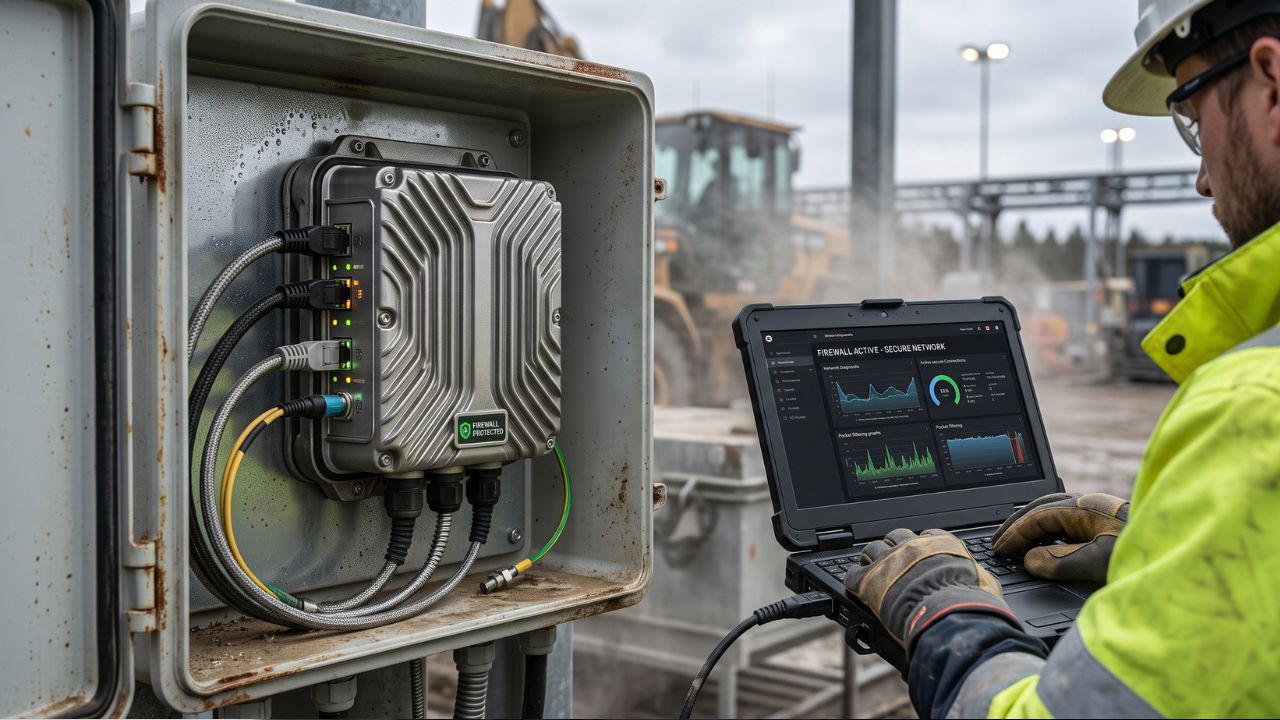
How a Ruggedized Firewall Protects Networks in Harsh Environments
A cabinet beside a railway line can spend July cooking in direct sun, then sit through months of vibration, brake dust, and damp winter air. Inside, the network equipment still has to pass control data, record events, and reject unwanted connections.
A standard office firewall may perform well on a “bench” but become the weakest component once installed. A Ruggedized firewall is built for jobs where cybersecurity depends partly on whether the hardware can survive tough conditions.
Security Starts With the Installation Site
Industrial security projects sometimes begin in the wrong room. The network team compares throughput and inspection features. But the site engineer is still working out:
- Cabinet temperature
- Available power
- Grounding
- Mounting space
Both conversations matter, but the second one can cancel the first.
Ruggedized Firewall Solutions for Industrial Networks are a strong option for factories, substations, transport infrastructure, mines, and remote utility sites. These sites face conditions that ordinary network appliances aren’t designed to endure.
The firewall controls traffic from a housing and hardware platform suited to wider temperature swings and persistent vibration, along with other site pressures.
A device approved for a sheltered production floor may be unsuitable for rolling stock or an outdoor cabinet. Check the stated operating temperature, humidity limits, shock and vibration ratings, power inputs, connector design, mounting method, and any certification required by the industry.
The actual enclosure is also crucial: a firewall rated for high ambient heat can still fail if unable to shed warmth.
Physical Failure Can Become a Security Failure
What happens after an ordinary firewall overheats at an unmanned pumping station? Remote visibility disappears. Engineers may lose access to logs and controls. If operations can’t wait for a replacement, someone may create a temporary bypass.
Temporary arrangements are remarkably good at surviving the incident that created them.
Industrial hardware attempts to eliminate familiar weaknesses. Fanless cooling avoids drawing dirty air through the appliance. Firm mounting resists continual movement. Also, locking connectors are less likely to come loose after thousands of small jolts.
Some sites use industrial DC supplies rather than the AC feed expected in an office. Dual inputs can keep a Ruggedized firewall running after one supply fails. This is true only when the two feeds don’t trace back to the same breaker.
Additionally, industrial-rated equipment, better enclosures, surge protection, and redundant power add to the project total. For a climate-controlled building, that spending may be unnecessary.
At a remote site, compare that cost with:
- Technician travel
- Restricted access
- Halted telemetry
These add to the operational pressure to reconnect equipment before proper security is restored.
Segmentation Shrinks the Damage Area
Old equipment is common in operational technology networks.
A controller may have run one process reliably for fifteen years. Replacing it could require a shutdown, application changes, safety testing, and regulatory approval. That leaves teams retaining devices that can’t run modern endpoint software or receive frequent patches.
A Ruggedized firewall can place a controlled boundary around those assets. Enterprise IT, supervisory systems, individual production cells, contractor connections, and safety-related networks shouldn’t automatically share unrestricted routes.
Policy can permit the communications required for production while refusing everything else.
Suppose a maintenance laptop needs to reach one controller using a defined industrial protocol. Don’t give it access to every other controller in the building because broad rules are easier to configure.
In fact, the Cybersecurity and Infrastructure Security Agency’s guidance for operational technology advises organizations to remove unintended internet exposure, separate IT and OT environments, and control data exchanged between them.
Blocking first and investigating later can stop production. Observe the traffic before writing the final policy.
Inspection Should Match Operational Consequences
Don’t enable every inspection feature on day one because industrial traffic isn’t ordinary business traffic. Some older equipment behaves badly when delays or connection patterns change.
Begin with a baseline. Record which systems communicate, the protocols involved, normal timing, and the commands capable of altering a physical process.
Obvious violations can be blocked early. However, less familiar exchanges may need monitoring through a full production cycle.
The NIST Guide to Operational Technology Security treats safety, reliability, and performance as core constraints for OT security decisions. It’s a “counterweight” to the temptation to apply the strictest setting everywhere.
Depending on the protocol and appliance, the firewall may distinguish routine status polling from commands that change equipment behavior. Visibility has limits, while encryption, proprietary protocols, undocumented traffic, or legacy devices can hide context.
So firewall logs must be read alongside asset records and process knowledge.
Remote Support Has Stipulations
A failed production machine late at night creates poor conditions for careful access control. The vendor wants immediate connectivity, the shift supervisor wants the line moving, and a shared account is close at hand.
In such a scenario, a Ruggedized firewall can terminate an encrypted remote connection on-site. It can then restrict the person connecting to an approved asset, service, and time window. Also, individual accounts and multifactor authentication make the record more useful.
Before authorizing remote work, verify that:
- No controller or management page is exposed directly to the internet
- The account expires after the approved maintenance period
- Logs are copied away from the remote appliance
- Operations staff know what to do if the connection drops mid-change
- The vendor can reach the assigned machine
Test Recovery More Than Performance
A proof of concept should resemble the planned deployment. Enable the inspection functions that will actually run.
Interrupt one power feed. Disconnect the wide-area link and confirm that logs are retained. Restore a saved configuration onto replacement hardware. Try management over a slow connection rather than the clean laboratory network.
Pay attention to details: Can a technician identify the correct cable in a crowded cabinet? Can the unit be replaced without dismantling neighboring equipment? Are spare power connectors available?
A Ruggedized firewall doesn’t compensate for careless segmentation, permanent contractor access, or an untested recovery plan. Its contribution is narrower, as it keeps the enforcement point operating where ordinary hardware may falter.
In a harsh environment, once the appliance goes dark, visibility and control can go with it. That’s when an inexpensive hardware decision starts appearing in the business-risk column.