Is Basement Finishing Worth It? A Complete Cost, Value and Decision Guide
For most homes, the basement is the single largest block of unused space on the property, and the question of what to do with it eventually comes up in every household. Is basement finishing worth it is really several questions folded into one: what will it cost, what will it add to the home’s value, how much will my family actually use it, and is there a better way to get more living space. The honest answer is that in most cases finishing a basement is one of the most efficient ways to gain usable square footage, but whether it is worth it for your specific home depends on a handful of factors this guide walks through in detail. From costs and resale value to the signs that finishing your basement beats building an addition, here is how to answer the question for your own home.
Why the Basement Is the Most Efficient Space You Own
Before weighing cost and value, it helps to understand why the basement is structurally different from every other improvement you could make.
An unfinished basement already exists. The foundation, the floor, the exterior walls, and the roof above are all in place, which means finishing it is a conversion of space you already own rather than the creation of new space. This is why basement finishing is consistently less expensive per square foot than building an addition, where every square foot must be built from the ground up, and why it is usually faster and less disruptive as well.
That efficiency has a direct consequence for the “worth it” question. When the goal is simply more usable room, a family room, a guest area, a gym, a home office, or a place for kids to spread out, the basement is frequently the clearest path, because the structure is already there and the project is contained to a part of the house the rest of the family can continue living in.
What a Finished Basement Actually Costs
The first half of any worth-it calculation is cost, and while every project is different, the drivers are consistent.
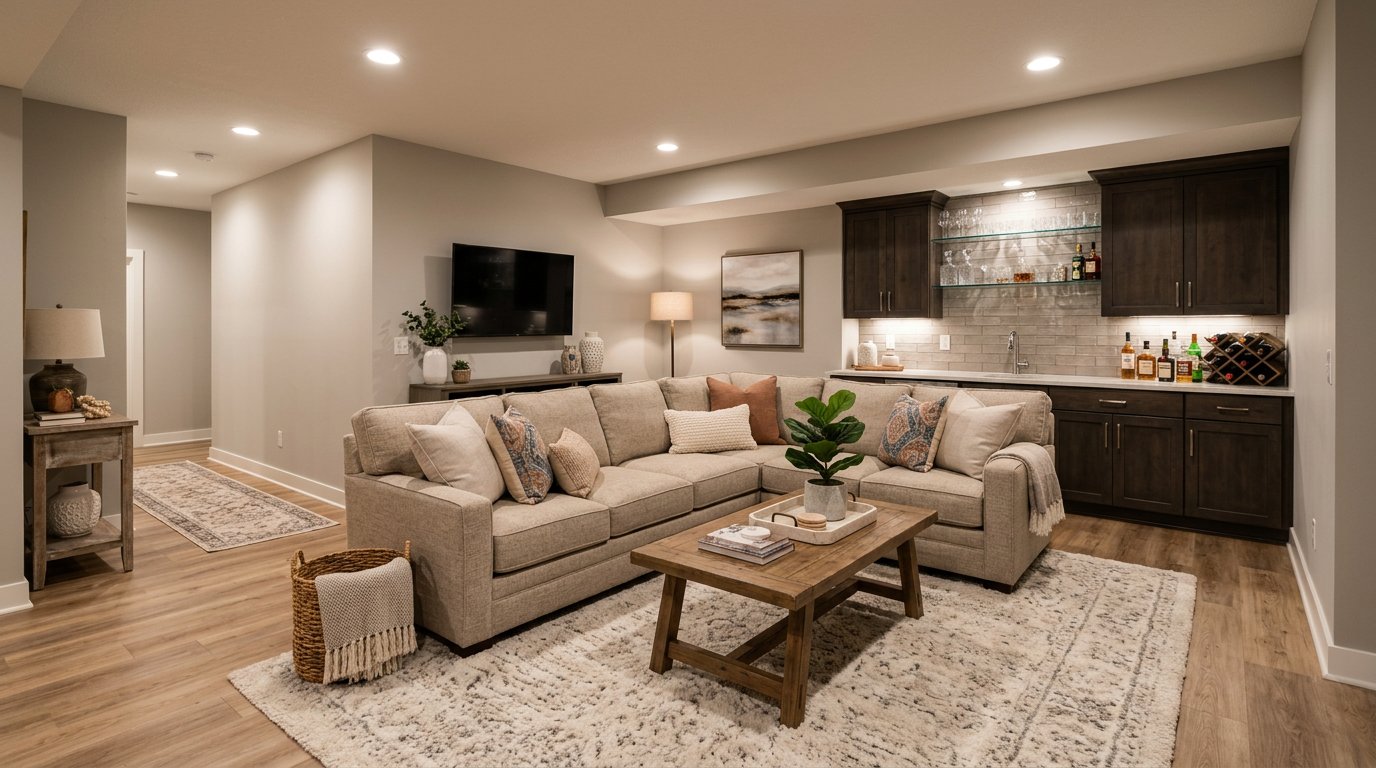
Basement finishing typically costs less per square foot than above-grade additions, but the total still depends heavily on scope. A simple, open lower-level family room with basic finishes sits at one end of the range. Adding a full bathroom, a wet bar, custom cabinetry, or specialty spaces such as a home theater or golf simulator moves the project toward the other end, because each of those features brings plumbing, electrical, framing, and finish work of its own.
The condition of the existing basement matters as much as the ambition of the plan. An older home may need moisture remediation, insulation, waterproofing, or ceiling-height adjustments before finishing work can begin, and those hidden steps are where budgets often grow. A design-build contractor who plans the full scope from the start, including permits, mechanicals, and finish details, will give a more reliable number than one who prices only the visible work.
Because costs vary so widely by region and scope, the practical approach is to get an itemised estimate from a contractor who has walked the space, and to budget a contingency for the conditions that only reveal themselves once walls are opened.
What a Finished Basement Adds to Your Home
The value side of the question has two distinct parts, and they are often conflated.
The first is everyday value, and it is the one homeowners actually feel. A finished basement changes how a family lives: it absorbs the home theater, the workout space, the guest bedroom, the playroom, and the hobby zone that would otherwise crowd the main floors. That daily utility is real value, even though it does not appear on an appraisal.
The second is resale value. A finished, functional lower level generally improves a home’s marketability, because buyers respond to usable square footage and finished, intentional spaces. What a basement returns at resale, however, depends on the quality and finish level of the work and the expectations of the local market. A well-executed finish that reads as connected to the rest of the house performs differently from a cheaply finished space that feels like an afterthought, which is why craftsmanship and integration matter even when the goal is eventually to sell.
The balanced way to think about it is this: finishing a basement is rarely the highest-percentage resale investment a homeowner can make, but it is one of the best combinations of daily enjoyment and long-term value available, because you get to live in the benefit before any buyer ever sees it.
When Basement Finishing Beats an Addition
The worth-it question is really a comparison, and the most common comparison is against building an addition, which is the clearest signpost in the decision.
Finishing the basement usually wins when the need is for space that does not require natural light or above-grade placement. A media room, a gym, a playroom, an office, a guest suite, a bar, and most recreation space all function perfectly well below grade, and building them within the existing footprint avoids the cost, permits, and site disruption of expanding outward.
An addition tends to win when the project genuinely needs daylight, views, or a ground-level connection, such as a larger kitchen, a main-floor primary suite, or a space meant to open onto the yard. Those are needs the basement cannot meet no matter how well it is finished.
Rite-Way Custom Homes, a design-build firm in Glen Ellyn, Illinois, frames the decision in exactly these terms: basement finishing often makes sense for homeowners who need more room but want to work within the footprint they already have, while a luxury home addition is the better path for projects that require more above-grade square footage. Knowing which need you actually have is the fastest way to resolve the worth-it question.
The Most Popular Ways to Finish a Basement
One of the strongest arguments for finishing a basement is flexibility, and the range of what the space can become illustrates the point.
Home theaters and entertainment rooms are among the most requested, taking advantage of the basement’s natural darkness and separation from the rest of the house. Wet bars and wine storage turn the lower level into a destination for entertaining, while a dedicated home gym or wellness space supports routines without occupying a bedroom or the garage.
Guest suites with a bedroom and bathroom are a recurring favourite for families who host visitors or anticipate multi-generational living. A home office in the basement offers the quiet and separation that remote work benefits from. Golf simulator rooms have become a notable request in recent years, as have game rooms, playrooms, and casual family lounges where kids and their friends can spread out.
Rite-Way’s portfolio reflects this same range: the firm has built home theaters, golf simulators, wine cellars, wet bars, home gyms, game rooms, lower-level family spaces, guest suites, bedrooms, and full bathrooms, each designed to feel intentional and connected to the rest of the home rather than like a converted storage room.
The Factors That Determine Whether It Is Worth It for You
Because the answer to “is basement finishing worth it” is specific to the house and the household, a few checks resolve the question quickly.
The first is the condition of the space. Ceiling height, moisture, and the state of the foundation and walls determine how much preparation the project needs before finish work can begin. A dry, high-ceilinged basement is a fundamentally different proposition from a damp, low one.
The second is how you will actually use it. The most reliable predictor of a project’s worth is whether it serves a named, recurring need, a guest suite you host visitors in, a gym you use, an office you work from, rather than a vague hope of future value. Space built for a real habit gets used, and used space justifies its cost.
The third is the finish standard. A basement finished to the same standard as the floors above adds value in a way a lower-grade finish does not, so if the budget only allows a rough conversion, it may be better to wait than to do the work twice.
The fourth is the local market. In areas where finished lower levels are common, an unfinished basement is a competitive disadvantage at resale; in areas where they are rare, the return is harder to predict. A local contractor who knows the market can tell you which situation you are in.
Working With a Design-Build Contractor
The contractor model matters more in a basement than in many other projects, because the scope touches framing, electrical, plumbing, insulation, and finish work at once.
A design-build firm handles planning and construction under one roof, which keeps the design aligned with the build from the start and reduces the miscommunication that arises when a designer and a builder work from separate assumptions. For a basement, where the existing conditions drive so many decisions, that continuity is genuinely valuable.
Rite-Way Custom Homes describes its approach in these terms: a design-build process that keeps planning, materials, construction, and finishing aligned from the beginning, handling the full scope from early planning and permits through trim work, cabinetry, lighting, and final finish details. The firm works with homeowners in Glen Ellyn, Illinois and nearby Wheaton, and it pairs basement finishing with broader capabilities in custom home building, kitchen remodeling, bathroom remodeling, and luxury additions, which matters when a basement project turns out to be part of a larger renovation.
Getting the Most From Your Finished Basement
If you decide to proceed, a few choices protect the value of the investment.
Address moisture and insulation first, before any finish work. A beautiful basement built over an unaddressed moisture problem will not stay beautiful, and the money spent on remediation is the cheapest insurance the rest of the project has.
Design for the future use, not the current one. A space built for a young family’s playroom should be able to become a teen lounge or a guest suite later, and good basements are planned with that flexibility in mind rather than built rigidly around a single stage of life.
Invest in the details that make a below-grade space feel like part of the home: lighting layers, ceiling treatment, finish materials, and a consistent style with the floors above. These are the choices that separate a finished basement from a finished-looking one.
And resist the temptation to finish the entire footprint at once if the budget is tight. Finishing in phases, starting with the space you will use first, is a legitimate way to get the benefit without compromising the standard of the work.
Conclusion
Is basement finishing worth it? For most homeowners, the answer is yes, and for a specific reason: it converts space you already own into living space you will actually use, at a lower cost per square foot than almost any alternative. It is not the right answer for every home, and it is not automatically the best resale investment in every market, but its combination of daily utility, flexibility, and long-term value is difficult to match, especially when the alternative is an addition the home does not truly need. The decision comes down to the condition of your basement, the reality of how you will use it, and the standard at which you are willing to finish it. For homeowners in Glen Ellyn and nearby Wheaton, a design-build firm such as Rite-Way Custom Homes can assess those factors directly and turn an unfinished lower level into the most valuable square footage the home has.
Frequently Asked Questions
1. Is finishing a basement worth the money?
In most cases yes, because it adds usable living space within the home’s existing footprint at a lower cost per square foot than building an addition.
2. How much does it cost to finish a basement?
Costs vary widely by size, scope, and the condition of the space, with features like bathrooms, wet bars, and theaters adding significantly; an itemised estimate is essential.
3. Does a finished basement increase home value?
A well-finished lower level generally improves marketability and value, though the return depends on finish quality and local buyer expectations.
4. Is finishing a basement better than adding on to a house?
It usually is when the need is for space like a media room, gym, office, or guest suite; an addition is better when the project requires natural light or above-grade placement.
5. What can you include in a finished basement?
Common inclusions are family rooms, home theaters, wet bars, game rooms, guest suites with bathrooms, gyms, offices, golf simulators, and storage.
6. Can a finished basement have a bathroom or wet bar?
Yes, bathrooms and wet bars are common in basement projects and make the lower level more comfortable and self-sufficient for guests and entertaining.