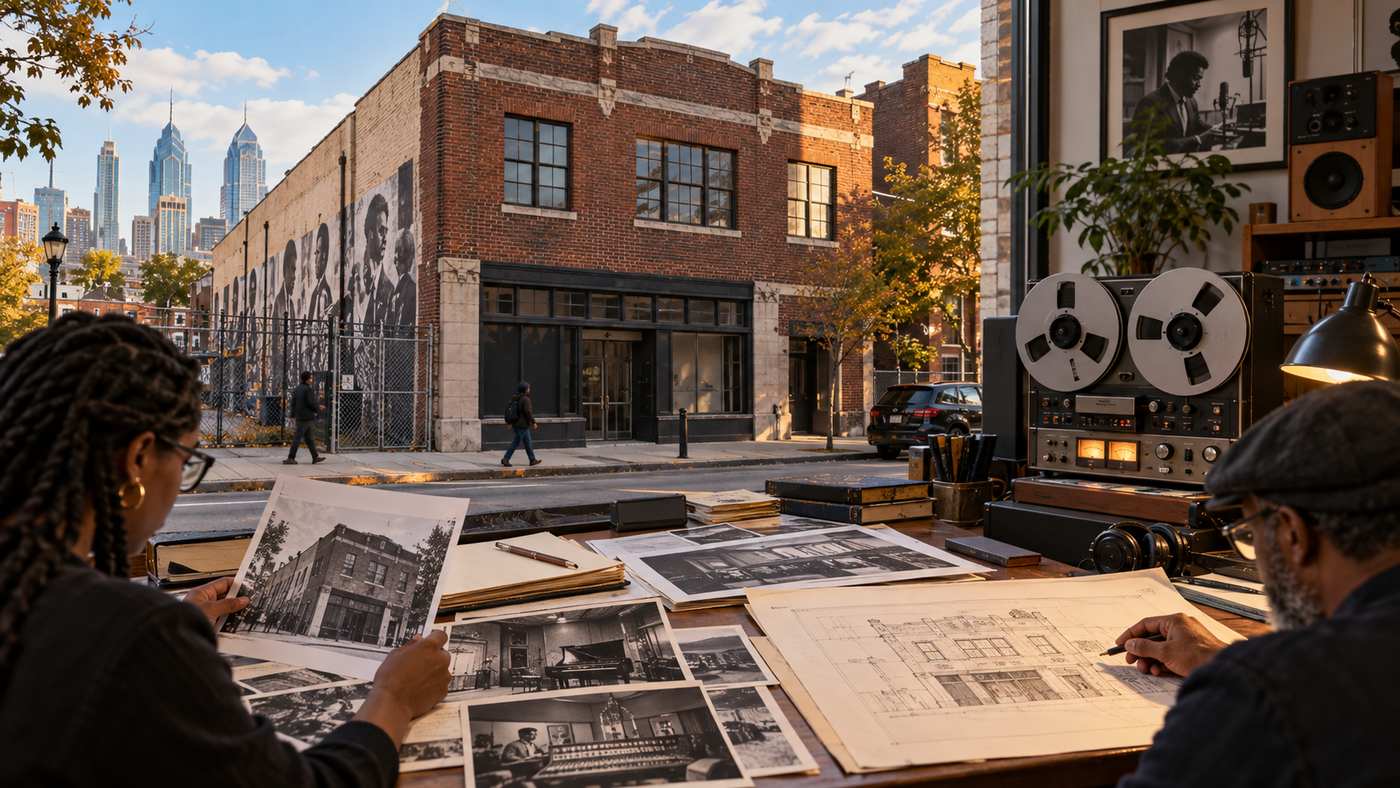
Nomination Document: Understanding the Historic Legacy of Sigma Sound Studios
A nomination document can be much more than an administrative form. When a historically important building is considered for inclusion on a local historic register, the document can bring together architectural details, ownership history, photographs, maps, cultural context and evidence explaining why the property deserves protection. The Philadelphia Historical Commission’s nomination for 210–12 N. 12th Street is an especially compelling example because the modest brick building was once home to Sigma Sound Studios, one of the most important recording studios in Philadelphia’s music history. City of Philadelphia
The official nomination identifies the resource as Sigma Sound Studios and places it at 210–12 N. 12th Street in Philadelphia’s 19107 ZIP code. It records a period of significance extending from approximately 1935 through 2013, names architect Charles E. Oelschlager, identifies Benjamin Alexander as the original owner and lists recording engineer Joe Tarsia among the significant people associated with the property. City of Philadelphia
Yet the strongest argument for preservation was cultural rather than architectural.
From this relatively unassuming Philadelphia building emerged recordings that helped define the internationally influential style known as Philly Soul or the Sound of Philadelphia.
What Is a Nomination Document?
A historic nomination document is the body of evidence submitted to support the designation of a building, structure, site, district or object as historically significant.
In Philadelphia, anyone may nominate a property to the Philadelphia Register of Historic Places, and owner consent is not required for the Historical Commission to consider designation. A property must satisfy at least one of the city’s established criteria for historic designation. City of Philadelphia
A typical nomination may contain:
- Official property address
- Historic and current names
- Property type
- Physical description
- Boundary information
- Construction date
- Architect or designer
- Historic photographs
- Statement of significance
- Bibliographical references
- Applicable designation criteria
These elements allow historians, commissioners, property owners and members of the public to evaluate the significance of a resource based on documented evidence.
1. The Sigma Sound Studios Nomination Document Identifies a Remarkably Important Building
The subject property is located at 210–12 N. 12th Street in Center City Philadelphia.
The nomination describes it as a two-story, flat-roofed, brick-clad commercial loft building occupying a roughly 36-by-95-foot parcel at the northwest corner of North 12th and Spring Streets. City of Philadelphia
Architect Charles E. Oelschlager designed the building in 1930 as a store and storage facility for real estate developer Benjamin Alexander, although construction appears to have been delayed until approximately 1935. City of Philadelphia
Architecturally, the property is relatively restrained.
Its 12th Street elevation includes:
- Tan brick
- A symmetrical window arrangement
- Brick piers
- Brick spandrel panels
- Limestone detailing
- A historic North 12th Street marker
The building was not nominated because it looked like a grand theater, mansion or monumental civic building.
Its significance came primarily from what happened inside.
That distinction demonstrates an important principle in historic preservation: an ordinary-looking building can possess extraordinary cultural value.
2. Sigma Sound Studios Became the Birthplace of the Sound of Philadelphia
The nomination describes Sigma Sound Studios as one of the most innovative and influential American recording studios of the late twentieth century.
Sound engineer Joseph “Joe” Tarsia founded Sigma Sound Studios in 1968 after building experience in Philadelphia’s recording industry. City of Philadelphia
The studio became closely associated with the emerging musical style now known as:
Philly Soul
or
The Sound of Philadelphia.
The nomination characterizes this music as a fusion involving soul, gospel, rhythm and blues, jazz, funk and classical influences. City of Philadelphia
Its defining characteristics often included:
- Lush orchestration
- Strong rhythm sections
- Sophisticated arrangements
- Strings and horns
- Soulful vocals
- Highly polished production
The result was a distinctive sound that became enormously influential during the late 1960s and 1970s.
3. The Nomination Document Connects Sigma to Legendary Producers
Historic significance becomes stronger when a building can be connected to influential people and events.
Sigma Sound Studios had many such connections.
One of the most important relationships involved songwriters and producers Kenny Gamble and Leon Huff.
After Sigma opened, the studio became an important recording facility for their work. Gamble and Huff later founded Philadelphia International Records in 1971. City of Philadelphia
Another major figure was producer, arranger and songwriter Thom Bell.
Together, the work of Gamble, Huff and Bell helped transform Philadelphia into a major center of American soul music.
The nomination explains that Tarsia had already worked with emerging Philadelphia talent during his earlier career at Cameo-Parkway Records. When that company declined, he recognized the potential of Philadelphia’s developing soul scene and established his own independent recording studio. City of Philadelphia
Joe Tarsia’s Role
Tarsia was far more than a businessman providing studio space.
He was a sound engineer.
The technical quality and recording environment developed at Sigma became part of the studio’s identity.
The nomination traces Tarsia’s recording career back to the late 1950s and his work with Philadelphia labels before Sigma opened. City of Philadelphia
That experience gave him both technical knowledge and strong connections within the city’s music industry.
4. Major Records Were Created at Sigma Sound Studios
The historic case becomes particularly compelling when considering the music associated with the building.
The nomination identifies numerous important recordings produced at Sigma.
Among the best-known examples are recordings by:
- The O’Jays
- Harold Melvin and the Blue Notes
- Billy Paul
- The Stylistics
- The Spinners
- Lou Rawls
- The Delfonics
The document specifically identifies major Sigma-recorded songs associated with the Sound of Philadelphia, including work by these artists during the 1960s and 1970s. City of Philadelphia
The studio’s significance therefore extends beyond local Philadelphia history.
It forms part of the wider story of American popular music.
Sigma’s House Musicians
Another essential part of the studio’s identity was the collective known as MFSB.
The nomination describes the group as a large studio ensemble that included accomplished Philadelphia musicians and contributed to Sigma’s distinctive orchestral sound. City of Philadelphia
These musicians created the instrumental foundation heard across numerous Philadelphia Soul recordings.
The combination of:
- Skilled session musicians
- Innovative producers
- Songwriters
- Arrangers
- Recording engineers
turned Sigma into an unusually productive creative environment.
5. International Artists Also Recorded at Sigma
Sigma Sound Studios was not limited to Philadelphia-based artists.
Its reputation brought nationally and internationally known musicians into the facility.
The historic nomination identifies artists associated with Sigma including:
- David Bowie
- Stevie Wonder
- B.B. King
- Wilson Pickett
- The Jacksons
- Robert Palmer
- Dusty Springfield City of Philadelphia
This demonstrates how Sigma moved from being a local studio to becoming part of the international recording industry.
Why This Strengthens Historic Significance
Historic designation usually requires more than nostalgia.
The nomination has to establish why a particular resource matters within a broader historical context.
Sigma provides unusually strong evidence because the building can be directly connected with:
- A distinctive musical movement
- Influential producers
- Important recording technology
- Nationally significant musicians
- Philadelphia’s cultural economy
The physical building became a place where creative and technical developments converged.
6. The Nomination Relied on Philadelphia’s Criteria A and J
Philadelphia uses several criteria when evaluating properties for historic designation.
The Sigma nomination argued primarily that the property qualified under Criteria A and J. City of Philadelphia
Criterion A
Criterion A applies to properties that possess significant character, interest or value in the development, heritage or cultural characteristics of the city, Commonwealth or nation, or that are associated with significant people from the past. City of Philadelphia
Sigma’s connection with influential musicians, engineers and producers provided strong support for this criterion.
Criterion J
Criterion J concerns resources that exemplify the cultural, political, economic, social or historical heritage of a community. City of Philadelphia
The nomination argued that Sigma represented Philadelphia’s musical and entertainment history as well as a neighborhood once populated by businesses connected with film, recordings and entertainment services. City of Philadelphia
The Committee on Historic Designation concluded that the nomination demonstrated both criteria.
7. The Nomination Document Ultimately Supported Historic Designation
A nomination is not the same thing as final designation.
It begins an official review process.
For Sigma Sound Studios, that process eventually resulted in formal protection.
On November 13, 2020, the Philadelphia Historical Commission voted to find that 210–12 N. 12th Street satisfied Criteria A and J and to designate the property as historic. The motion passed unanimously. City of Philadelphia
The Philadelphia Register subsequently records November 13, 2020 as the designation date for Sigma Sound Studios at 210–12 N. 12th Street. City of Philadelphia
This distinction is important.
The PDF itself documents the case for preservation.
The later Commission action represents the official decision.
The Building Before Sigma Sound Studios
The nomination traces the property to the Depression-era period.
Although Oelschlager prepared the design around 1930, the building was probably completed around 1935. City of Philadelphia
The property originally functioned as a commercial building rather than a purpose-built world-famous recording studio.
This makes its later history particularly interesting.
Historic buildings frequently change uses over time.
A structure constructed for an ordinary commercial purpose can acquire extraordinary significance because of later occupants.
A Former Recording Studio Already Existed There
Before Tarsia established Sigma, part of the property had housed another recording operation known as Reco-Art.
The nomination states that Tarsia leased a former recording studio at 212 N. 12th Street in late 1967 and rebuilt it using a custom-designed recording console. City of Philadelphia
Sigma officially opened on August 5, 1968.
Within only a few years, the facility was producing important albums for prominent soul performers. City of Philadelphia
Why Philadelphia Became Important to American Soul Music
Sigma’s story is inseparable from Philadelphia’s broader music history.
The city had already developed strong traditions in:
- Sheet music
- Radio
- Recording
- Rhythm and blues
- Doo-wop
- Rock and roll
The nomination explains that Philadelphia’s earlier recording industry helped establish the creative and technical foundation from which the Sound of Philadelphia later emerged. City of Philadelphia
Cameo-Parkway and American Bandstand
Joe Tarsia previously worked for Cameo-Parkway, another important Philadelphia music company.
The city’s music industry also benefited from the enormous influence of American Bandstand, which connected Philadelphia performers and records with national audiences. City of Philadelphia
When the local music industry changed during the 1960s, Sigma represented the next major chapter.
Rather than copying earlier Philadelphia sounds, producers working there helped create something new.
The Sound of Philadelphia Became an International Style
Philadelphia Soul influenced music far beyond Pennsylvania.
Its polished orchestration and dance-oriented rhythms contributed to developments in:
- Soul
- R&B
- Disco
- Pop
- Dance music
The nomination directly connects Sigma to the transformation of Philadelphia into one of America’s major soul-music centers during the 1970s. City of Philadelphia
This is why preserving the physical studio building matters.
Recorded music itself may survive digitally or on vinyl, but historic places provide tangible connections to where cultural movements actually happened.
Sigma Sound Studios and Soul Train
One example of Sigma’s cultural reach involved Soul Train.
According to the nomination, Sigma’s house musicians MFSB recorded music associated with the nationally influential television program during the 1970s. City of Philadelphia
This relationship helped connect Philadelphia’s studio musicians with a nationwide television audience.
The Sound of Philadelphia was therefore not limited to record buyers.
It entered American popular culture through radio, television, dance and entertainment.
Why Historic Nomination Documents Matter
A good nomination document serves several purposes.
It Preserves Research
Buildings can be altered.
Companies close.
People pass away.
Historic documentation preserves information that might otherwise disappear.
It Establishes Context
Knowing that a building is old is not enough.
The document explains:
- Who used it
- What occurred there
- Why those events mattered
- How the property fits into broader history
It Supports Public Decision-Making
Commissioners need evidence when considering historic designation.
Research allows decisions to be based on documented significance rather than public sentiment alone.
It Creates a Permanent Historical Resource
Even people who never visit the building can study a nomination decades later.
Philadelphia currently maintains historic nominations and register information as part of its public preservation records. City of Philadelphia
What Happens After a Property Is Designated?
In Philadelphia, a property added to the Philadelphia Register of Historic Places becomes subject to Historical Commission review for relevant building permit applications. City of Philadelphia
Historic designation does not necessarily mean a building can never change.
Instead, alterations affecting protected historic resources may require preservation review.
This allows historic properties to continue evolving while giving the city a formal process for considering changes that could affect significant characteristics.
Was Sigma Sound Studios Already Recognized Before the City Nomination?
Yes.
The nomination notes that the former studio received an official Pennsylvania state historical marker in 2015. City of Philadelphia
The later Philadelphia nomination provided another level of recognition.
The two actions serve related but different purposes.
A historical marker communicates significance to the public.
Local historic designation can also affect how future physical changes to the property are reviewed.
Why Music Studios Deserve Historic Preservation
Traditional historic preservation once concentrated heavily on:
- Famous houses
- Government buildings
- Churches
- Major architecture
Modern preservation increasingly recognizes cultural places whose significance comes from the people, communities and creativity associated with them.
Recording studios are excellent examples.
Their architectural exteriors may appear ordinary.
Yet inside those spaces, cultural history was created.
Sigma’s nomination illustrates this idea especially well.
The two-story brick building became historically significant because engineers, musicians, producers and songwriters used it to create recordings that shaped American music.
What Researchers Can Learn From This Nomination Document
The Sigma Sound Studios file is valuable beyond the designation itself.
Students, music historians, preservationists and researchers can use it to study:
- Philadelphia music history
- Recording technology
- Historic architecture
- Cultural preservation
- Urban entertainment industries
- Philadelphia Soul
- Joe Tarsia
- Gamble and Huff
- Thom Bell
- Historic designation procedures
Its photographs are particularly useful because they document changes to the property across different periods.
The PDF also brings together sources that might otherwise require substantial independent research.
The Difference Between Architectural and Cultural Importance
Sigma Sound Studios demonstrates why these concepts should not be confused.
A property does not necessarily need exceptional architectural ornamentation to possess extraordinary historic value.
The nomination describes the building as a commercial loft structure with relatively restrained architectural characteristics. City of Philadelphia
Its cultural associations, however, are exceptional.
The site is directly connected with:
- A major American musical genre
- Internationally known performers
- Important producers
- Recording innovation
- Philadelphia’s twentieth-century cultural history
That combination made the case for historic designation particularly strong.
Frequently Asked Questions
What is a nomination document for a historic property?
A nomination document is a researched submission explaining why a building, site, structure or object qualifies for historic designation. It normally includes history, architecture, photographs, boundaries and designation criteria.
What property does this nomination document cover?
The document covers the former Sigma Sound Studios at 210–12 N. 12th Street in Philadelphia, Pennsylvania. City of Philadelphia
Why is Sigma Sound Studios historically important?
Sigma was a major recording center associated with the creation and development of Philly Soul or the Sound of Philadelphia and hosted numerous influential musicians and producers. City of Philadelphia
When did Sigma Sound Studios operate at the property?
Joe Tarsia opened Sigma Sound Studios there in 1968, and the nomination records the studio’s association with the property through its closure in 2013. City of Philadelphia
Was Sigma Sound Studios officially designated historic?
Yes. The Philadelphia Historical Commission unanimously designated the property on November 13, 2020, under Criteria A and J and listed it on the Philadelphia Register of Historic Places. City of Philadelphia
What Philadelphia historic-designation criteria did Sigma satisfy?
The property was designated under Criteria A and J, recognizing both its important cultural associations and its role in the cultural, economic, social and historical heritage of the community. City of Philadelphia
Conclusion
The Sigma Sound Studios nomination document demonstrates how careful historical research can reveal extraordinary cultural significance behind an otherwise modest urban building. From 210–12 N. 12th Street, musicians, producers and engineers helped create the Sound of Philadelphia and influenced popular music far beyond the city. The 2020 historic designation ensures that this connection is formally recognized, while the nomination itself remains a valuable record of the people, architecture and musical history that made Sigma Sound Studios important
