Ventilation System: 7 Powerful Benefits for Healthier and More Comfortable Buildings
Maintaining a comfortable indoor environment involves more than controlling temperature. Homes, offices, and commercial properties also need a reliable supply of fresh outdoor air and effective removal of stale air, excess moisture, and indoor pollutants. A properly designed ventilation system plays an important role in creating healthier, more comfortable, and energy-conscious indoor spaces by managing how air enters, moves through, and leaves a building.
Indoor air can contain pollutants from cooking, cleaning products, building materials, furniture, everyday activities, and outdoor sources. Without sufficient ventilation, these substances may accumulate, especially in tightly sealed buildings designed to conserve energy.
Modern ventilation technology offers several ways to improve air exchange while limiting unnecessary heating and cooling losses. From simple exhaust fans to sophisticated whole-house heat recovery systems, different solutions are available for residential and commercial applications.
Understanding how ventilation works, which systems are available, and what factors affect performance can help property owners make informed decisions about indoor air quality and long-term building maintenance.
What Is a Ventilation System?
A ventilation system is a combination of equipment, air passages, and controls designed to introduce outdoor air into a building and remove indoor air.
Its main purpose is to provide an appropriate exchange of indoor and outdoor air, helping dilute contaminants and remove pollutants generated inside a property.
Ventilation can occur naturally through windows and other openings or mechanically through fans, ducts, and dedicated air-handling equipment.
In some buildings, natural and mechanical ventilation are used together.
How Does a Ventilation System Work?
Mechanical ventilation uses fans to move air into, out of, or through occupied spaces.
Depending on the system design, outdoor air may enter through dedicated intakes, pass through filters, and travel through ducts before reaching living or working areas.
Stale indoor air is removed through exhaust ducts or openings.
Some systems continuously exchange air, while others operate intermittently or respond to sensors and programmed controls.
Effective design considers airflow volume, distribution, air quality, building pressure, and energy consumption.
Why Indoor Air Exchange Matters
People generate moisture and carbon dioxide through everyday activities, while cooking, cleaning, and other household processes introduce additional contaminants.
Ventilation helps dilute or remove some of these pollutants.
According to the U.S. Environmental Protection Agency, improving outdoor-air ventilation is one important way to lower indoor pollutant concentrations. However, eliminating or reducing pollution at its source is often the most effective first step.
US EPA
Ventilation should therefore be considered part of an overall indoor air quality strategy rather than a solution to every contamination problem.
7 Powerful Benefits of Installing a Ventilation System
1. Improves Indoor Air Quality
One of the most significant benefits of a properly designed ventilation system is improved indoor air quality.
Indoor environments can contain suspended particles, odors, moisture, and gases released from everyday activities and materials.
Without adequate air exchange, certain pollutants may remain in occupied spaces for longer periods.
Controlled ventilation introduces suitable outdoor air and removes indoor air, helping reduce the concentration of some contaminants.
Reducing Indoor Pollutant Buildup
Common indoor pollution sources include cooking appliances, cleaning chemicals, renovation materials, and combustion equipment.
Ventilation can help lower concentrations of pollutants released during these activities.
Local exhaust fans are particularly useful because they can remove contaminants close to where they originate.
For example, a properly vented kitchen range hood can exhaust cooking emissions outdoors instead of allowing them to spread throughout the home.
Supporting Healthier Indoor Environments
Better air quality is particularly important in occupied spaces where people spend extended periods indoors.
However, ventilation does not eliminate every health risk.
Some contaminants require source removal, specialized filtration, professional remediation, or specific safety measures.
The EPA identifies source control, ventilation, and air cleaning as complementary strategies for addressing indoor air pollution.
US EPA
2. Helps Control Excess Indoor Moisture
Moisture management is another important function of building ventilation.
Everyday activities such as showering, cooking, cleaning, and drying laundry can increase indoor humidity.
When moisture accumulates and reaches cold building surfaces, condensation may develop.
Persistent dampness can damage materials and create conditions that support mold growth.
Reducing Condensation
Bathrooms, kitchens, and laundry areas frequently produce short periods of elevated humidity.
Exhaust fans that discharge outdoors can remove moist air near its source.
This helps reduce the amount of water vapor circulating through the building.
Correct fan capacity, duct installation, and operating time are important for effective moisture removal.
Supporting Mold Prevention
Mold prevention requires controlling unwanted moisture.
Ventilation can help by removing humid indoor air when outdoor conditions are favorable.
However, it cannot fix plumbing leaks, roof damage, water intrusion, or other ongoing moisture sources.
In hot and humid climates, introducing excessive outdoor air without suitable conditioning can actually increase indoor humidity.
For this reason, ventilation and humidity-control systems should be planned together.
3. Creates a Fresher and More Comfortable Indoor Environment
Stale or poorly circulated air can make indoor spaces feel uncomfortable.
Persistent cooking odors, limited air exchange, and uneven airflow may reduce occupants’ satisfaction with their environment.
A suitable ventilation system can introduce fresh outdoor air and remove unwanted indoor air.
Improving Air Distribution
Properly positioned supply and exhaust points help distribute ventilation air to occupied rooms.
Airflow design should consider room layout, doors, return paths, and the location of contamination sources.
Poor distribution can leave some spaces inadequately ventilated even when the building has sufficient total fan capacity.
Removing Unpleasant Odors
Cooking, cleaning, and everyday household activities may create odors.
Ventilation can help remove airborne substances responsible for some smells.
However, odors caused by mold, sewage problems, combustion leaks, or other hazardous conditions should be investigated rather than simply masked or diluted.
Supporting Everyday Comfort
Comfort depends on temperature, humidity, air movement, noise, and other factors.
Ventilation can contribute to comfort by supporting fresh-air supply and moisture control.
It does not necessarily heat or cool indoor spaces by itself.
Heating and air-conditioning systems may still be required to maintain suitable temperatures.
4. Supports More Efficient Heating and Cooling
Ventilation and energy efficiency are closely connected.
A building needs sufficient outdoor air for occupants, but introducing outside air can increase heating and cooling demands.
During winter, incoming air may require heating. During summer, outdoor air may need cooling and dehumidification.
Modern ventilation technologies can help manage these demands more efficiently.
Heat Recovery Ventilation
A heat recovery ventilator, commonly called an HRV, transfers heat between outgoing indoor air and incoming outdoor air.
In cold weather, warmth from the exhaust air can be transferred to the cooler incoming air without intentionally mixing the two streams.
This process reduces the amount of additional heating required for ventilation.
During warmer weather, heat exchange can also help reduce the cooling load under appropriate conditions.
Energy Recovery Ventilation
An energy recovery ventilator, or ERV, works similarly but also transfers some moisture between incoming and outgoing airstreams.
This can help moderate the humidity load associated with outdoor-air ventilation.
According to the U.S. Department of Energy, HRVs and ERVs provide controlled ventilation while reducing energy losses through heat exchange. ERVs additionally transfer some water vapor.
Building Science Education
Balancing Energy Savings and Air Quality
Reducing ventilation too much may lower heating and cooling expenses, but it can also allow indoor pollutants to accumulate.
Effective building design balances energy efficiency with adequate fresh-air delivery.
The best system is one that provides appropriate ventilation without unnecessary energy consumption.
5. Helps Manage Airborne Particles and Contaminants
Indoor air may contain particles from dust, cooking, outdoor pollution, and everyday activities.
Ventilation can dilute some airborne contaminants by replacing indoor air with cleaner outdoor air.
However, outdoor air is not always clean.
Traffic emissions, wildfire smoke, pollen, and industrial pollution may make unfiltered outdoor air unsuitable during certain conditions.
Combining Ventilation With Air Filtration
Mechanical ventilation equipment can incorporate filters that remove some particles from incoming air.
The appropriate filter depends on the system’s design, airflow capacity, and the contaminants being addressed.
High-efficiency filtration may improve particle removal, but filters must be compatible with the equipment.
Using a filter that creates excessive airflow resistance can reduce performance.
Understanding What Ventilation Cannot Remove
Ventilation is not equivalent to air purification.
Air purifiers generally recirculate indoor air through filters, while ventilation exchanges indoor air with outdoor air.
Some systems combine these functions.
The EPA explains that filtration can supplement ventilation and pollution source control but cannot remove every type of indoor pollutant.
US EPA
Managing Indoor Air During Poor Outdoor Conditions
When outdoor air quality deteriorates, additional filtration and suitable system operation become particularly important.
During wildfire smoke events or periods of severe outdoor pollution, opening windows or increasing unfiltered outdoor-air intake may worsen indoor conditions.
Property owners should follow relevant public health advice and adjust ventilation strategies appropriately.
6. Supports Reliable Building Operation
Ventilation is important in residential properties, commercial buildings, workplaces, and other occupied environments.
Different buildings have different occupancy patterns, activities, and air quality requirements.
A properly engineered ventilation system can help maintain appropriate air exchange under these changing conditions.
Residential Ventilation
Homes need ventilation to address pollutants associated with cooking, bathing, cleaning, occupancy, and building materials.
Newer energy-efficient homes may be relatively airtight, meaning uncontrolled leakage cannot be assumed to provide sufficient ventilation.
Dedicated mechanical systems offer a more predictable method of supplying outdoor air.
Commercial Ventilation
Offices, retail spaces, meeting rooms, and other commercial properties may have varying occupancy throughout the day.
Some systems adjust outdoor-air ventilation according to occupancy-related indicators or building schedules.
These strategies require proper design and controls to avoid inadequate ventilation.
Ventilation Standards and Regulations
The American Society of Heating, Refrigerating and Air-Conditioning Engineers, known as ASHRAE, publishes recognized ventilation standards.
ASHRAE Standard 62.1-2025 addresses ventilation and acceptable indoor air quality for covered buildings, while Standard 62.2-2025 focuses on dwelling units in residential occupancies.
ashrae.org
Actual legal requirements depend on the building’s location, occupancy classification, and adopted codes.
7. Contributes to Long-Term Building Maintenance
Ventilation affects more than the quality of air people breathe.
Poor moisture management and inadequate air movement can contribute to conditions that affect certain building materials and interior finishes.
A well-designed system can form part of a broader strategy for maintaining the property.
Reducing Moisture-Related Problems
Excess humidity may contribute to condensation around windows, ceilings, and other cold surfaces.
Over time, persistent moisture can affect paint, drywall, wood, insulation, and other materials.
Appropriate ventilation can help control indoor moisture loads, provided outdoor conditions and system operation support drying.
Supporting Indoor Environmental Stability
Building materials respond to temperature and moisture changes.
Controlling these conditions helps maintain a more stable interior environment.
However, ventilation alone cannot prevent all moisture damage.
Insulation, drainage, waterproofing, air sealing, and appropriate humidity control are also important.
Encouraging Preventive Maintenance
Ventilation systems require periodic inspection and servicing.
Regular attention to filters, fans, ducts, and controls can reveal problems before they significantly affect performance.
Preventive maintenance can help keep the equipment operating as intended and may reduce avoidable repair expenses.
Different Types of Ventilation Systems
Choosing the right ventilation technology requires understanding the main available options.
The U.S. Department of Energy identifies four broad types of whole-house mechanical ventilation: exhaust, supply, balanced, and energy recovery systems.
Building Science Education
Natural Ventilation
Natural ventilation uses wind pressure and temperature differences to move air through windows, doors, and suitable building openings.
It can be useful when outdoor air quality and weather conditions are favorable.
However, its effectiveness varies with weather, window position, and building design.
Natural ventilation is less predictable than properly controlled mechanical ventilation.
Exhaust Ventilation Systems
An exhaust system uses fans to remove indoor air.
Replacement air enters through intentional openings or leakage paths in the building envelope.
Bathroom exhaust fans and some whole-house exhaust installations use this principle.
Although the equipment can be relatively straightforward, excessive depressurization may create concerns involving unwanted air infiltration or combustion appliance backdrafting.
Supply Ventilation Systems
A supply system uses fans to introduce outdoor air into the building.
The resulting pressure difference allows indoor air to leave through designed openings or other leakage paths.
Outdoor-air filtration can be included.
System design must consider climate, moisture movement, pressure balance, and the building’s heating and cooling equipment.
Balanced Ventilation Systems
Balanced ventilation uses mechanical equipment to supply outdoor air and exhaust indoor air at approximately equal flow rates.
This provides greater control over ventilation and building pressure.
Balanced systems can use dedicated ductwork or suitable connections to other HVAC equipment.
Proper commissioning is important to verify actual airflow rates.
Heat Recovery and Energy Recovery Systems
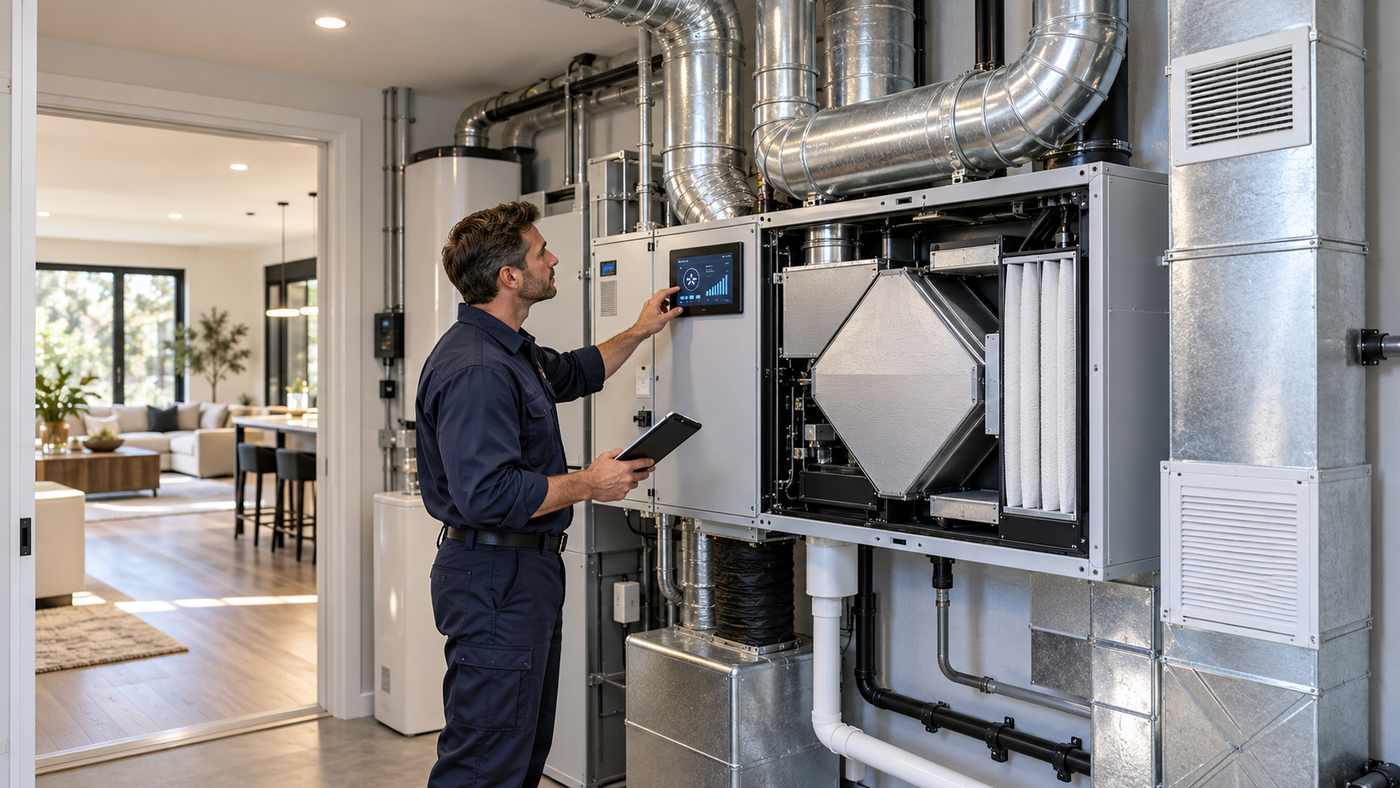
HRVs and ERVs are forms of balanced ventilation with heat-exchange equipment.
They can reduce the heating or cooling energy associated with replacing conditioned indoor air with outdoor air.
HRVs primarily transfer heat, while ERVs also transfer a portion of the moisture load.
The appropriate selection depends on climate, building characteristics, and the desired indoor conditions.
Important Components of a Ventilation System
Understanding the main components can help property owners communicate with HVAC contractors and recognize maintenance requirements.
Ventilation Fans
Fans create the pressure differences required to move air through mechanical ventilation equipment.
Fan selection depends on airflow requirements, static pressure, noise, power consumption, and installation conditions.
An undersized fan may not deliver enough air, while an improperly selected fan may waste energy or create excessive noise.
Air Ducts
Ducts distribute incoming air and transport outgoing air toward exhaust points.
Their dimensions, layout, sealing, and insulation can affect system performance.
Poorly designed ductwork may increase resistance, create noise, or reduce airflow.
Air Filters
Filters capture certain airborne particles as air moves through the system.
Their effectiveness depends on filter characteristics and compatibility with the ventilation equipment.
Dirty filters can restrict airflow and should be replaced or cleaned according to the manufacturer’s instructions.
Air Intake and Exhaust Terminals
Outdoor-air intakes should be positioned to reduce the likelihood of drawing contaminated air into the building.
Exhaust outlets must be located and installed appropriately.
The location of nearby combustion vents, vehicle emissions, refuse areas, and other pollution sources should be considered during design.
Dampers and Controls
Dampers regulate airflow through ducts and openings.
Controls may include timers, humidity sensors, occupancy-related systems, and programmable settings.
Automatic controls can improve convenience, but they require appropriate setup to maintain sufficient ventilation.
How to Choose the Right Ventilation System for Your Home
Selecting a ventilation solution involves more than choosing an appliance or comparing fan specifications.
Building size, layout, climate, airtightness, occupancy, and existing HVAC equipment all influence the decision.
Evaluate Your Building’s Airflow Needs
A professional assessment should consider how much outdoor air is required and how it will be delivered.
Ventilation requirements are influenced by building characteristics, occupancy, and applicable standards.
Airflow is commonly expressed in cubic feet per minute (CFM) in the United States or liters per second in metric specifications.
The correct airflow rate should be determined through appropriate design calculations rather than guesswork.
Consider Your Local Climate
Climate affects ventilation system selection.
In cold regions, heat recovery may help reduce heating losses associated with outdoor-air exchange.
In hot and humid environments, moisture control becomes especially important.
A suitable system should also account for local outdoor-air quality.
Assess Existing HVAC Equipment
A ventilation system may operate independently or integrate with heating and cooling equipment.
Integration can simplify certain installations, but it must be engineered correctly.
For example, using existing ducts without confirming their capacity may reduce performance.
An HVAC contractor should evaluate the equipment and duct arrangement before recommending modifications.
Evaluate Noise and Energy Consumption
Ventilation equipment may operate for extended periods.
Quiet fans, suitable duct design, and appropriate equipment placement can improve comfort.
Energy use should include not only fan electricity but also the effect of outdoor-air ventilation on heating and cooling.
Check Maintenance Accessibility
Filters, fans, drain components, and other serviceable parts should remain accessible.
Equipment installed in difficult-to-reach locations may be harder to maintain.
Convenient access supports consistent inspections and filter changes.
Professional Ventilation System Installation Process
Proper installation is essential for effective airflow and long-term equipment performance.
Even high-quality equipment may perform poorly when ducts, controls, or air terminals are incorrectly installed.
Step 1: Building Assessment
An HVAC professional evaluates the property layout, existing heating and cooling equipment, moisture concerns, and outdoor-air requirements.
The assessment may include measuring airflow or examining existing ducts and exhaust fans.
Step 2: System Design
The contractor determines appropriate ventilation rates, fan capacities, equipment locations, and duct arrangements.
The design should meet relevant building code requirements and account for potential pressure imbalances.
Step 3: Equipment Installation
Technicians install the selected equipment, ductwork, outdoor-air openings, electrical connections, and controls.
Installation procedures must follow applicable safety requirements and manufacturer specifications.
Step 4: Airflow Testing and Commissioning
After installation, the system should be tested to verify that it performs as designed.
Commissioning may include measuring supply and exhaust airflow, adjusting controls, and confirming correct operation.
A system that appears to be running may still deliver insufficient ventilation if airflow has not been checked.
Step 5: User Guidance and Maintenance Planning
The contractor should explain operating settings, filter maintenance, and recommended inspections.
Property owners should retain equipment manuals and commissioning documentation for future reference.
Signs Your Ventilation System May Need Attention
Ventilation problems are not always immediately obvious.
Certain changes in indoor conditions may indicate that equipment needs inspection or that the building has broader air quality issues.
Persistent Indoor Odors
Odors that remain long after cooking or other activities may indicate inadequate ventilation.
However, persistent smells can also result from hidden contamination or other problems that require source identification.
Excessive Window Condensation
Frequent condensation can signal elevated indoor humidity, cold surfaces, or both.
Ventilation may help in certain situations, but window performance, insulation, heating, and outdoor humidity also matter.
Unusual Fan Noise
Rattling, grinding, or unexpected vibration may indicate loose parts, worn components, or airflow restrictions.
Equipment producing unusual noises should be inspected before further damage occurs.
Reduced Airflow
Blocked filters, restricted ducts, malfunctioning dampers, or fan problems can reduce ventilation performance.
A qualified technician can measure airflow and identify the cause.
Ventilation System Maintenance Tips
Regular maintenance supports reliable operation and helps preserve the effectiveness of ventilation equipment.
Replace or Clean Filters
Inspect filters according to the manufacturer’s schedule.
Replacement frequency varies based on filter type, operating conditions, outdoor pollution, and equipment use.
Inspect Ventilation Grilles
Keep supply and exhaust grilles clear of dust, furniture, and other obstructions.
Blocked openings can interfere with normal airflow.
Check Outdoor Openings
Outdoor intakes and exhaust terminals may become obstructed by leaves, debris, or other materials.
Periodic visual inspections can identify obvious restrictions.
Arrange Professional Servicing
Technicians can inspect fans, heat-exchange components, duct connections, controls, and other equipment.
A maintenance schedule should reflect manufacturer recommendations and the operating environment.
How Much Does a Ventilation System Cost?
The cost of a ventilation system depends on the building and the selected installation method.
A basic local exhaust fan generally involves a different level of investment than a complete ducted whole-house ventilation system.
Energy recovery equipment, extensive ductwork, controls, and complicated retrofits may increase the total project cost.
Factors Affecting Installation Costs
Important considerations include the size of the property, existing duct infrastructure, selected ventilation equipment, electrical work, accessibility, labor rates, and permit requirements.
New construction may offer easier opportunities to incorporate ductwork than certain completed buildings.
Considering Long-Term Operating Costs
Initial price is only one part of the financial decision.
Operating costs include electricity consumption, filter replacements, servicing, and any additional heating or cooling demand.
Energy recovery equipment may reduce some conditioning costs, but actual savings vary with climate, equipment performance, and operating patterns.
Request a detailed written estimate from a qualified HVAC professional instead of relying on a universal installation price.
Common Mistakes to Avoid When Installing a Ventilation System
Poor ventilation performance often results from preventable design or maintenance problems.
Choosing Equipment Without Airflow Calculations
Selecting equipment based only on room size or advertised capacity can lead to inadequate performance.
A qualified professional should calculate ventilation requirements and account for duct resistance.
Ignoring Outdoor Air Quality
Introducing outdoor air without considering nearby pollution sources can affect indoor conditions.
Intake locations, filtration, and system operation should reflect local environmental conditions.
Neglecting Humidity Control
Ventilation does not automatically remove moisture in every climate.
In humid weather, excessive outdoor-air ventilation may increase indoor moisture loads.
A complete design should consider ventilation, cooling, and dehumidification together.
Assuming Air Conditioning Provides Fresh Air
Many residential heating and air-conditioning systems primarily recirculate indoor air.
They do not necessarily introduce outdoor air.
The EPA notes that most home heating and cooling systems do not mechanically bring fresh air inside unless designed to do so.
US EPA
A separate ventilation strategy may therefore be necessary.
Skipping Regular Maintenance
Filters, fans, and controls require attention to continue functioning as intended.
Neglect can reduce airflow and affect overall performance.
Frequently Asked Questions
1. What is the main purpose of a ventilation system?
A ventilation system introduces outdoor air and removes indoor air to help dilute pollutants, manage moisture, and support acceptable indoor air quality.
2. What is the best ventilation system for a home?
The best option depends on the home’s size, airtightness, climate, existing HVAC equipment, and ventilation requirements. Balanced HRV or ERV systems may be appropriate for some properties.
3. Does a ventilation system reduce electricity bills?
An energy-efficient ventilation design may reduce ventilation-related heating or cooling losses compared with less efficient approaches. Actual savings depend on equipment, climate, and operation.
4. How often should ventilation systems be serviced?
Maintenance frequency varies by equipment and operating conditions. Filters should be checked according to manufacturer guidance, and professional servicing should follow the recommended schedule.
5. What is the difference between ventilation and air conditioning?
Ventilation exchanges indoor and outdoor air, while air conditioning primarily controls indoor temperature and often humidity. Some HVAC systems combine these functions.
6. Can a ventilation system prevent mold?
Appropriate ventilation can help manage indoor moisture, which may reduce conditions favorable to mold growth. However, leaks, water intrusion, and other moisture problems must also be addressed.
Conclusion
A properly designed ventilation system is an important investment in indoor air quality, comfort, moisture management, and building performance. Whether used in a residential home or commercial property, the right equipment can help introduce fresh outdoor air, remove indoor contaminants, and support efficient operation. Choosing suitable technology, following applicable ventilation standards, and maintaining equipment regularly are essential for reliable results. With professional design and thoughtful maintenance, property owners can create cleaner, more comfortable indoor environments while managing long-term energy and maintenance costs.