CO2 Fire Extinguisher Guide: Uses, Safety, Limitations, and Maintenance
A CO2 fire extinguisher uses carbon dioxide as its extinguishing agent and is commonly selected for certain flammable liquid and energized electrical equipment fire hazards. Carbon dioxide works primarily by reducing the oxygen available around the fire while also producing a cooling effect during discharge, and it leaves no conventional dry chemical residue behind. Those characteristics can make it useful around sensitive electrical equipment, but CO2 is not appropriate for every fire. It has important limitations involving ordinary combustible materials, outdoor effectiveness, confined spaces, cold discharge components, and the possibility of fire reignition. Correct extinguisher selection should therefore be based on the actual hazards, applicable fire codes, equipment ratings, and guidance from recognized fire safety authorities.
What Is a CO2 Fire Extinguisher?
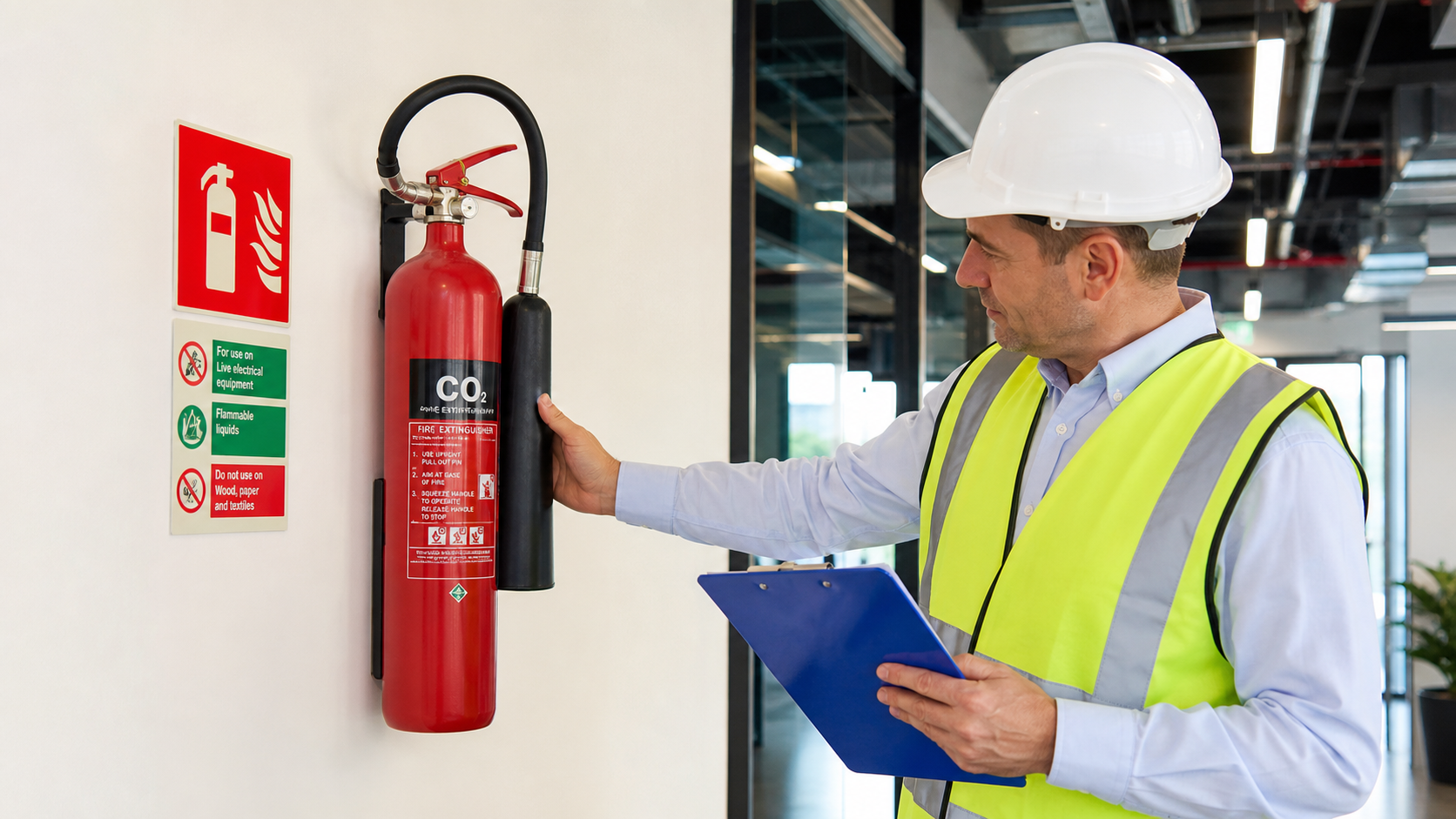
A carbon dioxide fire extinguisher is a portable or wheeled firefighting device containing carbon dioxide stored under pressure.
When the extinguisher is activated, carbon dioxide passes through its discharge assembly and expands rapidly as it leaves the container. The familiar horn shaped discharge component on many portable models helps direct the agent toward the fire.
CO2 extinguishers are generally identifiable by their labeling and distinctive discharge horn, but users should always read the fire classification and operating instructions on the specific unit rather than relying on appearance alone.
How Does a CO2 Fire Extinguisher Work?
Fire requires several conditions to continue, including sufficient oxygen, heat, and fuel.
Discharged carbon dioxide can reduce the oxygen concentration in the immediate fire area enough to suppress combustion. Rapid expansion of the agent also creates cooling, although carbon dioxide should not be viewed primarily as a deep cooling extinguishing agent.
Its ability to leave little conventional extinguishing residue is a major reason it is used around certain electrical and electronic hazards.
Does Carbon Dioxide Leave Residue?
Carbon dioxide is a gas under ordinary atmospheric conditions and does not leave the powder associated with typical dry chemical extinguishers.
This can be advantageous around electronics, laboratories, and other equipment where cleanup from extinguishing powder could be problematic.
The absence of powder residue does not mean equipment exposed to a fire will remain undamaged. Heat, smoke, soot, electrical faults, and combustion products can still cause substantial damage.
7 Powerful CO2 Fire Extinguisher Safety Facts
Understanding what carbon dioxide extinguishers can and cannot do is essential. These seven facts address fire classification, electrical hazards, operation, placement, and maintenance.
1. A CO2 Fire Extinguisher Is Designed for Specific Fire Classes
No portable extinguisher is automatically appropriate for every type of fire.
In the United States, extinguishers are labeled according to the types of fire hazards for which they are rated.
Class B Fire Applications
Class B fires involve flammable liquids and similar hazards within the classification system.
A properly rated CO2 extinguisher can be appropriate for certain Class B fires.
Examples of potential flammable liquid hazards can include fuels, solvents, paints, and other combustible or flammable liquids, although the correct extinguisher must always match the specific workplace or property hazard.
Class C Electrical Fire Applications
Class C refers to fires involving energized electrical equipment in the U.S. classification system.
CO2 is electrically nonconductive under its intended extinguishing application and does not leave dry chemical residue, making it a common choice around energized electrical equipment.
Electrical Power Should Be Isolated When Safe
Removing electrical power can eliminate the energized electrical component of the hazard.
Only disconnect power when it can be done safely. Never approach exposed energized components or enter a dangerous fire environment merely to reach a switch or breaker.
Emergency evacuation takes priority.
2. A CO2 Fire Extinguisher Is Not Ideal for Ordinary Combustibles
One of the most important limitations involves Class A materials.
Class A fires include ordinary combustible materials such as wood, paper, cloth, and many plastics.
Why CO2 Can Be Unsuitable for Deep Seated Class A Fires
Carbon dioxide can suppress visible flames without providing the deep cooling needed for some smoldering combustible materials.
After the gas disperses, hot material can reignite.
An extinguisher specifically rated for the relevant Class A hazard is generally more appropriate.
Read the Extinguisher Label
Never infer ratings merely from cylinder color, size, or location.
The unit’s label identifies its fire classification and instructions.
Local fire codes and hazard assessments determine what extinguishers should be provided in a building.
CO2 Is Not a Universal Kitchen Extinguisher
Commercial cooking oil and fat hazards require equipment intended for the applicable cooking fire classification.
In the United States, Class K extinguishers are associated with commercial cooking appliance hazards involving combustible cooking media.
Never assume that a nearby CO2 unit is appropriate merely because a kitchen contains electrical appliances.
3. A CO2 Fire Extinguisher Can Be Useful Around Electrical Equipment
Electrical and electronic environments are among the most recognizable applications for CO2 extinguishers.
Potential locations can include certain server rooms, electrical equipment spaces, laboratories, workshops, and commercial environments.
Why Residue Matters Around Electronics
Dry chemical extinguishing agents can contaminate sensitive equipment and create substantial cleanup requirements.
Carbon dioxide dissipates as a gas instead.
This can make it attractive where reducing agent residue is an important consideration.
Fire Damage Still Requires Inspection
Electrical equipment involved in or exposed to a fire should not simply be switched back on because extinguishing residue is absent.
Heat, insulation damage, smoke contamination, or the original electrical fault may remain.
Qualified electrical or equipment professionals should evaluate affected systems before they return to service.
CO2 Does Not Remove the Source of an Electrical Fault
If damaged wiring or equipment started the fire, extinguishing the flames addresses the immediate combustion rather than the underlying electrical failure.
The equipment should remain out of service until appropriately assessed.
4. CO2 Fire Extinguisher Discharge Requires Special Caution
Carbon dioxide extinguishers have hazards of their own.
Understanding those hazards before an emergency is considerably safer than discovering them during one.
The Discharge Horn Can Become Extremely Cold
Rapid expansion of carbon dioxide produces very low temperatures around discharge components.
On models without an insulated gripping area specifically designed for handling, touching very cold components can cause cold injury.
Hold Only the Designated Grip
Follow the instructions printed on the specific extinguisher.
Use the intended insulated handle or gripping area where provided and avoid touching parts identified by the manufacturer as unsafe during discharge.
Carbon Dioxide Can Displace Oxygen
CO2 works partly by reducing available oxygen around a fire.
That same characteristic creates an inhalation and asphyxiation concern when carbon dioxide accumulates in confined or poorly ventilated locations.
Confined Spaces Need Particular Attention
Do not remain in an unsafe enclosed area simply to operate an extinguisher.
If conditions create a risk to occupants, evacuate and call emergency services.
Firefighters have training and protective equipment for environments that are unsafe for unprotected occupants.
5. Correct CO2 Fire Extinguisher Operation Matters
Portable extinguishers are intended for limited, manageable fire situations when the correct unit is available and the user has a safe escape route.
They are not substitutes for professional firefighting.
Assess Whether You Should Attempt Extinguishment
Before using any portable extinguisher, consider whether:
• The fire is small and limited
• The correct extinguisher is available
• Emergency services have been notified as appropriate
• Smoke is not making conditions unsafe
• You have a clear escape route
• You are physically able and trained to use the unit
• The fire is not rapidly spreading
If those conditions are not met, evacuate.
Remember the PASS Method
A commonly taught extinguisher technique is summarized as PASS:
• Pull the pin
• Aim at the base of the fire
• Squeeze the operating handle
• Sweep the discharge across the fire area as appropriate
Users should still follow the instructions on their particular extinguisher and their fire safety training.
Maintain an Escape Route
Position yourself so the fire cannot easily block your path out.
Never move so far into a room that escape requires passing the fire.
If the extinguisher does not control the fire promptly, leave and close doors behind you when safe to do so.
6. CO2 Fire Extinguisher Placement Should Match the Hazard
Placing an extinguisher somewhere simply because a wall has empty space is poor fire safety planning.
Extinguisher type, quantity, mounting, accessibility, and travel distance can be regulated by applicable codes.
Keep Extinguishers Accessible
Portable units should not be concealed behind stored materials, furniture, equipment, or locked barriers that prevent appropriate access.
Required signage and mounting arrangements can depend on the facility and jurisdiction.
Do Not Put Yourself in Danger to Reach One
Placement should allow an occupant to approach an extinguisher while maintaining a safe route away from the hazard.
The extinguisher should not require a person to enter the developing fire area to retrieve it.
Commercial Properties Have Additional Requirements
In the United States, businesses can be subject to requirements involving OSHA, adopted fire codes, the authority having jurisdiction, insurer requirements, and recognized standards such as NFPA 10.
A qualified fire protection professional can determine appropriate extinguisher selection and placement for the actual occupancy.
7. A CO2 Fire Extinguisher Requires Inspection and Maintenance
A portable extinguisher is emergency equipment.
It needs to remain ready even if it goes unused for years.
Routine Visual Checks
Appropriate routine observations can include confirming that:
• The extinguisher is in its designated location
• Access is unobstructed
• Instructions are legible
• The safety seal or tamper indicator is intact where applicable
• The hose or horn appears undamaged
• The cylinder shows no obvious physical damage
• Inspection documentation is current where required
Exact inspection requirements depend on applicable standards and manufacturer instructions.
CO2 Units May Not Have a Typical Pressure Gauge
Many people expect every extinguisher to have a pressure gauge.
CO2 extinguishers are commonly evaluated differently because of how the carbon dioxide is stored.
Weight Can Be Important
Service professionals can use specified weight information to help determine whether a CO2 extinguisher contains its required charge.
Do not improvise servicing based on a household scale unless the manufacturer and applicable procedures specifically support it.
Understanding CO2 Fire Extinguisher Ratings
Portable extinguisher labeling communicates which hazards a unit is designed to address.
Understanding that information is more dependable than choosing by appearance.
Class B Ratings
A Class B rating relates to performance on qualifying flammable liquid fire tests.
Specific numeric ratings can appear on extinguisher labels.
The correct capacity and rating depend on the hazard and applicable code.
Class C Designation
Class C indicates suitability for fires involving energized electrical equipment.
It does not describe a separate amount of combustible material in the same way numerical classifications can for some other classes.
Fire Classification Varies Internationally
Fire classification systems are not identical worldwide.
For example, electrical fire terminology and classifications can differ by country.
Follow the standards and labeling used in the jurisdiction where the extinguisher will be installed.
CO2 Fire Extinguisher Versus Dry Chemical Extinguishers
Both products can address certain fire hazards, but their capabilities and cleanup characteristics differ.
Dry Chemical Extinguishers
Multipurpose dry chemical units are commonly rated for Class A, B, and C hazards in the United States.
This broad coverage makes them popular in many general occupancy settings.
Why Choose CO2 Instead?
A CO2 unit can be useful where residue from dry chemical agent would create additional problems.
Sensitive electrical equipment is a common example.
Why Choose Dry Chemical Instead?
Where ordinary combustibles are a significant hazard, a multipurpose ABC extinguisher can provide coverage that a typical BC rated CO2 extinguisher does not.
The facility’s complete hazard profile should guide selection.
CO2 Fire Extinguisher Versus Water Extinguishers
Water based extinguishers can be effective for appropriate ordinary combustible fires.
They are not interchangeable with CO2.
Water and Energized Electrical Equipment
Do not use an extinguisher on energized electrical equipment unless it is specifically rated for that application.
Standard water extinguishers are not intended for energized electrical hazards.
CO2 and Ordinary Combustibles
CO2 may fail to provide sufficient deep cooling for some Class A materials.
This demonstrates why one extinguisher type should not automatically replace another throughout a building.
CO2 Fire Extinguisher Versus Foam
Foam extinguishing products can be suitable for certain fire hazards depending on their specific ratings.
Some are used for Class A and certain Class B applications.
Residue and Cleanup
Foam creates different cleanup considerations from carbon dioxide.
Where sensitive electronics are the primary concern, CO2 may offer advantages because it does not leave conventional extinguishing agent residue.
Verify Electrical Suitability
Do not assume every foam extinguisher is suitable for energized electrical equipment.
Read the exact product classification and instructions.
CO2 Fire Extinguisher for Server Rooms
Server and telecommunications spaces are commonly associated with CO2 extinguishers because equipment can be sensitive to residue.
The overall fire protection strategy can be substantially more complex than simply mounting a portable extinguisher nearby.
Consider the Entire Fire Protection System
Depending on facility size and risk, protection can include:
• Smoke detection
• Fire alarms
• Portable extinguishers
• Automatic suppression
• Emergency procedures
• Electrical protection
• Compartmentation
A fire protection professional can design the system around actual hazards.
Personnel Safety Remains Essential
Using carbon dioxide in a confined room creates potential exposure concerns.
A clean agent or another fire protection strategy may be evaluated depending on occupancy, equipment, code, and system design.
CO2 Fire Extinguisher for Electrical Panels
Carbon dioxide can be suitable for some energized electrical equipment fires because of its Class C applicability in the United States.
However, extinguisher placement should not obstruct electrical working space or violate electrical safety requirements.
Keep Electrical Access Clear
Electrical panels require appropriate working clearances.
Do not place portable extinguishers, storage, or other objects where they interfere with required access.
Correct the Electrical Failure
After any panel or equipment fire, have the electrical system assessed before reenergizing it.
The immediate extinguishment does not repair damaged equipment.
CO2 Fire Extinguisher for Flammable Liquids
CO2 can suppress certain Class B fires by reducing oxygen around the flame.
The application has limitations.
Outdoor Conditions Can Reduce Effectiveness
Wind can disperse carbon dioxide rapidly.
This can make CO2 less effective outdoors or in highly ventilated settings than in protected conditions.
Reignition Is Possible
If the fuel remains hot or an ignition source remains active, flames can return after carbon dioxide dissipates.
This is another reason portable extinguisher use should be limited to suitable small fires.
Where a CO2 Fire Extinguisher Should Not Be Used
Using the wrong extinguisher can make an emergency worse or leave the fire inadequately controlled.
Ordinary Combustible Fires
Typical CO2 units should not be selected as the sole answer to substantial Class A hazards unless the specific extinguisher carries an applicable rating.
Cooking Oil Fires
Use an extinguisher designed and rated for the applicable cooking oil hazard.
In commercial kitchens in the United States, Class K protection is relevant to certain cooking appliance hazards.
Reactive Metal Fires
Combustible metal fires require specialized Class D extinguishing agents appropriate to the specific metal.
A standard CO2 extinguisher should not be assumed suitable.
Occupied Confined Spaces
Carbon dioxide accumulation can create dangerous atmospheric conditions.
Personal safety and evacuation take priority over property protection.
CO2 Fire Extinguisher Sizes
Portable CO2 extinguishers come in different capacities.
The correct size depends on the risk, user capability, code requirements, and required fire rating.
Larger Is Not Automatically Better
A larger cylinder can provide greater agent quantity but can also be significantly heavier and harder for some people to handle.
Accessibility includes practical usability.
Wheeled CO2 Fire Extinguishers
Larger industrial hazards may use wheeled extinguishing equipment.
These systems require appropriate training, inspection, positioning, and hazard evaluation.
They are not ordinary household substitutes.
CO2 Fire Extinguisher Inspection
Routine inspection helps identify obvious problems before an emergency.
Businesses may have formal inspection documentation requirements.
Look for Cylinder Damage
Rust, severe dents, damaged valves, broken components, or other abnormal conditions deserve professional evaluation.
Do not attempt to repair a pressurized extinguisher yourself.
Check the Discharge Horn
The horn and hose assembly should remain intact and unobstructed.
Damage can interfere with safe operation.
CO2 Fire Extinguisher Maintenance
Professional maintenance differs from a basic visual check.
Fire extinguishers are pressure vessels and should be serviced according to applicable standards and manufacturer requirements.
Recharge After Use
Even a short discharge requires professional evaluation and appropriate recharge before the extinguisher returns to service.
Do not place a partially used unit back on the wall and assume it remains ready.
Hydrostatic Testing
Extinguisher cylinders can require periodic hydrostatic testing according to applicable standards, regulations, cylinder type, and manufacturer information.
Hydrostatic testing evaluates the cylinder’s ability to withstand specified pressure under controlled procedures.
Never Test the Cylinder Yourself
Pressurized fire equipment can cause serious injury if improperly handled.
Use appropriately qualified extinguisher service professionals.
How Long Does a CO2 Fire Extinguisher Last?
There is no single useful expiration age that applies to every unit in every jurisdiction.
Serviceability depends on cylinder condition, required inspection and testing, manufacturer requirements, and applicable regulations.
Do Not Rely on Appearance Alone
An extinguisher can look clean while being overdue for required service.
Inspection and testing records matter.
Replace Damaged Equipment
A unit that fails required testing or has disqualifying damage should be removed from service according to professional guidance.
CO2 Fire Extinguisher Storage
Portable extinguishers should remain accessible and protected from conditions outside their approved storage specifications.
Temperature Matters
Manufacturers specify operating and storage temperature ranges.
Do not assume a CO2 extinguisher can be stored in every vehicle, outdoor enclosure, or extreme environment.
Secure Mounting
Approved brackets or cabinets can help keep extinguishers in their intended location and protect them from accidental damage.
Commercial mounting requirements can be governed by applicable codes.
CO2 Fire Extinguisher Cost
There is no universal price because size, certification, brand, installation, servicing, and local market conditions vary.
Commercial properties should budget for maintenance in addition to initial purchase.
Cost Factors
Pricing can be influenced by:
• Agent capacity
• Cylinder construction
• Fire rating
• Certification
• Mounting equipment
• Installation
• Inspection
• Recharge
• Hydrostatic testing
Compare equivalent certified equipment rather than purchase price alone.
How to Choose a CO2 Fire Extinguisher
Begin by identifying the hazard, not by selecting a cylinder size.
A qualified fire protection professional can conduct or assist with the assessment for workplaces and complex properties.
Questions to Ask
Consider:
• Which fire classes are present?
• Is energized electrical equipment a major hazard?
• Are ordinary combustibles also present?
• Is the area confined?
• Is the location exposed to wind?
• What rating is required?
• What travel distance requirements apply?
• Who will inspect and maintain the unit?
• What training do occupants need?
A single extinguisher type may not cover every hazard within the property.
Common CO2 Fire Extinguisher Mistakes
Using an inappropriate extinguisher is among the most consequential errors.
Other mistakes can reduce readiness before a fire even occurs.
Blocking the Extinguisher
Emergency equipment needs to remain readily accessible.
Do not place furniture or stored materials in front of it.
Touching the Discharge Assembly Incorrectly
Unprotected discharge components can become extremely cold during operation.
Use only designated gripping areas.
Attempting to Fight a Large Fire
Portable extinguishers have limited agent and discharge duration.
If the fire is spreading, conditions are smoky, or a safe exit is uncertain, evacuate.
Failing to Service a Used Unit
Any discharged extinguisher should be evaluated and recharged or replaced as appropriate before returning to service.
Frequently Asked Questions
What is a CO2 fire extinguisher used for?
A CO2 fire extinguisher is commonly used for certain Class B flammable liquid and Class C energized electrical equipment fires under the U.S. classification system.
Can a CO2 fire extinguisher be used on electrical fires?
Yes, properly rated CO2 extinguishers are commonly used for energized electrical equipment because carbon dioxide is suitable for Class C applications and leaves no dry chemical residue.
Can a CO2 fire extinguisher be used on wood fires?
A typical BC rated CO2 extinguisher is not the preferred choice for ordinary Class A materials such as wood because deep seated material can remain hot and reignite.
Is CO2 from a fire extinguisher dangerous?
High carbon dioxide concentrations can displace oxygen and create an asphyxiation hazard. Discharge components can also become extremely cold and cause cold injury.
Does a CO2 fire extinguisher need maintenance?
Yes. It requires appropriate inspections, professional maintenance, recharging after use, and periodic testing according to manufacturer instructions and applicable standards.
Does a CO2 fire extinguisher leave a mess?
CO2 does not leave conventional powder or foam residue, although the fire itself can leave smoke, soot, damaged materials, and potentially hazardous combustion products.
Conclusion
A CO2 fire extinguisher can provide effective portable fire protection for appropriate flammable liquid and energized electrical hazards, particularly where extinguishing agent residue is a concern. Its limitations are equally important because carbon dioxide is not a universal solution for ordinary combustibles, cooking oil, combustible metals, or large fires. Correct hazard selection, accessible placement, user training, professional maintenance, and a clear evacuation plan are essential parts of using CO2 extinguishers responsibly.