Local SEO Search: How to Build Visibility in Google Maps and Local Results
Effective Local SEO Search optimization helps businesses improve their visibility when potential customers look for nearby products, professional services, stores, restaurants, contractors, healthcare providers, and other location specific solutions. Unlike traditional organic SEO alone, local optimization involves signals such as Google Business Profile information, relevance to a user’s query, geographic context, business prominence, reviews, website content, local citations, and links. Businesses cannot control every ranking factor, especially a searcher’s location, but they can make their information accurate, useful, and trustworthy across search platforms and their own websites. This guide explains the core strategies that support sustainable local visibility without relying on keyword stuffing or manipulative shortcuts.
What Is Local SEO Search?
Local SEO Search is the process of improving a business’s digital presence so search engines can better understand what the business offers, where it operates, and when it is relevant to location based queries.
Examples of local intent searches include someone looking for a plumber in their city, a coffee shop nearby, an emergency dentist, a local roofing company, or a store carrying a specific product.
Local optimization can influence visibility across conventional organic results, local business listings, map based experiences, and AI generated search interfaces.
How Does Local SEO Search Work?
Search engines evaluate multiple signals to determine which businesses may satisfy a local query.
For Google’s local results, Google publicly describes three broad considerations as relevance, distance, and prominence.
Relevance concerns how closely a business matches the searcher’s query.
Distance considers how far potential results are from the location used in the search.
Prominence relates broadly to how well known a business appears, including information available across the web.
Local SEO Versus Traditional SEO
Traditional SEO can target users regardless of physical location.
Local SEO places additional emphasis on geographic relevance.
A national ecommerce company may primarily optimize product and category pages, while a local electrician needs search engines to understand the services offered and the legitimate areas served.
The two disciplines still overlap substantially.
7 Powerful Local SEO Search Tips for Better Rankings
No ethical strategy can guarantee a specific local ranking because search results vary by query, location, competition, device, and other factors. The following seven practices strengthen the information search systems can use.
1. Optimize Google Business Profile for Local SEO Search
For businesses eligible for Google Business Profile, the listing is a central component of Google’s local ecosystem.
The profile should accurately represent the real business.
Complete Core Business Information
Important details include:
• Business name
• Primary category
• Relevant secondary categories
• Address where applicable
• Service area where applicable
• Phone number
• Website
• Opening hours
• Holiday hours
• Services
• Products where relevant
• Business description
• Photographs
Accuracy is more valuable than adding information solely for ranking purposes.
Use the Real Business Name
Do not add city names, service keywords, promotional language, or other terms to the business name unless those terms genuinely form part of the real world business name.
Google’s Business Profile policies govern how businesses should represent themselves.
Choose Categories Carefully
Categories help Google understand the nature of a business.
Select the most appropriate primary category and only use additional categories that genuinely represent business activities.
Adding irrelevant categories can make the profile less accurate.
Keep Hours Updated
Incorrect hours create poor customer experiences.
Update seasonal, holiday, and temporary hours when necessary.
Businesses should also review profile information periodically because operational details can change.
2. Build a Locally Relevant Website
A Google Business Profile should connect to a useful website that clearly explains the business’s services, expertise, and location.
The website needs content for people first.
Optimize Important Service Pages
Rather than placing every service on one thin page, important services can have dedicated pages when enough unique, useful information exists to justify them.
A quality service page can explain:
• What the service includes
• Who it is for
• Common problems addressed
• How the process works
• Qualifications
• Relevant local considerations
• Pricing factors
• Frequently asked questions
• How to contact the business
Each page should provide substance rather than merely swapping keywords.
Include Location Naturally
A business should clearly state where it is based and where relevant services are genuinely available.
Location terms can appear in page titles, headings, body content, contact information, and other appropriate areas.
Avoid Geographic Keyword Stuffing
Repeating a city name excessively does not make a page more useful.
Write naturally and include geographic information where it helps users understand the service.
Improve Contact Pages
A useful contact page can include current business information, opening hours, telephone details, directions, parking information where relevant, and other practical information.
The goal is to help potential customers take the next step.
3. Use Reviews to Strengthen Local SEO Search Trust
Customer reviews influence purchase decisions and can contribute to a business’s online prominence.
A legitimate review strategy focuses on generating authentic feedback rather than manufacturing ratings.
Ask Customers for Reviews
Businesses can create a repeatable process for requesting reviews after real customer interactions.
Depending on platform policies, requests can be sent through:
• SMS
• Receipts
• Follow up messages
• Appropriate review links
Make the process straightforward.
Never Buy Fake Reviews
Purchased, fabricated, or manipulated reviews violate the policies of major platforms and can mislead consumers.
They can also create legal and reputational problems.
Do Not Incentivize Reviews Without Checking Rules
Platforms have different policies concerning incentives.
Consumer protection requirements can also apply to endorsements and testimonials.
Review current platform and regulatory guidance before offering anything of value in exchange for feedback.
Respond Professionally
Business owners can respond to positive and negative feedback where platforms permit.
Responses should be useful rather than defensive.
Avoid revealing private customer information when responding publicly.
4. Build Accurate Local Citations
A local citation is a reference to business information on another website or digital directory.
Common data includes the business name, address, and phone number.
Keep Core Information Consistent
Search engines and customers benefit when major business details are accurate across important platforms.
Focus on:
• Business name
• Address
• Phone number
• Website
• Opening hours where provided
Exact formatting differences such as “Street” versus “St.” are usually less important than whether the underlying information is correct.
Prioritize Quality Directories
Businesses do not need listings on every directory that exists.
Prioritize platforms relevant to the country, industry, location, and customer audience.
Industry Directories Can Be Valuable
Professional associations, licensing databases, chambers of commerce, local business organisations, and industry specific directories can provide meaningful references when legitimate.
Do not pay for low quality directory listings solely to manufacture links.
5. Earn Local Links and Mentions
Links remain useful for organic search because they can help search engines discover pages and understand relationships across the web.
For local businesses, relevant community and industry links can be particularly valuable.
How to Earn Local Links
Legitimate opportunities can include:
• Local partnerships
• Professional associations
• Community organisations
• Local media coverage
• Sponsorships with genuine involvement
• Industry resources
• Supplier or manufacturer relationships
• Charitable activities
• Useful original research
The link should result from a genuine relationship, resource, or editorial reason.
Local Digital PR
Businesses with genuine local expertise can become sources for journalists and community publications.
A roofing contractor, for example, might provide factual guidance about preparing roofs for severe regional weather.
Avoid Manipulative Link Schemes
Buying large quantities of backlinks, exchanging links at scale, or creating artificial websites purely to pass ranking value can violate search engine spam policies.
Sustainable authority is built through relevance and genuine reputation.
6. Strengthen On Page Local SEO Search Signals
On page optimization helps search engines and users understand each page.
Clear structure generally works better than forcing a keyword into every possible sentence.
Title Tags
Page titles should describe the content accurately and can include relevant service and geographic information.
Avoid making every title nearly identical.
Meta Descriptions
Meta descriptions can summarize pages and encourage qualified clicks, although search engines may choose different snippets in results.
They are not a guaranteed ranking lever.
Headings
Use headings to organize information logically.
A service page might move from what the service is to benefits, process, costs, service area information, and FAQs.
Internal Linking
Link related pages when doing so helps users navigate the site.
For example, a main plumbing page can link to leak detection, water heater installation, sewer repair, and emergency service pages.
Descriptive anchor text helps clarify the destination.
7. Improve Technical SEO and User Experience
Local relevance cannot compensate completely for a website that is inaccessible, confusing, or technically broken.
Search engines need to crawl and understand important pages, while customers need to use them easily.
Mobile Experience Matters
Many local searches happen on phones.
Important information should be easy to read and interact with on a small screen.
Telephone numbers can be made convenient to call, and forms should not be unnecessarily difficult.
Improve Page Performance
Large images, excessive scripts, poor hosting, and unnecessary third party code can slow websites.
Compress appropriately sized images and eliminate avoidable page weight.
Core Web Vitals
Google uses Core Web Vitals as part of its broader page experience considerations.
They measure aspects of loading, responsiveness, and visual stability.
Strong scores alone will not make an irrelevant business rank locally, but good usability benefits visitors.
Local SEO Search and GEO Optimization
Generative Engine Optimization, commonly called GEO, focuses on making information easier for AI powered search and answer systems to discover, understand, contextualize, and cite where applicable.
GEO should complement strong SEO rather than replace it.
Provide Direct Answers
AI systems often extract concise answers from clearly written content.
Pages should answer fundamental questions directly, including:
• What the business offers
• Where it operates
• Who provides the service
• How the service works
• What affects price
• What qualifications matter
• When customers need professional assistance
Specific, factual information is easier to interpret than generic marketing language.
Strengthen Entity Information
Consistent information about the business across its website and authoritative third party sources can help search systems understand the entity.
Clearly identify the legitimate business name, location, services, contact information, and professional credentials where relevant.
Demonstrate Firsthand Expertise
Useful content can include original photographs, documented projects, staff credentials, local experience, real service processes, and clear explanations written from genuine operational knowledge.
Avoid creating fake case studies or fabricated testimonials merely to appear experienced.
EEAT and Local SEO Search
Experience, expertise, authoritativeness, and trust are useful quality concepts when planning local content, especially in industries affecting health, finances, safety, or substantial purchases.
Trust should be demonstrated rather than declared.
Show Who Is Behind the Business
Useful trust information can include:
• Staff biographies
• Relevant qualifications
• Professional registrations
• Business history
• Real contact information
• Licensing where applicable
• Insurance information where useful
• Editorial authorship
• Clear policies
Do not display credentials that cannot be verified.
Cite Reliable Sources
Content involving regulations, medical topics, building codes, or technical claims should rely on appropriate primary or authoritative sources.
This improves usefulness for both people and AI systems.
Local Keyword Research
Keyword research identifies how potential customers describe their needs.
The objective is to understand search intent rather than repeat exact phrases excessively.
Types of Local Keywords
Searches can include combinations such as:
• Service and city
• Service near me
• Product and location
• Emergency service and area
• Best service provider nearby
• Service cost and city
• Problem and local professional
Users can also search conversationally through AI assistants and voice interfaces.
Use Search Intent
A person searching “water heater repair near me” likely has different needs from someone searching “how water heaters work.”
Pages should satisfy the intended purpose of the query.
Use Long Tail Keywords Naturally
Specific searches can reveal strong intent.
For example, “emergency sewer repair in Glasgow” communicates more about immediate need and location than “plumbing.”
Create content because the topic deserves a page, not merely because a keyword tool shows search volume.
Location Pages for Local SEO Search
Businesses legitimately serving several areas can create useful location pages.
However, mass producing nearly identical pages for every nearby suburb can create thin, repetitive content.
What Makes a Useful Location Page?
Include genuinely location relevant information such as:
• Services available
• Local office information where real
• Coverage details
• Local regulations where relevant
• Regional conditions
• Real projects
• Customer information
• Travel or scheduling considerations
• Local contact routes
Do not invent offices.
Avoid Doorway Pages
Pages created solely to rank for numerous geographic variations while directing users to effectively the same destination can create quality and spam concerns.
Focus on legitimate service areas and unique value.
Service Area Businesses
Businesses such as plumbers, roofers, electricians, cleaners, and mobile professionals may travel to customers instead of serving them at a storefront.
Google Business Profile has specific guidelines for service area businesses.
Use Address Information Correctly
Businesses that do not serve customers at their address should follow current Google guidance about hiding the address where appropriate and setting legitimate service areas.
Do not use virtual offices or addresses that do not satisfy platform requirements merely to rank in another city.
Service Areas Do Not Guarantee Rankings Everywhere
Adding many cities to a Business Profile does not automatically establish strong visibility in each location.
Distance remains relevant to local search.
Google Maps and Local SEO Search
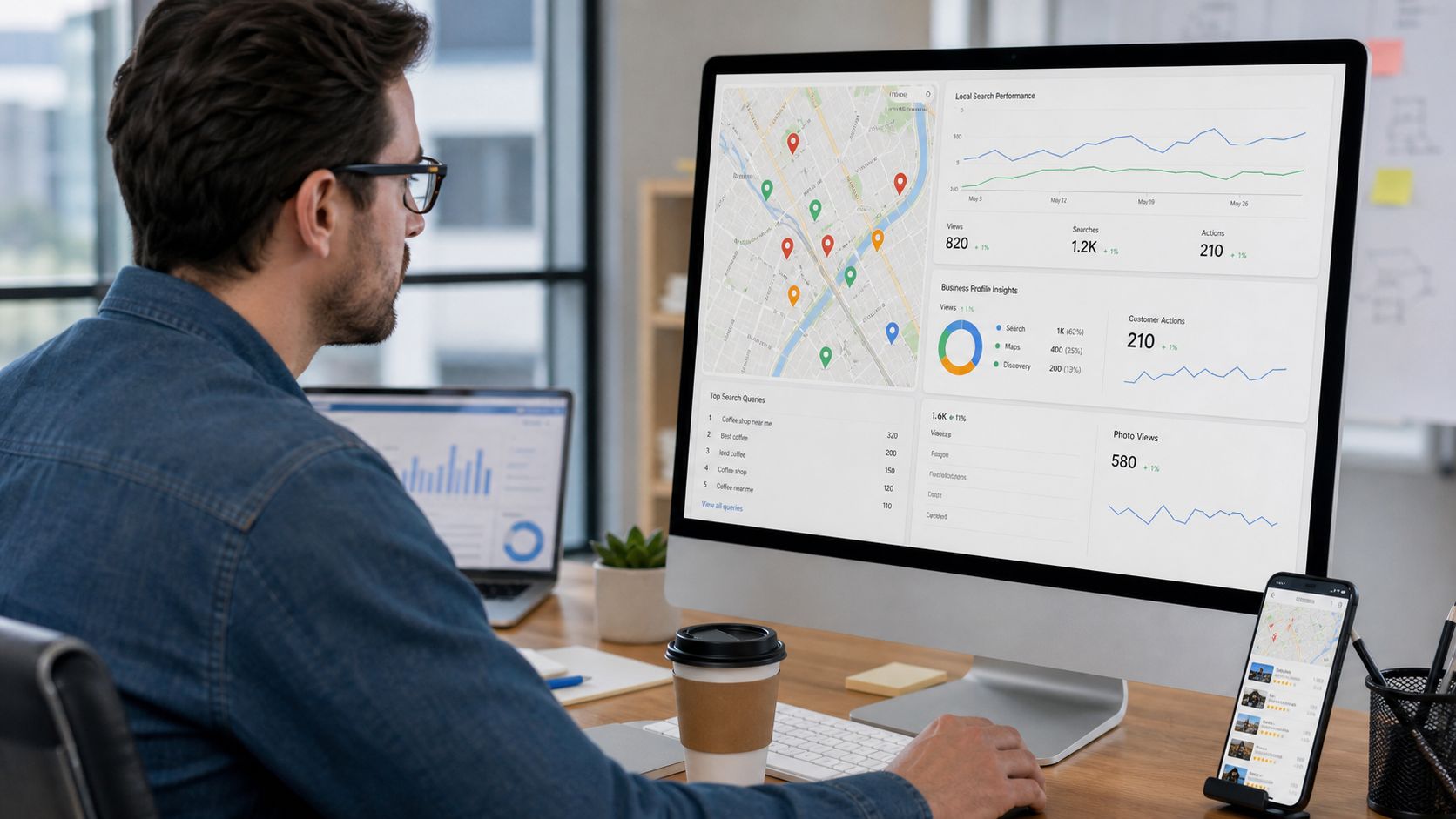
Map visibility can generate calls, directions, website visits, and other high intent actions.
Optimizing the underlying business information is more useful than searching repeatedly for your own ranking.
Local Results Vary by Searcher
A business can rank differently for two people performing the same search from different neighborhoods.
Results can also vary based on query wording and other contextual signals.
Use Rank Tracking Carefully
Local grid tools can visualize rankings from multiple geographic points.
They are useful for identifying patterns but should not be treated as perfect representations of every customer’s search experience.
Schema Markup for Local Businesses
Structured data can help search engines understand information on a website.
LocalBusiness and related schema types can be useful when implemented accurately.
Information That Can Be Marked Up
Depending on eligibility and page content:
• Business name
• Address
• Phone number
• URL
• Opening hours
• Geographic information
• Business type
Structured data should match information visible to users.
Schema Does Not Guarantee Rankings
Adding structured data will not automatically produce higher local positions or rich results.
It helps communicate information in a machine readable way.
Local SEO Search for Multi Location Businesses
Businesses with multiple legitimate locations need an organized website and profile strategy.
Each real location can have distinct information.
Individual Location Pages
A location page can contain:
• Correct address
• Phone number
• Hours
• Services
• Staff information
• Directions
• Local photographs
• Location specific details
Avoid duplicate pages containing only a different city name.
Separate Business Profiles
Eligible individual locations can maintain their own profiles according to platform rules.
Information should correspond to the actual location.
Reviews and Reputation Management
Reviews provide valuable customer feedback in addition to their search visibility effects.
Businesses should monitor major relevant platforms.
Do Not Review Gate
Some platforms prohibit selectively encouraging satisfied customers to leave public reviews while diverting dissatisfied customers elsewhere.
Use a fair, policy compliant review request process.
Learn From Negative Reviews
Repeated complaints about scheduling, communication, pricing, or workmanship can reveal operational problems.
SEO cannot compensate indefinitely for poor customer experience.
Local SEO Search for Healthcare and Regulated Services
Healthcare providers, financial professionals, lawyers, and other regulated industries require additional care when creating local content.
Accuracy and professional standards matter.
Do Not Exaggerate Outcomes
Avoid guaranteed health, financial, legal, or safety outcomes.
Content should describe evidence, qualifications, risks, and limitations appropriately.
Verify Professional Information
Licences, certifications, and professional registrations should be current and accurately described.
Trust is particularly important for high impact services.
Measuring Local SEO Search Performance
Rankings are only one performance indicator.
Businesses should connect search visibility to useful customer actions.
Metrics to Monitor
Depending on business goals, useful measures include:
• Organic search traffic
• Qualified local leads
• Phone calls
• Form submissions
• Appointment requests
• Direction requests
• Profile interactions
• Conversion rates
• Review growth
• Revenue from organic leads where measurable
Use analytics in accordance with applicable privacy laws and consent requirements.
Track Leads Accurately
Call tracking and form analytics can help attribute enquiries, but they should be implemented carefully so business information remains accurate for users and search engines.
How Long Does Local SEO Search Take?
There is no fixed ranking timeline.
Results depend on existing authority, competition, location, website quality, business prominence, reviews, technical health, and the work required.
New Businesses Need Time to Establish Signals
A brand new company usually has less historical information and fewer mentions than an established competitor.
Accurate profiles, strong services, genuine reviews, useful content, and legitimate local relationships can build visibility over time.
Be Careful With Guaranteed Timelines
No agency controls Google’s organic or local algorithms.
Promises of guaranteed number one rankings within a fixed period should be treated cautiously.
How Much Does Local SEO Search Cost?
SEO pricing varies according to market, competition, number of locations, website condition, scope, content needs, and agency expertise.
There is no universal monthly figure.
Potential SEO Services
A campaign can include:
• SEO audit
• Keyword research
• Business Profile optimization
• Website improvements
• Content creation
• Technical SEO
• Citation management
• Local link development
• Review strategy
• Reporting
• Conversion optimization
Ask providers to explain deliverables rather than selling an undefined monthly SEO package.
Choosing a Local SEO Agency
The agency should be able to explain its methods in plain language.
Avoid providers that hide manipulative practices behind claims of proprietary secrets.
Questions to Ask
Consider asking:
• How will you research our market?
• What will you change on our Business Profile?
• How do you approach reviews?
• How do you earn links?
• Who writes content?
• How do you verify factual claims?
• How will success be measured?
• Which work requires our approval?
• Do we retain ownership of accounts?
• How do you report results?
Account ownership is particularly important. Businesses should generally maintain appropriate control over their core digital assets.
Common Local SEO Search Mistakes
Several shortcuts can undermine otherwise strong businesses.
Keyword Stuffing
Repeating city and service keywords unnaturally reduces readability and is unnecessary.
Write for users while making subject and location clear.
Fake Business Locations
Creating false offices or misleading addresses can violate platform rules and erode customer trust.
Fake Reviews
Manufactured feedback creates platform, legal, and reputation risks.
Duplicate Location Pages
Changing only the city name across dozens of pages creates little user value.
Inconsistent Business Information
Outdated phone numbers, addresses, and hours frustrate customers and create unnecessary ambiguity.
Ignoring the Website
A Business Profile is important, but businesses should not build their entire local presence on a platform they do not own.
A useful website remains a central long term asset.
Frequently Asked Questions
What is Local SEO Search?
Local SEO Search is the process of improving a business’s visibility for geographically relevant searches across organic results, maps, local listings, and related search experiences.
What influences Local SEO Search rankings?
Google describes relevance, distance, and prominence as key local ranking considerations. Website quality, reviews, business information, links, and other signals can contribute.
How can Google Business Profile improve Local SEO Search?
An accurate, complete profile helps Google and customers understand the business’s services, category, location, hours, contact information, and other relevant details.
Do reviews help Local SEO Search?
Authentic reviews can strengthen reputation and contribute to local prominence. Businesses should request legitimate feedback without buying, fabricating, or manipulating reviews.
How long does Local SEO Search optimization take?
There is no guaranteed timeline. Competition, geography, website condition, business prominence, reviews, and existing authority all influence progress.
Can a business guarantee first place Local SEO Search rankings?
No legitimate provider can guarantee a fixed number one organic or local position because search engines determine rankings and results vary by location and query.
Conclusion
Strong Local SEO Search performance comes from making a real business easy for customers and search systems to understand and trust. Accurate Business Profile information, useful local content, authentic reviews, consistent citations, legitimate links, technical website quality, and clear expertise work together to improve discoverability. Businesses that focus on genuine local relevance and measurable customer outcomes are better positioned for sustainable visibility across traditional search, maps, and AI powered search experiences.