How an AI Hiring Partner Helps You Hire Top 1% Talent in 48 Hours
For most startups, hiring is the single biggest bottleneck between an idea and a shipped product. Founders can raise capital, validate a market, and design a brilliant roadmap, but none of it moves forward without the right people in the right seats. The traditional hiring process, with its weeks of sourcing, screening, and back-and-forth scheduling, was never built for the speed at which modern product companies need to move. This is exactly the gap an AI hiring partner is designed to close, and it is why more founders are rethinking how they build their teams from the ground up.
Why Speed Matters More Than Ever for Startups
In a traditional hiring model, filling a single technical role can take anywhere from three to eight weeks. For an early-stage startup, that timeline can be the difference between shipping a feature before a competitor does or losing the window entirely. Every day a critical role sits open is a day of slower product development, delayed launches, and mounting pressure on an already stretched team.
Founders do not have the luxury of slow hiring cycles. They need people who can contribute from day one, and they need them fast. This is where the idea of compressing the hiring timeline down to 48 hours stops sounding like a marketing claim and starts sounding like a genuine competitive advantage. Getting there, however, requires more than just moving faster through the same old process. It requires a fundamentally different approach to sourcing, screening, and matching talent.
What an AI Hiring Partner Actually Does
An AI hiring partner is not simply a resume filter or a chatbot that schedules interviews. It is a system that combines a large network of screened candidates with intelligent matching technology to identify the right person for a role almost as soon as the job requirements are defined. Instead of a recruiter manually sifting through hundreds of applications, an AI hiring partner analyzes skills, experience, and role fit at a scale and speed no human team could match on its own.
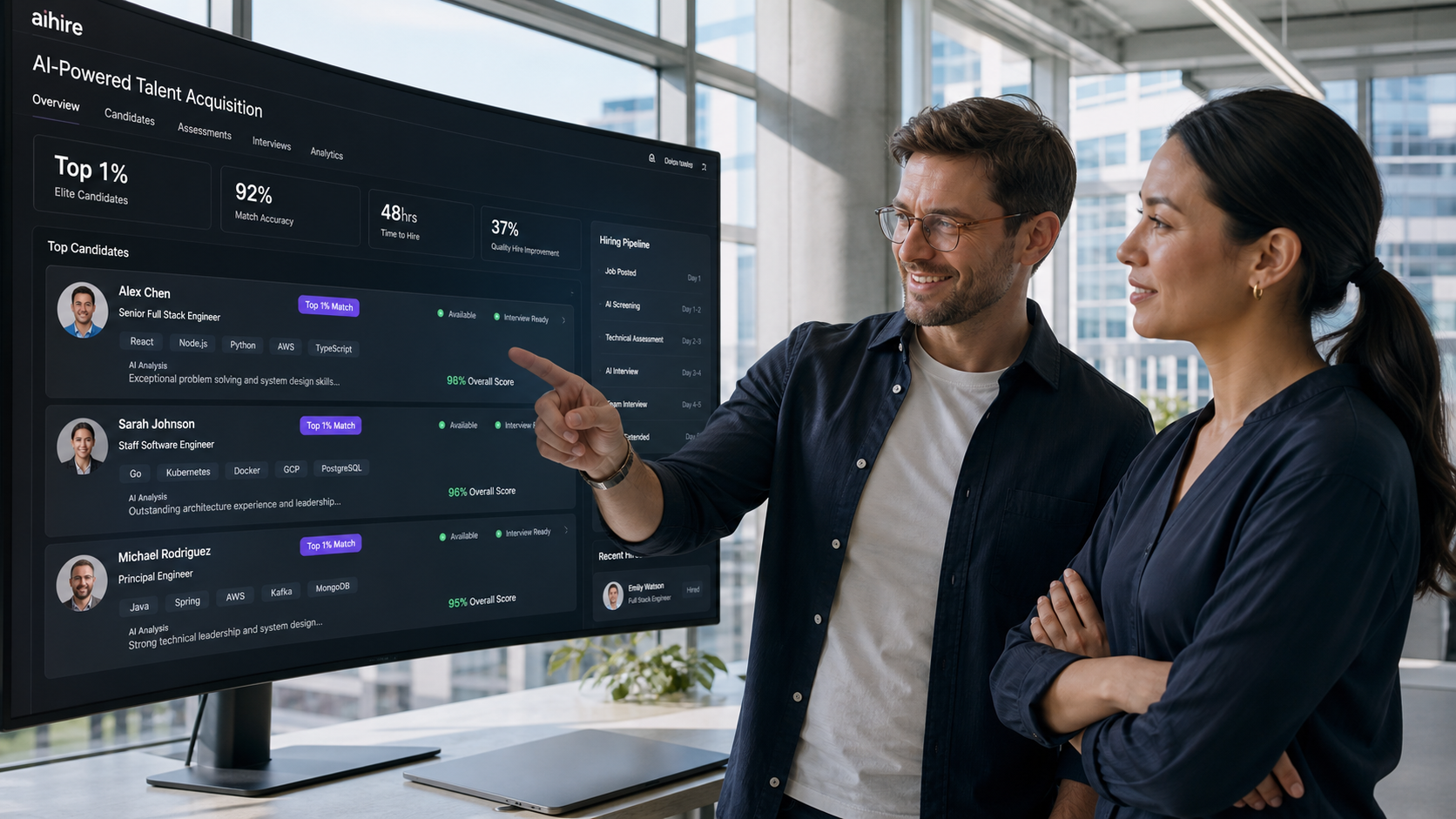
For product companies, this means the difference between waiting weeks for a shortlist and receiving a curated list of highly qualified candidates within hours. The technology behind an AI hiring partner typically draws on pre-screened talent networks, so the heavy lifting of verifying skills and experience has already happened before a founder even posts a role. That is what makes the 48-hour timeline realistic rather than aspirational. The matching happens against a network that has already been screened for quality, so speed does not come at the cost of standards.
This is a crucial distinction for founders to understand. Speed without quality is just noise. The real value of an AI hiring partner lies in its ability to deliver both at once, connecting startups with top 1 percent talent without forcing a trade-off between how fast a role gets filled and how well the hire actually performs.
Why Startups and Product Companies Benefit the Most
Large enterprises often have the luxury of dedicated recruiting teams, employer brand recognition, and big budgets to absorb slow hiring cycles. Startups rarely have any of that. A five-person engineering team cannot afford to spend two months finding a senior backend developer while competitors ship faster and investors ask harder questions about execution speed.
This is precisely why an AI hiring partner has become so valuable for early and growth-stage companies. It levels the playing field. A ten-person startup can access the same caliber of talent-matching intelligence that used to be reserved for companies with massive recruiting budgets. Founders get to focus on building the product and the culture, while the heavy lifting of sourcing and initial vetting happens in the background, powered by data rather than guesswork.
Product companies in particular benefit because their hiring needs are often highly specific. A fintech startup building a payments engine needs a very different skill set than a healthtech company building patient-facing software. Generic hiring processes struggle with this kind of specificity, but an AI hiring partner trained on skills-based matching can zero in on the right technical and domain expertise far more precisely than a manual keyword search through resumes ever could.
Top 1% Talent Is Not a Marketing Phrase, It Is a Filtering Problem
The phrase “top 1 percent talent” gets used loosely across the hiring industry, but for founders it should mean something concrete: people who have already been tested for real skill, not just credentials on paper. An AI hiring partner earns that claim by applying rigorous, consistent filtering criteria across a massive talent network, something that is nearly impossible to do manually at scale.
This matters enormously for startups because a single bad hire in a small team can be far more damaging than in a large organization. When a team has five engineers, one weak hire does not just underperform; it drags down velocity for the entire group. Founders who lean on an AI hiring partner are effectively outsourcing the hardest, most error-prone part of hiring, the initial quality filter, to a system built specifically to get that filter right.
Building a Hiring Strategy Around Speed and Quality
Founders who want to make the most of this shift should think of an AI hiring partner not as a replacement for human judgment, but as an accelerant for it. The AI does the heavy lifting of sourcing and initial matching, while founders and hiring managers still make the final call after interviews and culture-fit conversations. This combination, machine speed paired with human decision-making, is what makes the 48-hour hiring model sustainable rather than reckless.
As the talent market continues to grow more competitive, especially for specialized technical and product roles, the startups that win will be the ones that treat hiring speed as a strategic priority, not an afterthought. Platforms and tools built around an AI hiring partner model are becoming a practical way for founders to compete with far larger companies for the same scarce talent, without needing an in-house recruiting team of their own.
For any founder building a product company in today’s environment, the lesson is simple. The startups that grow fastest are usually the ones that hire smartest, and increasingly, hiring smart means letting an AI hiring partner handle the parts of the process that speed and data can solve, so founders can spend their time on the parts that only human judgment can.