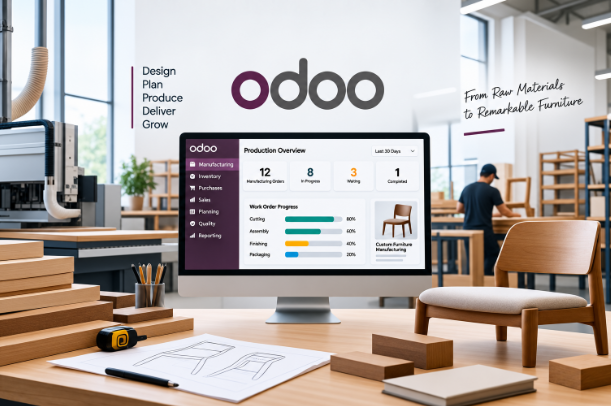
Modernizing US Furniture Production with Odoo ERP
Furniture manufacturing involves more than turning raw materials into finished products. Manufacturers must coordinate materials, product variations, production stages, inventory, and delivery while keeping customer orders on schedule. As operations grow, managing these processes across disconnected systems can create visibility and coordination challenges.
Odoo ERP brings manufacturing, inventory, purchasing, sales, and other business operations into a connected system. For US furniture manufacturers, this can provide a more structured way to manage production while adapting to different products, materials, and customer requirements. A closer look at Odoo ERP for furniture manufacturers shows how the platform can support these interconnected workflows.
Why Furniture Production is Difficult to Manage
Furniture manufacturing involves several moving parts that need to stay coordinated from the initial order to final delivery. Unlike standardized production, furniture businesses often work with different dimensions, materials, finishes, designs, and customer-specific requirements. Even a small change to a product can affect material requirements, production steps, inventory, and delivery timelines.
Material planning is another challenge. Manufacturers may need to manage wood, metal, glass, fabric, hardware, finishing materials, and packaging components across multiple products. If inventory information is not connected to production planning, teams may discover material shortages only after an order has entered production.
Production itself can involve several stages, such as cutting, machining, assembly, finishing, quality inspection, and packing. When these activities are tracked manually or across separate systems, it becomes harder to see where an order stands or identify delays early.
For growing US furniture manufacturers, connecting these processes is therefore less about adding another software tool and more about creating a consistent flow of information across sales, purchasing, inventory, and production.
How Odoo Connects the Furniture Production Workflow
Odoo connects furniture production by linking the activities that happen before, during, and after manufacturing. Instead of treating sales, inventory, purchasing, and production as separate processes, the ERP can connect them into a continuous workflow.
1) Sales Order: The process starts when a customer order is confirmed. Product and order information provides the basis for planning what needs to be produced and delivered.
2) Material Availability: Odoo can connect production requirements with inventory information, helping teams determine whether the required materials and components are available.
3) Purchasing: When materials are unavailable, purchasing activities can be initiated to replenish the required components before they affect production.
4) Manufacturing Order: Once materials are available, a manufacturing order can organize the production of the required furniture items.
5) Work Orders: Production can then move through defined operations such as cutting, machining, assembly, finishing, and packing.
6) Quality Checks: Quality control activities can be incorporated into the production workflow at relevant stages before products move forward.
7) Finished Inventory: Once manufacturing is completed, finished products can be recorded in inventory and prepared for the next stage.
8) Delivery: The completed order can then move from finished inventory toward delivery, completing the production-to-customer cycle.
This connected workflow gives sales, purchasing, warehouse, and production teams a shared view of order progress. More importantly, it helps reduce the need to repeatedly transfer information between disconnected systems or manually coordinate every stage of production.
Managing Furniture BOMs and Material Requirements
A furniture product is only as manageable as the information behind its production requirements. A Bill of Materials (BOM) defines the components and quantities needed to manufacture a finished product, giving production teams a structured reference for planning materials and manufacturing activities.
For example, a wooden dining table may require a tabletop, legs, brackets, screws, finishing materials, and packaging components. Each of these items needs to be accounted for before production begins. As furniture manufacturers handle more products and configurations, maintaining this information accurately becomes increasingly important.
Odoo uses BOMs as part of its manufacturing workflow, connecting product requirements with manufacturing orders and material planning. This can help teams determine what materials are required, check availability, and identify purchasing requirements before production starts.
For manufacturers working with complex furniture products, understanding how furniture Odoo BOM structures can support production planning can be particularly useful. A well-defined BOM provides a foundation for coordinating materials, production steps, and inventory while reducing the need to manage these details separately.
The result is a clearer connection between what a customer orders and what the production team needs to manufacture it. When BOM data, inventory, purchasing, and manufacturing are aligned, teams can plan production with better visibility into material requirements and potential shortages.
Improving Production Planning and Work Orders
Once materials are planned, the next challenge is keeping production moving in the right sequence. Furniture manufacturing can involve several operations, and a delay in one stage can affect every stage that follows. Odoo can help organize these activities through manufacturing orders, work orders, and work centers.
For furniture manufacturers, production planning can be structured around key areas such as:
- Defined production stages: Operations such as cutting, drilling, assembly, sanding, finishing, and packing can be organized into a clear sequence.
- Work center coordination: Different operations can be associated with the appropriate work centers, helping teams understand where each task needs to be performed.
- Production progress: Teams can track which operations are completed, in progress, or still waiting to begin.
- Bottleneck visibility: If a particular operation is taking longer than expected, production managers can identify where work is accumulating and respond accordingly.
- Order coordination: Multiple manufacturing orders can be managed with greater visibility into production requirements and progress.
For example, if finishing becomes a bottleneck, the production team can identify the delay before it affects packing and delivery. This visibility helps manufacturers coordinate production more systematically rather than relying on separate spreadsheets, verbal updates, or manual status checks.
For US furniture manufacturers handling multiple orders at once, connecting production planning with work orders can provide a clearer path from scheduled production to completed products.
Handling Custom Furniture and Product Variations
Furniture manufacturers rarely produce every item in exactly the same configuration. Customers may request different dimensions, materials, colors, finishes, fabrics, or hardware, and these changes can affect both production requirements and inventory planning.
Odoo can help manufacturers organize these variations within their product and manufacturing workflows. Instead of treating every variation as an entirely unrelated product, businesses can structure products around different attributes and configurations while maintaining the information needed for production.
Common furniture variations may include:
- Dimensions: Different lengths, widths, heights, or configurations.
- Materials: Different types of wood, metal, glass, fabric, or other components.
- Finishes: Different colors, coatings, textures, or surface treatments.
- Hardware: Different handles, hinges, brackets, fittings, or other components.
Managing these differences within a connected ERP workflow can help sales and production teams work from consistent product information. It can also make it easier to understand how a customer’s specific requirements affect materials, production activities, and inventory.
For manufacturers handling both standard and customized furniture orders, the ability to manage product variations alongside production processes can provide a more structured approach to fulfilling different customer requirements without losing visibility across the wider manufacturing workflow.
Where Odoo Customization Can Fit
While Odoo provides a broad set of manufacturing and business capabilities, every furniture manufacturer has its own processes. A company producing standard furniture may have very different requirements from one handling highly customized orders, multiple production facilities, or complex integrations.
Customization can be useful when the standard workflow does not fully match a specific operational requirement. Common areas may include:
- Production workflows: Adapting manufacturing stages, approvals, or production rules to existing processes.
- Custom reporting: Creating reports and dashboards around production, inventory, orders, or operational performance.
- Integrations: Connecting Odoo with e-commerce platforms, accounting systems, shipping providers, barcode solutions, or other business applications.
- Specialized workflows: Supporting unique requirements that are specific to a manufacturer’s products or operations.
This does not mean every process needs to be customized. In many cases, manufacturers can use Odoo’s standard functionality and introduce changes only where there is a clear business need. When additional development is required, Odoo software development can help adapt the platform while keeping the broader ERP workflow connected.
The goal should be to make the system fit the business where necessary without creating unnecessary complexity that becomes difficult to maintain as the company grows.
What US Furniture Manufacturers Should Consider Before Adopting Odoo
Choosing an ERP is not only about selecting software. Furniture manufacturers also need to consider how the system will fit their existing processes, data, people, and technology. Before adopting Odoo, manufacturers should evaluate a few practical areas:
1) Map existing production processes
Document how orders currently move from sales through purchasing, production, quality control, inventory, and delivery. This helps identify where Odoo can support existing workflows and where changes may be needed.
2) Review product and BOM data
Accurate product information, material lists, and BOMs are essential for reliable production planning. Cleaning and organizing this data before implementation can make the transition smoother.
3) Define customization requirements
Separate genuine business requirements from processes that could be handled using Odoo’s standard capabilities. This helps prevent unnecessary customization and keeps the system easier to maintain.
4) Plan integrations early
Manufacturers should identify the systems that need to work with Odoo, such as e-commerce platforms, accounting software, shipping tools, or other operational applications.
5) Prepare teams for the change
Production, warehouse, purchasing, sales, and management teams all interact with the ERP differently. Clear workflows and practical training can help employees adopt the system more effectively.
Taking these factors into account before implementation can help furniture manufacturers build an ERP environment that supports their actual operations rather than simply replacing existing software.
Conclusion
For US furniture manufacturers, modernizing production is about more than replacing spreadsheets or adding another software system. The bigger opportunity is to connect sales, materials, purchasing, manufacturing, quality, inventory, and delivery within a consistent workflow.
Odoo can provide that connected foundation while giving manufacturers flexibility to structure production around their products, materials, and operational requirements. From managing BOMs and work orders to tracking production and supporting customized workflows, an integrated ERP can make information easier to coordinate across teams.
The results ultimately depend on how well the system is aligned with the manufacturer’s processes and how thoughtfully it is implemented. Businesses evaluating Odoo should therefore consider their production workflows, data, integrations, and long-term requirements before getting started.
Working with an experienced Odoo ERP software development company can also help manufacturers evaluate these requirements and build an ERP environment that can adapt as their operations grow.