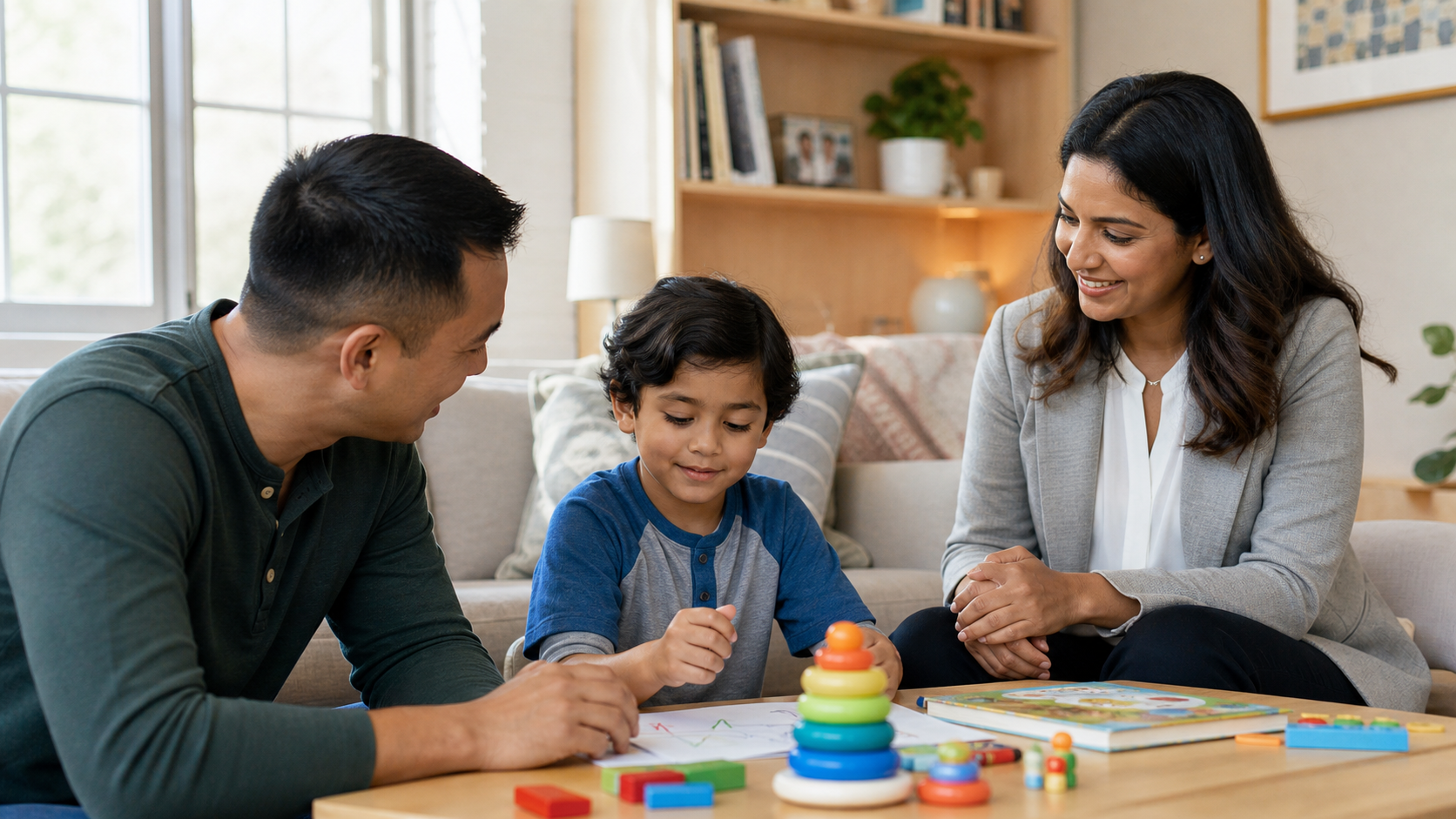
Role of Parent Training in Child Development: How Parents Can Support Healthy Growth
The Role of Parent Training in Child Development is to give parents practical, evidence informed skills for supporting children’s communication, behavior, emotional regulation, learning and everyday independence. Parent training does not mean teaching adults one rigid way to raise a child. Effective programs typically help caregivers understand development, respond consistently to behavior, reinforce useful skills, create predictable routines and adapt strategies to a child’s individual needs. Research supports several structured parent based interventions for particular childhood behavioral and developmental concerns, although outcomes depend on the child, family, program, implementation and clinical context.
Children develop through continuing interactions with their families, schools, communities and wider environments. Parents and other caregivers are especially influential because many important learning opportunities occur during ordinary activities such as meals, play, getting dressed and preparing for school.
Parent training can turn these everyday interactions into opportunities for learning and connection.
It can also provide strategies for specific challenges. Depending on a child’s needs, appropriately selected programs may form part of support for behavioral difficulties, attention deficit hyperactivity disorder, autism related needs, developmental delays or other concerns.
This guide explains what parent training involves, its potential benefits, common approaches and how families can choose appropriate professional support.
What Is the Role of Parent Training in Child Development?
Parent training is a structured approach that teaches caregivers practical strategies for encouraging desired skills, responding to challenging behavior and supporting a child’s development.
The term covers different interventions rather than one universal program.
Some approaches emphasize positive behavior support. Others focus on communication, parent child interaction, daily routines or skills relevant to a particular developmental or behavioral condition.
Programs may be delivered individually, in groups, in clinics, through schools or using telehealth where appropriate.
What Does Parent Training Teach?
Content varies, but common areas include:
• Understanding child development
• Setting realistic expectations
• Positive reinforcement
• Clear communication
• Consistent boundaries
• Emotional coaching
• Play and learning
• Managing challenging behavior
• Building routines
• Supporting independence
• Tracking progress
Training should consider the child’s developmental level rather than focusing only on chronological age.
Parent Training Is Not About Blaming Parents
Parent interventions are used because caregivers have frequent opportunities to support learning, not because developmental or behavioral conditions can simply be attributed to parenting.
Child development reflects complex interactions among biological, psychological, social and environmental factors.
For neurodevelopmental conditions in particular, parent training should not be framed as a way to remove or cure the underlying condition.
Role of Parent Training in Child Development at Home
Skills practiced in professional sessions become most useful when families can apply them naturally in daily life.
For example, communication can be encouraged during breakfast, play or shopping. Independence can be supported while dressing or organizing school materials.
This makes the home a valuable environment for practicing skills repeatedly in meaningful contexts.
7 Powerful Benefits of Parent Training for Children
No program can guarantee a particular developmental result. However, well matched parent mediated interventions can provide meaningful support in several areas.
1. More Positive Parent Child Interaction
Healthy development is supported by responsive interaction.
Parent coaching can encourage caregivers to notice children’s communication attempts, follow appropriate interests during play and provide positive attention for useful behaviors.
This can make interaction more predictable and enjoyable.
Some structured interventions specifically coach parents while they interact with their children, allowing techniques to be practiced rather than merely discussed.
2. Better Communication Support
Communication involves more than spoken vocabulary.
Young children may communicate through gestures, facial expressions, sounds, words or communication systems selected according to their needs.
Parents can learn how to create opportunities for communication, give a child sufficient time to respond and acknowledge meaningful attempts.
Children with significant speech or language concerns may also require assessment by a qualified speech and language professional.
3. More Effective Behavior Management
Challenging behavior can have many functions and causes.
A child might behave differently because a task is difficult, communication is limited, expectations are unclear, sensory conditions are uncomfortable or attention and reinforcement patterns are influencing behavior.
Parent training can teach caregivers to observe what happens before and after behavior rather than reacting only to the behavior itself.
This information can support more appropriate interventions.
4. Development of Emotional Skills
Children gradually learn to identify, express and regulate emotions.
Caregivers can support this development by labeling emotions, modeling coping strategies and maintaining predictable responses.
Developmental expectations matter.
A young child experiencing intense emotions may require substantial adult support rather than being expected to regulate in the same way as an older child.
5. Greater Independence in Daily Activities
Development includes practical skills as well as academic learning.
Parent coaching can help families break activities into manageable steps and reinforce progress.
Depending on age and ability, these activities might include dressing, hygiene, eating routines, packing a school bag or completing simple household responsibilities.
6. Better Consistency Across Daily Routines
Children often receive instructions from several adults.
Significantly different expectations and consequences can create confusion.
Training can help parents and other caregivers agree on key routines and responses where appropriate.
Consistency does not mean responding identically to every situation. Strategies should remain flexible enough to reflect the child’s needs and circumstances.
7. Greater Caregiver Confidence and Skills
Parents can find persistent behavioral or developmental challenges difficult to navigate without guidance.
Structured training provides specific strategies to try and a framework for evaluating whether they work.
Improving caregiver skills can make daily problem solving feel more manageable, although parent wellbeing may require support beyond training when significant stress, anxiety or other concerns are present.
Role of Parent Training in Child Development and Positive Behavior
Behavior is influenced by context.
Instead of simply labeling behavior as good or bad, many evidence based approaches examine what the child may be communicating or obtaining through that behavior.
Understanding Behavior Patterns
Professionals and caregivers may consider:
• What happened before the behavior?
• What exactly did the child do?
• What happened immediately afterward?
• Is there a consistent pattern?
• Does the behavior occur during particular tasks or environments?
Observing patterns can help identify reasonable hypotheses about why behavior occurs.
For persistent or dangerous behavior, professional assessment may be needed.
Using Positive Reinforcement
Positive reinforcement involves increasing the likelihood of a behavior by following it with something meaningful to the child.
That may include praise, attention, access to an activity or another appropriate consequence.
Effective reinforcement is specific and connected clearly to the behavior being encouraged.
Giving Clear Instructions
Children may struggle with instructions that are lengthy, vague or inconsistent.
Simple, age appropriate directions can make expectations easier to understand.
Role of Parent Training in Child Development Through Consistency
Consistency helps children learn relationships between actions and outcomes.
If expectations constantly change, learning can become more difficult.
However, consistent parenting should not mean rigid parenting. Development, disability, illness, tiredness and context can all require reasonable adaptation.
Parent Training and Language Development
Early communication grows through repeated social experiences.
Following the Child’s Attention
Parents can observe what interests a child and use that moment to communicate.
If a child is playing with a toy vehicle, for example, the parent might name what the child is doing or add simple language connected to the activity.
This links words to immediate meaning.
Expanding Communication
When children begin using words or short phrases, adults can model slightly richer language.
If a young child says “car,” a caregiver might naturally respond with “red car” or “car is moving,” depending on the child’s communication level.
The goal is exposure and interaction, not repeatedly testing the child.
Reading Together
Shared book reading can support vocabulary and conversation.
Parents can comment on pictures, respond to the child’s interests and ask questions appropriate to their developmental level.
When Communication Needs Professional Assessment
Development varies between children, but persistent communication concerns deserve professional discussion.
Parents can raise concerns with a pediatrician, general practitioner, health visitor, speech and language professional or appropriate local developmental service.
Early evaluation can clarify whether additional support is needed.
Parent Training for Children With ADHD
Behavioral parent training is among the psychosocial approaches used for children with attention deficit hyperactivity disorder.
Treatment planning should be individualized and guided by qualified healthcare professionals.
Creating Predictable Routines
Children with ADHD may benefit from external structure.
Visual schedules, clearly defined routines and simple task sequences can make expectations easier to follow.
A morning routine, for example, can be divided into individual steps rather than communicated as one broad instruction.
Reinforcing Target Behaviors
Parents can select a small number of clearly defined behaviors to encourage.
Feedback should be timely and specific.
Broad goals such as “behave better” are difficult to measure. A target such as beginning homework after an agreed cue is more observable.
Working With Schools
When appropriate, coordination between families and educational professionals can improve consistency.
School based accommodations and interventions depend on the child’s needs and local educational system.
Role of Parent Training in Child Development With ADHD
Parent training does not cure ADHD.
Its role is to provide caregivers with strategies for managing behavior, establishing structure and supporting functional skills.
Depending on age, symptoms and impairment, professional treatment plans may also include school interventions, child focused therapy, medication or other supports.
Parent Training and Autism Support
Parent mediated interventions are also used with some autistic children.
Goals should be individualized and respectful of the child’s communication style, needs and wellbeing.
Supporting Functional Communication
Parents can learn strategies that encourage communication during everyday routines.
For some children, this involves spoken language. Others may use augmentative and alternative communication.
The objective should be meaningful communication rather than forcing a particular communication method without considering the child’s needs.
Supporting Predictability
Some autistic children find unexpected changes difficult.
Visual supports, preparation and clear routines can make transitions more predictable for certain children.
Strategies should be individualized rather than applied to every autistic person automatically.
Understanding Sensory Needs
Sensory experiences can influence behavior and participation.
A child may react strongly to particular sounds, textures, lights or other stimuli.
Qualified occupational therapists and other professionals can help evaluate functional sensory concerns when necessary.
Role of Parent Training in Child Development for Autistic Children
Training can help parents understand their child’s strengths and needs while embedding useful strategies into everyday routines.
It should not promise to make a child no longer autistic.
Families should be cautious of programs making cure claims or guaranteeing normalization.
Parent Training and Emotional Development
Caregivers play an important role in helping children understand emotions.
Naming Emotions
Children benefit from learning words associated with feelings and experiences.
Parents can use everyday situations to identify emotions without turning every interaction into a formal lesson.
Recognizing emotions is one part of learning how to respond to them.
Modeling Regulation
Children observe how adults manage frustration, disappointment and conflict.
Caregivers can model appropriate coping behaviors such as problem solving, taking space when safe or expressing feelings without aggression.
Validating Without Removing Boundaries
Recognizing an emotion does not require allowing every behavior.
A parent can acknowledge that a child is angry while maintaining a reasonable safety boundary.
This distinction can help children learn that emotions are acceptable while some actions remain inappropriate.
Role of Parent Training in Child Development Through Play
Play provides opportunities to practice communication, social interaction, creativity and problem solving.
Child Led Play
In appropriate contexts, following the child’s interests can encourage engagement.
The parent can observe, imitate or comment without controlling every part of the activity.
This creates opportunities for shared attention and communication.
Learning Through Everyday Activities
Developmental learning does not require expensive products.
Sorting laundry can involve categorization. Cooking can support counting and sequencing. Shopping can involve language and decision making.
The most appropriate activity depends on the child’s age and abilities.
Avoiding Excessive Pressure
Turning every activity into a performance test can reduce enjoyment.
Children also need unstructured play, rest and ordinary family interaction.
A sustainable approach integrates learning opportunities without making the home feel like a continuous therapy session.
Choosing a Parent Training Program
Programs differ in goals, evidence base and professional requirements.
Start With the Child’s Needs
Identify the concern you are trying to address.
A family seeking support for severe behavioral difficulties may need a different program from parents wanting general developmental guidance.
A professional assessment can help when needs are unclear.
Check Provider Qualifications
Relevant qualifications depend on the intervention.
Providers may include psychologists, behavioral professionals, occupational therapists, speech and language professionals, social workers or other trained practitioners.
Verify professional credentials through appropriate regulatory organizations where applicable.
Ask About the Evidence
A provider should be able to explain why a program is recommended and what outcomes it is designed to address.
Be cautious of universal claims that one approach works for every child.
Warning Signs in Parent Training Programs
Be cautious when programs:
• Guarantee developmental outcomes
• Claim to cure neurodevelopmental conditions
• Blame parents for a child’s diagnosis
• Discourage necessary medical care
• Use fear to sell expensive packages
• Cannot explain practitioner qualifications
• Refuse to discuss potential limitations
• Make scientific claims without credible evidence
Families deserve realistic information about both benefits and limitations.
Parent Training at Different Developmental Stages
Parenting strategies naturally change as children mature.
Early Childhood
Young children often benefit from predictable routines, responsive communication and simple expectations.
Play and everyday activities offer frequent opportunities to build early skills.
School Age Children
As children develop, parent training may focus increasingly on independence, organization, problem solving and school related routines.
Children can often participate more actively in establishing appropriate goals.
Adolescence
Adolescents require increasing autonomy.
Parent focused interventions may therefore emphasize communication, collaborative problem solving, boundaries and gradually increasing responsibility.
Strategies appropriate for preschool children should not simply be transferred unchanged to teenagers.
Measuring Whether Parent Training Is Working
Progress should be defined in meaningful and observable ways.
Instead of broad goals such as “improve behavior,” identify what improvement would look like.
For example, a family might track the number of successful transitions during a particular routine or whether a child independently completes selected age appropriate tasks.
Avoid measuring every behavior continuously.
Tracking should provide useful information without creating excessive burden for the family.
If a strategy consistently fails, review it with the professional involved rather than simply increasing intensity.
Supporting Parents During the Training Process
Parent training requires time and practice.
Strategies that work during a clinic session may need adaptation when used with siblings, school schedules and everyday family demands.
Set Realistic Goals
Choose a manageable number of priorities.
Trying to change many behaviors simultaneously can make it difficult to understand what is working.
Practice in Real Situations
Skills become useful when they can be applied during normal routines.
This supports generalization beyond structured sessions.
Maintain Parent Wellbeing
Caregiving can become demanding, particularly when families are navigating substantial developmental, medical or behavioral needs.
Practical support, respite, peer networks or professional mental health care may be appropriate depending on circumstances.
Supporting caregiver wellbeing can also make intervention plans more sustainable.
Frequently Asked Questions
What is the Role of Parent Training in Child Development?
Parent training teaches caregivers practical strategies for supporting communication, behavior, emotional skills, learning and independence during everyday interactions.
Does parent training improve child behavior?
Evidence supports specific behavioral parent interventions for some childhood concerns, but outcomes vary according to the child, family, intervention and consistency of implementation.
Is parent training useful for ADHD?
Behavioral parent training can form part of ADHD management, particularly for behavioral and functional challenges, alongside other supports recommended by qualified professionals.
Can parent training support autistic children?
Parent mediated approaches can support communication, routines and functional skills for some autistic children when goals are individualized and respectful of their needs.
At what age should parent training begin?
There is no single starting age. Programs exist for different developmental stages, and support should be selected according to the child’s and family’s needs.
How can parents choose a reliable training program?
Look for appropriately qualified providers, clear goals, relevant evidence, individualized strategies and realistic claims without guarantees or promises of cures.
Conclusion
The Role of Parent Training in Child Development is to help caregivers create supportive everyday environments where children can practice communication, emotional, behavioral and independence skills. Effective programs use developmentally appropriate strategies and adapt them to the individual child instead of relying on one universal parenting formula. Parent training can be particularly valuable when integrated with appropriate educational, developmental or healthcare support. The strongest programs empower families with practical skills while respecting children’s individual strengths, needs and developmental differences.