Lion’s Mane Mushroom Powder: Benefits, Uses, Safety and What Science Says
Lion’s mane mushroom powder is made from Hericium erinaceus, an edible mushroom recognized by its distinctive white, cascading spines and increasingly marketed as a functional food and dietary supplement. Research has investigated lion’s mane for possible effects involving cognition, mood, nerve biology and other areas, but human evidence remains limited and does not establish it as a treatment for dementia, depression, nerve disease or other medical conditions. Consumers interested in trying the powder should pay attention to whether it contains fruiting body, mycelium or both, how it was processed, independent quality testing, serving information and potential medication or allergy concerns.
Interest in functional mushrooms has expanded rapidly, and lion’s mane is among the most recognizable products in this category. Powders are convenient because they can be mixed into drinks, smoothies and foods or incorporated into a daily supplement routine.
Convenience, however, can make it easy to overlook an important point: not every mushroom powder is equivalent.
Species identity, growing substrate, plant part or fungal material used, extraction, concentration and quality control can all differ between products. Marketing claims can differ even more dramatically.
This guide separates plausible research areas from established facts and explains what to check before purchasing or using lion’s mane.
What Is Lion’s Mane Mushroom Powder?
Lion’s mane is the common name for Hericium erinaceus, an edible fungus found naturally in parts of Asia, Europe and North America and also cultivated commercially.
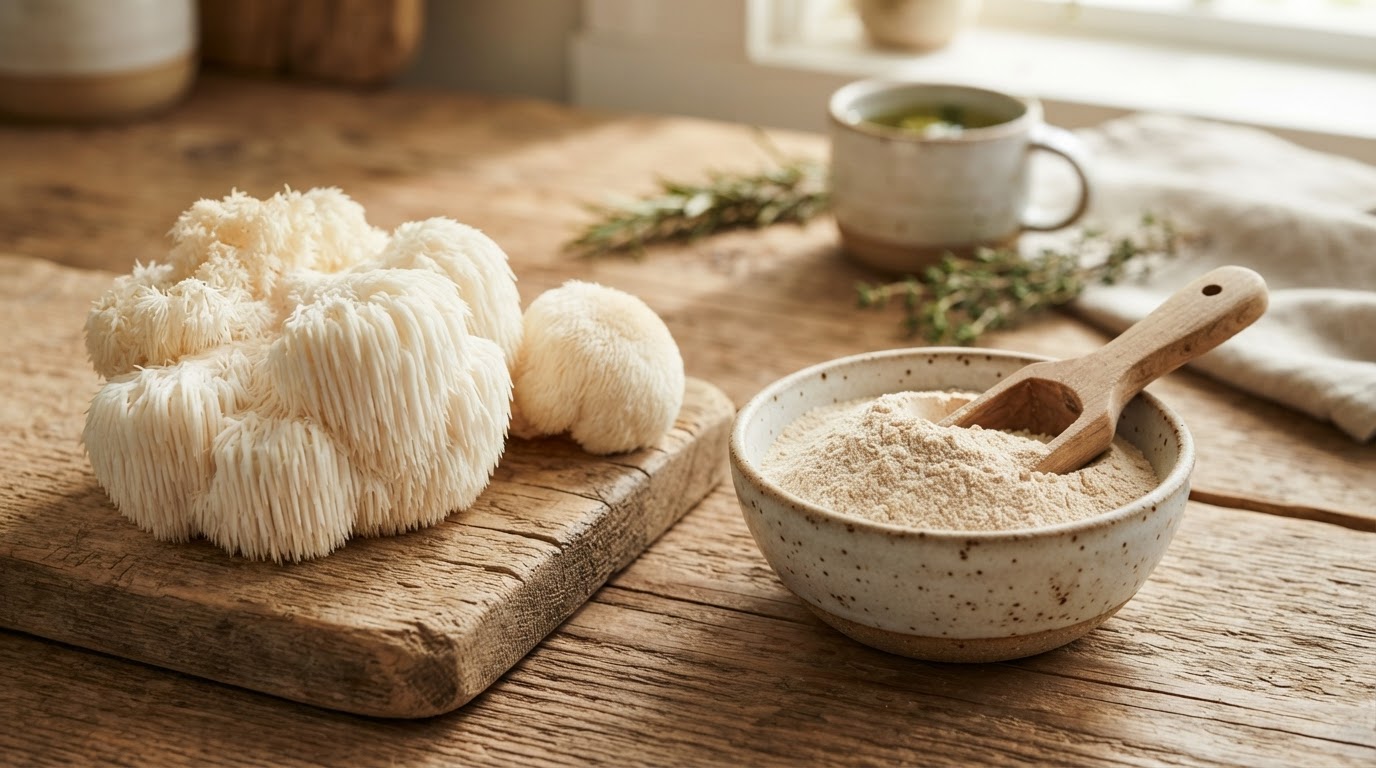
The mature fruiting body has long white spines that give the mushroom its characteristic mane like appearance.
Powdered products can be produced by drying and milling mushroom material or by processing extracts into powder.
Those manufacturing differences matter when comparing supplements.
Fruiting Body Versus Mycelium
The fruiting body is the visible mushroom structure people generally recognize.
Mycelium is the network of fungal filaments through which a fungus grows.
Commercial supplements can contain fruiting body, cultured mycelium or combinations of material. Mycelium based products may also contain components of the growth substrate, depending on how they are cultivated and processed.
Neither the word fruiting body nor mycelium alone proves that a product is clinically superior.
Lion’s Mane Extract Versus Regular Powder
A simple mushroom powder can be produced by drying and grinding material.
Extract powders undergo additional processing intended to extract particular soluble constituents before the resulting material is concentrated or dried.
An extract may therefore have a different chemical profile from an ordinary whole mushroom powder.
Why Lion’s Mane Mushroom Powder Products Differ
The label lion’s mane does not guarantee that two products contain chemically equivalent material.
Differences can arise from:
• Fungal material used
• Cultivation method
• Growth substrate
• Drying process
• Extraction method
• Extract concentration
• Storage conditions
• Testing standards
This is one reason research involving a particular preparation should not automatically be generalized to every retail powder.
7 Potential Benefits of Lion’s Mane Mushroom Powder
Claims surrounding lion’s mane range from reasonable research questions to unsupported promises.
The following areas have attracted scientific interest, but potential benefits should not be interpreted as guaranteed health outcomes.
1. Potential Cognitive Support
Cognition is one of the most heavily promoted uses of lion’s mane.
Small human studies have explored whether particular Hericium erinaceus preparations may affect aspects of cognitive function. Some have reported potentially promising findings in selected groups.
However, the evidence base remains limited by issues such as relatively small sample sizes, different preparations and short study periods.
Larger, well designed trials are needed before strong conclusions can be made.
2. Research Into Nerve Biology
Lion’s mane contains compounds that have attracted interest in laboratory research involving neural biology.
Much of this evidence comes from cell and animal experiments.
Such studies can help scientists investigate mechanisms, but laboratory findings cannot be assumed to produce the same effects in humans consuming commercially available powder.
3. Possible Mood Related Effects
A limited amount of research has examined lion’s mane in relation to mood, anxiety or stress related outcomes.
Results from small studies have generated interest but do not establish the mushroom as a treatment for anxiety disorders or depression.
Anyone experiencing persistent anxiety, depression or substantial changes in mood should seek appropriate healthcare rather than replacing established care with a supplement.
4. Provides Mushroom Derived Nutrients and Compounds
Lion’s mane is an edible mushroom that contains fungal polysaccharides and other naturally occurring compounds.
The nutritional profile of a particular powder depends on processing and serving size.
Supplement powders should not automatically be treated as nutritionally identical to eating fresh mushrooms.
5. Easy Addition to Foods and Drinks
Powder offers practical convenience.
It can often be mixed with coffee, tea, smoothies, soups or other foods according to product directions and personal preference.
Convenience is a genuine product characteristic even when specific medical claims remain uncertain.
6. Potential Source of Fungal Beta Glucans
Mushrooms contain beta glucans, a group of polysaccharides that vary structurally between species and products.
The amount in a commercial powder can vary substantially.
If beta glucan content is important to your buying decision, look for quantified analytical information rather than relying only on phrases such as high polysaccharides.
7. Active Area of Scientific Research
Lion’s mane continues to receive scientific interest.
Researchers are investigating its chemistry, biological activity and potential applications.
That research is valuable, but ongoing investigation is not evidence that every proposed benefit has already been demonstrated in people.
Lion’s Mane Mushroom Powder and Brain Health
Brain health is the area most likely to attract exaggerated supplement claims.
It deserves careful distinction between preliminary evidence and proven treatment.
Does Lion’s Mane Improve Memory?
Current evidence does not justify guaranteeing memory improvement for healthy people who use ordinary commercial powder.
Some small clinical studies involving specific preparations and populations have reported changes in cognitive measures.
These findings are better understood as reasons for further study than proof of a universal cognitive effect.
Can It Prevent Dementia?
There is not sufficient evidence to establish lion’s mane powder as a way to prevent dementia.
Dementia is a broad clinical category with multiple causes.
People experiencing memory changes should seek medical evaluation, particularly when symptoms are new, progressive or affecting daily activities.
What About Nerve Growth Factor?
Lion’s mane is frequently marketed using claims involving nerve growth factor, often abbreviated NGF.
Laboratory research involving compounds from Hericium species has contributed to this interest.
Lion’s Mane Mushroom Powder and Human Evidence
A biological effect observed in cultured cells does not demonstrate that consuming a powder will produce the same result in the human brain.
Absorption, metabolism, dose and biological availability all matter.
Consumers should therefore be cautious when laboratory mechanisms are presented as established clinical benefits.
Important Compounds in Lion’s Mane
Two compound groups frequently discussed in scientific literature and supplement marketing are hericenones and erinacines.
Hericenones
Hericenones are compounds associated primarily with the fruiting body in scientific discussions.
Their laboratory activity has contributed to interest in lion’s mane and neurobiology.
The presence of such compounds does not demonstrate a clinical outcome in humans.
Erinacines
Erinacines are another group of compounds investigated in Hericium research and commonly associated with mycelial material.
Different cultivation and processing methods can influence product chemistry.
Beta Glucans
Beta glucans occur in the cell walls of fungi and have been studied extensively across different mushroom species.
Not all polysaccharides are beta glucans.
Why Compound Claims Require Context
A supplement may advertise particular compounds without stating how much of them the final serving contains.
Ask whether reported values come from actual batch testing and which analytical method was used.
A named compound on a marketing page should not be confused with evidence of clinical effectiveness.
Lion’s Mane Mushroom Powder Dosage
There is no universally established clinical dose of lion’s mane powder for improving cognition or treating a medical condition.
Research studies have used different preparations and amounts.
Follow Product Instructions
For ordinary supplement use, consumers should follow the serving instructions of the specific product unless a qualified healthcare professional recommends otherwise.
Do not assume that increasing the amount produces greater benefits.
Different powders and extracts may have different concentrations.
Whole Powder and Extract Dosages Are Not Equivalent
A gram of ordinary dried mushroom powder is not necessarily equivalent to a gram of concentrated extract.
Likewise, products labeled with extraction ratios may not be directly comparable without additional manufacturing information.
This makes generic internet dosage recommendations unreliable.
Starting Lion’s Mane Mushroom Powder Carefully
If a healthcare professional considers supplementation appropriate, following the product directions and monitoring tolerance is more sensible than immediately taking large quantities.
People with medical conditions, allergies or ongoing medications may benefit from discussing supplementation with a qualified healthcare professional first.
How to Use Lion’s Mane Mushroom Powder
Powder is flexible and can be added to various foods.
Mix It Into Coffee
Lion’s mane powder is commonly added to coffee.
Its earthy mushroom flavor can be noticeable depending on the product and serving amount.
Adding it to coffee does not establish or amplify cognitive benefits.
Add It to Smoothies
Smoothies can mask some of the mushroom flavor.
Combine the powder with ingredients you already tolerate and enjoy.
Mix It Into Food
Depending on the manufacturer’s directions, powder can be incorporated into soups, sauces or other foods.
Check whether the product is designed as a conventional food ingredient, supplement or extract and use it accordingly.
When Should You Take Lion’s Mane Mushroom Powder?
There is no well established scientific evidence demonstrating one universally optimal time of day.
Some consumers use it with breakfast, while others simply take it when most convenient.
Consistency with product instructions matters more than unsupported claims about precise timing.
Lion’s Mane Safety and Side Effects
Human safety data are less extensive than marketing popularity might suggest.
Culinary consumption of edible mushrooms and use of concentrated supplements should also not automatically be treated as equivalent exposures.
Possible Side Effects
Published research and consumer use indicate that adverse effects can occur, although their frequency is not fully characterized across all products.
Potential concerns can include digestive discomfort and hypersensitivity reactions.
Stop using a product and seek appropriate medical advice if a significant unexpected reaction develops.
Mushroom Allergies
People can be allergic to mushrooms.
Anyone with a known mushroom allergy should exercise particular caution and consult a qualified healthcare professional where appropriate.
Difficulty breathing, significant swelling or other signs of a severe allergic reaction require emergency medical attention.
Pregnancy and Breastfeeding
Robust safety information for lion’s mane supplements during pregnancy and breastfeeding is limited.
Avoid assuming that natural means proven safe during pregnancy.
Discuss supplement use with an appropriate healthcare professional.
Lion’s Mane Mushroom Powder and Medication Interactions
Reliable human interaction data remain limited.
People taking prescription medicines, particularly those managing chronic conditions, should discuss supplements with their physician or pharmacist when relevant.
Do not discontinue prescribed medicine in favor of lion’s mane.
Who Should Be Particularly Cautious?
Some people should approach supplements more carefully because uncertainty has greater potential consequences.
People With Medical Conditions
If you have a diagnosed medical condition, ask whether supplementation is appropriate for your treatment plan.
This is especially relevant when supplements are being considered to address symptoms of that condition.
People Preparing for Surgery
Healthcare professionals often ask patients about supplement use before procedures.
Tell your surgical team about all supplements, medications and over the counter products you use.
Follow their instructions on what should be stopped and when.
Children
Adult supplement products should not automatically be given to children.
Pediatric safety and dosing require age appropriate consideration and professional guidance where necessary.
How to Choose High Quality Lion’s Mane Mushroom Powder
Quality is one of the most important issues in the supplement market.
Confirm the Species
Look for the scientific name Hericium erinaceus on the product information.
Common names alone can be less precise.
Species identification is especially useful when comparing mushroom products.
Identify What the Product Contains
The manufacturer should ideally make clear whether the product contains fruiting body, mycelium or a combination.
For mycelium products, information about cultivation and substrate can also be useful.
Look for Independent Testing
Third party laboratory testing can help assess identity, contaminants and composition, depending on the tests performed.
The existence of testing does not mean every possible quality issue has been evaluated.
Ask whether results apply to the actual production batch.
Certificate of Analysis for Lion’s Mane Mushroom Powder
A certificate of analysis can provide useful batch information.
Depending on the product, relevant testing may include:
• Identity
• Microbial contamination
• Heavy metals
• Pesticide residues where relevant
• Beta glucan content if claimed
• Other declared active constituents where analytically appropriate
Check whether the laboratory and methods are credible rather than accepting the words lab tested without supporting information.
Fruiting Body Versus Mycelium: Which Is Better?
This question is common but is often oversimplified.
Different parts and cultivation methods can contain different compounds.
Fruiting Body Products
Fruiting body powders contain the visible mushroom structure.
They are commonly marketed as closer to culinary mushroom material.
Composition still depends on strain, cultivation, processing and testing.
Mycelium Products
Mycelium is biologically part of the fungus.
Research has investigated compounds associated with mycelial preparations, including erinacines.
However, some commercial mycelium powders can include residual growth substrate.
Focus on Measured Composition
Rather than deciding entirely from the words fruiting body or mycelium, evaluate transparent manufacturing information and credible analytical testing.
A well characterized product is easier to assess than one relying on broad marketing terminology.
Powder Versus Capsules and Extracts
Different formats offer different practical advantages.
Powder
Powder is convenient for mixing into drinks and food.
Its flavor can be a disadvantage for some consumers.
Capsules
Capsules provide premeasured servings and hide the flavor.
They still contain powder or extract, so capsule format alone says nothing about product quality.
Extracts
Extracts can concentrate selected compounds depending on the extraction process.
An extraction ratio by itself does not provide a complete chemical analysis.
Which Lion’s Mane Product Is Best?
There is no universal best format.
Choose according to product transparency, testing, intended use, serving convenience and professional guidance where relevant.
Quality is more important than whether the supplement comes in powder or capsule form.
Organic Lion’s Mane Mushroom Powder
Organic certification concerns how products are produced under a specific certification standard.
It does not establish clinical effectiveness.
Verify Certification
If organic status matters to you, look for certification appropriate to the country where the product is being sold.
Do not rely exclusively on green packaging or words such as natural.
Organic Does Not Mean Contaminant Free
Certified organic products can still require quality testing.
Mushrooms can interact with substances present in their growing environment, making responsible cultivation and contaminant controls important.
Lion’s Mane and Functional Mushroom Blends
Commercial blends often combine lion’s mane with mushrooms such as reishi, cordyceps or chaga.
Check Individual Amounts
Proprietary blends can make it difficult to determine how much of each ingredient is present.
Transparent quantities make products easier to evaluate.
More Ingredients Are Not Automatically Better
Combining several supplements increases complexity.
It can also make identifying the cause of an adverse reaction more difficult.
Evaluate each ingredient rather than assuming a larger formula provides superior effects.
How to Read Lion’s Mane Marketing Claims
Supplement marketing often moves faster than clinical evidence.
Be Cautious With Cure Claims
Claims that lion’s mane cures dementia, repairs neurological disease or replaces medical treatment go beyond established evidence.
Serious neurological or psychiatric symptoms require qualified medical care.
Question Guaranteed Outcomes
Individuals can respond differently, and current research does not support guaranteed cognitive outcomes.
Testimonials are not controlled clinical evidence.
Look for Specific Evidence
When a company cites research, ask whether the study tested the same preparation sold in the product.
Research on isolated compounds, animals or a different extract cannot automatically validate a retail powder.
EEAT Standards for Lion’s Mane Mushroom Powder Information
Trustworthy health content should distinguish human evidence from laboratory findings, identify uncertainty and avoid promising treatment outcomes.
Sources such as peer reviewed research, established medical institutions and relevant regulatory agencies are more useful than anonymous promotional claims.
Health information should also be updated as the evidence evolves.
Storing Lion’s Mane Powder Correctly
Storage can affect product quality.
Follow the manufacturer’s instructions.
In general, powders should be protected from conditions that promote moisture uptake or degradation.
Keep the container properly closed and use clean, dry utensils.
Do not use products showing unexpected moisture, mold, unusual contamination or packaging damage.
Also observe the manufacturer’s expiration or best before information.
Frequently Asked Questions
What is lion’s mane mushroom powder?
Lion’s mane powder is made from processed Hericium erinaceus material and may contain dried fruiting body, mycelium, extract or a combination depending on the product.
Does lion’s mane mushroom powder improve memory?
Preliminary human research has explored cognitive effects, but current evidence is insufficient to guarantee that commercial lion’s mane powder improves memory.
How much lion’s mane mushroom powder should I take?
There is no universally established clinical dose for cognitive benefits. Follow the specific product instructions and seek professional guidance when medical considerations apply.
Can you take lion’s mane every day?
Some studies and commercial products involve repeated use, but long term safety data are limited. Suitability depends on the individual and specific preparation.
Does lion’s mane mushroom powder have side effects?
Side effects and allergic reactions are possible. Human safety evidence remains limited, particularly for long term use and highly concentrated products.
Is fruiting body lion’s mane better than mycelium?
Neither is universally superior. They can contain different compounds, so manufacturing quality, measured composition and credible testing provide more useful information.
Conclusion
Lion’s mane mushroom powder is an increasingly popular functional mushroom product with interesting but still developing scientific research behind many of its promoted uses. Preliminary studies justify further investigation into cognition and neurobiology, but they do not establish lion’s mane as a treatment for neurological or mental health conditions. Consumers should prioritize transparent ingredients, credible batch testing and realistic claims while following product instructions and considering medication or allergy risks. Quality evidence and professional healthcare advice should take priority over supplement marketing when health conditions are involved.