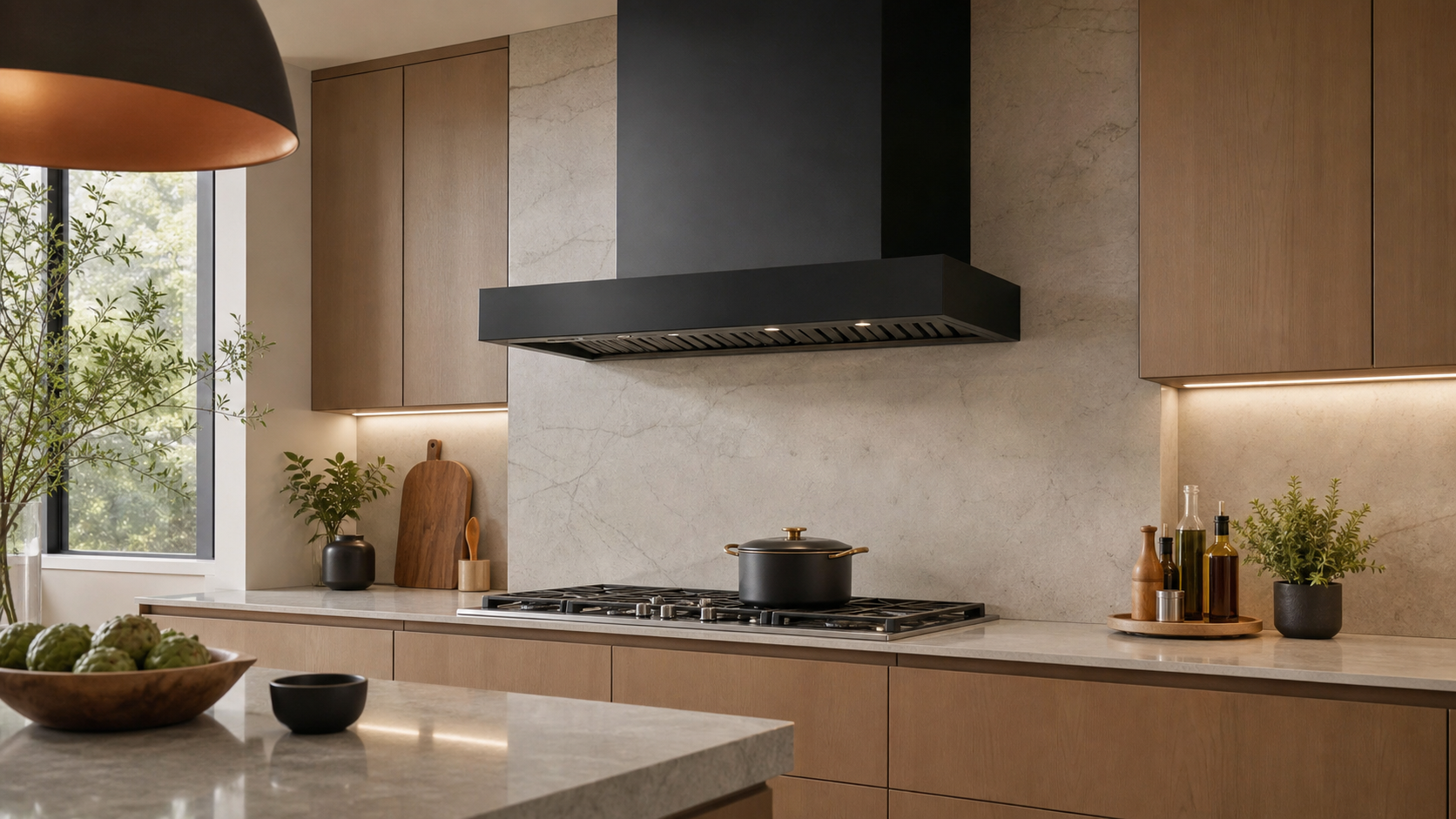
Black Range Hoods: The Complete Guide to Style, Ventilation and Buying the Right Hood
Choosing black range hoods can give a kitchen a distinctive visual focal point while providing ventilation for cooking generated grease, moisture, heat, odors and airborne contaminants. Available as wall mounted, under cabinet, island, insert and convertible models, black hoods can complement contemporary, industrial, transitional and traditional interiors. Appearance matters, but effective ventilation depends more heavily on correct hood dimensions, installation height, airflow, duct design, makeup air requirements and how the appliance is used and maintained.
A range hood is one kitchen appliance where style and building performance meet directly. An attractive hood that captures cooking emissions poorly can be frustrating, while an oversized, unnecessarily powerful unit can create excessive noise or pressure related complications.
Buyers should therefore evaluate ventilation requirements before focusing on finishes.
This guide covers hood types, airflow, sizing, filters, ducting, noise, installation, maintenance and design so homeowners can make an informed decision.
What Are Black Range Hoods?
Black range hoods are kitchen ventilation appliances finished primarily in black and designed for installation over or near a cooking surface.
The exterior can use painted or powder coated steel, black stainless steel, glass, decorative metal or other materials depending on the manufacturer.
Internally, most hoods combine a fan or blower with grease filtration, lighting and controls.
What Does a Range Hood Do?
Cooking releases airborne material into the kitchen.
The quantity and type depend on the food, temperature and cooking method. Frying and high temperature cooking, for example, can generate significant grease containing particles and odors.
Gas cooking also produces combustion byproducts that make effective ventilation particularly important.
A ducted hood captures air near the cooking surface and exhausts it outdoors. A recirculating hood filters air and returns it to the room.
Why Choose a Black Finish?
Black creates strong visual contrast against lighter cabinets, walls and backsplashes.
It can also coordinate with dark appliances, window frames, cabinet hardware or lighting fixtures.
Unlike a highly reflective stainless finish, matte black can create a softer architectural presence.
Black Range Hoods Versus Stainless Steel Hoods
The primary difference is usually exterior appearance rather than the fundamental ventilation principle.
Performance depends on blower design, capture area, filters, ducting and installation.
Choose finish according to design preferences, then compare actual technical specifications between individual models.
7 Stunning Benefits of Black Range Hoods
Black finishes have become popular because they combine practical appliance functionality with broad interior design compatibility.
1. Creates a Strong Kitchen Focal Point
A hood often occupies a highly visible location directly above the cooking area.
Black can turn this necessary appliance into an intentional design feature.
This effect can be particularly striking against white, cream, natural timber or light grey cabinets.
2. Works Across Multiple Interior Styles
Black is not limited to ultramodern kitchens.
A streamlined chimney hood can suit contemporary interiors, while a larger decorative black hood can complement farmhouse or transitional design.
The hood’s shape matters as much as its color.
3. Coordinates With Black Hardware
Many kitchens use black cabinet handles, faucets, window frames or light fittings.
A black hood can visually connect these separate details.
Avoid assuming that every black finish is identical. Matte, satin, textured and gloss surfaces can look noticeably different beside one another.
4. Available in Multiple Installation Types
Consumers can find black finishes across most major hood categories.
This means color usually does not force the homeowner into one installation style.
The building layout and cooking equipment can remain the primary selection factors.
5. Can Contrast With Natural Materials
Black works effectively alongside timber, stone and textured tile.
Against natural wood cabinetry, it can create definition without requiring every appliance to have the same finish.
6. Offers Matte and Gloss Finish Choices
Matte finishes produce a restrained look, while glossier surfaces reflect more surrounding light.
Maintenance experience can differ between finishes because fingerprints, oils and cleaning marks may be more visible on some surfaces.
7. Fits Both Compact and Large Kitchens
A simple under cabinet hood can provide a subtle dark detail in a small kitchen.
In a large kitchen, an oversized architectural canopy can become a major feature.
Scale should remain proportionate to cabinetry and, more importantly, appropriate for effective capture.
Types of Black Range Hoods
Installation style is one of the first decisions buyers should make.
Wall Mounted Range Hoods
Wall mounted hoods attach above a cooking surface positioned against a wall.
Many feature a chimney extending upward to conceal ductwork.
This format can provide a distinctive architectural appearance and effective capture when correctly sized.
Under Cabinet Range Hoods
Under cabinet models fit beneath wall cabinetry.
They are useful where homeowners want to preserve storage or avoid a large decorative chimney hood.
Ducting may pass through the cabinet or wall depending on the installation.
Island Range Hoods
Island hoods suspend from the ceiling above an island cooktop.
Because there are no surrounding walls to help contain cooking plumes, island installations can present different capture challenges.
Correct positioning and sizing deserve careful attention.
Black Range Hoods for Kitchen Islands
An island model should be selected specifically for island installation rather than assuming any wall hood can simply be ceiling mounted.
Consider ceiling height, sightlines, duct route and structural support.
A large hood suspended incorrectly can create both performance and safety problems.
Range Hood Inserts
Inserts are ventilation units designed to fit inside a custom enclosure.
This approach allows homeowners to create a tailored hood shape while retaining the ventilation components inside.
A black custom surround can then become part of the cabinetry or architectural design.
Downdraft Ventilation
Downdraft systems pull air downward or sideways near the cooking surface rather than capturing rising plumes from above.
They can be useful in specific layouts where an overhead hood is undesirable or impractical.
Performance characteristics differ from overhead capture, so compare options based on actual cooking needs.
Ducted Versus Ductless Black Range Hoods
This is one of the most consequential buying decisions.
How Ducted Hoods Work
A ducted hood pulls captured air through grease filters and exhausts it outdoors.
This physically removes cooking pollutants, heat and moisture from the kitchen.
For many cooking situations, effective exterior venting provides advantages over recirculation.
How Recirculating Hoods Work
A recirculating hood passes air through grease filtration and typically an additional odor filtering medium such as activated carbon before returning air to the room.
It does not exhaust indoor air outdoors.
As a result, it cannot remove cooking generated moisture in the same way an externally vented system does.
Convertible Range Hoods
Some models can operate in either ducted or recirculating configuration.
Accessories or different filter arrangements may be required.
Which Black Range Hoods Provide Better Ventilation?
Where practical and permitted, properly designed ducted ventilation generally offers more complete removal of cooking generated pollutants because contaminated air leaves the building.
Actual performance still depends on capture, airflow and duct installation.
A badly installed ducted hood can perform poorly despite its theoretical advantage.
Choosing the Correct Range Hood Size
Hood width should relate closely to the cooking surface.
Match the Cooking Zone
A hood should provide enough coverage to capture rising cooking plumes.
Manufacturer instructions often specify minimum hood dimensions for particular installations.
Some configurations benefit from a hood wider than the cooktop, particularly where cooking emissions can spread laterally.
Consider Hood Depth
Width is not the only dimension affecting capture.
A hood that is too shallow may not extend adequately over front cooking zones.
Compare hood depth with cooktop location and cabinet dimensions.
Installation Height Matters
Manufacturers specify acceptable distances between the cooking surface and hood.
Installing too high can reduce capture effectiveness. Installing too low can create clearance or heat related concerns.
Sizing Black Range Hoods for Gas Cooktops
Gas appliances require particular attention to ventilation and clearance requirements.
Follow both the cooking appliance and hood manufacturer’s instructions, along with applicable building and mechanical codes.
Where requirements conflict, consult qualified installation professionals rather than improvising a clearance.
Understanding Range Hood Airflow
Airflow capacity is commonly expressed in cubic feet per minute in the United States and other airflow units elsewhere.
A bigger number is not automatically better.
Why Airflow Matters
The fan needs to move enough air for the hood to capture and exhaust cooking emissions effectively.
Required performance depends on hood design, cooking equipment, ductwork and cooking intensity.
Why Excessive Airflow Can Cause Problems
Powerful exhaust systems remove substantial quantities of air from a building.
That air needs to be replaced.
In tightly constructed homes, large exhaust rates can create pressure imbalances and may interact with combustion appliances if the ventilation system is not designed appropriately.
Makeup Air
Some building codes require makeup air systems when kitchen exhaust exceeds particular thresholds.
Requirements vary by jurisdiction.
Airflow Requirements for Black Range Hoods
Do not choose airflow solely from an online formula.
Follow appliance manufacturer requirements and applicable local codes. For high output cooking equipment or unusually powerful exhaust systems, an HVAC or mechanical professional can help evaluate ventilation and makeup air needs.
Ductwork Design and Performance
Even an excellent hood can underperform when connected to poor ductwork.
Use the Correct Duct Size
Manufacturers specify duct dimensions suitable for their equipment.
Reducing duct diameter can increase resistance and noise.
Do not modify the specified duct configuration without appropriate technical guidance.
Keep the Route Efficient
Long duct routes and numerous bends increase airflow resistance.
A relatively short and direct exterior route generally supports better performance when building design allows it.
Vent Outdoors Correctly
Kitchen exhaust should terminate at an appropriate exterior location according to applicable codes and manufacturer instructions.
Do not casually terminate cooking exhaust into an attic, wall cavity or other unsuitable enclosed space.
Why Black Range Hoods Can Be Noisy
Noise can originate from the blower, turbulent airflow, duct restrictions and vibration.
A powerful fan attached to undersized or poorly routed ductwork may sound significantly louder than expected.
Check both sound specifications and installation requirements.
Filters Used in Black Range Hoods
Filters help capture grease before it accumulates inside the fan and ductwork.
Baffle Filters
Metal baffle filters direct air through a series of surfaces that separate grease from the airflow.
They are common in many higher capacity hoods.
Maintenance requirements vary by manufacturer.
Mesh Filters
Metal mesh filters capture airborne grease through layered material.
They can be effective when cleaned as specified.
Neglected filters can accumulate grease and restrict airflow.
Carbon Filters
Activated carbon filters are commonly used with recirculating systems to reduce odors.
They have finite service lives and require periodic replacement.
Maintaining Filters in Black Range Hoods
Follow the manufacturer’s cleaning and replacement schedule.
Cooking frequency and cooking style can influence how rapidly grease accumulates.
Frequent frying may require more regular filter attention than occasional light cooking.
Black Range Hoods and Kitchen Design
Ventilation specifications should come first, but thoughtful styling can make the hood a successful part of the room.
Black Hood With White Cabinets
Black and white create high contrast.
A black hood can anchor a bright kitchen and coordinate with smaller black details.
Use repetition selectively rather than making every accessory black.
Black Hood With Wood Cabinets
Warm timber and black metal create a balanced combination.
Lighter woods can create strong contrast, while dark woods can produce a more subdued appearance.
Black Hood With a Stone Backsplash
Natural stone can add movement and texture behind a simple black hood.
Check the hood installation and backsplash requirements before completing wall finishes.
Black on Black Kitchens
Dark cabinetry combined with a black hood can create an integrated aesthetic.
Lighting becomes particularly important in dark interiors.
Task lighting around food preparation and cooking zones should remain functional.
Matte Black Range Hoods Versus Gloss Black
Matte black typically reflects less light and can produce a contemporary appearance.
Gloss surfaces can look more dramatic but may reveal fingerprints or cleaning marks differently.
Request material samples where possible because online images can represent finishes inaccurately.
Range Hood Lighting
Lighting beneath the hood improves visibility over the cooking surface.
LED Lighting
LEDs are common because of their energy efficiency and relatively long operating life.
Some hoods offer multiple brightness levels.
Check replacement procedures because integrated lighting assemblies can differ from conventional replaceable bulbs.
Color Temperature
Light appearance affects how countertops and food look.
If visual consistency matters, coordinate hood lighting approximately with other kitchen task lighting.
The specifications available depend on the individual model.
Controls and Smart Features
Modern range hoods range from simple switches to connected controls.
Push Button Controls
Physical buttons can be easy to operate while cooking.
They may also be preferable for users who want straightforward functionality.
Touch Controls
Touch panels create a smooth appearance.
Consider how easy they are to operate with wet or greasy hands.
Automatic Fan Features
Some products can adjust ventilation based on appliance integration or sensors.
Capabilities differ considerably between brands.
Are Smart Black Range Hoods Worth Buying?
Smart features can add convenience but should remain secondary to ventilation performance, serviceability and build quality.
Consider whether connected functions provide genuine value in your cooking routine.
Also check how the hood operates if internet connectivity or a companion application becomes unavailable.
Installation of Black Range Hoods
Professional installation is often worthwhile because hood performance depends substantially on correct placement and ducting.
Structural Support
Wall and island hoods can be heavy.
Mounting must support the appliance securely.
Ceiling mounted island products may require additional structural planning.
Electrical Requirements
Range hoods need an appropriate electrical supply.
Wiring and circuits should comply with the manufacturer’s specifications and local electrical requirements.
Electrical work should be performed by qualified professionals where required.
Duct Installation
Ductwork should be appropriately sized, sealed and routed.
Exterior termination should include suitable fittings as required by the installation design and local rules.
Professional Installation for Black Range Hoods
A qualified installer can coordinate clearances, mounting, electrical connections and ductwork.
Complex installations may involve cabinetmakers, electricians or HVAC professionals.
Review the manufacturer’s installation manual before cabinetry and duct locations become fixed.
Cleaning and Maintaining a Black Range Hood
Black finishes can remain attractive for years when maintained with suitable products.
Clean Grease Regularly
Cooking residue becomes harder to remove when allowed to accumulate.
Wipe exterior surfaces using methods approved by the manufacturer.
Avoid assuming an abrasive cleaner is safe simply because the surface is metal.
Protect Matte Finishes
Aggressive chemicals and abrasive pads can alter some matte coatings.
Test unfamiliar cleaners in an inconspicuous location where appropriate.
A soft cloth and compatible cleaning solution are often safer choices.
Clean the Underside
The underside of a hood receives direct exposure to grease and steam.
Include this area in routine cleaning while following electrical safety and manufacturer instructions.
Keeping Black Range Hoods Looking New
Clean spills and fingerprints before heavy residue develops.
Wash or replace filters as required and avoid products likely to scratch or discolor the finish.
Consistent light maintenance is usually easier than infrequent aggressive cleaning.
Common Range Hood Buying Mistakes
A hood should not be selected exclusively because it looks attractive in a showroom.
Choosing Style Before Ventilation
Confirm dimensions, airflow and duct requirements before selecting a decorative design.
The best looking hood is a poor purchase if it cannot function correctly in the planned kitchen.
Ignoring Duct Diameter
A remodel may leave existing ductwork that is too small for the chosen appliance.
Inspect the duct route before purchasing.
Installing Too High
A hood positioned far above its recommended range can struggle to capture cooking emissions.
Follow the installation specifications.
Overlooking Noise
A hood that is unpleasantly loud may be used less frequently.
Compare sound data and consider how duct design could influence actual noise.
Buying Black Range Hoods Without Checking Replacement Parts
Filters, lights and electronic components may eventually require replacement.
Check whether consumable filters and relevant parts are readily available.
This is particularly important for recirculating models that rely on replacement carbon filters.
Range Hood Safety Considerations
Cooking ventilation is part of broader kitchen safety.
Use the hood as recommended while cooking and maintain grease filters.
Accumulated grease should not be ignored.
For gas cooking, adequate ventilation deserves particular attention because cooking can introduce both food generated emissions and combustion pollutants into indoor air.
A range hood is not a substitute for appropriately installed smoke and carbon monoxide alarms where required or recommended.
How to Choose the Best Black Range Hoods
Start with technical requirements.
Determine the cooking appliance dimensions, available mounting position, exterior duct route and applicable ventilation requirements.
Then compare candidate models.
Prioritize:
• Correct dimensions
• Suitable airflow
• Compatible duct size
• Appropriate installation height
• Manageable noise
• Accessible filters
• Useful lighting
• Suitable finish
• Replacement part availability
• Manufacturer warranty
Once those requirements are satisfied, design becomes much easier to evaluate.
Frequently Asked Questions
Are black range hoods hard to keep clean?
Not necessarily. Maintenance depends on the specific finish, while matte and gloss surfaces can show grease or fingerprints differently. Follow manufacturer cleaning guidance.
Are black range hoods better than stainless steel?
Neither finish is inherently better for ventilation. Performance depends on capture area, airflow, filters, ductwork and installation rather than exterior color.
Should a range hood be wider than the cooktop?
Some installations benefit from additional capture width, but requirements vary. Follow the hood and cooking appliance manufacturer’s sizing recommendations.
Are ducted black range hoods better than ductless models?
Properly installed ducted hoods generally remove cooking pollutants, heat and moisture more completely because captured air is exhausted outdoors.
How powerful should a black range hood be?
Required airflow depends on cooking equipment, hood design, ductwork and local code requirements. Avoid selecting a unit solely by choosing the highest airflow rating.
How often should range hood filters be cleaned?
Cleaning frequency depends on filter type and cooking habits. Inspect filters regularly and follow the manufacturer’s specified cleaning or replacement schedule.
Conclusion
Black range hoods combine a strong architectural appearance with the practical task of capturing cooking related grease, moisture, odors and airborne pollutants. The right choice depends first on hood dimensions, ventilation type, airflow, duct design, installation height and local requirements, with color and style considered after those fundamentals. Proper installation and regular filter maintenance are essential for reliable performance. By balancing technical requirements with thoughtful kitchen design, a black range hood can become both an effective ventilation appliance and a distinctive visual feature.