Velcro Patches Guide: How to Choose, Use and Design Removable Patches
Practical, customizable, and easy to reposition, Velcro patches are widely used on clothing, backpacks, work gear, uniforms, equipment bags, and other compatible textile surfaces. Unlike permanently sewn or heat applied designs, hook and loop patches can usually be attached, removed, exchanged, or reorganized whenever the compatible fastening surfaces are available. Choosing the right patch requires more than selecting a design, however. Material, construction, backing, dimensions, edge finishing, attachment strength, intended environment, and care can all influence performance.
What Are Velcro Patches?
Velcro patches are removable patches that use a hook and loop fastening system. One side contains small hooks while the corresponding surface contains loops. When pressed together, these components mechanically engage and hold the patch in position.
Velcro is a trademarked brand name associated with hook and loop fastening products. As a result, not every hook and loop patch on the market is necessarily manufactured using VELCRO Brand fastening material.
In everyday conversation, the term is often used generically. Buyers who specifically require branded components should confirm the manufacturer’s material specifications rather than relying on a product title alone.
A typical removable patch includes the decorative patch itself and hook material on the back. It attaches to a compatible loop panel positioned on a garment, bag, hat, vest, or other item.
The simplicity of this system makes interchangeable patches practical across numerous applications.
9 Powerful Benefits of Velcro Patches
Hook and loop patches offer advantages for both decorative and functional uses. Their most important benefit is the ability to change an identifier or design without permanently modifying the underlying item each time.
1. Easy Attachment and Removal
The primary advantage of removable patches is convenience.
A compatible patch can usually be positioned by pressing its hook backing firmly against an appropriate loop surface. Removing it generally requires peeling it away.
No sewing is necessary each time the design changes.
This feature is particularly useful when one bag, jacket, hat, or piece of equipment is used with different identifiers.
2. Interchangeable Designs
Traditional sewn patches are intended to remain relatively permanent. Removing one normally involves cutting stitches and potentially sewing another patch into its place.
Hook and loop designs simplify this process.
A person can maintain a collection of compatible patches and choose between them based on activity, purpose, or visual preference.
The underlying loop panel remains in place while the decorative patch changes.
3. Customization for Clothing and Gear
Patches can provide a relatively small visual element with substantial customization potential.
They are commonly used with:
• Jackets
• Backpacks
• Hats
• Equipment bags
• Workwear
• Organizers
• Outdoor gear
• Compatible uniforms
• Display panels
Compatibility should always be confirmed first. Hook backing is intended to engage suitable loop material rather than arbitrary clothing fabric.
4. Several Patch Materials Are Available
A removable backing system does not limit the patch itself to one construction method.
The decorative portion may be embroidered, woven, printed, PVC, or made using another suitable process.
Each material creates a different appearance.
Embroidery emphasizes thread and texture, woven construction can accommodate relatively fine textile detail, and PVC can produce raised molded elements and surfaces that differ significantly from fabric patches.
5. Useful for Identification
Hook and loop patches can carry names, roles, labels, symbols, or other identifying information when appropriate.
This makes them useful for equipment organization and some workplace applications.
For example, removable labels can help identify bags, storage pouches, or equipment assigned to different purposes.
Where patches form part of an official uniform, safety system, or regulated identification scheme, organizational rules should determine what may be displayed.
6. Replaceable When Damaged
A removable patch that becomes worn can generally be replaced without replacing the garment or bag it is attached to.
This differs from permanently printed graphics or embroidery applied directly to an item.
The loop panel and surrounding material should still be inspected because those components can also wear over time.
7. Suitable for Collections
Patch collecting is a hobby as well as a customization method.
Collectors can use loop covered boards, panels, or other compatible surfaces to display designs without permanently mounting every piece.
Hook and loop backing also allows displays to be reorganized relatively easily.
8. Multiple Shape and Size Options
Custom manufacturing makes numerous shapes possible.
Common designs include circles, rectangles, squares, shields, and irregular outlines.
Complex shapes may require specific border construction and production methods.
Size should be selected according to both the design and the attachment surface.
Velcro Patches and Proper Sizing
A patch should fit fully within the usable loop area whenever secure attachment is required.
A large patch placed on a substantially smaller loop panel will leave areas unsupported. This can cause edges to lift or catch on surrounding objects.
Measure the intended attachment area before ordering rather than estimating from photographs.
9. Flexible Branding and Personalization
Businesses, clubs, organizations, events, and individuals can use custom patches to present logos, names, artwork, or other authorized designs.
Removability can be particularly useful for equipment intended for several uses.
However, customization does not create rights to use someone else’s logo, character, insignia, or artwork. Buyers and manufacturers should ensure they have appropriate authorization for protected designs.
Types of Velcro Patches
Patch construction affects visual detail, texture, flexibility, durability, and cost.
Understanding the major categories makes it easier to select a suitable product.
Embroidered Velcro Patches
Embroidered patches use thread stitched onto a base material to create the design.
Their raised thread texture produces a traditional patch appearance. Bold lettering, logos, and graphic shapes can work particularly well.
Very fine details and extremely small text can be difficult to reproduce accurately through embroidery.
A manufacturer may recommend simplifying intricate artwork to maintain clarity.
Woven Hook and Loop Patches
Woven patches create imagery through tightly woven threads.
Because the threads can produce finer detail than many conventional embroidered designs, woven construction may suit smaller lettering or intricate graphics.
The finished surface is generally flatter than embroidery.
This difference is aesthetic as well as practical, so buyers should compare physical samples if texture is important.
PVC Velcro Patches
PVC patches are molded rather than stitched.
They can incorporate raised and recessed areas, bold colors, and detailed shapes. Their surface behaves differently from textile patches when exposed to moisture or dirt.
PVC itself should not automatically be described as universally waterproof or indestructible. Overall performance depends on construction, backing, adhesives where present, environment, and manufacturing quality.
Printed Patches
Printing can reproduce gradients, photographic elements, and fine graphics that may be difficult to create with thread.
Print durability depends on the process, substrate, coatings, exposure, and care.
Buyers should ask manufacturers how a printed design is intended to withstand washing, abrasion, sunlight, and regular handling.
Choosing the Best Velcro Patches for Your Design
Consider the visual objective before choosing construction.
Embroidery can work well when texture is important. Woven patches can suit detailed textile artwork. PVC offers a distinctly molded appearance, while printing can reproduce complex color transitions.
Request a digital proof and, for larger orders, consider a physical sample where practical.
How Velcro Patches Work
Hook and loop fastening relies on mechanical engagement.
Small hooks catch within looped fibres when the two surfaces are pressed together. Pulling the surfaces apart disengages these connections.
Performance can vary according to material type, hook design, loop design, engaged surface area, contamination, wear, and load direction.
Hook Side vs Loop Side
Many removable patches have hook material attached to the back.
The garment or equipment then carries a loop panel.
This arrangement is common because a softer loop surface remains exposed when the decorative patch is removed.
Not every product follows exactly the same arrangement, so confirm compatibility before ordering replacement patches.
Why Surface Area Matters
A larger engaged area can generally provide more fastening contact than a small one, assuming compatible materials and proper attachment.
Shape also matters.
Long unsupported corners or narrow design elements can be more susceptible to lifting.
Making Velcro Patches Attach Correctly
For reliable attachment:
• Use compatible hook and loop surfaces
• Align the patch within the loop panel
• Press across the entire patch
• Keep fastening surfaces reasonably clean
• Remove lint from hooks when necessary
• Replace excessively worn components
Do not use a removable patch as a structural fastening method unless the complete fastening system has been specifically designed and rated for that purpose.
Velcro Patches for Clothing
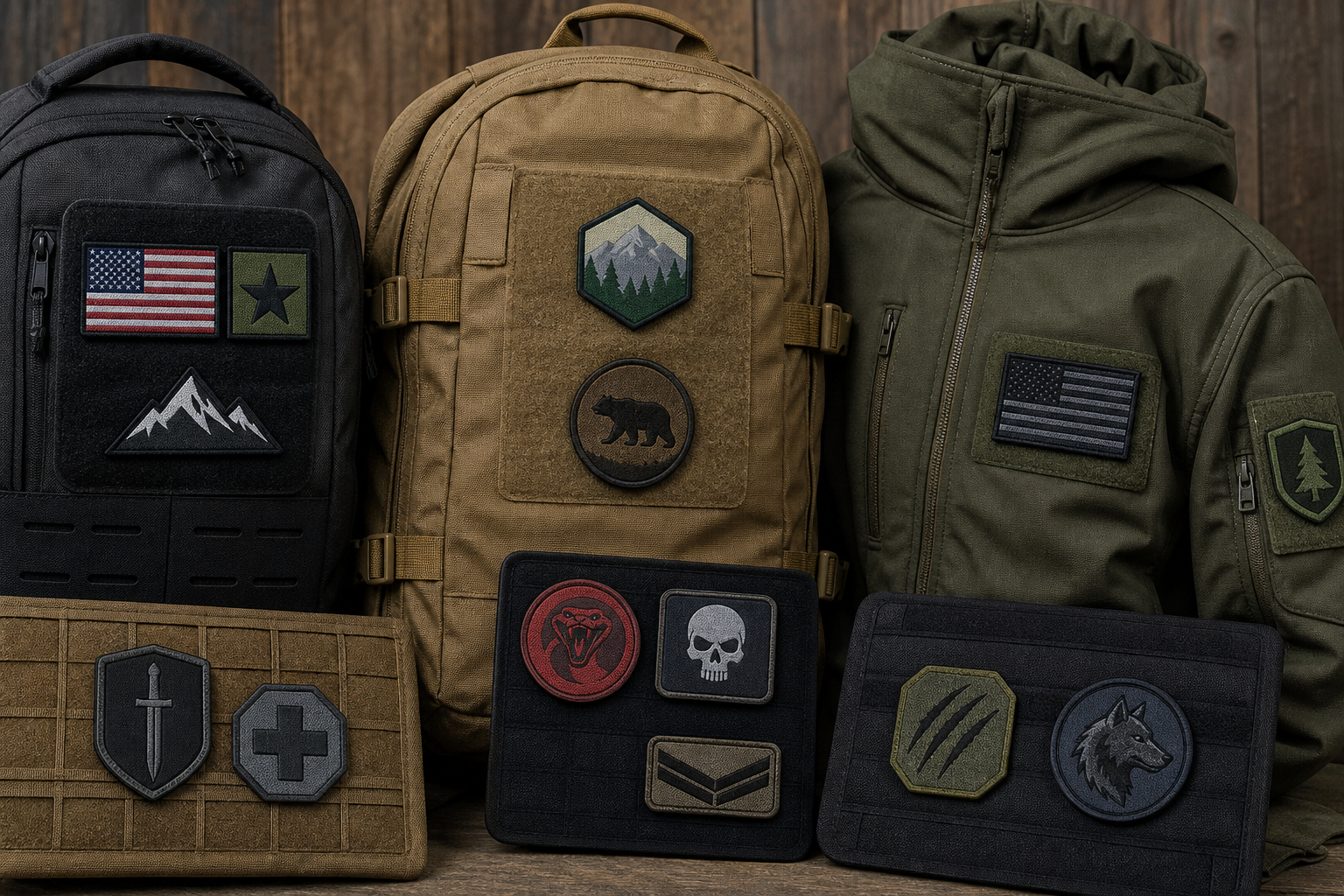
Removable patches can work particularly well on garments intentionally manufactured with loop panels.
Jackets, workwear, hats, and certain specialist garments may include these areas.
Jackets and Outerwear
Jackets often provide enough surface area for medium or large patches.
Check where the loop panel sits relative to pockets, zippers, straps, and high movement areas.
A patch that repeatedly rubs against a backpack strap may experience more wear than one positioned elsewhere.
Hats and Caps
Some caps include small loop fields intended for interchangeable patches.
Because the available area is limited, accurate dimensions are especially important.
Smaller patches also require simplified design elements if text needs to remain readable.
Uniform Applications
Organizations may use removable patches for names, roles, departments, or approved identifiers.
Uniform standards should always take priority over personal customization.
Velcro Patches for Professional Clothing
Workplace patches should be clear, appropriate, and compatible with any employer policies.
Where visibility or safety labeling is important, do not assume a decorative patch meets applicable occupational or product standards.
Required safety markings should comply with the rules relevant to the workplace and equipment.
Velcro Patches for Backpacks and Bags
Bags are among the most common items equipped with loop panels.
A removable patch can identify ownership, organize equipment, or simply change the appearance of the bag.
Measuring the Loop Panel
Measure both width and height.
For unusually shaped panels, create a simple paper template to understand how the proposed patch will fit.
Leave enough clearance to prevent edges from extending beyond the attachment area.
Consider Bag Usage
A commuter backpack experiences different conditions from outdoor equipment.
For frequent outdoor use, consider exposure to rain, mud, sunlight, abrasion, and repeated handling.
Construction should match the environment.
Securing Velcro Patches on Frequently Used Gear
Inspect both patch and panel periodically.
Dirt, fibres, and lint can interfere with effective engagement. Hook material can also catch on unrelated fabrics when the patch is removed.
A compatible protective loop cover can sometimes be used over exposed hook backing during storage.
Custom Velcro Patches for Businesses and Organizations
Custom patches allow organizations to create removable identifiers without applying permanent decoration directly to every item.
They may be useful for events, branded merchandise, clubs, staff equipment, or other authorized applications.
Preparing Artwork for Custom Patches
Start with the clearest artwork available.
Vector files are commonly useful because they can be scaled without the same loss of sharpness associated with low resolution raster images.
Manufacturers may need to modify artwork according to the production process.
Thin lines, small gaps, gradients, and tiny lettering can all present manufacturing challenges.
Keep Text Readable
Text should remain legible at the final physical size.
A design that appears clear when enlarged on a computer monitor can become difficult to read on a small patch.
Always review proofs at approximately actual size.
Ordering Custom Velcro Patches With a Logo
Before submitting a logo, confirm that you own it or have permission to reproduce it.
This is particularly important for trademarks, organizational insignia, entertainment characters, sports branding, and other protected artwork.
A patch manufacturer accepting a file does not necessarily establish that the customer has legal permission to use the design.
How to Design Velcro Patches
Good patch design recognizes the limitations and strengths of the production method.
Simple shapes and strong contrast are often effective at small sizes.
Start With the Intended Size
Designing at the final dimensions helps maintain realistic expectations.
Ask the manufacturer about minimum line thickness and minimum text size for the selected process.
These specifications can differ by equipment and patch type.
Use Contrast Strategically
Text and important graphic elements should be distinguishable from their backgrounds.
Color differences that appear obvious on a bright screen may be less distinct when reproduced with thread or molded material.
Physical color samples can help with important brand colors.
Consider the Border
Borders help define the patch edge.
Merrowed edges are associated with many traditional embroidered patches, while heat cut or laser cut borders can support certain detailed or irregular shapes.
Available options depend on construction.
Designing Velcro Patches for Small Areas
Small patches benefit from simplification.
Prioritize one main symbol, short text, or a strong graphic element rather than attempting to reproduce every component of a complex design.
Removing unnecessary detail can improve recognition.
Velcro Patches vs Sew On Patches
Both attachment systems can be useful, but they solve different problems.
Sew on patches are physically stitched to the underlying material and are appropriate when a more permanent attachment is desired.
Hook and loop patches emphasize removability.
A loop panel must already exist or be added to the underlying item for the removable system to function as intended.
When Removable Patches Make Sense
Choose a hook and loop arrangement when designs need to change frequently, labels need to be reassigned, or patches need to be removed before washing or other activities.
They are also practical for collectors.
When Sew On Patches May Be Better
Permanent patches may be more suitable when there is no reason to remove the design.
They also avoid the need for a visible loop field when the patch is absent.
The correct choice depends on the application rather than one system being universally superior.
Velcro Patches vs Iron On Patches
Iron on patches typically use a heat activated adhesive to bond the patch to suitable material.
This creates a very different attachment method.
Not every garment can tolerate the heat required for an iron on application. Fabric coatings, synthetic materials, waterproof treatments, and heat sensitive textiles can complicate installation.
Hook and loop avoids repeated heat application because the decorative patch attaches mechanically to an existing loop field.
Are Velcro Patches Better for Repeated Changes?
For applications requiring frequent changes, hook and loop is generally more practical because removal is part of its intended function.
Iron on products are usually chosen when a more permanent bond is desired.
The durability of either method depends on material compatibility, manufacturing quality, installation, and use conditions.
How Durable Are Velcro Patches?
There is no universal lifespan for a removable patch.
Durability varies with patch material, fastening components, construction quality, exposure, frequency of removal, abrasion, washing, and storage.
A lightly used display patch may remain visually intact much longer than one used every day outdoors.
What Causes Hook and Loop Wear?
Frequent opening and closing gradually changes fastening components.
Hooks can bend or become contaminated, while loop material can become fuzzy or worn.
Lint, hair, thread, and other debris can also reduce effective engagement.
Outdoor Durability
Outdoor use introduces sunlight, precipitation, temperature changes, dirt, and abrasion.
Buyers needing patches for demanding environments should ask for specific material performance information.
Extending the Life of Velcro Patches
Reasonable maintenance can help preserve function:
• Keep hook surfaces free from lint
• Avoid unnecessary repeated removal
• Follow garment and patch washing instructions
• Store patches clean and dry
• Avoid harsh chemicals unless approved
• Inspect stitching and backing periodically
Product specific instructions should take priority over general advice.
How to Clean Velcro Patches
Cleaning depends on patch construction.
Embroidered, woven, printed, and PVC designs may have different care requirements.
If the patch can be removed, taking it off before laundering a garment may prevent unnecessary wear when recommended by the manufacturer.
Cleaning Hook Backing
Debris can become trapped between hooks.
Careful removal with an appropriate small tool or brush may restore some fastening performance without damaging the components.
Avoid aggressive techniques that bend or cut hooks.
Washing Textile Patches
Check care instructions first.
Heat, agitation, bleach, strong cleaning products, and tumble drying may affect threads, colors, adhesives, or backing.
Caring for Velcro Patches After Washing
Allow compatible patches to dry properly before storing them.
Do not keep damp textile patches compressed in sealed storage for long periods.
Inspect the backing before reattaching to ensure the hook surface is reasonably clean.
How to Choose High Quality Velcro Patches
Quality should be assessed through construction rather than marketing terms such as premium or military grade without supporting specifications.
Examine the clarity of stitching or molding, backing coverage, border quality, color consistency, and overall finishing.
Review Samples Before Large Orders
A physical sample is particularly valuable for custom orders.
It allows buyers to assess:
• Actual dimensions
• Color reproduction
• Thread quality
• Text readability
• Border finish
• Backing coverage
• Flexibility
• Visual detail
Corrections are easier before mass production.
Compare Price and Total Value
Patch prices depend on size, material, colors, complexity, quantity, backing, production method, and shipping.
The lowest unit price may not represent the best value if the design lacks clarity or attachment materials perform poorly.
Questions to Ask a Velcro Patches Supplier
Before placing a custom order, ask what material forms the patch, which hook and loop system is used, what backing coverage is provided, and what artwork limitations apply.
Also clarify minimum order quantities, sampling, proofs, production times, shipping, defect policies, and reorder procedures.
Common Velcro Patch Buying Mistakes
Ordering before measuring the attachment area is one of the easiest mistakes to make.
Another is assuming any hook backed patch will perform identically with every loop surface.
Other issues include:
• Making text too small
• Using overly complex artwork
• Ignoring border requirements
• Choosing material only by appearance
• Forgetting intended weather exposure
• Assuming all products use branded VELCRO material
• Ordering large quantities before proof approval
• Reproducing protected artwork without authorization
• Ignoring care requirements
Clear specifications reduce the chance of receiving a product that looks good in a mockup but performs poorly in actual use.
Frequently Asked Questions
What are Velcro patches?
Velcro patches are removable patches using hook and loop fastening. Typically, hook backing on the patch attaches to a compatible loop panel on clothing or gear.
Do Velcro patches stick directly to clothing?
They require a compatible loop surface for dependable attachment. Ordinary fabric should not automatically be assumed to function as a suitable loop panel.
What are the best materials for Velcro patches?
Embroidery, woven textiles, PVC, and printed constructions all offer different advantages. The best choice depends on detail, texture, environment, budget, and intended use.
Can Velcro patches be washed?
Some can be washed under appropriate conditions, but care requirements vary by material and construction. Follow the patch and garment manufacturer’s instructions.
How do I order custom Velcro patches?
Choose dimensions, shape, artwork, colors, construction, border, and backing, then request a proof or sample from a suitable manufacturer before approving production.
How long do Velcro patches last?
Lifespan varies according to materials, fastening quality, frequency of removal, abrasion, washing, contamination, weather exposure, and storage conditions.
Conclusion
Velcro patches provide a convenient way to customize, identify, and reorganize compatible clothing, bags, equipment, and displays without repeatedly making permanent alterations. Choosing the right construction requires attention to material, dimensions, design complexity, backing quality, intended environment, and care requirements. Accurate measurements and a production sample are especially valuable when ordering custom patches in quantity, helping ensure the final design looks clear and attaches reliably.