Hardwood Flooring Guide: How to Choose Beautiful, Durable Floors for Your Home
Choosing the right hardwood flooring can transform the appearance, comfort, and character of a home. Natural wood offers distinctive grain patterns, a broad range of colors, and a surface that can remain attractive for many years when the flooring is selected, installed, and maintained correctly. However, homeowners should consider more than appearance. Wood species, construction, finish, moisture conditions, installation method, daily traffic, and maintenance expectations all influence how a floor performs.
What Is Hardwood Flooring and Why Is It Popular?
Hardwood flooring is a residential flooring material made from real wood. Depending on its construction, a floor may consist of solid pieces of timber or layers of wood assembled to improve dimensional stability.
Its enduring popularity comes largely from its natural appearance. Each board can display variations in grain, knots, mineral streaks, and color. These characteristics give a wood floor visual depth that manufactured patterns sometimes attempt to reproduce.
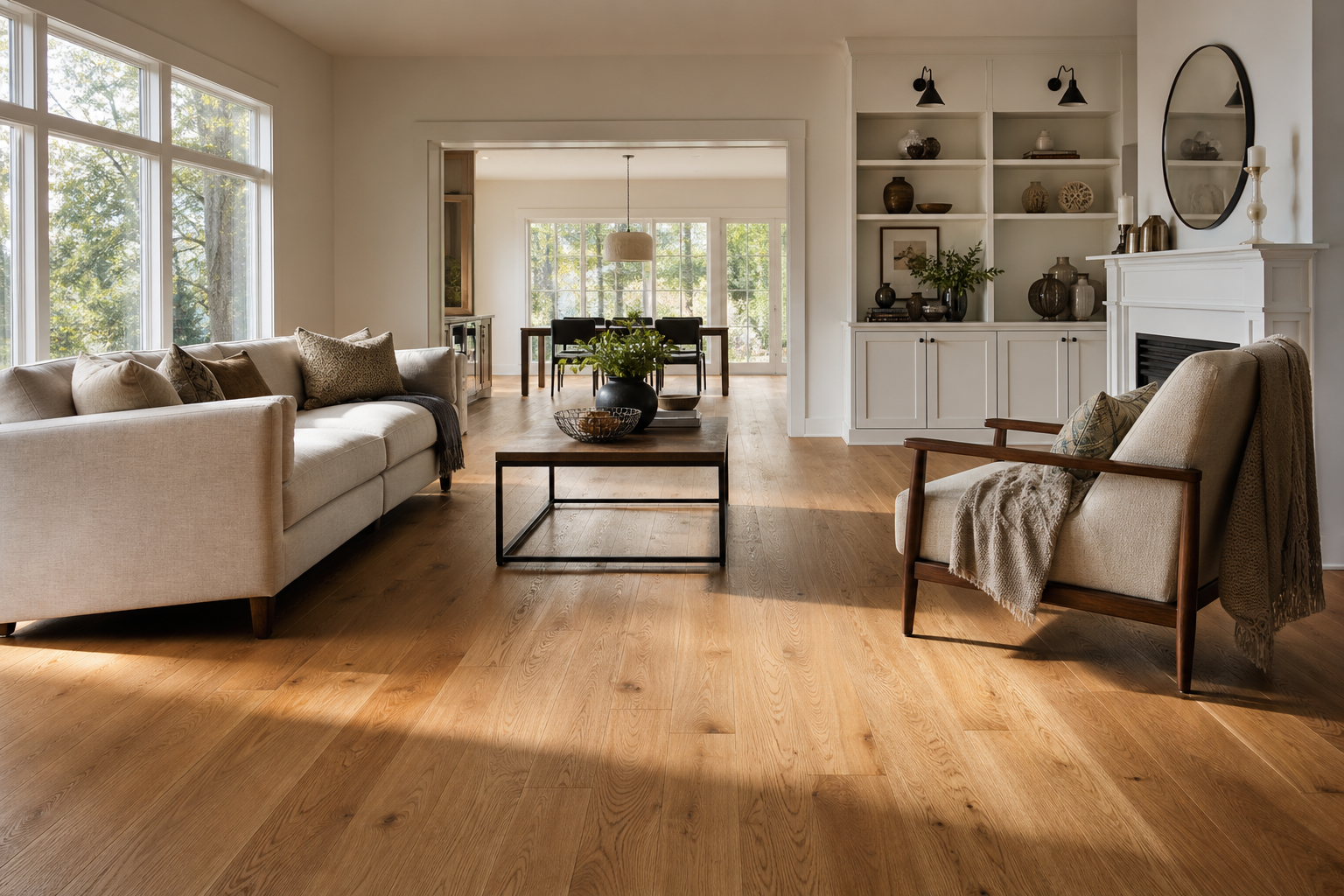
Wood flooring can also complement many interior styles. Light oak can suit contemporary rooms, while richer brown species and traditional plank arrangements can work well in classic interiors. Changing the stain or finish during a future renovation may also provide an opportunity to update the appearance of certain floors rather than replacing them.
Performance varies considerably, however. Species, product quality, board construction, installation, indoor humidity, and maintenance can all affect the service life and appearance of a floor.
9 Benefits of Hardwood Flooring for Homeowners
Understanding the practical advantages of wood makes it easier to decide whether it fits a particular room, budget, and lifestyle.
1. Hardwood Flooring Provides Natural Character
One of the most recognizable advantages of wood is its natural variation. No two boards have exactly identical grain patterns.
Different species provide distinct appearances. Oak is known for visible grain, maple generally has a smoother visual character, and walnut commonly offers deeper brown tones. Grades and cuts can create additional differences within the same species.
This variation means the installed floor can have an individual appearance rather than a perfectly repeated pattern.
2. It Works With Many Interior Designs
Wood provides a comparatively neutral foundation for furniture, paint, rugs, and architectural details. It can be used in traditional, transitional, rustic, minimalist, and contemporary interiors.
Homeowners can choose among different:
• Wood species
• Plank widths
• Surface textures
• Stain colors
• Sheen levels
• Board arrangements
The right combination can make a floor either a prominent design feature or a subtle background element.
3. Many Wood Floors Can Have a Long Service Life
A properly chosen and maintained wood floor can remain useful for decades, although no universal lifespan applies to every installation.
Longevity depends on the thickness and construction of the product, wear layer, finish, moisture exposure, traffic, cleaning practices, and whether the floor can be refinished.
Solid wood generally provides greater refinishing potential because the board consists of wood throughout most of its thickness. Some engineered products can also be refinished, but the number of possible refinishing cycles depends heavily on the thickness of their real wood wear layer.
4. Hardwood Flooring Is Relatively Easy to Clean
Routine care is generally straightforward. Dust, grit, and small particles can usually be removed with a soft broom, microfiber dust mop, or vacuum designed for hard surfaces.
Spills should be cleaned promptly because prolonged moisture can damage wood and its finish. Cleaning products should also be compatible with the flooring manufacturer’s instructions.
More water does not mean better cleaning. Excessive wet mopping can allow moisture to enter seams and contribute to swelling, cupping, discoloration, or finish problems.
5. Wood Can Be Refinished in Suitable Products
Refinishing is one of the most important distinctions between real wood and many products that merely imitate it.
Certain solid wood floors can be professionally sanded and refinished when their surfaces become heavily worn. This process can remove an old finish and provide a new protective surface.
Engineered flooring requires more careful evaluation.
How Hardwood Flooring Wear Layers Affect Refinishing
An engineered plank contains a real wood surface layer over a layered core. Whether it can be sanded depends partly on the thickness of that top wood layer and the construction of the board.
Homeowners should check the manufacturer’s specifications rather than assume every engineered product can be refinished. Aggressive sanding of a thin wear layer can permanently damage the flooring.
6. Numerous Species and Finishes Are Available
Wood floors offer substantial design flexibility. Species differ in hardness, grain, color, availability, and response to staining.
Oak remains a common choice because of its recognizable grain and broad availability. Maple offers a different grain structure, while walnut is associated with darker natural coloring. Other domestic and imported species may be available depending on location.
Finish selection matters as much as species. A matte surface may make minor wear less visually prominent than a high sheen surface in some environments.
7. Hardwood Can Feel Comfortable Underfoot
Wood generally provides a different tactile experience from ceramic tile or stone. Room conditions, the subfloor, installation system, and any approved underlayment also influence how the finished floor feels and sounds.
Area rugs can add further comfort in bedrooms and living areas while helping protect high traffic zones.
Homeowners planning radiant heating should verify compatibility with the particular flooring manufacturer. Changes in heat and moisture can affect wood, so product specific installation guidance is important.
8. Damaged Areas May Sometimes Be Repairable
Scratches, dents, stains, or individual damaged boards do not automatically mean that an entire floor requires replacement.
Depending on the construction and installation method, professionals may be able to repair the finish, replace individual boards, or refinish a larger area. The appropriate solution depends on how deep the damage extends.
Keeping several matching boards after installation can make future repairs easier, particularly if a specific color or product is later discontinued.
9. Wood Offers an Authentic Material Choice
Real wood has variation in texture, color, and grain that originates from the timber itself. For homeowners who prioritize natural materials, that authenticity can be an important design consideration.
That does not make wood universally superior to laminate, vinyl, or tile. Each material solves different problems. Wood is most compelling when its appearance, repair potential, maintenance needs, and moisture limitations align with the household’s priorities.
Solid vs Engineered Hardwood Flooring
The decision between solid and engineered products is one of the first choices buyers encounter.
Solid wood flooring is manufactured primarily from a single piece of timber. Engineered wood uses a genuine wood surface bonded to multiple underlying layers.
Neither construction is automatically right for every project.
Solid Hardwood Flooring
Solid flooring has historically been popular because of its substantial wood construction and refinishing potential. It is commonly fastened to an appropriate wood subfloor, although requirements vary by product.
Because natural wood responds to changes in moisture and humidity, installation conditions matter. Boards can expand or contract as environmental conditions change.
Solid products may therefore be unsuitable for certain locations or installation systems. Manufacturer specifications should determine where and how a particular floor is installed.
Engineered Hardwood Flooring
Engineered wood is designed with multiple layers intended to provide greater dimensional stability than a comparable solid board under certain conditions.
Depending on the product, installation may involve fastening, adhesive, or a floating system. This flexibility can make engineered flooring suitable for projects where conventional solid wood installation is impractical.
Quality varies significantly. Buyers should examine the top layer, core construction, finish warranty, installation instructions, and refinishing guidance rather than judging an engineered product by appearance alone.
Choosing Hardwood Flooring Construction for Your Room
Consider the subfloor, installation level, moisture conditions, heating system, room use, and manufacturer restrictions before choosing a construction.
A flooring professional can assess site conditions when moisture, structural suitability, or installation compatibility is uncertain.
How to Choose the Best Hardwood Flooring
The best floor is not necessarily the hardest species or most expensive product. It is the one that balances aesthetics with the conditions in which it will be used.
Consider Wood Species and Hardness
Species naturally vary in hardness. The Janka hardness test is widely used to compare a wood species’ resistance to indentation under standardized testing conditions.
Janka ratings can help with comparisons, but they should not be treated as a complete durability score. Finish quality, grain, color, household activity, grit, furniture, pets, and maintenance all influence how visible everyday wear becomes.
A harder species can still scratch, and a softer species can perform well when appropriately maintained.
Look at Color and Grain
Floor samples should be examined in the actual room whenever possible. Natural and artificial lighting can significantly change how a wood color appears.
It is also useful to view multiple boards rather than one small sample. Natural flooring contains inherent variation, so a single display piece may not represent the full installed appearance.
Choose the Right Plank Width
Board dimensions influence visual scale. Wider planks can emphasize broad areas of grain and create fewer visible seams. Narrower boards can provide a more traditional visual rhythm.
Width can also affect movement characteristics and installation considerations. Always follow specifications covering subfloor preparation, expansion space, fastening, and indoor environmental conditions.
Evaluate the Finish
Factory finished flooring arrives with its surface coating already applied. Site finished flooring is installed first and then sanded and coated at the property.
Factory finishes offer controlled manufacturing conditions and can reduce finishing work inside the home. Site finishing provides greater flexibility for customized stains and can create a different visual treatment between boards.
The better option depends on the project schedule, desired appearance, existing flooring, and installer recommendations.
Hardwood Flooring Installation Essentials
Even a premium product can perform poorly when installation conditions are unsuitable. Preparation is therefore a major part of a successful project.
The subfloor should meet the flooring manufacturer’s requirements for flatness, cleanliness, structural condition, and moisture. The flooring itself may also require specific storage or conditioning procedures before installation.
Common Hardwood Flooring Installation Methods
Installation systems generally include nail or staple fastening, adhesive installation, and floating installation. Availability depends on board construction and manufacturer approval.
A floating floor is joined together without fastening each board directly to the subfloor. Glue installations bond compatible flooring to an approved substrate. Fastened installations secure boards mechanically.
The manufacturer’s instructions take priority because not every floor supports every method.
Why Hardwood Flooring Moisture Testing Matters
Wood responds to moisture. Excessive moisture in a subfloor or inappropriate indoor conditions can contribute to dimensional changes and flooring failure.
Professional installers may assess the flooring and substrate using methods appropriate to the material and installation system. Applicable manufacturer requirements and industry standards should be followed rather than relying on visual inspection alone.
Bathrooms and other repeatedly wet locations require particular caution. A product should not be installed in a wet environment unless the manufacturer specifically approves that application.
How Much Does Hardwood Flooring Cost?
There is no single reliable price for all wood flooring projects. Material prices vary by species, grade, construction, board dimensions, finish, manufacturer, and geographic market.
Installation costs also depend on the site.
Removing existing floors, disposing of materials, repairing or leveling a subfloor, moving furniture, working around stairs, adding trim, and using complex patterns can increase the final project price.
For useful comparisons, homeowners should obtain itemized local quotations based on the same project scope. A quotation should clarify what is included so a low initial figure is not mistaken for the complete installed cost.
Hardwood Flooring Maintenance and Cleaning
Preventive care is generally easier than repairing significant surface damage.
Remove abrasive dirt regularly, clean spills promptly, and use cleaning products approved for the floor’s finish. Protective pads beneath furniture can reduce scratching, while mats at entrances can capture grit before it reaches the flooring.
Avoid assuming that steam cleaners, waxes, oils, or general purpose chemicals are safe for every wood floor. Finishes have different maintenance requirements, and an unsuitable treatment can leave residue or cause damage.
Protecting Hardwood Flooring From Daily Wear
High traffic areas often show wear first. Entryways, hallways, kitchen work areas, and spaces beneath moving chairs deserve particular attention.
Useful preventive practices include:
• Place suitable mats near exterior entrances
• Add protective pads beneath furniture legs
• Lift furniture instead of dragging it
• Remove dirt and grit regularly
• Wipe liquid spills promptly
• Follow manufacturer recommendations for indoor conditions
• Keep pet nails appropriately maintained
Rugs and pads should also be compatible with the floor finish. Some backing materials can discolor or react with particular coatings.
Cleaning Hardwood Flooring Without Causing Damage
Begin with dry soil removal. When damp cleaning is required, use an approved cleaner and the smallest appropriate amount of moisture.
Do not leave standing water on the surface. If a significant leak or flood occurs, address the moisture source promptly and consider professional evaluation because water may reach areas that cannot be seen from above.
Hardwood Flooring vs Other Flooring Materials
Comparing flooring options based only on purchase price can overlook important differences.
Laminate generally uses an image layer designed to reproduce the appearance of wood rather than a natural wood wear surface. Luxury vinyl products can also reproduce wood visuals while offering different moisture and maintenance characteristics.
Tile performs differently again and may be particularly suitable where water resistance is a primary concern.
Real wood distinguishes itself through natural grain variation and, in appropriate products, repair and refinishing possibilities. Its tradeoffs include sensitivity to moisture and the potential for scratching, denting, and seasonal movement.
The right choice depends on the room rather than on a universal ranking of materials.
Sustainability Considerations When Buying Hardwood Flooring
Sustainability depends on where timber comes from, how forests are managed, how products are manufactured, transportation requirements, durability, and end of life considerations.
Consumers interested in responsible sourcing can look for credible forest certification and documentation about the origin of the wood. The Forest Stewardship Council is one organization that maintains certification standards for responsibly managed forest products.
Certification claims should be verified rather than assumed from marketing language.
Long product life can also influence environmental considerations. Maintaining an existing usable floor or refinishing a suitable wood floor may avoid unnecessary replacement materials.
Common Hardwood Flooring Mistakes to Avoid
Many problems arise from selecting or installing a floor without considering real room conditions.
A common mistake is choosing entirely by color. Appearance matters, but construction, moisture compatibility, finish, maintenance, and installation requirements also deserve attention.
Another mistake is ignoring manufacturer instructions. Generic flooring advice cannot override requirements written for a specific product.
Homeowners should also avoid expecting natural wood to remain visually unchanged. Sunlight, normal wear, environmental conditions, and aging can alter its appearance over time. Natural variation is part of the material.
Finally, do not assume every scratch requires sanding. Minor marks may be handled through manufacturer approved maintenance or professional finish repair. Excessive sanding unnecessarily removes wood.
Is Hardwood Flooring Worth Choosing?
Wood is a strong candidate for homeowners who value natural appearance, long term design flexibility, and the possibility of repairing or refinishing appropriate products.
It may be less suitable where repeated water exposure is unavoidable or where the household wants flooring that requires minimal attention to environmental conditions.
A worthwhile purchase depends on matching the product to the property. Consider the complete installed cost, expected maintenance, room conditions, manufacturer warranty, and likely length of ownership before deciding.
Frequently Asked Questions
What is the best hardwood flooring for a home?
There is no universal best species or construction. The right choice depends on traffic, moisture, subfloor conditions, appearance preferences, maintenance expectations, and budget.
How long does hardwood flooring last?
Service life varies considerably by product, installation, traffic, finish, environmental conditions, and maintenance. Well maintained wood flooring can remain functional for decades in suitable conditions.
Can hardwood flooring be refinished?
Many solid wood floors can be refinished, while some engineered products can also be refinished depending on their wear layer. Check product specifications before sanding.
Is engineered hardwood flooring real wood?
Yes. Engineered wood flooring has a genuine wood surface bonded to a layered core, although its construction differs from a solid wood plank.
Can hardwood flooring be installed in a kitchen?
Many wood products can be used in kitchens when their manufacturer permits it, but spills should be cleaned quickly and leaks addressed immediately. Product specific instructions should guide installation and care.
How should hardwood flooring be cleaned?
Regularly remove dust and grit, wipe spills promptly, and use a cleaner approved by the flooring manufacturer. Avoid excessive water and unapproved steam cleaning methods.
Conclusion
Hardwood flooring combines natural character, broad design flexibility, and potential long term service when the right product is matched to the right environment. Choosing between solid and engineered construction requires consideration of moisture, installation, wear layer, maintenance, and room conditions. Careful product research and qualified installation can help protect the investment while preserving the floor’s appearance for years to come.