Custom Candle Boxes: The Complete Guide to Protective, Brand Ready Candle Packaging
Well designed Custom candle boxes do more than create an attractive first impression. Candle packaging can help protect glass vessels, reduce movement during handling, organize legally or commercially necessary information, and create a consistent brand experience across retail and ecommerce channels. Choosing the right box requires careful attention to candle dimensions, material strength, inserts, printing, finishing, shipping conditions, sustainability goals, budget, and applicable labeling requirements rather than appearance alone.
What Are Custom Candle Boxes?
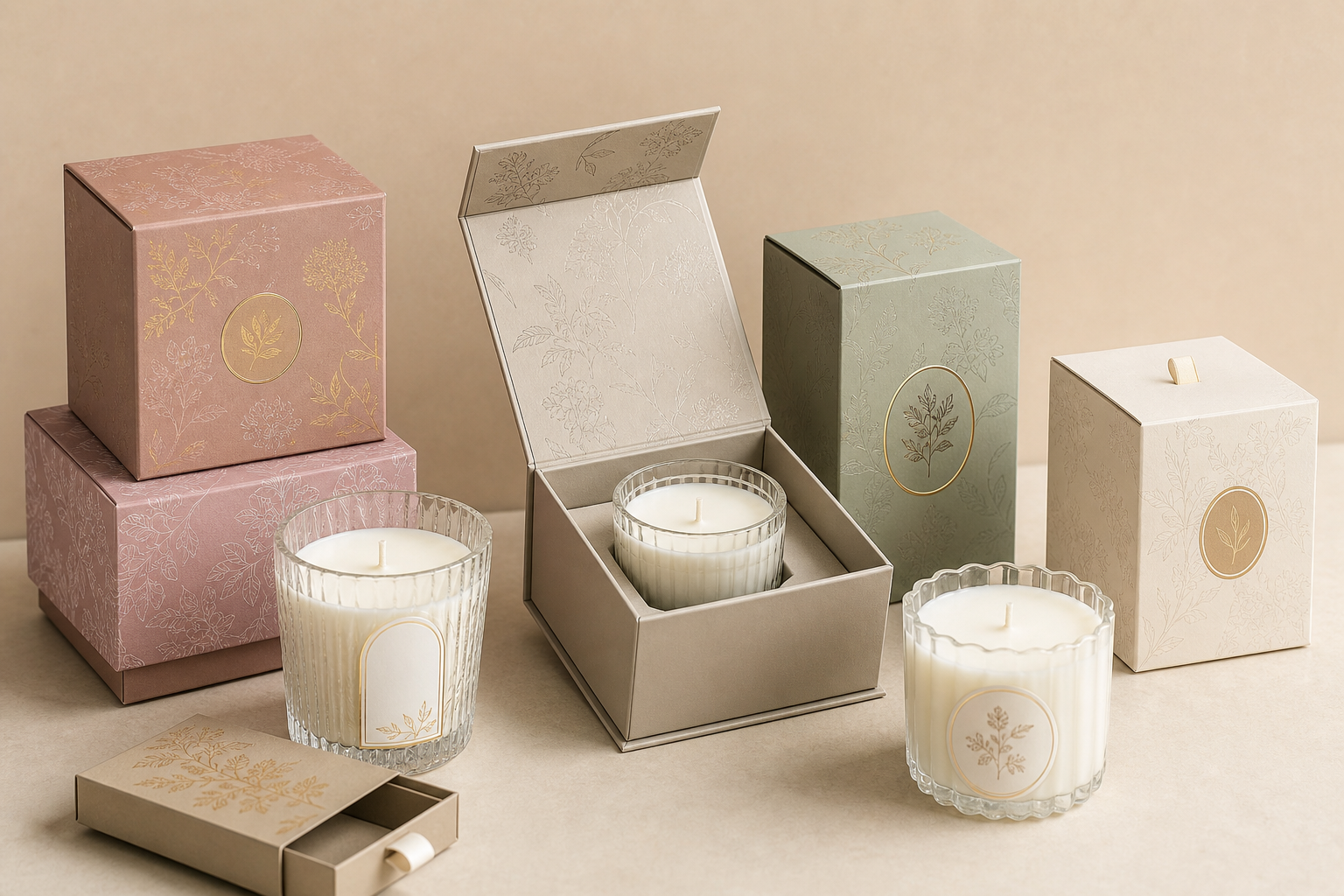
Custom candle boxes are packaging designed around the dimensions, presentation, protection, and branding requirements of a particular candle product or range.
Unlike generic boxes, custom packaging can be manufactured to specific dimensions and printed with selected colors, graphics, product information, instructions, and brand elements. Depending on the structure, packaging can also incorporate inserts that help hold a candle securely.
Customization ranges from relatively simple printed folding cartons to more substantial rigid presentation boxes.
The most suitable format depends on the candle itself and how customers receive it. A candle sold from a physical retail shelf faces different handling conditions from a glass candle shipped individually through an ecommerce fulfillment network.
Packaging should therefore begin with product requirements before visual design decisions.
9 Powerful Benefits of Custom Candle Boxes
Packaging can influence protection, presentation, storage, shipping, and customer experience. These benefits explain why candle businesses often invest in packaging designed specifically for their products.
1. Better Product Protection
Candles can be vulnerable to damage, particularly when they use glass, ceramic, or other breakable vessels.
Appropriately sized boxes can limit unnecessary movement and provide a structured layer around the product.
Protection does not come from the outer carton alone. The complete packaging system can include inserts, cushioning, dividers, closures, and shipping materials.
For fragile candles, businesses should test the finished packaging under realistic distribution conditions rather than assuming an attractive box is sufficiently protective.
2. More Consistent Brand Presentation
Packaging is one of the physical surfaces through which a customer interacts with a candle brand.
Color, typography, imagery, material texture, and finishing can create a consistent visual identity across different fragrances and product sizes.
Consistency does not require every box to look identical.
A brand might use the same structural layout while assigning different colors or illustrations to individual scents. This keeps products recognizable while helping customers distinguish variants.
3. Improved Retail Shelf Appearance
Physical retail packaging needs to communicate quickly.
Shoppers may see several candle brands in close proximity, making clear product identification important. Packaging can organize the brand name, fragrance, candle type, quantity, and other relevant information into a readable hierarchy.
Structural design matters too.
Boxes should remain stable when displayed and should fit shelving arrangements suitable for the target retailers.
4. A Stronger Ecommerce Unboxing Experience
Online customers often encounter the physical product only after purchase.
Packaging therefore becomes an important part of the first hands on experience.
A clean, appropriately fitted box can make a product feel considered and professionally presented without requiring excessive layers or decorative components.
The unboxing experience should still remain practical. Packaging that is difficult to open, produces excessive waste, or sacrifices protection for appearance can undermine the experience it was intended to improve.
5. Space for Useful Product Information
A candle package provides space for information customers may need.
Depending on the product and applicable requirements, this can include product identity, net quantity, manufacturer or responsible business information, safety statements, burning instructions, fragrance information, batch information, or other disclosures.
Requirements vary by product composition and market.
Businesses should determine which rules apply in the jurisdictions where their candles are sold rather than copying another brand’s packaging.
6. Better Fit for Different Candle Sizes
Candle collections frequently include vessels of different dimensions.
Custom sizing allows packaging to reflect these differences more precisely than one generic box used for every product.
A better fit can reduce empty internal space while making the product presentation more intentional.
Custom Candle Boxes and Accurate Sizing
Accurate dimensions are essential before production.
Measure the completed candle, including its lid, decorative components, labels, or other features that affect overall dimensions.
Packaging designers also need to consider clearance and any insert surrounding the product.
A box that matches the vessel dimensions exactly may be too tight once material thickness, tolerances, and inserts are considered.
7. Opportunities for Premium Finishes
Custom printing provides access to finishing techniques that can emphasize selected design elements.
Depending on the packaging supplier and material, options may include embossing, debossing, foil effects, spot coatings, textured papers, or specialty printing.
Premium finishes should be used purposefully.
Applying several processes to every surface can increase cost without necessarily improving visual communication. A restrained finish on a logo or key element can sometimes create greater impact.
8. More Efficient Product Organization
A consistent packaging system can simplify how candle variations are identified, stored, and prepared for sale.
Color systems, labels, printed product names, barcodes, or stock identifiers can help distinguish fragrances and sizes.
Operational requirements should be considered during design.
A beautiful box can create warehouse complications if staff cannot quickly identify the product without opening it.
9. Greater Control Over Packaging Materials
Customization enables a business to specify material types, board weights, printing processes, inserts, and finishes according to product requirements.
This can also support sustainability goals.
For example, a brand may investigate recyclable paper based structures, responsibly sourced fibres, reduced material use, or inserts that avoid unnecessary components.
Environmental claims should be specific and supportable rather than relying on vague terms such as green or environmentally friendly.
Custom Candle Boxes and Packaging Materials
Material selection influences structural strength, printing, texture, cost, shipping weight, and disposal options.
There is no universal best candle packaging material.
Paperboard Folding Cartons
Paperboard is widely used for retail cartons because it can be printed, cut, folded, and produced in a wide range of structures.
Folding cartons are generally shipped flat before assembly, potentially reducing storage space compared with preassembled rigid structures.
Board thickness and strength should suit the weight and vulnerability of the candle.
Heavy glass containers may require more structural support than lightweight candle products.
Corrugated Candle Packaging
Corrugated board incorporates a fluted layer between liner materials, providing additional cushioning and structural properties.
It is commonly associated with shipping packaging but can also be used for retail ready structures.
For ecommerce candles, corrugated materials may form an important part of the protective shipping system.
A printed retail box placed inside a properly designed corrugated mailer can provide both presentation and distribution protection.
Rigid Candle Boxes
Rigid boxes are manufactured from relatively substantial board and commonly use wrapped paper or other exterior treatments.
They are often selected for premium gift presentation.
Rigid packaging can provide a distinctive feel but may require more material, storage space, and transportation volume than folding cartons.
Cost and environmental objectives should therefore be considered alongside presentation.
Choosing Materials for Custom Candle Boxes
Evaluate materials based on actual packaging requirements:
• Candle weight
• Vessel fragility
• Box dimensions
• Distribution method
• Retail presentation
• Print requirements
• Insert design
• Storage space
• Budget
• Recycling considerations
Request physical material samples whenever possible before approving a large production order.
How to Design Custom Candle Boxes
Effective candle packaging design balances aesthetics, communication, structure, and manufacturability.
Design should begin with the product rather than a decorative template.
Establish a Clear Visual Hierarchy
Customers should be able to identify the most important information quickly.
The front panel might prioritize the brand, fragrance name, candle type, or another primary product identifier.
Secondary details can appear elsewhere.
Avoid filling every available surface with text. White space can improve readability and make important information easier to distinguish.
Design for the Target Customer
A luxury candle brand may use understated typography, textured materials, and restrained colors. A playful home fragrance business may use illustrations and stronger color combinations.
Neither approach is inherently better.
The goal is visual consistency with the product positioning and audience expectations.
Consider the Complete Product Range
Design systems should work beyond one fragrance.
Before approving packaging, test the design concept with several product names, colors, vessel sizes, and information requirements.
This can reveal problems that are invisible when developing only one box.
Custom Candle Boxes for Brand Recognition
Repeated visual elements can make a product family easier to recognize.
Consistent typography, logo positioning, structural design, illustration style, or color logic can connect products even when individual fragrances differ.
Recognition should come from legitimate brand identity rather than imitating another candle company’s distinctive packaging.
Custom Printed Candle Boxes and Printing Methods
Printing method can influence color, detail, cost, and order quantities.
Packaging suppliers may offer several processes depending on the box structure and production volume.
Digital Printing
Digital printing can be suitable for shorter production runs, prototypes, personalization, or designs requiring frequent variation.
Because setup requirements differ from conventional plate based processes, it can provide flexibility for smaller brands.
Exact economics depend on the supplier, material, coverage, and quantity.
Offset Printing
Offset printing is frequently used for high quality commercial packaging and larger production quantities.
It can provide precise reproduction and consistent results when production is correctly managed.
Setup requirements can make it less economical for certain very small orders.
Flexographic Printing
Flexographic printing is widely used across packaging applications, including corrugated materials.
It can be appropriate for larger production runs and various packaging substrates.
The correct process should be selected according to design requirements rather than because one method is universally superior.
Color Accuracy on Custom Candle Boxes
Colors can appear differently across screens, paper types, coatings, inks, and printing processes.
Brands for which color consistency is critical should discuss color management with their packaging supplier.
Physical proofs or production samples can provide information that an on screen mockup cannot.
Custom Candle Boxes With Inserts
Inserts can help position the candle within the outer carton and reduce movement.
Common insert materials can include paperboard, corrugated board, moulded pulp, foam, and other engineered packaging materials.
Material suitability depends on the product.
Why Candle Box Inserts Matter
A box can look perfectly sized externally while still allowing the vessel to move internally.
Movement may increase the likelihood of cosmetic or physical damage during transportation.
An insert can help center the product and create separation between vulnerable areas and the external package.
Test Inserts With the Actual Candle
Computer aided packaging designs are useful, but prototypes should be tested with the final production candle.
Small differences in vessel diameter, lids, labels, or handmade components can change how the product fits.
Testing Custom Candle Boxes Before Production
Prototype testing can examine:
• Product fit
• Insert stability
• Opening experience
• Closure security
• Print placement
• Barcode readability
• Assembly time
• Shipping performance
• Visible damage after handling
More demanding distribution environments may justify professional packaging testing using appropriate standards and methods.
Custom Candle Boxes for Ecommerce Shipping
A retail carton and a shipping container perform different functions.
A decorative candle box may not provide enough protection to travel through parcel networks without additional packaging.
Use an Appropriate Outer Shipping Box
The outer package should be designed for transportation conditions.
Its size, board specification, cushioning, internal movement, package weight, and closure method can influence performance.
Fragile candle vessels should not be considered protected simply because they have a retail carton.
Reduce Unnecessary Empty Space
Excess package volume can increase material consumption and, depending on carrier pricing, shipping cost.
However, minimizing space should not compromise necessary protection.
The objective is an efficient packaging system with enough protective material for the specific product and distribution environment.
Custom Candle Boxes for Subscription and Gift Orders
Gift sets and subscription orders may contain several candles or additional products.
Dividers or custom inserts can keep individual items separated.
Design these systems around the heaviest and most fragile components first, then consider presentation and decorative features.
Sustainable Custom Candle Packaging
Sustainability is a complex packaging consideration rather than a single material choice.
Material source, quantity, manufacturing, transportation, reuse, recyclability, and local waste infrastructure can all matter.
Reduce Material Where Practical
Reducing unnecessary packaging can lower material use while potentially reducing package dimensions and transportation requirements.
This does not mean removing material required for protection.
Damaged products also have environmental and financial costs.
Consider Recyclability
Paper based packaging may be recyclable in appropriate waste streams, but coatings, laminates, adhesives, windows, inserts, and local collection rules can affect real world recyclability.
Packaging suppliers should provide specific material information.
Sustainability Claims on Custom Candle Boxes
Environmental marketing claims should be accurate, specific, and capable of substantiation.
Rather than using broad claims without context, businesses can communicate verifiable details such as certified fibre content or specific material composition when accurate and relevant.
Requirements governing environmental claims vary by jurisdiction.
Candle Packaging Labeling and Safety Considerations
Candles are products involving an open flame during normal use, making clear safety communication important.
Applicable labeling requirements and industry standards depend on where products are sold.
Businesses should identify the regulations and standards relevant to their market.
Leave Space for Required Information
Packaging artwork should account for compliance information before visual design is finalized.
Attempting to add required text after completing the design can result in overcrowded panels or poor readability.
Coordinate packaging development with the people responsible for product compliance.
Avoid Unsupported Product Claims
Claims about burn duration, ingredients, environmental impact, safety, or product performance should be based on adequate evidence.
A packaging box has limited space, which makes precise wording especially important.
Compliance Planning for Custom Candle Boxes
Manufacturers selling in multiple markets may encounter different requirements.
Maintain controlled artwork files and clearly identify which packaging version applies to each market.
When requirements are unclear, seek advice from an appropriately qualified compliance professional rather than relying on a competitor’s label.
How Much Do Custom Candle Boxes Cost?
There is no single meaningful price for custom candle packaging.
Cost depends on dimensions, board type, structure, quantity, printing, coatings, inserts, finishes, freight, tooling, supplier location, and other production factors.
Higher quantities can reduce per unit manufacturing costs in some production methods, but they also require greater upfront spending and storage.
Understand Minimum Order Quantities
Packaging manufacturers may specify a minimum order quantity, often called an MOQ.
Minimums vary by supplier and production process.
New candle businesses should balance unit price against inventory risk. Ordering a very large quantity at a lower unit cost can become expensive if branding, products, regulations, or dimensions later change.
Request Comparable Packaging Quotes
Provide the same specification to several suitable suppliers when comparing quotations.
Include:
• Exact dimensions
• Box structure
• Material specification
• Quantity
• Printing requirements
• Insert requirements
• Finishes
• Proofing
• Delivery destination
• Required schedule
Comparable specifications produce more useful price comparisons.
How to Choose a Custom Candle Box Supplier
A packaging supplier should be assessed on more than price.
Ask about production capabilities, material specifications, quality control, lead times, proofing, minimum quantities, freight, and procedures for manufacturing defects.
Samples are particularly valuable.
A supplier’s photographs cannot fully communicate board stiffness, print appearance, texture, folding quality, or structural fit.
Check Prototypes and Proofs Carefully
Before authorizing production, confirm dimensions, artwork orientation, spelling, colors, barcodes, legal information, and structural details.
Have more than one person review final artwork.
A small error repeated across thousands of boxes can become expensive.
Plan for Manufacturing Lead Times
Custom packaging usually requires design, proofing, manufacturing, quality checks, and transportation.
International supply chains can add additional time and uncertainty.
Ordering Custom Candle Boxes Without Overstocking
Forecast demand conservatively when packaging contains product specific information that may change.
Brands with many fragrances can sometimes reduce complexity by using a common outer box combined with product specific labels or sleeves, provided the solution meets branding and compliance requirements.
This approach can make inventory easier to manage.
Common Custom Candle Packaging Mistakes
One common mistake is selecting packaging based entirely on appearance.
The box must also protect the candle, communicate necessary information, fit operational workflows, and survive its intended distribution environment.
Other mistakes include:
• Incorrect internal dimensions
• Insufficient protection for glass vessels
• Overcomplicated box structures
• Tiny or difficult to read text
• Excessive packaging layers
• Poor color proofing
• Unverified sustainability claims
• Ordering large quantities before testing
• Forgetting ecommerce shipping requirements
• Ignoring assembly time
Prototyping can identify many of these problems before full production.
Frequently Asked Questions
What are Custom candle boxes?
Custom candle boxes are packages manufactured to specific candle dimensions, structural requirements, branding, printing, and presentation needs rather than using generic stock packaging.
What material is best for Custom candle boxes?
Paperboard, corrugated board, and rigid board are common choices. The best material depends on candle weight, fragility, shipping conditions, presentation, budget, and sustainability goals.
Do Custom candle boxes protect glass candles during shipping?
They can contribute to protection, but a retail box alone may be insufficient. Fragile glass candles often require tested inserts, cushioning, and an appropriate outer shipping package.
Can Custom candle boxes be environmentally responsible?
Packaging can reduce environmental impact through efficient sizing, lower material use, responsibly sourced fibres, and suitable recyclable structures where local infrastructure supports them.
How should Custom candle boxes be measured?
Measure the completed candle, including its lid and labels, then account for inserts, board thickness, clearance, and manufacturing tolerances when determining internal dimensions.
What should I check before ordering Custom candle boxes?
Confirm dimensions, materials, structural design, artwork, printing, inserts, finishes, compliance information, minimum quantities, proofs, lead times, shipping costs, and supplier terms.
Conclusion
Custom candle boxes can combine product protection, brand presentation, customer communication, and practical distribution when they are designed around the actual candle. Material selection, accurate sizing, inserts, printing, compliance, and shipping performance deserve as much attention as visual design. Prototyping the complete packaging system before a large production run can help candle brands identify problems early while creating packaging that looks professional and works effectively.