Warehouse Rental Hong Kong: 7 Vital Secrets for Prime Logistics, Air Cargo Synergy, and Maximum Storage Efficiency
Positioned at the geographical heart of the Asia-Pacific region and operating as the premier gateway to the Greater Bay Area, the Hong Kong Special Administrative Region remains one of the world’s most vital, high-density multimodal logistics hubs. Securing prime warehouse rental facilities in Hong Kong provides multinational supply chain conglomerates, regional e-commerce retailers, pharmaceutical cold-chain distributors, and high-value luxury freight forwarders with an indispensable operational nexus. While Hong Kong boasts the world’s busiest international air cargo hub via Hong Kong International Airport (HKG) and deep-water maritime shipping connectivity through the Kwai Tsing Container Terminals, industrial land scarcity presents unique spatial, structural, and financial challenges. Navigating multi-storey ramp-up industrial facilities, strict building floor-loading limits, hazardous materials fire safety codes, and customs-bonded zones requires strategic foresight. By examining industrial property submarkets, mechanical engineering specifications, and automation infrastructure, global enterprises can maximize cubic storage capacity, streamline customs clearance, and insulate supply chains from regional disruption.
The Unique Industrial Topography of Hong Kong Logistics
Unlike the sprawling, horizontal single-storey logistics parks common across North America and mainland Europe, Hong Kong’s mountainous topography and strict municipal land zoning have driven the development of vertical multi-storey industrial architecture.
The Physics of Multi-Storey Vertical Industrial Warehouses
Industrial developers in Hong Kong construct reinforced concrete multi-storey warehouse towers that rise ten to thirty storeys into the skyline. Managing high-throughput cargo logistics in a vertical facility requires two primary structural typologies:
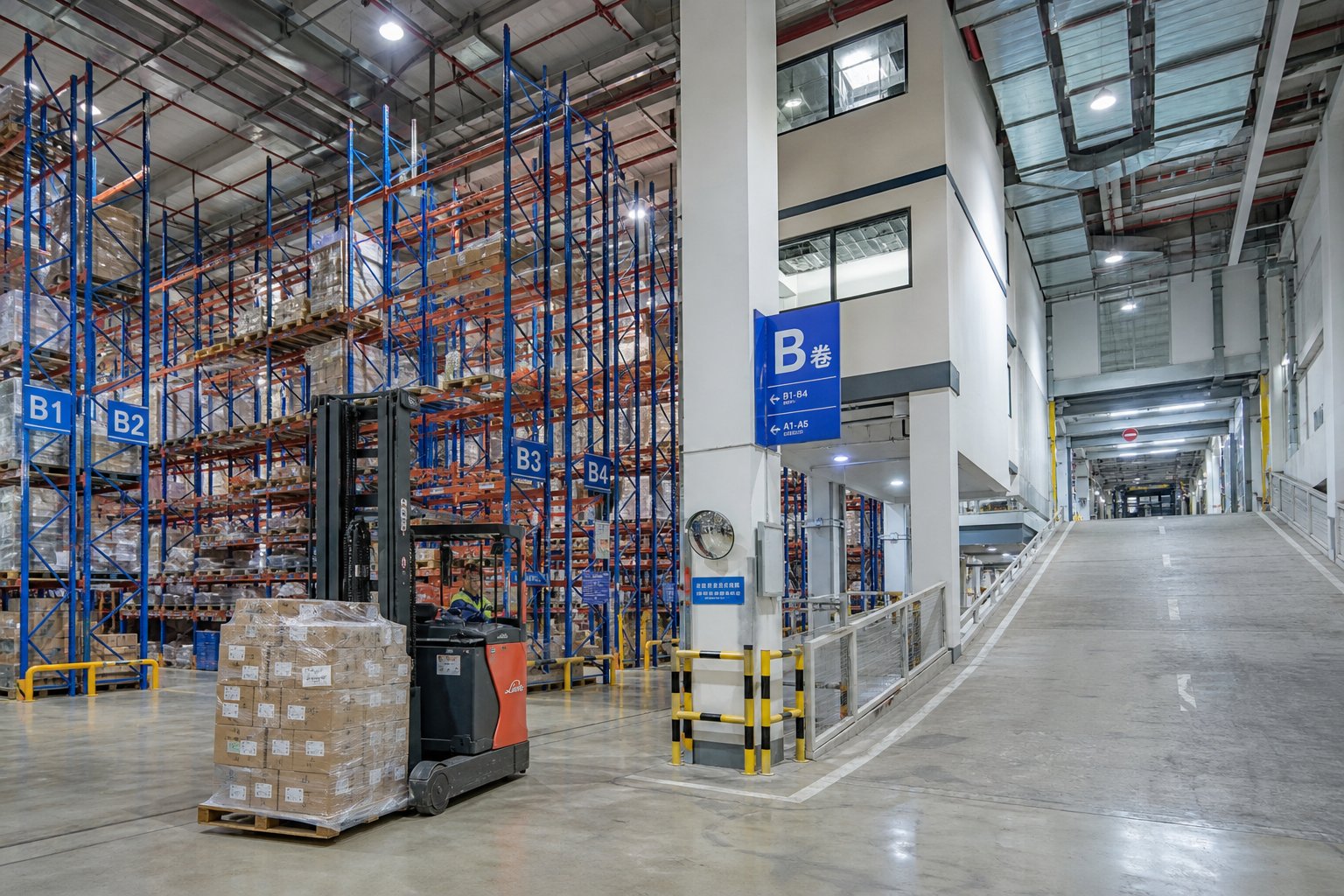
- Ramp-Up Logistics Facilities: Engineered with sweeping, helical exterior vehicular ramps that allow forty-foot intermodal container tractor-trailers to drive directly up to elevated floor loading docks. This design eliminates bottleneck delays caused by cargo freight lifts, enabling direct container stuffing, destuffing, and cross-docking on upper floors.
- Cargo-Lift Access Industrial Godowns: Older or secondary industrial properties rely on banks of heavy-duty industrial goods lifts (freight elevators) with capacities ranging from three to five metric tons. While more economical per square foot, goods-lift facilities require goods to be transferred from trucks onto flatbed pallet trucks, creating handling queues during peak maritime and air cargo shipping cycles.
Structural Floor Loading Capacities (kPa) and Clear Ceiling Heights
In vertical warehousing, structural engineering parameters dictate the types of inventory and racking systems an operator can deploy:
- Superimposed Floor Dead-Load Limits: Floor loading capacity is measured in kiloNewtons per square meter (kN/m²) or pounds per square foot. Ground and lower ramp floors typically support heavy industrial loads between twenty and twenty-five kPa (roughly four hundred to five hundred pounds per square foot), allowing heavy machinery storage and high-density vertical selective pallet racking. Upper floors in older godowns may only support seven to twelve kPa, restricting operations to lightweight apparel, electronics, or document archiving.
- Clear Ceiling Heights: Modern logistics centers offer clear ceiling heights between 5.5 and 7.5 meters (eighteen to twenty-five feet), allowing five to six tiers of vertical pallet racking. Older legacy facilities frequently feature low 3.5-meter beams that severely constrain vertical cubic storage density.
Strategic Geographical Submarkets Across Hong Kong
Selecting the optimal warehouse rental Hong Kong location requires balancing proximity to international border crossing points, seaport terminals, and consumer population centers.
Airport Cargo and Lantau Island (Chek Lap Kok & Tung Chung)
Facilities situated directly adjacent to Hong Kong International Airport—including the Airport Freight Forwarding Centre (AFFC) and surrounding Lantau logistics parks—represent the gold standard for high-value, time-critical air freight:
- 24/7 Dedicated Customs Processing: Immediate proximity to airport cargo terminals allows freight forwarders to transfer electronics, biological pharmaceuticals, and fresh perishables directly from inbound cargo aircraft into temperature-controlled storage within hours of touchdown.
- Direct Cross-Border Road Links: The Hong Kong-Zhuhai-Macao Bridge provides rapid overland transit across the western Pearl River Delta, linking airport warehouse facilities directly with manufacturing hubs in Zhuhai and Zhongshan.
Kwai Chung and Tsing Yi (Maritime Port Vicinity)
Surrounding the nine container terminals of Kwai Tsing, this maritime submarket represents the core of ocean freight distribution:
- Direct Container Docks: Facilities in Tsing Yi and Kwai Chung are engineered for massive ocean freight container turnaround, maritime consolidation, and regional transshipment.
- Central Urban Transit Links: Positioned along Route 3 and the West Kowloon Highway, providing rapid overland truck access into Kowloon and Hong Kong Island retail shopping districts.
New Territories North (Kwai Chung, Tuen Mun, Yuen Long, and Fanling)
The northern industrial corridors provide critical staging grounds for cross-border logistics interfacing with mainland Shenzhen:
- Cross-Border Land Border Checkpoints: Direct road transit connecting through Lok Ma Chau, Man Kam To, and the Heung Yuen Wai boundary control points.
- Cost-Effective Square Footage: Submarkets in Yuen Long, Tuen Mun, and Fanling offer more competitive monthly rental rates per square foot compared to core airport and maritime terminals, making them ideal for bulk pallet reserves and domestic e-commerce fulfillment centers.
Regional Industrial Submarket Comparison Matrix
| Logistics Submarket | Primary Transit Synergy | Average Floor Loading (Typical) | Typical Clear Height | Best Suited Cargo Operations |
|---|---|---|---|---|
| Airport (Chek Lap Kok) | Hong Kong International Airport (HKG) | 15 – 25 kN/m² (High load) | 6.0 m – 8.0 m | High-value tech, cold chain pharma, air freight |
| Tsing Yi & Kwai Chung | Kwai Tsing Maritime Container Ports | 17.5 – 25 kN/m² | 5.5 m – 7.5 m | Maritime ocean freight, FMCG, retail cross-docking |
| Tuen Mun & Yuen Long | Western GBA Links / Shenzhen Bay | 10 – 17.5 kN/m² | 4.5 m – 6.0 m | Domestic e-commerce, general distribution |
| Fanling & Sheung Shui | Eastern Cross-Border Land Checkpoints | 7.5 – 12.5 kN/m² | 3.8 m – 5.0 m | Bulk overflow storage, cross-border consolidation |
| Tsuen Wan / Kwun Tong | Urban Consumer Core (Last-Mile) | 5.0 – 10 kN/m² | 3.2 m – 4.2 m | Urban last-mile micro-fulfillment, self-storage |
Specialized Warehouse Categories: Cold Chain, Dangerous Goods, and Bonded Facilities
Modern global trade demands specialized physical environments governed by stringent international quality standards and Hong Kong statutory safety regulations.
Pharmaceutical Cold Chain and Perishable Refrigerated Storage
Hong Kong serves as the primary regional distribution center for high-value biomedical vaccines, biologics, and luxury fresh food imports:
- Temperature-Controlled Zones: Facilities must provide validated climate zones, including Ambient Controlled (15°C to 25°C), Chilled Cool Rooms (2°C to 8°C), and Deep Freeze Storage (-18°C to -25°C).
- GDP Certification: Pharmaceutical storage mandates Good Distribution Practice (GDP) certification, requiring multi-point digital telemetry temperature mapping, automated liquid-nitrogen or diesel backup generators, and hermetic air-lock loading docks to maintain continuous cold-chain integrity.
Licensed Dangerous Goods (DG) Warehousing
Chemical supply chains, lithium-ion battery distributors, and industrial coating manufacturers must comply with the Hong Kong Fire Services Department’s Dangerous Goods Ordinance:
- Fire Separation and Explosion Venting: DG warehouses feature explosion-relief wall panels, reinforced blast-resistant concrete firewalls, and specialized chemical foam deluge sprinkler systems.
- Strict Category Segregation: Flammable liquids (Cat 3), toxic substances (Cat 4), and corrosive chemicals (Cat 5) must be isolated into independent, bunded containment zones to prevent chemical reactions during accidental leaks.
Free Port Benefits and Secure Bonded Operations
Hong Kong operates as a free port, meaning the vast majority of consumer goods enter and exit free of customs duties, import tariffs, or value-added taxes (VAT):
- Dutiable Commodities: Dutiable goods—specifically tobacco, methyl alcohol, hydrocarbon oils, and liquors with an alcoholic strength exceeding thirty percent—must be stored in bonded warehouses licensed by the Hong Kong Customs and Excise Department until customs duty is settled.
- Streamlined Re-Exportation: The absence of general import tariffs allows international brands to use Hong Kong as a regional hub, holding consolidated inventory securely before distributing orders across Asian markets without incurring customs duty friction.
Warehouse Automation, Material Handling, and Tech Upgrades
High rental rates per square foot demand that warehouse operators maximize every cubic meter of vertical space through automation.
Automated Guided Vehicles (AGVs) and Autonomous Mobile Robots (AMRs)
Given tight labor markets in Hong Kong’s logistics sector, high-throughput fulfillment centers deploy fleets of Autonomous Mobile Robots (AMRs):
- QR-Code and SLAM Navigation: Robots navigate polished concrete floors using optical cameras and LiDAR for simultaneous localization and mapping, gliding beneath mobile racking pods to bring entire shelving towers directly to human packing stations.
- Labor Density Reduction: Automated goods-to-person picking quadruples hourly picking throughput while reducing the physical aisle space required for human-operated forklifts.
High-Density Automated Storage and Retrieval Systems (AS/RS)
In facilities with exceptionally clear ceiling heights (exceeding seven to ten meters), operators install automated shuttle systems and robotic mini-load cranes:
- Narrow Aisle Storage: Stacking storage bins thirty feet high along narrow vertical tracks maximizes cubic capacity, increasing storage density by over sixty percent compared to traditional wide-aisle forklift layouts.
- Real-Time WMS Integration: Cloud Warehouse Management Systems (WMS) automate inventory tracking, providing live stock visibility, batch tracking, and automated customs documentation dispatch.
Critical Lease Negotiation Strategies and Financial Due Diligence
Executing an industrial commercial lease in Hong Kong involves complex commercial real estate conventions that impact overall operating expenses.
Navigating Gross vs. Net Lettable Floor Area (GFA vs. NFA)
In Hong Kong commercial property leasing, rental rates are traditionally quoted based on Gross Floor Area (GFA) rather than Net Lettable Floor Area (NFA):
- The Efficiency Ratio Challenge: Industrial buildings possess efficiency ratios typically ranging from sixty to seventy-five percent. A lease for 10,000 square feet of Gross Floor Area may yield only 6,500 to 7,500 square feet of usable interior floor space, with the remainder allocated to shared elevator lobbies, stairwells, and mechanical riser shafts. Tenants must audit the net usable area to calculate true operational storage capacity.
- Government Rates and Management Fees: In addition to base rent, commercial leases require tenants to pay monthly property management fees and quarterly government rates (typically five percent of the rateable value assessed by the Rating and Valuation Department).
Electrical Infrastructure and Power Substation Capacity
Modern automated fulfillment centers and cold storage facilities require immense electrical power:
- Verifying 3-Phase Amperage: Standard industrial godown floors may only provide 60 to 100 amps of three-phase electrical power. Running commercial refrigeration compressors, charging large forklift battery fleets, or powering automated conveyor systems demands three-phase power supplies exceeding 400 to 800 amps. Securing high-voltage power upgrades from regional electric utilities (CLP Power or HK Electric) requires landlord consent and lengthy transformer installation lead times.
Frequently Asked Questions About Warehouse Rental Hong Kong
What is the difference between a ramp-up warehouse and a cargo-lift godown in Hong Kong?
A ramp-up warehouse allows heavy container trucks to drive directly up ramps to loading docks on upper floors, whereas a cargo-lift godown requires cargo to be unloaded at ground level and transported via freight elevators.
Is Hong Kong a free port for warehouse storage?
Yes, Hong Kong does not levy customs duties, tariffs, or value-added tax on the vast majority of goods; only four specific commodities (liquor over 30% ABV, tobacco, hydrocarbon oil, and methyl alcohol) are subject to excise duties.
What is the standard lease term for commercial warehouse rental in Hong Kong?
Commercial industrial leases typically run for three-year firm terms, frequently with an option to renew for an additional two or three years at prevailing open-market rental rates.
What is an efficiency ratio in Hong Kong industrial real estate?
The efficiency ratio represents the percentage of usable net floor area (NFA) compared to the gross leased floor area (GFA), typically ranging from 60% to 75% in industrial buildings.
Can food and pharmaceuticals be stored in any standard warehouse in Hong Kong?
No, food products require hygiene certifications from the Food and Environmental Hygiene Department, and pharmaceuticals must be stored in GDP-certified facilities with validated temperature monitoring.
Where are the best warehouse locations in Hong Kong for air cargo logistics?
The Airport Freight Forwarding Centre (AFFC) and logistics parks situated directly on Chek Lap Kok and Lantau Island offer the fastest, 24/7 access to Hong Kong International Airport cargo terminals.
Conclusion
Securing the ideal warehouse rental Hong Kong facility is a strategic operational decision that dictates the speed, efficiency, and cost structure of your Asia-Pacific supply chain. By evaluating the structural realities of vertical multi-storey industrial architecture—including floor loading capacities, clear ceiling heights, and vehicular ramp access—enterprises position themselves to operate at maximum efficiency. Selecting the right geographic submarket, whether utilizing the immediate air cargo connectivity of Chek Lap Kok, the ocean container terminals of Kwai Tsing, or the cross-border highway links of the New Territories, ensures fast transit times to regional and international markets. When combined with advanced warehouse automation, certified cold-chain capabilities, and disciplined commercial lease negotiations, leasing industrial warehouse space in Hong Kong transforms supply chain logistics into a powerful competitive advantage that drives commercial expansion across global markets.