Rocket Badge Guide: How to Create a Distinctive Design That Gets Noticed
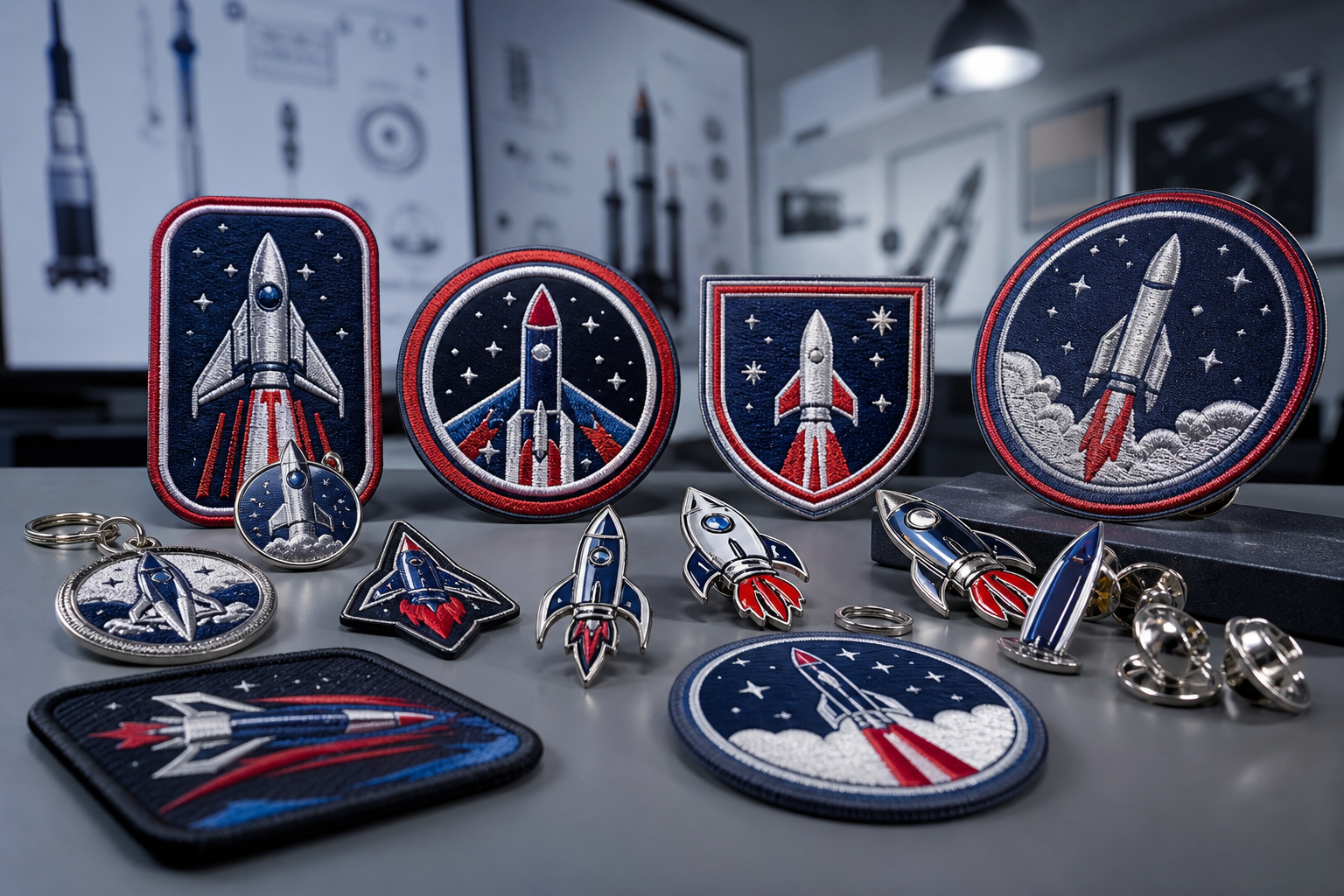
A well designed Rocket Badge turns a simple space inspired symbol into a compact visual identity that can be used for clubs, events, educational activities, employee recognition, apparel, collectibles, and promotional merchandise. The strongest designs balance an instantly recognizable rocket motif with appropriate materials, readable artwork, durable construction, and an attachment method suited to the intended use. Before ordering custom badges, understanding embroidery, enamel, woven, PVC, and printed options can help you avoid design problems and select a format that performs as intended.
What Is a Rocket Badge?
A rocket badge is a decorative or identifying badge that incorporates a rocket, spacecraft, launch, or related space inspired design.
The term does not describe one particular manufacturing method. A badge featuring a rocket can be embroidered, woven, molded from PVC, printed, or manufactured from metal with enamel style color fills.
It can also serve different purposes.
A school science club might use rocket badges as participation awards. A technology company might use an original rocket illustration for an internal event. A collector may simply enjoy space themed patches and pins.
The intended purpose should guide the design process.
A children’s activity badge needs different materials and attachment considerations from a premium metal collectible or an embroidered patch designed for a jacket.
9 Powerful Rocket Badge Design Ideas and Benefits
A rocket is a visually recognizable motif, but successful badge design requires more than placing detailed artwork inside a small shape. These nine considerations can help create a stronger final product.
1. Create a Clear Rocket Silhouette
Badges are relatively small objects. The main graphic should therefore remain recognizable at actual production size.
A strong rocket silhouette can often communicate the concept faster than an illustration containing many tiny components.
The body, nose, fins, window, and exhaust plume provide obvious visual elements that can be simplified according to the manufacturing method.
A designer should regularly zoom the artwork down to its intended physical size during development. Details that disappear on screen at approximately actual size may also be difficult to reproduce on the manufactured badge.
2. Use Bold Color Contrast
Contrast helps separate major design elements.
A light rocket against a dark space background can be easy to distinguish, while red, orange, or yellow exhaust colors can create a strong focal point.
There is no required rocket color palette.
Organizations can adapt the design to an existing brand system, provided the key visual elements remain distinct.
Remember that screen colors do not always reproduce identically in thread, enamel, printed inks, PVC, or other physical materials.
3. Select a Shape That Supports the Artwork
Circular badges naturally suit planet, orbit, and mission inspired designs. Shield shapes can create a traditional emblem appearance, while a badge cut around the rocket itself can feel more playful or contemporary.
The outer shape affects production as well as aesthetics.
Complex outlines may need laser cutting, die cutting, molding, or another production technique suited to the material.
Rocket Badge Shapes That Work at Small Sizes
Simple shapes usually create cleaner edges and easier visual recognition.
Popular options can include:
• Circles
• Ovals
• Shields
• Rectangles
• Stars
• Rocket silhouettes
• Capsules
• Rounded geometric shapes
Choose the outline after considering how the badge will be displayed and attached.
4. Add Short, Readable Text
Text can transform a generic image into an event badge, club identifier, achievement award, or branded item.
Keep wording concise.
A short organization name, year, achievement level, or event title is generally easier to reproduce than a full slogan around a small border.
Manufacturers often specify minimum lettering requirements depending on the process.
5. Match the Material to the Purpose
An embroidered rocket badge has a very different appearance from a polished metal pin.
Embroidery communicates texture and traditional patch styling. Enamel style badges can offer crisp metal outlines and strong colors. PVC creates a molded, dimensional look.
There is no universally superior material.
The correct one is the material that matches the design, environment, quantity, budget, and desired appearance.
6. Use Space Elements Without Overcrowding
Stars, planets, moons, orbital lines, flames, and launch trails can support the central rocket motif.
Using all of them together, however, can make a small design difficult to understand.
Establish a hierarchy.
The rocket might be the primary element, a planet the secondary element, and several small stars the background detail.
7. Create a Series of Collectible Badges
Rocket designs naturally lend themselves to collections.
A series could represent different missions, achievement levels, years, planets, teams, educational milestones, or event categories.
Keep certain visual elements consistent across the range.
The same border shape and typography, for example, can provide continuity while colors and rocket graphics change between badges.
8. Choose the Right Attachment
A badge only works practically when its attachment method suits the object on which it will be used.
Sew on backing works for permanent textile applications. Hook and loop backing provides removability on compatible surfaces. Metal pins may use posts and clutches, safety style fasteners, magnets, or other systems depending on construction.
Safety and suitability should guide the choice.
9. Build an Original Design
Rocket imagery is widely used, but specific logos, fictional spacecraft, mission insignia, characters, and organizational emblems may be protected intellectual property.
Creating original artwork reduces the risk of confusing your badge with someone else’s identity.
This is particularly important for commercial orders.
Original Rocket Badge Artwork and Intellectual Property
Do not assume that an image found through an online search can be copied onto merchandise.
Copyright, trademark, and other intellectual property rights can apply to artwork, names, logos, and distinctive commercial identifiers.
Use artwork you created, appropriately licensed assets, or designs for which you otherwise have permission.
Custom Rocket Badge Materials Explained
Material is one of the first specifications to establish because it affects the artwork that can be reproduced successfully.
Embroidered Rocket Badges
Embroidery uses thread stitched into a textile base to build the graphic.
The raised thread surface gives the badge noticeable texture and a classic patch appearance.
Bold rocket shapes and relatively simple lettering often work well in embroidery.
Highly detailed shading, miniature text, and thin graphic lines may need simplification because thread has physical limitations.
Woven Rocket Badges
Woven badges create the design through woven threads rather than applying raised embroidery to a separate background.
Their finer construction can reproduce certain small details more cleanly than traditional embroidery.
The finished surface is typically flatter.
A woven badge may be appropriate when the artwork contains compact lettering or more detailed line work but the buyer still wants a textile product.
PVC Rocket Badges
PVC badges are molded, allowing raised and recessed graphic elements.
They can produce a distinctive three dimensional appearance and strong blocks of color.
PVC can be useful for bags and equipment where a textile aesthetic is not required.
Performance under weather exposure depends on the complete product and manufacturing specification, so avoid assuming every PVC badge has identical outdoor durability.
Metal and Enamel Rocket Badges
Metal badges and pins can provide a polished collectible appearance.
Colored recesses can be created through enamel style manufacturing methods, while plating determines much of the appearance of exposed metal.
Gold tone, silver tone, black, copper tone, and other finishes may be available.
Choosing a Material for Your Rocket Badge
A simple selection approach is to match the material with the desired result:
• Embroidery for traditional textured patches
• Woven construction for fine textile detail
• PVC for molded dimensional designs
• Metal and enamel for collectible pins
• Printing for gradients or highly detailed imagery
Ask suppliers for physical samples whenever material quality is important.
How to Design a Custom Rocket Badge
Custom badge design normally begins with artwork, dimensions, construction method, and intended use.
Establishing these requirements before requesting quotations can produce more meaningful comparisons between manufacturers.
Define the Badge Purpose
Ask where the badges will be used.
A backpack patch may need hook and loop backing. A school award might need a safe and suitable attachment system. A corporate gift could prioritize presentation and finishing.
Purpose should determine specifications instead of being considered after the visual design is complete.
Establish the Final Dimensions
Design at realistic physical dimensions.
A detailed rocket illustration that looks impressive at 20 centimetres wide may lose its key features when reduced to 3 centimetres.
Ask manufacturers for minimum line widths and text sizes.
Different manufacturing methods have different tolerances.
Simplify Complex Illustrations
Effective badge graphics often rely on strong shapes.
Remove details that are unlikely to reproduce cleanly and enlarge the elements essential for recognition.
Negative space can be as valuable as additional graphic detail.
Preparing Rocket Badge Artwork for Manufacturing
Vector artwork is commonly preferred for custom manufacturing because shapes and lines can be scaled cleanly.
Your supplier may request formats compatible with its production workflow.
Before approval, check:
• Dimensions
• Shape
• Colors
• Text
• Spelling
• Line thickness
• Border style
• Attachment type
• Artwork orientation
Request a final production proof before manufacturing begins.
Rocket Badge Sizes and Dimensions
Size influences visibility, cost, weight, comfort, and reproduction quality.
Small badges suit hats, lapels, and compact achievement displays, while larger patches can work better on jackets and bags.
Small Rocket Badges
Small formats require disciplined artwork.
One rocket, a simple background, and minimal text usually reproduce more effectively than a crowded scene.
If detailed lettering is essential, ask whether woven or printed manufacturing would produce a clearer result than embroidery.
Large Rocket Patches
Larger dimensions offer more design space.
They can accommodate additional text, multiple colors, stars, planets, and mission inspired graphical elements.
Larger badges can also become heavier or stiffer, depending on material.
Measuring for a Rocket Badge
Measure the usable area on the garment, bag, display, or packaging rather than estimating visually.
Create a paper version at the intended dimensions and place it on the item.
This simple prototype can reveal proportion problems before production.
Rocket Badge Backing and Attachment Options
Backing determines how a patch interacts with clothing or equipment.
Not every backing works with every material.
Sew On Backing
Sew on patches are designed for relatively permanent textile attachment.
Stitching can provide dependable attachment when properly completed on a compatible garment.
Consider whether the underlying fabric can be sewn without compromising its function. Waterproof or technical garments may require specialist advice.
Hook and Loop Backing
Hook and loop allows badges to be removed and exchanged.
Typically, the patch carries the hook component and attaches to a compatible loop panel.
This system is useful for collections and items whose badges need to change.
Iron On Backing
Iron on patches use heat activated adhesive.
Fabric must be compatible with the required heat and application process.
Some synthetic, waterproof, coated, or heat sensitive materials can be damaged by high temperatures.
Pin Backing for a Metal Rocket Badge
Metal badges often use one or more posts with clutches or another pin mechanism.
Small products may use one post, while larger designs may benefit from additional stabilization depending on their shape.
Sharp pins require appropriate handling and may be unsuitable for certain users or applications.
Rocket Badge Ideas for Schools and Education
Rocket imagery naturally connects with science, engineering, astronomy, creativity, and exploration.
Educational organizations can use original rocket themed badges for participation or achievement programs.
STEM Achievement Badges
A badge system can represent milestones such as completing a science activity, coding project, engineering challenge, astronomy module, or model rocket exercise.
Clear levels can help participants identify progress.
Designs should avoid implying affiliation with external organizations unless permission exists.
Classroom Recognition
Teachers or organizations can use badges as one type of recognition item where appropriate.
A series might use different colors or planets for different activities.
Rocket Badge Safety for Children
Attachment systems deserve special attention for products intended for children.
Small components and sharp pin fasteners can present hazards depending on the child’s age and product design.
Manufacturers and sellers should determine which product safety requirements apply in the market where the badge will be supplied.
Rocket Badges for Clubs and Events
Events can use badges as attendee items, team identifiers, participation awards, or collectibles.
The design can incorporate event specific information while maintaining a recognizable visual theme.
Event Badge Design
Include the information people will actually want to remember.
The event name and year may be sufficient.
Overloading the design with sponsors, locations, dates, slogans, and other text can make a small badge visually ineffective.
Limited Edition Collections
A limited design can commemorate a specific event or anniversary.
If a product is marketed as limited edition, businesses should communicate the claim accurately and avoid creating misleading scarcity.
Rocket Badge Collections for Annual Events
Maintain a recurring structure and update one or two elements each year.
Changing the rocket color, planet, launch number, or background can create collectible continuity without requiring a complete redesign.
Rocket Badge Ideas for Businesses
The rocket symbol is often associated metaphorically with launches, projects, speed, growth, and innovation.
Businesses can use original rocket themed graphics for internal campaigns or approved merchandise.
Claims implied by the surrounding messaging should remain accurate.
A rocket graphic does not justify unsupported promises of explosive sales, guaranteed growth, or investment returns.
Employee Recognition
An original badge might recognize training, a completed project, an internal milestone, or participation in an event.
Clear criteria make recognition more meaningful.
Product Launch Merchandise
Rocket visuals can complement a legitimate product launch theme.
Badges may be included with event materials or branded merchandise when artwork rights have been properly addressed.
How to Choose a Rocket Badge Manufacturer
Manufacturers vary in equipment, minimum quantities, materials, pricing, and quality control.
Look beyond the headline unit price.
Ask for Relevant Samples
Request samples produced using the same process you intend to order.
An embroidery sample does not demonstrate a supplier’s enamel quality, and vice versa.
Inspect color consistency, edges, lettering, backing, and overall finish.
Understand Minimum Order Quantities
Custom manufacturing often has minimum order requirements.
Higher quantities may reduce unit cost, but they increase upfront expenditure and inventory.
Order according to realistic demand rather than chasing the lowest theoretical unit price.
Questions to Ask a Rocket Badge Supplier
Before ordering, confirm:
• Available materials
• Final dimensions
• Color options
• Border construction
• Backing choices
• Minimum order quantity
• Setup or tooling charges
• Proofing process
• Sample availability
• Manufacturing lead time
• Shipping terms
• Defect and replacement policy
Get important specifications in writing.
How Much Does a Custom Rocket Badge Cost?
There is no universal badge price because manufacturing specifications differ.
Cost can be influenced by material, dimensions, number of colors, artwork complexity, quantity, backing, metal plating, molding, embroidery coverage, packaging, freight, and setup requirements.
Compare quotations using identical specifications.
A lower unit price based on a different size or thinner specification is not a direct comparison.
Consider Total Order Cost
Include setup, sampling, tooling, delivery, taxes or duties where applicable, individual packaging, and other charges.
For imported goods, understand applicable customs requirements before calculating the final budget.
Reducing Rocket Badge Costs Without Sacrificing Design
Simplifying artwork can sometimes reduce complexity while actually improving visual clarity.
Standard dimensions and common materials may also be more economical than unusual specifications.
Ask the manufacturer where meaningful savings can be made without compromising the design’s essential features.
How to Care for Rocket Badges
Care depends entirely on the construction.
A metal enamel pin has different requirements from an embroidered or PVC patch.
Follow supplier instructions when available.
Textile Badge Care
If possible, remove detachable badges before washing a garment.
Sewn or heat applied designs may need to remain attached, in which case care requirements for both garment and patch should be compatible.
Harsh heat or chemicals can affect some threads, adhesives, and colors.
Metal Badge Care
Keep metal badges reasonably clean and dry.
Certain finishes may tarnish or change appearance over time depending on materials, environment, and handling.
Avoid abrasive cleaning unless specifically recommended.
Storing a Rocket Badge Collection
Textile badges can be stored on compatible display panels, while metal pins can use purpose designed boards, cases, or other displays.
Keep collections away from avoidable moisture and conditions likely to cause fading or material deterioration.
Common Rocket Badge Design Mistakes
One of the most frequent mistakes is adding too much detail.
Badges are physically small, so successful artwork needs to communicate quickly.
Other problems include:
• Text that becomes unreadable
• Insufficient color contrast
• Incorrect dimensions
• Choosing the wrong manufacturing process
• Forgetting attachment requirements
• Ignoring material thickness
• Approving only an enlarged digital mockup
• Ordering large quantities without sampling
• Using protected artwork without permission
• Overlooking safety considerations
A physical prototype can resolve many of these concerns before full production.
Frequently Asked Questions
What is a Rocket Badge?
A Rocket Badge is a decorative or identifying badge featuring a rocket or space inspired design. It can be embroidered, woven, printed, molded from PVC, or manufactured from metal.
What is the best material for a Rocket Badge?
The best material depends on its purpose. Embroidery provides texture, woven material supports fine textile detail, PVC creates dimensional effects, and metal suits collectible pins.
Can I order a custom Rocket Badge with my logo?
Yes, many manufacturers accept custom artwork. You should own or have appropriate permission to reproduce any logo, image, trademark, or other protected design.
What size should a Rocket Badge be?
Size depends on its intended placement and artwork complexity. Measure the usable attachment area and test a paper version at actual size before approving production.
Can a Rocket Badge use hook and loop backing?
Yes. Many textile and PVC badges can be produced with hook and loop backing for use on compatible loop panels, subject to the manufacturer’s available options.
How much do custom Rocket Badge designs cost?
Pricing depends on material, size, complexity, quantity, backing, setup, finishing, packaging, and shipping. Obtain quotations based on identical specifications for accurate comparisons.
Conclusion
A Rocket Badge can turn the familiar imagery of space exploration into an effective collectible, achievement award, event item, or customizable accessory. The strongest results come from clear artwork, appropriate dimensions, suitable materials, and an attachment system matched to actual use. By checking proofs, samples, manufacturing specifications, and artwork rights before production, buyers can create rocket badges that remain distinctive, practical, and visually clear.