Leather Automatic Watch Winder Guide: How to Choose the Right Winder for Your Automatic Watches
A well chosen leather automatic watch winder combines mechanical watch storage with a motorized holder designed to periodically rotate a compatible self winding watch when it is not being worn. A winder can be convenient for watches with complications that take time to reset, but not every automatic watch needs one, and incorrect settings can make an expensive accessory unnecessarily complicated. Motor quality, turns per day, rotation direction, watch compatibility, holder design, power supply, leather construction, noise, and long term care should all be considered before buying.
What Is a Leather Automatic Watch Winder?
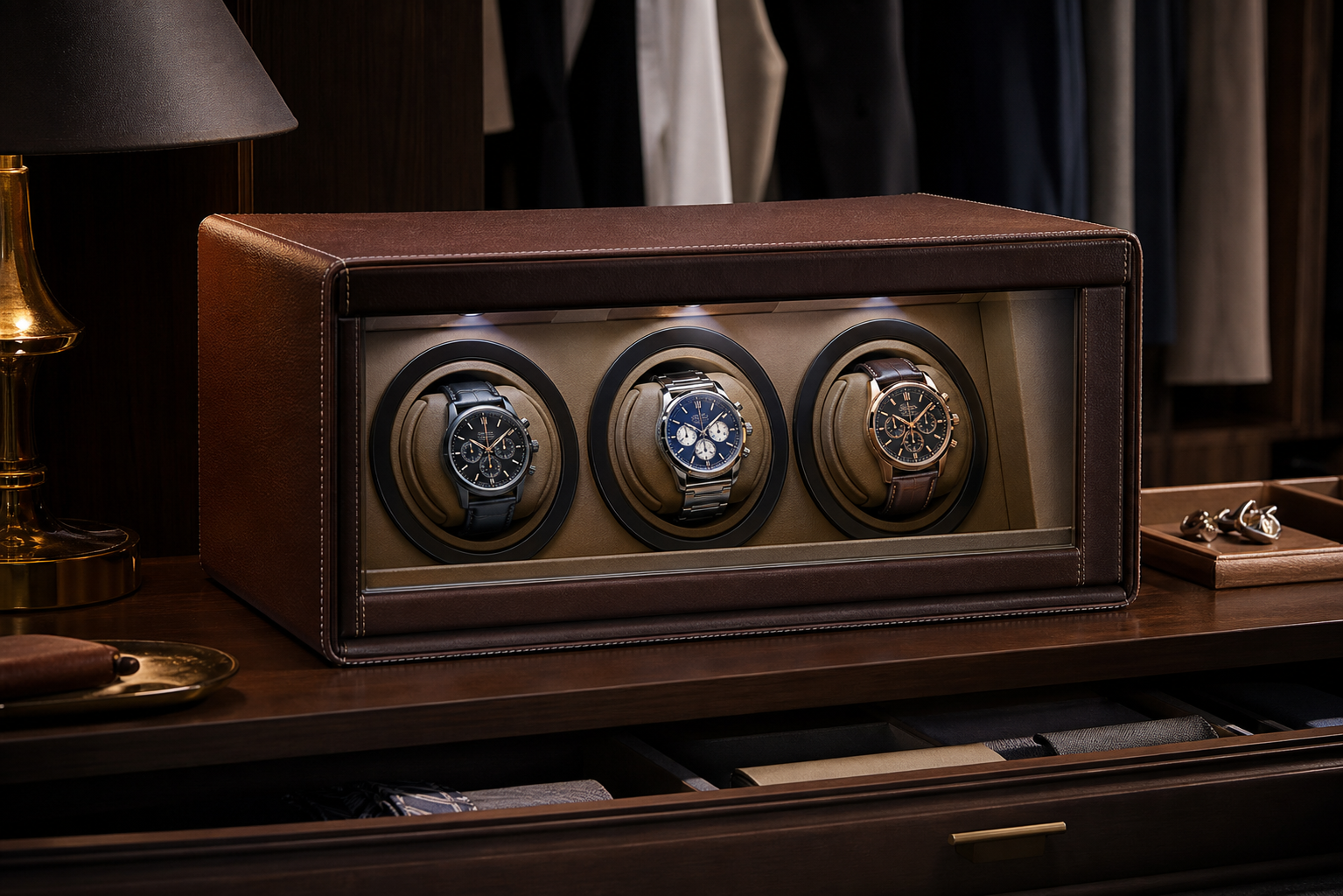
A leather automatic watch winder is a powered storage device that holds and periodically rotates one or more automatic mechanical watches.
Automatic watches normally use movement from the wearer’s wrist to move a weighted rotor inside the movement. That rotor contributes to winding the mainspring through the movement’s winding mechanism.
When a watch remains unworn for long enough, its stored power eventually runs down and the watch stops.
A watch winder periodically moves the watch to simulate some of the motion associated with wear. When its settings are appropriate for the movement, this can help maintain the watch’s state of wind.
The word leather describes the exterior or decorative material and does not determine the quality of the winding mechanism itself.
A beautifully finished leather case can still contain a noisy or poorly controlled motor, making internal specifications just as important as appearance.
9 Powerful Benefits of a Leather Automatic Watch Winder
A watch winder is primarily a convenience and storage accessory. Claims that every automatic watch requires constant winding for mechanical health should be treated cautiously unless the watch manufacturer provides specific guidance.
1. Keeps Compatible Automatic Watches Running
The central purpose of a winder is to periodically rotate an automatic watch while it is off the wrist.
If the winder provides an appropriate rotation pattern for the movement, it can help prevent the watch from exhausting its power reserve during periods of nonuse.
This can be convenient for someone who regularly rotates between several watches.
It is less important for a person who wears the same automatic watch daily.
2. Reduces Repeated Date and Time Resetting
When an automatic watch stops, the owner generally needs to reset the time before wearing it again.
Date displays may also require adjustment.
For a simple three hand watch, this may take very little time. For watches with additional calendar indications or other complications, setup can be more involved.
A winder can therefore be particularly appealing when resetting a compatible watch is inconvenient.
3. Provides Dedicated Watch Storage
A winder can double as an organized display and storage solution.
Enclosed models may help protect watches from routine household dust while keeping them in one designated location.
Protection depends on the case design.
A watch winder should not automatically be treated as a safe. Unless specifically certified for a security purpose, its locks or covers may offer little meaningful protection against theft.
4. Offers Adjustable Rotation Settings
Better winders often provide control over turns per day, frequently abbreviated as TPD, and rotation direction.
These settings matter because automatic movements do not all have identical winding requirements.
Some movements can wind effectively in either direction, while others may have movement specific recommendations.
Leather Automatic Watch Winder TPD Settings
Do not choose the maximum available TPD simply because it sounds more effective.
Start with the watch or movement manufacturer’s recommendation where available.
If documentation is unavailable, identify the exact movement and consult a credible technical source, authorized retailer, manufacturer, or qualified watchmaker.
The appropriate setting should maintain sufficient winding without unnecessary motion.
5. Multiple Watch Capacity Is Available
Watch winders range from single units to cabinets designed for larger collections.
Collectors can select a unit based on the number of automatic watches that genuinely need winding.
A four watch winder does not necessarily operate all positions identically.
Higher quality multi watch products may provide independent controls for each motor or pair of holders, which can be useful when a collection contains different movements.
6. Leather Can Complement Luxury Watch Storage
Leather and leather finished cases can complement traditional mechanical watch design.
Available finishes may include black, brown, tan, burgundy, navy, and other colors.
Interior materials can include microfiber, suede style textiles, or other soft linings.
Appearance should be considered alongside construction quality, especially where the product will remain prominently displayed.
7. Quiet Operation Can Suit Bedrooms and Offices
Watch winders run intermittently, meaning motor noise can become important in quiet rooms.
A loud mechanism can be distracting even if it functions correctly.
Manufacturers may describe motors as silent or ultra quiet, but these terms do not represent a universal objective noise standard.
Independent reviews and in person testing can provide additional context.
8. Programmable Rest Periods Can Mimic Intermittent Wear
A winder should not necessarily rotate continuously.
Many products operate through programmed cycles that alternate rotation and rest.
This approach can provide the required approximate daily rotation while avoiding constant operation.
Actual programming differs by model.
9. Creates an Organized Watch Display
A high quality leather case can present a mechanical watch collection in a neat and visually consistent way.
This is an aesthetic benefit rather than a horological necessity.
Collectors who value display may choose glass fronted winders, while buyers prioritizing discretion may prefer enclosed designs without large viewing windows.
How an Automatic Watch Winder Works
Understanding the basic mechanism can prevent unrealistic expectations.
A winder does not directly connect to the watch movement.
It rotates the complete watch while secured on a holder.
Automatic Watch Rotor Movement
Inside most automatic movements is a rotor designed to move as the watch changes orientation.
Through the winding mechanism, this movement contributes energy to the mainspring.
Different movement designs respond differently to rotational direction and activity.
A winder attempts to supply enough suitable motion to maintain winding while the watch remains stationary overall.
Turns Per Day Explained
TPD represents the approximate number of turns a winder delivers within its programmed daily operation.
It does not refer to the watch’s rotor making exactly the same number of complete rotations internally.
Manufacturer settings should therefore be treated as operational parameters for the winder rather than a literal measurement of every internal movement.
Why Leather Automatic Watch Winder Settings Matter
If a watch continually stops while using a winder, possible explanations include:
• Incorrect TPD
• Incorrect rotation direction
• Poor positioning
• Winder malfunction
• Watch movement problems
• Inadequate initial state of wind
Do not assume increasing TPD will solve every problem.
A watch that repeatedly loses power despite suitable settings may need inspection by a qualified watchmaker.
Clockwise, Counterclockwise, and Bidirectional Rotation
Winding direction is a key compatibility specification.
Clockwise Rotation
Some automatic movements respond to clockwise winder rotation for effective winding.
The orientation is generally described from the perspective specified by the winder or compatibility guidance.
Read instructions carefully because terminology can occasionally create confusion.
Counterclockwise Rotation
Other movements may require or perform best with rotation in the opposite direction.
Again, movement specific recommendations should take priority.
Bidirectional Rotation
Many movements support winding through motion in either direction, and many winders include alternating programs.
Setting a Leather Automatic Watch Winder Correctly
Identify the exact watch reference and movement if possible.
Then determine:
• Recommended TPD
• Suitable direction
• Whether bidirectional winding is supported
• Whether the manufacturer advises winder use
• How the winder defines rotational direction
Record settings for each watch in a larger collection.
Does Every Automatic Watch Need a Winder?
No.
An automatic mechanical watch can normally be allowed to stop when it is not being worn, subject to the watch manufacturer’s specific advice.
A winder mainly offers convenience.
When a Winder May Be Useful
A winder can be especially convenient for:
• Owners rotating several automatic watches
• Watches with calendar complications
• Frequently worn watches that sit unused for several days
• Collectors who want organized powered storage
Simple automatic watches that are easy to set may gain less practical benefit.
When a Winder May Be Unnecessary
If a watch is worn regularly enough to remain powered, a winder may add little value.
Likewise, an owner who enjoys manually setting a watch after storage may prefer a conventional watch box.
Leather Automatic Watch Winder vs Watch Box
A watch box stores watches without moving them.
A winder adds powered rotation.
For collections containing quartz, manual wind, and automatic watches, a combination storage solution may be more practical than placing every watch in a motorized position.
Can a Watch Winder Damage a Watch?
A properly functioning winder used with an appropriate compatible automatic watch is designed for this purpose, but suitability should not be assumed in every case.
Automatic movements commonly include mechanisms intended to prevent continued rotor winding from indefinitely increasing mainspring tension once a suitable state of wind is reached.
That does not mean unlimited motion is desirable.
Avoid Excessive Unnecessary Rotation
Set the winder according to credible movement recommendations rather than automatically choosing the highest setting.
More rotations provide no inherent benefit once the goal of maintaining adequate winding has been achieved.
Consider Vintage or Delicate Watches
Vintage watches can differ substantially in mechanical condition.
A watch that has not been serviced appropriately or already shows winding problems may not be a good candidate for continuous use on a winder.
Using a Leather Automatic Watch Winder With Valuable Watches
For valuable, vintage, or unusual movements, consult the manufacturer, an authorized service provider, or a qualified independent watchmaker when compatibility is uncertain.
Generic online TPD databases can be useful references, but movement specific authoritative guidance is preferable.
Genuine Leather vs Synthetic Leather Watch Winders
The word leather is used loosely in product listings.
Buyers seeking a particular material should read specifications carefully.
Genuine Leather Construction
A winder described as genuine leather may use leather over a structural case rather than being constructed entirely from leather.
Quality varies by hide, tanning, finish, thickness, stitching, backing, and manufacturing.
The generic term genuine leather does not by itself indicate premium quality.
Synthetic Leather
Synthetic leather can provide a similar visual appearance at a different price and maintenance profile.
Materials may include polyurethane based coverings and other compositions.
Sellers should accurately describe material content.
Full Grain and Top Grain Leather
Full grain and top grain terminology can indicate different processing approaches, but consumers should still evaluate the complete product.
Evaluating Leather Automatic Watch Winder Materials
Check:
• Exterior material description
• Interior lining
• Stitch quality
• Edge finishing
• Case rigidity
• Hinges
• Window construction
• Controls
• Watch holder materials
A premium exterior cannot compensate for a poor motor or holder.
Motor Quality and Noise
The motor is among the most important components in a watch winder.
It determines rotational consistency, operating noise, and potentially long term reliability.
Quiet Motor Operation
A winder placed in a dressing room may tolerate more audible operation than one beside a bed.
Buyers sensitive to sound should investigate independent user experiences rather than relying entirely on marketing claims.
Independent Motor Controls
For multi watch collections, independent motors can increase flexibility.
One watch might require a different rotation direction from another.
Leather Automatic Watch Winder Motor Reliability
Look for meaningful warranty coverage and available technical support.
If a motor fails, determine whether the manufacturer offers replacement modules or repair services.
Repairability can improve the long term value of an expensive unit.
Watch Holder Design and Fit
The holder should keep the watch stable without placing inappropriate pressure on the bracelet, strap, clasp, or case.
Adjustable Cushions
Wrist sizes vary considerably.
A holder designed for a large bracelet may overextend a small watch band.
Adjustable or compressible cushions can provide better compatibility across different sizes.
Heavy Watches
Large watches can place additional load on the winder mechanism.
Check manufacturer limits or guidance when using unusually heavy watches.
Leather Automatic Watch Winder for Leather Strap Watches
Leather watch straps should not be forced around holders that are excessively large.
Repeatedly closing a strap tightly around an oversized cushion can place unnecessary stress on the strap and buckle holes.
Choose holders compatible with the actual closed circumference of the watch.
Power Options for Automatic Watch Winders
Power supply affects where a winder can be placed.
AC Powered Winders
Mains powered units work well where the winder remains permanently positioned near an outlet.
Check whether the supplied adapter matches local electrical requirements.
Use manufacturer approved power supplies.
Battery Powered Winders
Battery operation can be useful for cabinets, closets, or locations without convenient outlets.
Battery life depends on motor design, battery type, settings, load, and frequency of operation.
Do not assume manufacturer estimates will be identical under every usage pattern.
Dual Power Models
Some winders support both mains and battery operation.
Power Safety for a Leather Automatic Watch Winder
Avoid unapproved adapters with incorrect voltage, polarity, or current specifications.
Inspect damaged cables and stop using an electrical device that overheats, emits a burning odor, or shows other signs of electrical failure.
Choosing the Right Winder Capacity
Buy for the collection you actually expect to wind.
A single watch owner does not necessarily benefit from purchasing an eight position cabinet.
Single Watch Winders
Single units are compact and can be easier to place.
They also allow each watch to have an independent device and programming.
Double and Multi Watch Winders
Multi watch models create a consolidated display.
Check whether each position has independent settings.
Watch Winder Cabinets
Large cabinets are designed for extensive collections.
They can include both rotating positions and static storage.
Planning Leather Automatic Watch Winder Capacity
Consider:
• Number of automatic watches
• Number actually requiring winding
• Future collection plans
• Available furniture space
• Power access
• Independent control requirements
• Static storage needs
Leaving some capacity can be sensible, but unnecessary motorized positions increase cost and physical size.
Watch Winder Security and Storage
An enclosed winder may protect watches from casual contact and dust, but security requires separate consideration.
Locks Are Not Automatically Safes
A small key lock can discourage casual access without providing tested burglary protection.
For high value collections, consider a properly specified safe or secure storage system appropriate to the risks.
Sunlight and Humidity
Avoid prolonged direct sunlight where possible.
Sun exposure can affect leather, interior materials, and watch straps over time.
Extreme humidity and environmental conditions may also affect watches and storage materials.
Placing a Leather Automatic Watch Winder Safely
Use a stable, level surface away from edges, vibration, excessive heat, dampness, and direct sunlight.
Large units should be positioned according to manufacturer guidance.
How to Care for Leather Watch Winder Surfaces
Leather requires appropriate care to preserve its appearance.
First establish whether the exterior is genuine leather, coated leather, bonded material, or synthetic upholstery.
Different surfaces require different products.
Routine Cleaning
Dust can often be removed using a clean, soft cloth.
For stains, follow the manufacturer’s instructions.
Avoid soaking leather surfaces.
Leather Conditioners
Do not assume every conditioner is safe for every leather finish.
Some products can darken or alter surface coatings.
Test compatible treatments cautiously in an inconspicuous area where manufacturer guidance permits.
Leather Automatic Watch Winder Interior Care
Keep the interior free from grit that could mark a watch case or bracelet.
Use gentle cleaning methods appropriate to the lining.
Do not spray cleaner directly around the motor, electronics, or controls.
How to Set Up a Leather Automatic Watch Winder
Read both the watch and winder instructions before setup.
Correct programming should be based on movement requirements.
Identify the Watch Movement
The movement may be listed in manufacturer documentation or reliable reference material.
Watches within the same brand can use different movements.
Do not apply one setting across an entire brand automatically.
Secure the Watch Correctly
Place the watch around the holder so it remains stable during rotation.
Avoid excessive strap tension.
Select Appropriate Settings
Program the recommended TPD and direction.
Observe performance over time.
Troubleshooting Leather Automatic Watch Winder Settings
If the watch stops:
• Confirm power to the winder
• Check the program
• Verify rotation direction
• Confirm recommended TPD
• Ensure the watch is secure
• Determine whether the watch was initially sufficiently wound
• Consider whether the watch needs professional inspection
Avoid endless increases in rotation without identifying the cause.
Buying a Leather Automatic Watch Winder
Price ranges vary widely, so specifications provide a better basis for comparison than brand positioning alone.
Check Programming Flexibility
Look for TPD choices appropriate to your movements and the direction settings you require.
A winder with limited fixed settings may not suit a diverse collection.
Review the Warranty
Motors and electronic controls can fail.
Understand warranty duration, exclusions, return requirements, and repair support.
Evaluate Build Quality
Inspect case alignment, hinges, stitching, switches, holders, motor operation, and interior finishing.
Leather Automatic Watch Winder Buying Checklist
Before purchasing, compare:
• TPD settings
• Rotation directions
• Motor noise
• Watch capacity
• Independent controls
• Holder adjustment
• Maximum watch dimensions
• Power options
• Leather type
• Interior lining
• Warranty
• Repairability
• Return policy
• Overall dimensions
These specifications are more useful than luxury language alone.
Common Watch Winder Mistakes
The most common mistake is assuming every automatic movement has the same winding requirements.
Another is using the highest available setting unnecessarily.
Other avoidable problems include:
• Buying before checking TPD requirements
• Ignoring rotation direction
• Forcing straps around oversized cushions
• Treating a decorative lock as high security
• Assuming genuine leather always means premium leather
• Placing the winder in direct sunlight
• Using an incorrect power adapter
• Ignoring unusual motor noises
• Putting manual wind or quartz watches on a winder unnecessarily
• Assuming a winder can fix a mechanically faulty watch
The accessory should support an already functional automatic movement, not substitute for servicing.
Leather Automatic Watch Winder vs Manual Winding
Many automatic watches also permit manual winding through the crown, although owners should follow the manufacturer’s instructions for their specific watch.
Manual winding can restore power without a winder.
A winder is useful primarily because it automates periodic movement during storage.
Neither method removes the need for appropriate watch maintenance.
Does a Winder Replace Watch Servicing?
No.
A winder does not lubricate, clean, regulate, or repair a mechanical movement.
If a watch loses time abnormally, stops despite suitable power, feels unusual during winding, or demonstrates another mechanical problem, professional inspection may be appropriate.
Frequently Asked Questions
What is a leather automatic watch winder?
A leather automatic watch winder is a powered storage device that periodically rotates compatible self winding mechanical watches while providing a leather or leather finished exterior.
Does an automatic watch need a watch winder?
Usually not. A winder is primarily a convenience for keeping compatible automatic watches running, especially watches that are rotated frequently or have time consuming complications to reset.
How many TPD should a leather automatic watch winder use?
The appropriate turns per day depend on the specific watch movement. Follow the watch manufacturer’s guidance or another credible movement specific technical source.
Can a leather automatic watch winder overwind a watch?
Modern automatic movements generally incorporate mechanisms that limit excessive mainspring tension, but unnecessary rotation should still be avoided by using appropriate movement specific settings.
Is genuine leather better for an automatic watch winder?
Not automatically. Leather quality, case construction, motor performance, holder design, controls, stitching, and warranty collectively determine the quality of a winder.
How do I choose the best leather automatic watch winder?
Match TPD and direction settings to your watch movements, then compare motor noise, holder fit, capacity, power options, construction, leather quality, warranty, and repair support.
Conclusion
A leather automatic watch winder can combine attractive watch storage with convenient powered rotation for compatible automatic movements. The most important buying considerations are movement specific TPD and direction settings, quiet motor performance, secure holder fit, dependable power, and sound construction rather than appearance alone. Choosing suitable settings and caring properly for both the leather exterior and mechanical components can make a quality winder a practical addition to an automatic watch collection.