AC Replacement: How to Choose the Right System Without Costly Mistakes
A properly planned AC replacement can improve indoor comfort and may reduce cooling energy use when an aging or failing air conditioner is replaced with an appropriately sized, efficient system and the rest of the HVAC installation supports its performance. Choosing new equipment based only on brand, price, or nominal tonnage can lead to disappointing results. Cooling load, climate, ductwork, airflow, humidity, efficiency ratings, installation quality, refrigerant requirements, electrical capacity, warranties, and long term operating costs all deserve consideration before a new air conditioner is installed.
What Does AC Replacement Include?
AC replacement involves removing or decommissioning existing cooling equipment and installing a new system designed to meet the property’s cooling requirements.
The scope depends on the type of HVAC system and its condition.
For a typical central split air conditioner, work may involve an outdoor condensing unit and an indoor evaporator coil. Depending on compatibility, the project can also affect the furnace or air handler, thermostat, refrigerant lines, condensate drainage, electrical components, ductwork, equipment pad, and controls.
Replacing only the outdoor unit without checking indoor equipment compatibility can create performance or warranty problems.
Modern equipment is commonly tested and rated as a matched system. Contractors should identify compatible indoor and outdoor components rather than assembling equipment based solely on similar nominal capacity.
A complete replacement proposal should explain exactly which components are changing and which existing components will remain.
9 Powerful AC Replacement Tips for Homeowners
Air conditioning equipment can operate for many years, making replacement a significant home investment. These principles can help homeowners evaluate proposals more effectively.
1. Confirm That Replacement Is Actually Necessary
A malfunction does not automatically mean the entire air conditioner needs replacement.
Problems involving controls, capacitors, contactors, motors, drainage, or other repairable components can sometimes be corrected without replacing the system.
Before approving a full replacement, ask the technician to explain the existing fault and the repair alternatives.
Replacement may become more compelling when expensive failures occur alongside broader equipment deterioration, difficult parts availability, poor efficiency, unsuitable capacity, or repeated reliability problems.
The decision should reflect current condition rather than age alone.
2. Require Proper AC Sizing
One of the most important replacement decisions is capacity.
An air conditioner that is too small may struggle during design conditions. An oversized system can cycle differently and may create comfort, humidity, or efficiency concerns depending on equipment and climate.
The size of the old unit is not proof that the same size should be installed again.
Homes change over time.
Windows, insulation, additions, air sealing, roofing, occupancy, and other factors can alter heating and cooling loads.
AC Replacement and Manual J Load Calculations
In the United States, ACCA Manual J is a recognized residential load calculation methodology used to estimate heating and cooling requirements.
A load calculation considers factors such as:
• Climate
• Building orientation
• Floor area
• Insulation
• Window characteristics
• Air leakage assumptions
• Occupancy
• Internal loads
• Building construction
Equipment selection should then be matched appropriately to calculated requirements and relevant design procedures.
3. Compare Efficiency Ratings Correctly
Efficiency ratings can help compare air conditioning equipment, but a higher number does not automatically make one system the best financial choice.
In the United States, current residential equipment may be described using SEER2 and EER2 metrics, depending on product and regulatory requirements.
SEER2 represents seasonal cooling efficiency under standardized testing.
Real world energy use also depends on climate, thermostat settings, duct performance, installation, maintenance, occupancy, building envelope, and electricity prices.
4. Inspect Existing Ductwork
Installing efficient equipment on a poorly performing duct system can limit comfort and efficiency.
Ducts may have leakage, inadequate insulation, restrictive design, poor connections, or sizing issues.
A replacement project is a useful opportunity to evaluate airflow problems that existed with the old system.
Rooms that have always been uncomfortable should not be assumed to improve automatically because the outdoor unit is new.
5. Consider Humidity Performance
Cooling and moisture removal are related.
In humid climates, equipment sizing, runtime, airflow, controls, and system design can influence indoor humidity management.
Variable capacity and multistage systems can provide different operating characteristics from traditional single stage equipment.
That does not mean they are automatically necessary for every home.
A contractor should explain how the proposed system addresses the local climate and comfort requirements.
6. Check Electrical Requirements
A replacement system must be compatible with the property’s electrical service and branch circuit requirements.
Changes to equipment capacity or technology may require electrical modifications.
Disconnects, circuit protection, wiring, grounding, and other components should comply with applicable electrical codes and manufacturer instructions.
Qualified personnel should complete electrical work.
7. Review Refrigerant Considerations
Air conditioning technology and refrigerant regulations change over time.
Older systems may use refrigerants that are no longer produced or are being phased down under environmental regulations.
New equipment can use different refrigerants and may have specific installation and safety requirements.
AC Replacement and Refrigerant Compatibility
Existing indoor coils, refrigerant lines, tools, and components cannot automatically be assumed compatible with a new refrigerant system.
The HVAC contractor should follow equipment manufacturer requirements and applicable regulations.
In the United States, technicians who service equipment in ways that could release regulated refrigerants generally need appropriate EPA Section 608 certification.
8. Compare Complete Installed Cost
The equipment price is only one component of an AC replacement.
A complete quotation may need to include removal, disposal, indoor and outdoor equipment, refrigerant line work, drains, electrical work, controls, permits, duct modifications, commissioning, labor, and warranties.
Compare the entire scope rather than headline equipment prices.
9. Prioritize Installation Quality
Even highly efficient premium equipment can perform poorly if installation is deficient.
Airflow, refrigerant charge, drainage, electrical setup, thermostat configuration, equipment matching, duct connections, and commissioning all matter.
The contractor’s competence can therefore be as important as the brand printed on the condenser.
Signs You May Need AC Replacement
Air conditioners can exhibit several symptoms as they age or develop problems.
These signs justify evaluation but do not individually prove replacement is required.
Frequent AC Repairs
Repeated failures can change the economics of keeping an older system.
Track repair expenses and the types of components being replaced.
Several unrelated failures can indicate broad deterioration, while recurrence of the same fault may point to an unresolved root cause.
Poor Cooling Performance
An air conditioner that runs but cannot maintain comfortable temperatures may have airflow, refrigerant, compressor, duct, sizing, or building envelope issues.
Replacement is only one possible solution.
Diagnosis should identify why performance is poor.
Increasing Operating Costs
Higher electricity bills can reflect weather, rates, thermostat settings, occupancy, equipment problems, or changes elsewhere in the home.
Compare similar periods when possible.
AC Replacement After a Major Component Failure
When an older system experiences a major compressor or coil failure, request both repair and replacement options where practical.
Consider:
• Repair cost
• Remaining warranty
• System condition
• Parts availability
• Refrigerant
• Current efficiency
• Replacement cost
• Expected ownership period
This produces a more informed decision than relying on a single age threshold.
AC Repair vs AC Replacement
Homeowners frequently face this decision when a system fails during hot weather.
Urgency can make careful comparison difficult.
When AC Repair May Make Sense
Repair may be reasonable when the equipment is otherwise in good condition, the fault is limited, parts remain readily available, and costs are proportionate.
Warranty coverage can further improve repair economics.
When Replacement May Be More Practical
Replacement may deserve consideration when major repair costs are high relative to the value and condition of existing equipment or when the old system has multiple deficiencies.
A new system can also address known sizing or compatibility problems when properly designed.
Avoid Simple AC Replacement Formulas
Rules such as multiplying repair cost by equipment age are sometimes used as shortcuts.
They are not engineering or financial requirements.
Actual decisions should account for repair scope, reliability, energy use, replacement quality, household plans, and budget.
How AC Replacement Sizing Works
Residential air conditioners are often described by cooling capacity, commonly measured in British thermal units per hour or tons in the United States.
One nominal ton of cooling corresponds to 12,000 BTU per hour.
This does not mean a particular square footage automatically needs a particular tonnage.
Why Square Footage Alone Is Not Enough
Two houses of identical size can have substantially different cooling loads.
One may have extensive west facing glass and limited insulation, while another has efficient windows, strong insulation, substantial shade, and lower air leakage.
Simple square foot rules ignore these differences.
Equipment Selection After the Load Calculation
Once design loads are established, the contractor can select equipment whose performance matches those requirements under relevant conditions.
A system’s nominal model size does not tell the complete performance story.
AC Replacement for Additions and Renovations
If a home has been expanded or substantially renovated since the current HVAC system was installed, recalculate the load.
Do not assume the existing duct system can support additional conditioned space without evaluation.
Renovations can either increase or decrease cooling requirements depending on what changed.
AC Replacement Efficiency Ratings Explained
Energy efficiency is an important purchasing factor, especially in climates with substantial cooling seasons.
What Is SEER2?
SEER2 is a seasonal energy efficiency metric used for residential cooling equipment under updated testing procedures in the United States.
Higher rated equipment uses less electricity under standardized test conditions to provide a given amount of seasonal cooling than otherwise comparable lower rated equipment.
Actual savings vary.
What Is EER2?
EER2 provides another measure of cooling efficiency under specified conditions.
It can be particularly relevant when considering performance during higher load conditions.
The Department of Energy establishes minimum efficiency standards that vary according to equipment category and region.
Is Higher Efficiency Always Worth the AC Replacement Cost?
Not necessarily.
Compare additional purchase price with expected operating savings, climate, usage patterns, maintenance requirements, electricity prices, incentives, and expected ownership period.
Avoid sales claims promising specific savings percentages without calculations relevant to the actual home.
Central AC Replacement vs Heat Pump Installation
Some homeowners replacing an air conditioner consider switching to an electric heat pump.
A heat pump can provide both cooling and heating.
How Heat Pumps Differ
In cooling mode, an air source heat pump operates similarly to an air conditioner.
In heating mode, it reverses the refrigeration cycle to transfer heat indoors.
Modern heat pumps are available for various climates, including colder regions when appropriately selected and designed.
Consider the Existing Heating System
A homeowner currently using a furnace may choose a heat pump with backup or supplemental heat in a dual fuel configuration, depending on climate and system design.
Other homes may use all electric systems.
AC Replacement With a Heat Pump
Evaluate heating loads, electricity and fuel prices, climate performance, electrical capacity, incentives, ductwork, and controls before switching technologies.
A qualified contractor can model the options for the specific property.
Ductwork During AC Replacement
Duct systems often outlast individual HVAC units, but that does not mean they should be ignored during replacement.
Check for Leakage
Leaks can allow conditioned air to escape into attics, crawl spaces, or other unconditioned areas.
Return side leaks can also draw unwanted air into the system.
Appropriate sealing methods depend on duct material and location.
Evaluate Duct Sizing
Undersized ducts or restrictive fittings can contribute to high static pressure and inadequate airflow.
This can affect comfort, noise, and equipment operation.
Inspect Duct Insulation
Ducts passing through hot unconditioned spaces may require appropriate insulation.
Damaged insulation can reduce thermal performance.
AC Replacement Airflow Testing
A contractor can measure system airflow and static pressure to evaluate whether the duct system supports the proposed equipment.
This is particularly valuable where the old system had airflow complaints.
AC Replacement Costs
Replacement costs vary substantially by geographic location and project.
A universal national number can be misleading.
What Influences AC Replacement Cost?
Major factors include:
• Equipment capacity
• Efficiency
• System type
• Indoor equipment
• Controls
• Duct modifications
• Refrigerant lines
• Electrical work
• Drainage
• Accessibility
• Permits
• Labor
• Local market conditions
Variable capacity equipment generally has different pricing from basic single stage systems.
Get Multiple Detailed Quotes
For planned replacement, consider obtaining several proposals from qualified contractors.
Ensure each quote addresses comparable equipment and scope.
Hidden AC Replacement Costs to Check
Ask whether the quote includes:
• Old equipment removal
• Refrigerant recovery
• New indoor coil
• Equipment pad
• Line set work
• Electrical disconnect
• Condensate drain modifications
• Thermostat
• Permits
• Duct connections
• Startup and commissioning
• Warranty registration
Clear scope reduces surprises.
AC Replacement Rebates and Tax Incentives
Energy efficiency incentives may reduce the effective cost of qualifying HVAC equipment.
Programs change over time.
Potential incentives can come from utilities, manufacturers, state programs, federal programs, municipalities, or other organizations.
Verify Eligibility Before Purchase
Equipment must often meet specified efficiency or certification criteria.
Installation deadlines and documentation can also apply.
Do not rely solely on a salesperson’s statement that a system definitely qualifies.
Check current official program requirements.
AC Replacement Incentive Documentation
Keep invoices, equipment model numbers, efficiency certificates, contractor information, and other required documentation.
For tax questions, consult current government guidance or an appropriately qualified tax professional.
Choosing an AC Replacement Contractor
Contractor selection is a major quality decision.
Verify Licensing and Insurance
HVAC licensing requirements vary by jurisdiction.
Check with relevant state or local authorities.
Ask for applicable insurance documentation and refrigerant handling credentials.
Ask About Load Calculations
A contractor who proposes equipment size solely by looking at the old unit may miss opportunities to correct previous sizing problems.
Ask how the cooling load will be established.
Review Equipment Matching
Request model numbers for both indoor and outdoor equipment.
Contractors should be able to provide performance information for the proposed matched system.
Questions to Ask Before AC Replacement
Ask prospective contractors:
• Will you perform a load calculation?
• How was the proposed size selected?
• Are the indoor and outdoor units properly matched?
• Will you assess ductwork?
• What efficiency ratings apply?
• Which refrigerant does the system use?
• What electrical changes are required?
• Are permits included?
• How will the system be commissioned?
• What warranties apply?
• Is labor warranty included?
• Who registers manufacturer warranties?
Detailed answers help distinguish comparable proposals.
The AC Replacement Installation Process
Installation should follow manufacturer specifications and applicable codes.
Removing the Existing System
Refrigerant should be recovered using appropriate equipment and procedures rather than released intentionally.
The old equipment can then be disconnected and removed.
Disposal and recycling options vary locally.
Installing New Equipment
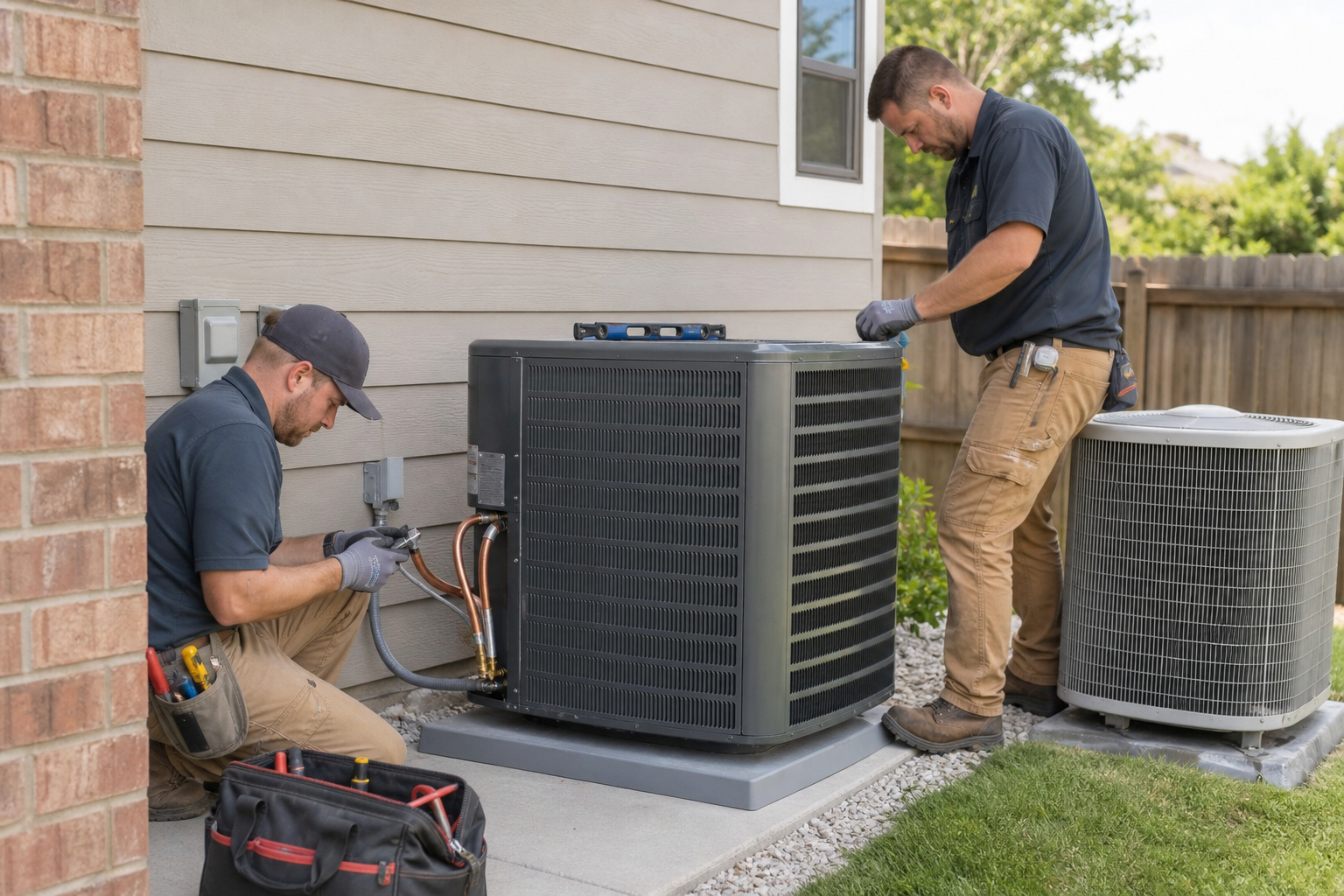
The contractor positions and connects indoor and outdoor components, addressing refrigerant piping, electrical service, drainage, ductwork, and controls as required.
Startup and Commissioning
Installation is not complete when the equipment first turns on.
AC Replacement Commissioning
Commissioning can include checking:
• Airflow
• Static pressure
• Refrigerant system performance
• Electrical operation
• Controls
• Temperature change
• Condensate drainage
• Equipment configuration
• Safety operation
Relevant results can be documented for future reference.
AC Replacement Warranties
HVAC warranties can have several layers.
Manufacturer Parts Warranty
Manufacturers commonly provide coverage for specified components under defined conditions.
Registration may affect coverage in some jurisdictions or circumstances, subject to applicable law.
Read the warranty rather than relying on a verbal summary.
Contractor Labor Warranty
Manufacturer warranties do not necessarily pay the contractor’s labor for every covered component replacement.
Ask what labor warranty the installer provides.
Extended Coverage
Extended warranties may cover additional periods or costs.
Protecting an AC Replacement Warranty
Keep:
• Purchase contract
• Model numbers
• Serial numbers
• Warranty documentation
• Registration confirmation
• Maintenance records
• Repair invoices
Follow maintenance requirements stated by the manufacturer.
AC Replacement and Indoor Air Quality
Replacing an air conditioner can create an opportunity to evaluate filtration, humidity, and ventilation, but an AC system does not solve every indoor air quality problem.
Air Filtration
The filter must be appropriate for the HVAC system.
A highly restrictive filter installed without considering system airflow can create performance problems.
Filter efficiency and pressure drop should both be considered.
Humidity Management
In humid climates, appropriate system sizing and controls contribute to moisture management.
Persistent excessive indoor humidity may require broader evaluation.
Indoor Air Quality Upgrades During AC Replacement
Optional equipment can include enhanced filtration, dedicated ventilation, dehumidification, or other systems where justified.
Select upgrades according to an identified need rather than treating every accessory as universally beneficial.
Smart Thermostats and New AC Systems
Smart thermostats can provide scheduling, remote control, and energy management features.
Compatibility is essential.
Variable capacity or communicating HVAC systems may require proprietary or specialized controls.
Installing an incompatible thermostat can disable functions or prevent proper equipment operation.
Ask the contractor which control preserves the intended system capabilities.
Best Time for AC Replacement
A failed air conditioner during extreme heat creates pressure to make a quick decision.
When existing equipment is showing clear signs of deterioration, planning replacement before complete failure may provide more time to compare contractors and equipment.
Seasonal Availability
HVAC contractor demand can vary throughout the year.
Equipment availability can also change.
There is no guaranteed cheapest season in every market.
Planning AC Replacement Before Failure
If a system requires increasingly frequent repair, obtain replacement options before the next breakdown.
Planning does not obligate you to replace the unit immediately, but it provides useful cost and equipment information if failure occurs later.
Common AC Replacement Mistakes
The biggest mistakes often involve system design rather than equipment brand.
Avoid:
• Replacing equipment based solely on existing tonnage
• Choosing the cheapest quote without comparing scope
• Oversizing for faster cooling
• Ignoring ductwork
• Focusing only on SEER2
• Overlooking humidity
• Installing unmatched components
• Assuming every smart thermostat is compatible
• Skipping permits where required
• Ignoring commissioning
• Failing to verify rebates
• Not reading warranty conditions
The complete installation determines how the equipment performs in the home.
Frequently Asked Questions
How do I know when AC replacement is necessary?
Consider replacement when major repairs, repeated failures, declining performance, parts availability, system condition, or high operating costs make continued repair less practical.
How much does AC replacement cost?
Costs vary by capacity, efficiency, system type, labor, location, ductwork, electrical work, controls, permits, and installation complexity. Compare detailed local quotes.
How is the correct AC replacement size determined?
Professional sizing should consider the home’s cooling load, climate, windows, insulation, air leakage, orientation, and other building characteristics rather than square footage alone.
Should I choose the highest efficiency AC available?
Not automatically. Compare additional equipment cost with climate, expected usage, electricity rates, incentives, comfort features, maintenance, and expected ownership period.
Can I replace my AC with a heat pump?
Often, but suitability depends on climate, heating requirements, electrical capacity, ductwork, existing heating equipment, operating costs, and available incentives.
How long does AC replacement take?
Many straightforward residential replacements can be completed relatively quickly, but duct, electrical, refrigerant, permit, accessibility, or system conversion work can extend the project.
Conclusion
AC replacement is most successful when the new cooling system is designed around the home rather than selected from equipment specifications alone. Proper load calculations, matched components, suitable efficiency, adequate ductwork, correct refrigerant practices, professional installation, and thorough commissioning all contribute to comfort and performance. Comparing detailed contractor proposals and lifecycle costs can help homeowners choose a system that meets current needs without paying for unnecessary capacity or features.