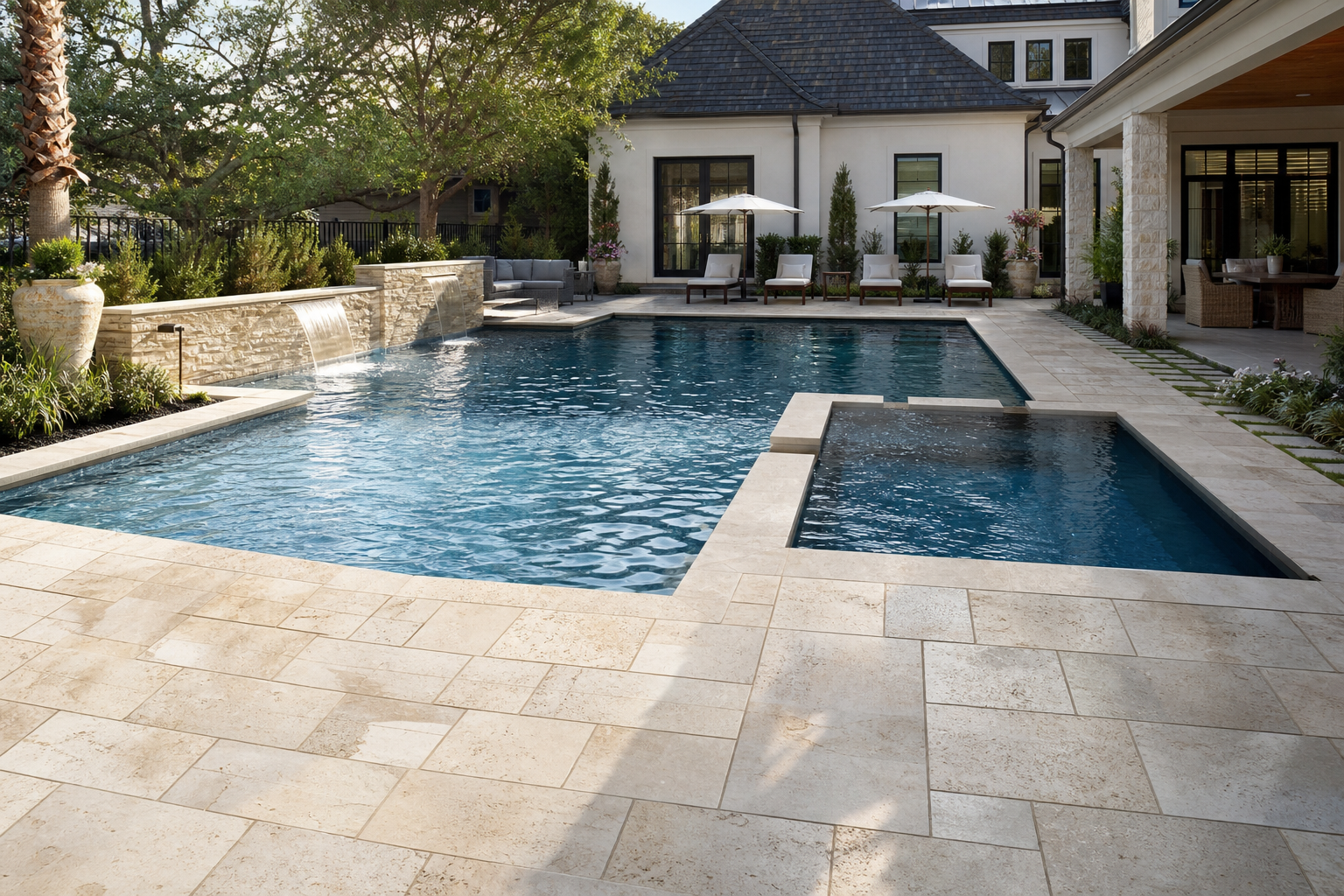
Pool Deck Pavers: How to Choose a Safer, Cooler, and More Durable Poolside Surface
Choosing the right pool deck pavers requires more than finding a color or pattern that looks attractive beside the water. A pool surround is routinely exposed to moisture, direct sun, pool chemicals, bare feet, furniture, temperature changes, and frequent traffic. Paver material, surface texture, heat retention, drainage, coping compatibility, base preparation, joint construction, and maintenance can all affect long term performance. Evaluating these factors before installation can help create a pool area that balances appearance, practicality, durability, and appropriate slip resistance.
What Are Pool Deck Pavers?
Pool deck pavers are individual paving units installed around a swimming pool to create a usable hard surface for walking, seating, furniture, and access to the water.
Depending on the project, they may be manufactured from concrete, natural stone, porcelain, clay, or other materials specifically suitable for exterior paving.
Unlike a continuous poured surface, a paver deck consists of individual units installed in a defined pattern. The specific installation system can vary considerably.
Some pavers are installed over a compacted aggregate base and bedding layer. Others may be installed over concrete using appropriate bonding or support systems. Raised pedestal systems can also be used in certain applications.
The correct construction depends on product type, soil, climate, drainage, pool design, and manufacturer requirements.
9 Powerful Benefits of Pool Deck Pavers
Pavers offer several advantages around pools, but these benefits depend on selecting suitable materials and installing them correctly.
1. Individual Pavers Can Be Replaced
One practical advantage of modular paving is localized repair.
If an individual unit becomes cracked, stained, or otherwise damaged, it may be possible to replace that piece without rebuilding the entire pool surround.
Matching can become difficult as products age or are discontinued.
Keeping spare pavers from the original production batch can therefore be helpful for future repairs.
2. Numerous Surface Textures Are Available
Surface texture is particularly important around water.
Manufacturers offer pavers with different finishes, including textured, tumbled, honed, molded, brushed, or other surfaces depending on material.
Appearance should not be confused with slip performance.
A surface that looks rough in photographs is not necessarily appropriate for wet pool environments.
3. Flexible Design Options
Individual paving units make numerous layouts possible.
Homeowners can combine different sizes, shapes, colors, borders, and laying patterns while coordinating the deck with pool coping and surrounding architecture.
A restrained palette can help maintain visual consistency.
Complex patterns can look impressive but may increase cutting, installation time, and material waste.
4. Access to Underlying Areas May Be Easier
In some installations, removable pavers can make it easier to access selected underground services than monolithic pavement.
This depends heavily on construction.
Pavers installed permanently over concrete with bonded systems do not provide the same degree of straightforward removal as flexible paving.
5. Appropriate Pavers Can Handle Outdoor Exposure
Exterior rated pavers are designed for outdoor conditions, but suitability varies by product.
Freeze and thaw exposure, high temperatures, salt, pool chemicals, ultraviolet light, and moisture can affect materials differently.
Local climate should influence selection.
Pool Deck Pavers for Freeze and Thaw Climates
In cold climates, confirm that the specific paving product is intended for freeze and thaw exposure.
Moisture absorption and material properties can influence durability.
Installation also needs drainage that prevents unnecessary water accumulation within the pavement structure.
Follow regional construction requirements and manufacturer specifications.
6. Paver Joints Can Accommodate Some Movement
Modular pavement has joints between individual units.
These joints can make certain forms of movement less visually disruptive than cracking across a continuous rigid surface.
This does not make a paver deck immune to settlement or heaving.
Poor base preparation can still cause significant unevenness.
7. Multiple Material Choices
Pool pavers are available in several broad material categories.
This allows property owners to balance appearance, cost, maintenance, heat behavior, durability, and local availability.
Product specific performance matters more than material name alone.
Two concrete pavers or two natural stones can behave very differently.
8. Drainage Can Be Integrated Into the Design
Pool decks need to move water away from appropriate areas.
Pavers can be graded toward drains, drainage channels, landscape areas, or other approved locations according to project design.
Certain permeable paving systems can manage water differently, but they require a complete system specifically designed for infiltration and local site conditions.
9. Pavers Work With Many Architectural Styles
Pool paving can complement modern, Mediterranean, coastal, traditional, rustic, and other landscape designs.
Large format light colored units may suit contemporary architecture, while irregular natural stone may create a different visual character.
Practical performance should remain the first filter before style choices are finalized.
Best Materials for Pool Deck Pavers
The best material depends on climate, budget, pool chemistry, surface temperature, maintenance preferences, and desired appearance.
Concrete Pool Deck Pavers
Concrete pavers are manufactured units available in many sizes, colors, textures, and shapes.
Their broad design range makes them suitable for numerous landscape styles.
Quality and performance differ by manufacturer and product line.
Ask about exterior suitability, freeze and thaw resistance where relevant, wet slip characteristics, maintenance requirements, and compatibility with pool environments.
Natural Stone Pavers
Natural stone can provide unique color and texture because each piece is formed geologically rather than manufactured to be visually identical.
Common poolside materials can include travertine, limestone, granite, sandstone, and other stones depending on region.
Not every stone is suitable for every pool.
Porosity, mineral composition, finish, freeze resistance, staining, and chemical exposure need consideration.
Porcelain Pool Pavers
Exterior porcelain pavers are manufactured to provide low water absorption and are available in designs resembling stone, concrete, or other surfaces.
Pool applications require an appropriately rated exterior product with a suitable wet surface finish.
Installation methods differ from ordinary interior tile.
Choosing Pool Deck Pavers by Material Performance
Ask suppliers for specific data concerning:
• Exterior use
• Wet slip characteristics
• Water absorption
• Freeze and thaw suitability
• Thickness
• Load requirements
• Pool chemical exposure
• Salt exposure where relevant
• Installation method
• Cleaning requirements
Technical product information is more useful than descriptions such as premium outdoor quality.
Slip Resistance Around Swimming Pools
Wet surfaces can become slippery, making traction one of the most important pool deck considerations.
No pool deck surface can eliminate all slip and fall risk.
Understand Product Testing
Different countries use different test methods and classifications for slip resistance.
Ask suppliers which standard was used to test a product and whether the rating applies to wet conditions relevant to pool areas.
Avoid relying solely on generic statements such as nonslip.
Surface Finish Matters
The same stone can behave differently depending on whether it is polished, honed, textured, or treated using another finishing process.
Polished surfaces can be unsuitable in certain wet exterior applications.
Pool Deck Pavers and Wet Barefoot Areas
Pool surrounds are often used barefoot, which creates specific comfort and traction considerations.
A highly abrasive surface might offer useful texture but feel uncomfortable under bare feet.
Aim for a product specifically suited to wet barefoot applications where possible, and confirm applicable local requirements.
Do Pool Deck Pavers Get Hot?
Any outdoor paving exposed to strong sunlight can become hot.
Surface temperature depends on solar exposure, color, material, texture, thermal properties, air temperature, shade, and time of day.
Lighter Colors and Surface Temperature
Lighter colored materials often absorb less solar energy than darker surfaces under comparable conditions, but color is not the only factor influencing temperature.
Two similarly colored paving materials can still reach different surface temperatures.
Test Samples in Direct Sunlight
When heat is a significant concern, obtain physical samples.
Place them in the actual location under representative sunny conditions and compare how they feel at relevant times of day.
Choosing Cooler Pool Deck Pavers
Useful considerations include:
• Lighter colors
• Shaded areas
• Material thermal behavior
• Landscape design
• Pergolas or umbrellas
• Exposure orientation
Avoid assuming that a product marketed as cool deck will remain comfortable under every climate condition.
Pool Deck Pavers and Drainage
Water management should be designed before installation starts.
The deck should direct water toward appropriate drainage points rather than allowing persistent puddles.
Proper Deck Slope
Deck slope should account for local codes, accessibility, existing elevations, buildings, and pool geometry.
Water generally should not be intentionally directed into areas where it could damage structures or create another hazard.
Local requirements should determine the final design.
Channel and Deck Drains
Linear or point drainage systems can collect water where grading alone is insufficient.
Drains need appropriate capacity and ongoing cleaning.
Leaves, hair, sediment, and other debris can restrict flow.
Pool Deck Pavers Near House Foundations
Where a pool deck approaches a building, drainage deserves particular attention.
A visually attractive deck should not direct water toward doors, walls, or foundations.
Complex sites may benefit from drainage design by an appropriate landscape, drainage, or engineering professional.
Base Preparation for Pool Deck Pavers
A paver installation performs only as well as the supporting structure beneath it.
Settlement, lipping, poor drainage, and uneven surfaces are often related to base or installation problems.
Excavation and Subgrade
Unsuitable soil, organic material, and unstable areas may need removal or treatment.
The subgrade should be prepared to support the intended pavement system.
Requirements depend on local soil and climate.
Aggregate Base
Flexible paver installations commonly use compacted aggregate.
Material specification and depth should match site conditions and anticipated loading.
Pool decks used only by pedestrians have different loading requirements from areas that may occasionally support service vehicles.
Bedding Layer
The bedding layer provides the immediate support beneath some paver systems.
It should be installed according to the paver manufacturer’s system requirements.
Why Pool Deck Pavers Need Proper Compaction
Inadequate compaction can allow settlement and create uneven walking surfaces.
Compaction should be performed in appropriate layers using suitable equipment.
Simply adding thicker pavers cannot compensate for an unstable foundation.
Pool Coping and Paver Integration
Pool coping forms the finished edge around the swimming pool.
It can also help protect the pool structure and create a transition between the water and deck.
Matching Coping to Pool Deck Pavers
Coping can match the deck or provide deliberate contrast.
Practical considerations include edge profile, traction, comfort, water exposure, and compatibility with the pool structure.
Expansion and Movement
Pools and surrounding decks can move differently.
Movement joints and separation details may be required so that deck movement does not transfer damaging forces to the pool structure.
Pool Deck Pavers Around Existing Coping
When resurfacing an existing deck, confirm whether the current coping is sound and whether added pavement thickness will create elevation or drainage problems.
Door thresholds, drains, skimmers, and landscape levels all need consideration.
Installing Pool Deck Pavers
Installation methods vary by material and site.
Sand Set Pavers
Some concrete and stone pavers are installed using a flexible base and bedding system.
Edge restraints help maintain the pavement pattern.
Joint material is then installed according to the system specification.
Mortar Set Pavers
Some installations use a concrete substrate with mortar or another bonded system.
This approach requires appropriate preparation, movement joints, drainage, and compatible bonding materials.
Pedestal Systems
Certain pavers can be installed on pedestal support systems.
These are often used on terraces or other specialized applications.
Professional Pool Deck Paver Installation
Poolside paving involves drainage, elevations, structural transitions, wet conditions, and potentially utilities.
Professional installation can be particularly valuable around complex pool structures or where local codes impose specific requirements.
Pool Deck Paver Costs
Pool deck paving costs vary widely by location and project design.
Material price alone cannot predict the installed total.
Cost Factors
Pricing can depend on:
• Paver material
• Deck area
• Excavation
• Base preparation
• Existing deck removal
• Drainage
• Access
• Coping
• Pattern complexity
• Cutting
• Steps
• Site elevation
• Labor rates
• Sealing
• Permits where applicable
Natural stone and specialty porcelain may have different installation requirements from common concrete pavers.
Compare Detailed Quotes
Ask contractors to specify material, base construction, installation method, drainage work, joint material, edge restraints, coping, and cleanup.
Pool Deck Pavers Cost vs Long Term Value
The lowest installation price can become expensive if inadequate base preparation leads to settlement.
Compare lifecycle maintenance and repair potential alongside upfront cost.
A durable installation should prioritize fundamentals that become difficult to correct later.
Maintaining Pool Deck Pavers
Routine maintenance can preserve appearance and identify developing problems.
Regular Cleaning
Sweep or rinse appropriate surfaces to remove loose debris.
Use cleaning products compatible with the specific paving material and pool environment.
Avoid assuming highly acidic or alkaline cleaners are safe for every stone or concrete product.
Joint Maintenance
Joint material can deteriorate, wash out, or become contaminated over time.
Maintenance requirements depend on the installation system.
Control Organic Growth
Shaded and persistently damp areas may develop algae or other biological growth that affects appearance and potentially traction.
Address moisture conditions where practical.
Cleaning Pool Deck Pavers Safely
Follow manufacturer guidance for pressure washing.
Excessive pressure or inappropriate nozzles can damage surfaces, remove joint material, or affect sealers.
Test unfamiliar cleaning methods in an inconspicuous location.
Should Pool Deck Pavers Be Sealed?
Sealing is product dependent.
Some pavers or stones may benefit from a compatible sealer for particular staining or maintenance goals, while other materials may not require it.
What Sealers Can Do
Depending on formulation, sealers may alter water absorption, staining behavior, color appearance, or surface finish.
They are not universal waterproofing solutions.
Slip Resistance After Sealing
A sealer can alter surface characteristics.
For pool areas, verify that the complete treated surface remains suitable for wet conditions.
Sealing Natural Stone Pool Deck Pavers
Stone type matters.
A product suitable for one stone may be inappropriate for another.
Consult the stone supplier or an experienced installer before applying a treatment.
Pool Deck Paver Repair
One of the strengths of modular paving is localized repair.
Sunken Pavers
Settlement can create low areas and trip hazards.
Repair often involves removing affected units and addressing the underlying bedding or base condition before resetting them.
Simply adding material directly beneath one corner can create unstable support.
Cracked Pavers
A damaged unit can often be removed and replaced.
Investigate recurring cracks because they may indicate underlying movement or inadequate support.
Matching Replacement Pool Deck Pavers
Retain extra pavers after installation whenever possible.
Manufacturing batches and natural stone lots vary in color.
New replacement products may also contrast with an older deck until weathering occurs.
Pool Deck Pavers for Saltwater Pools
A saltwater pool does not eliminate chemical exposure around the deck.
Splash out and evaporation can leave salts on surrounding surfaces.
Check Material Compatibility
Some materials, metals, sealers, and setting products respond differently to salt exposure.
Ask suppliers for product specific guidance.
Rinse Where Appropriate
Fresh water rinsing may help reduce accumulated residues on compatible surfaces.
Follow material care recommendations.
Pool Deck Pavers and Pool Chemicals
Chlorine, salt, cleaning chemicals, and altered water chemistry can contact the deck through splash or maintenance activities.
Do not select materials based solely on decorative samples without considering chemical exposure.
Concrete Pavers vs Natural Stone
Both can perform well around pools when appropriately specified.
Advantages of Concrete Pavers
Concrete products offer controlled sizes, numerous colors, repeating shapes, and broad availability.
Replacement units may be easier to source for established product lines, although designs can still be discontinued.
Advantages of Natural Stone
Stone provides natural variation and distinctive texture.
No two pieces are exactly identical.
Its suitability varies significantly by stone type and finish.
Choosing Between Pool Deck Pavers
Base the decision on:
• Wet traction
• Surface temperature
• Climate
• Maintenance
• Appearance
• Product availability
• Budget
• Installation requirements
• Chemical compatibility
Avoid choosing solely from photographs.
Pool Deck Pavers vs Poured Concrete
Poured concrete creates a continuous surface, while pavers create a modular system.
Concrete can be economical and can support numerous surface finishes.
Pavers provide easier localized replacement and flexible patterns.
Both systems can fail when drainage or foundation preparation is poor.
The better option depends on site conditions, budget, design, maintenance preferences, and available contractors.
Pool Deck Accessibility and Safety
Pool design should account for all expected users.
Local building codes may regulate barriers, gates, deck dimensions, electrical safety, and other pool features.
Reduce Trip Hazards
Uneven pavers, raised edges, damaged coping, and poorly placed drainage components can create hazards.
Address settlement promptly.
Consider Accessible Routes
Commercial, public, and certain multifamily pools may have specific accessibility requirements.
Residential homeowners can also benefit from designing routes with appropriate width, gradients, and surface stability for household needs.
Pool Deck Pavers and Electrical Safety
Swimming pools have special electrical safety requirements because water and electricity are a dangerous combination.
Bonding, grounding, receptacles, lighting, and electrical equipment should comply with applicable codes.
Paver contractors should coordinate with licensed electrical and pool professionals when work affects these systems.
Sustainable Pool Deck Paver Considerations
Environmental performance depends on material sourcing, manufacturing, transportation, lifespan, repairability, and end of life.
Local materials may reduce some transportation requirements, but distance alone does not determine total environmental impact.
Permeable paving can support stormwater management in suitable designs, although a conventional paver with narrow joints is not automatically permeable.
A true permeable pavement requires compatible units, joints, base layers, subgrade considerations, and drainage design.
How to Choose a Pool Deck Paver Contractor
Look for contractors with direct experience installing paving around swimming pools.
General patio experience can be valuable, but pools add specialized drainage, coping, and utility considerations.
Review Comparable Projects
Ask to see installations using similar materials and construction methods.
Where possible, examine projects that are several years old rather than only newly completed work.
Verify Contractor Requirements
Licensing and insurance requirements vary by location and project scope.
Check applicable credentials and permits.
Questions to Ask a Pool Deck Pavers Contractor
Ask:
• Which material do you recommend and why?
• Is it intended for wet pool areas?
• How will slip resistance be evaluated?
• How will the base be constructed?
• How will water drain?
• How will coping be handled?
• What movement joints are required?
• How will existing pool equipment be protected?
• Is sealing recommended?
• What warranty applies?
• How should the deck be maintained?
• Will spare pavers remain after completion?
Detailed answers make contractor comparisons easier.
Common Pool Deck Paver Mistakes
Focusing exclusively on appearance is one of the most common errors.
Other mistakes include:
• Choosing polished surfaces for wet areas without suitable performance data
• Ignoring how hot the material becomes
• Inadequate base preparation
• Poor deck drainage
• Using incompatible sealers
• Forgetting movement joints
• Failing to coordinate coping
• Directing runoff toward buildings
• Pressure washing too aggressively
• Discarding all spare pavers
• Assuming every paver is suitable for freeze and thaw exposure
Product specifications and installation quality should drive the final decision.
Frequently Asked Questions
What are the best pool deck pavers?
The best pool deck pavers provide suitable wet traction, climate durability, manageable surface temperature, chemical compatibility, and practical maintenance for the specific property.
Do pool deck pavers get hot in the sun?
Yes, pavers can become hot under direct sunlight. Color, material, solar exposure, texture, climate, and shade all influence surface temperature.
Are pool deck pavers slippery when wet?
Slip performance varies by material and finish. Choose products with relevant wet slip testing or classifications suitable for poolside use.
How much do pool deck pavers cost?
Costs depend on material, area, base work, drainage, coping, access, pattern, existing surface removal, labor, and location. Detailed local quotations provide better estimates.
Should pool deck pavers be sealed?
Some materials may benefit from a compatible sealer, while others may not need one. Confirm that any treatment is appropriate for the paver and wet pool environment.
Can damaged pool deck pavers be replaced?
Yes, individual units can often be removed and replaced. Keeping spare pavers from the original installation can improve future color and dimensional matching.
Conclusion
Pool deck pavers can create an attractive, durable, and repairable pool surround when materials and installation are matched to the environment. Wet traction, surface temperature, drainage, base preparation, coping, climate, and chemical exposure deserve as much attention as color and pattern. Reviewing product specifications, testing samples, and choosing an experienced installer can help create a pool deck that remains practical and visually appealing through years of regular use.





One Comment