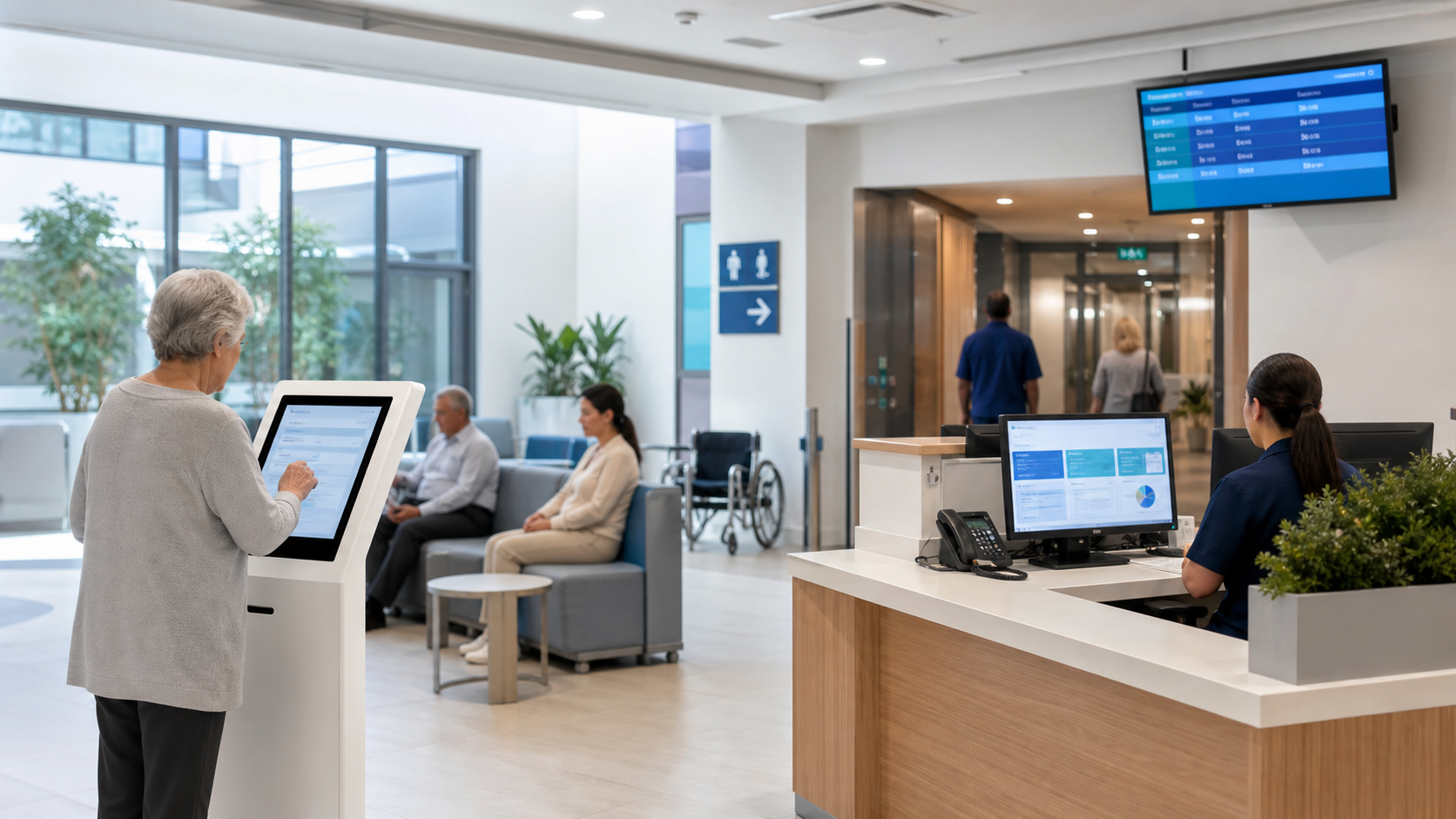
Queue Management Systems for Hospitals: Improving Patient Flow Without Compromising Care
Effective queue management systems for hospitals coordinate patient check in, waiting, prioritization and routing across departments while giving authorized staff clearer information about patient flow. Modern systems can combine reception software, self service kiosks, digital displays, mobile notifications, appointment data and operational analytics. They can reduce avoidable administrative friction and make waiting more transparent, but software alone cannot solve clinical staffing shortages or inadequate capacity. Successful implementation requires careful workflow design, accessibility, privacy safeguards, integration with existing hospital systems and clinical rules that always take priority over simple first come, first served queues.
Hospitals have unusually complex waiting environments. A patient arriving for routine blood work has different needs from someone attending a specialist appointment or presenting with potentially urgent symptoms.
That complexity makes ordinary retail ticketing systems insufficient for many clinical settings.
Healthcare queue technology needs to understand appointments, departments, patient categories and operational priorities while maintaining confidentiality.
This guide examines seven major benefits, core features, integrations, security considerations, implementation and the criteria hospitals should use when evaluating vendors.
What Are Queue Management Systems for Hospitals?
A hospital queue management system is technology that organizes how people enter, wait for and move through healthcare services.
The system may begin interacting with patients before they physically arrive. Appointment reminders or digital preregistration can prepare information ahead of the visit.
After arrival, patients may check in through reception, a kiosk, a mobile interface or another approved channel.
The system then coordinates the patient’s place within an operational workflow according to the hospital’s configured rules.
How Does Hospital Queue Management Work?
A typical workflow can involve several stages:
• Appointment recognition or registration
• Patient check in
• Service selection
• Queue assignment
• Priority application
• Staff notification
• Patient calling
• Department routing
• Service completion
• Operational reporting
Actual workflows vary considerably by department.
Virtual Queue Versus Physical Queue
A physical queue usually requires patients to wait in a particular place.
Virtual queuing can allow people to receive updates through digital methods and potentially wait elsewhere when clinically and operationally appropriate.
This can reduce crowding in some settings.
Virtual systems still require alternatives for patients who do not own smartphones or cannot use digital services.
Why Queue Management Systems for Hospitals Differ From Retail Queues
Healthcare does not always follow arrival order.
Clinical urgency, appointment type, infection control needs, accessibility requirements and resource availability can all affect sequencing.
A queue system should therefore support clinical workflows rather than override them.
7 Powerful Benefits of Queue Management Systems for Hospitals
When appropriately configured, queue technology can improve several aspects of hospital operations and patient experience.
1. More Organized Patient Check In
Busy reception areas can become congested when every patient must complete the same administrative process with a staff member.
Self service check in can handle suitable routine arrivals while reception teams assist people who need direct support.
This can redistribute administrative workload.
It should not eliminate staffed pathways for patients who require them.
2. Better Patient Flow Visibility
Without centralized information, staff may struggle to see where bottlenecks are developing.
Queue dashboards can show waiting volumes and service status across relevant areas.
Managers can use this information to respond operationally.
Data visibility does not create extra capacity by itself, but it can help teams use available resources more effectively.
3. More Transparent Waiting
Uncertainty can make waiting frustrating.
Digital displays or mobile notifications can provide progress information without revealing unnecessary personal details.
Estimated wait information should be presented carefully because emergencies, complex cases and staffing changes can alter timing.
4. Reduced Reception Pressure
Automating suitable administrative tasks can allow reception staff to focus on exceptions and patients needing direct assistance.
Automation should complement people rather than simply transfer every responsibility to the patient.
5. Improved Department Routing
Large hospitals can be difficult to navigate.
Queue systems can integrate service routing with appropriate wayfinding.
This can reduce situations in which patients wait in the wrong location because they misunderstood where to go.
6. Operational Analytics
Time stamped workflow events can help hospitals understand queue patterns.
Managers can examine peak arrival periods, waiting intervals, no shows and service bottlenecks.
Analytics need careful interpretation because a long wait can have multiple underlying causes.
7. Support for Multiple Access Channels
Patients have different abilities and preferences.
A mature system can support staffed reception, kiosks and selected digital channels within one broader workflow.
This flexibility promotes more inclusive service delivery.
Queue Management Systems for Hospitals and Patient Flow
Patient flow describes how people move through healthcare services from arrival to completion or transfer.
Arrival Management
Hospitals need to distinguish scheduled arrivals from unscheduled visitors.
Appointment integration can help match people with expected services.
Processes should also account for patients who arrive early, late or without all expected documentation.
Check In
Check in confirms that a person has arrived for the appropriate service.
Identity verification is particularly important in healthcare.
The system should not create duplicate patient records simply because information was entered slightly differently.
Routing
After check in, the patient may need registration, triage, diagnostics, consultation or another step.
The route can change according to clinical and operational information.
Real Time Queue Management Systems for Hospitals
Real time dashboards can help authorized staff understand current waiting conditions.
However, presenting more data does not automatically improve care.
Interfaces should emphasize information staff can act on rather than filling screens with unnecessary metrics.
Hospital Self Service Check In Kiosks
Kiosks are among the most visible components of many patient flow systems.
Patient Identification
A kiosk might identify a patient through appropriate combinations of information or approved identifiers.
The process should balance convenience against the risk of exposing records to the wrong person.
Appointment Confirmation
After identification, the kiosk can display relevant appointment information and confirm arrival.
Only the minimum necessary information should appear on a screen visible in a public area.
Registration Updates
Some systems allow appropriate demographic or administrative information to be reviewed.
High risk changes should be validated before overwriting authoritative patient records.
Accessible Kiosks in Hospital Queue Management
Accessibility should be designed from the beginning.
Consider:
• Wheelchair access
• Screen height
• Text size
• Color contrast
• Touch target size
• Language options
• Audio needs
• Staff assistance
• Alternatives for patients unable to use touchscreens
Local accessibility laws and standards should inform design.
Virtual Queuing in Healthcare
Virtual queues can extend patient flow beyond the waiting room.
Mobile Notifications
Patients can potentially receive a message when their service is approaching.
This can provide greater flexibility where hospital workflow allows it.
Remote Waiting
Some outpatient settings may allow patients to wait in another approved location.
This is not appropriate for every clinical service.
Patients who need observation or rapid reassessment may need to remain in designated areas.
Digital Inclusion
Not every patient has a smartphone, mobile data or confidence using digital tools.
Hospitals should preserve nondigital alternatives.
Queue Management Systems for Hospitals Without Smartphones
A well designed system does not make mobile technology mandatory unless there is a justified and accessible alternative.
Paper tickets, calling displays, reception assistance or other workflows can remain available.
Digital transformation should expand options rather than exclude vulnerable users.
Clinical Prioritization and Hospital Queues
Healthcare sequencing requires more than appointment time.
Triage Comes Before Queue Position
In emergency and urgent care, clinical prioritization should be determined by appropriate healthcare professionals and established clinical protocols.
A patient arriving later can legitimately be treated earlier when the clinical situation requires it.
Queue software should support this principle.
Priority Rules
Different departments can have operational categories.
Examples might reflect clinical urgency, appointment type or other authorized workflow factors.
Rules should be governed by healthcare policy rather than configured casually by software administrators.
Human Override
Authorized clinical or operational staff should be able to respond when circumstances change.
Automated systems cannot anticipate every situation.
Safe Queue Management Systems for Hospitals
No system should encourage staff to prioritize dashboard performance over patient safety.
If waiting time targets create incentives that conflict with clinical judgment, governance needs revision.
Technology should reinforce safe care pathways rather than distort them.
Queue Management for Outpatient Departments
Outpatient clinics are particularly suitable for structured queue management because many patients have planned appointments.
Specialty Clinics
Different specialties have different workflows.
Some patients require diagnostic tests before seeing a clinician, while others go directly to consultation.
Software should support these variations.
Laboratory and Phlebotomy Services
High volume services can benefit from organized check in and calling.
Walk in and scheduled patients may require separate or blended workflows.
Imaging Departments
Imaging appointments can involve preparation requirements and different procedure lengths.
Queue estimates should account for this variability rather than treating each visit as identical.
Emergency Department Queue Management
Emergency departments require a fundamentally different model from routine outpatient services.
Clinical Triage
Patients should be prioritized according to appropriate clinical assessment.
A digital ticket number must never imply that someone with life threatening symptoms should wait passively for their number.
Changing Patient Condition
A patient’s condition can worsen while waiting.
Processes must allow clinical reassessment and escalation.
Public Wait Displays
Public information should avoid exposing patient identities or confidential clinical information.
Estimated waits must also be communicated carefully.
Queue Management Systems for Hospitals in Emergency Care
Emergency queue technology can support registration, flow visibility and operational tracking, but it cannot replace triage or clinical observation.
Clinical governance should define how software interacts with urgent care processes.
Patient safety remains the overriding requirement.
Integration With Hospital Information Systems
Standalone queue software can create duplicate work.
Integration can reduce unnecessary data entry.
Electronic Health Records
Where appropriate, queue systems can receive relevant appointment or patient status information from electronic health record systems.
Access should be limited to what is necessary for the workflow.
Hospital Information Systems
Hospital information systems can contain admissions, scheduling and administrative data.
Integration allows queue status to reflect existing operational systems.
Appointment Scheduling
Scheduling integration helps distinguish expected patients and relevant service destinations.
It can also support analysis of arrival behavior.
Queue Management Systems for Hospitals and APIs
Modern integration frequently relies on APIs and healthcare interoperability standards.
Depending on the environment, HL7 and FHIR based interfaces may be relevant.
Technical compatibility should be demonstrated rather than assumed from a vendor stating that its platform is integration ready.
Privacy and Patient Confidentiality
Queue systems can process sensitive information.
Minimize Displayed Information
Public calling displays should reveal only what is necessary.
Displaying full patient names alongside department information can create unnecessary privacy exposure.
Hospitals should design identifiers according to local privacy requirements.
Kiosk Screen Privacy
Kiosks should be positioned to reduce casual viewing by nearby people.
Screen timeout and automatic session clearing can help protect information after a patient leaves.
Mobile Messages
Text messages and notifications can appear on locked phone screens.
Avoid including unnecessary sensitive medical information.
Data Protection in Queue Management Systems for Hospitals
Privacy requirements depend on jurisdiction.
Organizations may need to consider frameworks such as HIPAA in applicable US contexts, GDPR within the European Union, UK GDPR in the United Kingdom or other national health privacy laws.
Legal and privacy teams should assess the specific implementation.
Cybersecurity Requirements
Healthcare systems are high value targets for cyberattacks.
Queue technology must therefore be included in hospital cybersecurity programs.
Identity and Access Management
Staff access should follow the principle of least privilege.
Users should receive only the permissions their roles require.
Administrator access needs stronger controls.
Encryption
Sensitive data should be protected appropriately during transmission and storage.
Specific requirements depend on architecture and regulation.
Patch Management
Kiosks, servers and applications require supported software and security updates.
A kiosk should not become an unmanaged endpoint simply because it is installed in a public hallway.
Audit Logging
Important system activity should be recorded.
Logs can assist security investigations and privacy auditing.
Cybersecurity Due Diligence for Queue Management Vendors
Hospitals should evaluate vendor security practices before procurement.
Review vulnerability management, incident response, access controls, data hosting, subcontractors, business continuity and relevant independent security assessments.
A security certification can support evaluation but should not replace system specific risk analysis.
Hospital Queue Management Analytics
Analytics can transform operational events into useful management information.
Average Waiting Time
Average waiting time can indicate overall trends.
However, an average can hide extremely long waits experienced by a smaller group.
Percentiles and distribution data can provide additional context.
Patient Volume
Understanding arrivals by hour, day and service can support staffing discussions.
Historical volume does not guarantee future demand.
Abandonment or Walk Away Rates
Some services can track patients who leave before receiving the intended service.
Interpretation should consider clinical and administrative context.
No Show Rates
Appointment data can identify missed visits.
Interventions should consider why people miss appointments rather than assuming lack of interest.
Queue Management Systems for Hospitals Metrics
Useful metrics can include:
• Arrival volume
• Check in time
• Wait distribution
• Service start time
• Service duration
• Routing delays
• No shows
• Abandonment
• Kiosk utilization
• Staff override frequency
Metrics should support improvement rather than punish staff for complexity outside their control.
Can Queue Systems Reduce Hospital Waiting Times?
They can reduce some forms of avoidable delay, but they cannot guarantee shorter overall waits.
What Technology Can Improve
Software can streamline registration, improve routing and provide clearer operational information.
It can also expose bottlenecks that managers previously could not measure well.
What Technology Cannot Fix Alone
A queue platform cannot create extra doctors, nurses, examination rooms or diagnostic equipment.
When the primary problem is insufficient capacity, software can improve visibility without eliminating the underlying constraint.
Avoiding Unsupported Queue Management Claims
Hospitals should be cautious of vendors promising a fixed percentage reduction in waiting times without studying existing processes.
Ask what evidence supports performance claims and whether results came from comparable clinical environments.
A pilot can provide local evidence before a large deployment.
Queue Management System Costs
Hospital pricing depends on scope.
Hardware Costs
Hardware can include:
• Kiosks
• Ticket printers
• Digital displays
• Media players
• Calling terminals
• Networking equipment
• Accessibility accessories
Not every implementation requires every hardware category.
Software Licensing
Vendors may use subscription, perpetual or other licensing models.
Pricing can depend on sites, departments, users, kiosks or transaction volume.
Integration Costs
Connecting the queue platform to clinical and administrative systems can represent a significant part of implementation.
Custom interfaces also require ongoing maintenance.
Support and Maintenance
Clarify support hours, service levels and hardware replacement procedures.
Hospitals operating around the clock may need different coverage from an outpatient clinic open only during business hours.
Total Cost of Queue Management Systems for Hospitals
Include implementation, training, integration, cybersecurity, hardware, software and ongoing support.
The cheapest initial license can become expensive if extensive customization or manual administration is required.
Compare total lifecycle cost rather than purchase price alone.
Implementing a Hospital Queue Management System
Implementation should begin with workflows, not screens.
Map the Current Patient Journey
Document how patients currently move through each service.
Identify bottlenecks and exceptions.
Do not automate an inefficient process before asking whether the process itself should change.
Define Objectives
Specify what the project should improve.
Possible goals include faster check in, better flow visibility or less congestion at reception.
Goals should be measurable.
Pilot Before Scaling
A limited department can test workflow assumptions.
Collect staff and patient feedback.
Use results to improve configuration before expanding to additional services.
Staff Training for Queue Management Systems for Hospitals
Training should cover normal operation and exceptions.
Staff need to know what to do when a patient cannot use a kiosk, a network fails or clinical priority changes.
Good implementation prepares people for failure conditions as well as routine workflow.
Business Continuity and Downtime
Hospitals cannot assume technology will always be available.
Offline Procedures
Document what happens when the queue platform is unavailable.
Departments may need manual check in, paper processes or alternative communication methods.
Network Failure
If kiosks depend on central systems, connectivity problems can interrupt service.
Architecture should match the hospital’s resilience requirements.
Power Failure
Critical environments may require equipment to participate appropriately in the building’s continuity strategy.
The requirements depend on the clinical importance of the system.
Downtime Planning for Hospital Queue Systems
Practice fallback procedures.
A written downtime process that staff have never tested may fail during a real outage.
Business continuity should form part of procurement and implementation from the beginning.
Choosing Queue Management Systems for Hospitals
The best system is the one that fits the hospital’s clinical and operational workflows securely.
Evaluate Healthcare Experience
Ask vendors for comparable healthcare implementations.
A system designed exclusively for retail may lack necessary privacy, integration or clinical workflow capabilities.
Test Accessibility
Include patients and accessibility specialists where possible.
A kiosk that technically functions but cannot be used by significant patient groups creates additional work at reception.
Review Integration Capabilities
Confirm compatibility with the hospital’s actual systems.
Request technical documentation and proof of existing integration patterns.
Examine Vendor Support
Hospitals need clear escalation procedures.
Understand who responds when kiosks, integrations or software fail.
Questions to Ask Queue Management System Vendors
Ask:
• How does the platform support clinical prioritization?
• Which hospital systems can it integrate with?
• Which interoperability standards are supported?
• How is patient privacy protected?
• What accessibility features are included?
• What happens during network outages?
• How is software patched?
• Where is patient data stored?
• Which subcontractors process data?
• What analytics are provided?
• Can workflows differ by department?
• How are implementation and support priced?
Documented answers make procurement comparisons more meaningful.
The Future of Hospital Queue Management
Healthcare queuing is becoming increasingly connected with broader patient flow management.
Mobile arrival, digital wayfinding and predictive operational analytics may continue to expand.
Artificial intelligence can potentially help identify developing bottlenecks or forecast demand using appropriate data.
Any AI based clinical or operational recommendation should be validated for its intended purpose.
Automation should remain transparent enough for hospital teams to understand how important workflow decisions are made.
The most successful systems will likely be those that make healthcare easier to navigate without forcing patients into a purely digital experience.
Frequently Asked Questions
What are queue management systems for hospitals?
They are digital systems that coordinate patient arrival, check in, waiting, prioritization, routing and operational monitoring across healthcare services.
Can hospital queue systems reduce waiting times?
They can reduce some administrative delays and improve flow visibility, but they cannot independently solve staffing, room or clinical capacity shortages.
Do hospital queue systems integrate with EHR software?
Many systems offer integrations with healthcare software, but compatibility with specific EHR platforms and standards should be verified before purchase.
Are hospital self check in kiosks secure?
They can be deployed securely when identity verification, privacy, access controls, patching and secure system integrations are designed appropriately.
Can queue management systems support emergency departments?
Yes, for operational workflows, but clinical triage and reassessment must take priority over ordinary queue order.
How do hospitals choose a queue management system?
Hospitals should compare healthcare experience, workflow flexibility, integrations, cybersecurity, privacy, accessibility, analytics, resilience, support and total lifecycle cost.
Conclusion
Queue management systems for hospitals can improve check in, patient routing, operational visibility and waiting communication when they are designed around real healthcare workflows. The strongest systems integrate safely with existing hospital technology while protecting patient privacy, supporting accessibility and preserving clinical prioritization. Hospitals should evaluate measurable outcomes rather than vendor promises and retain reliable downtime procedures for system failures. With careful implementation, queue technology can reduce administrative friction and help staff manage patient flow more effectively without compromising clinical judgment or equitable access to care.