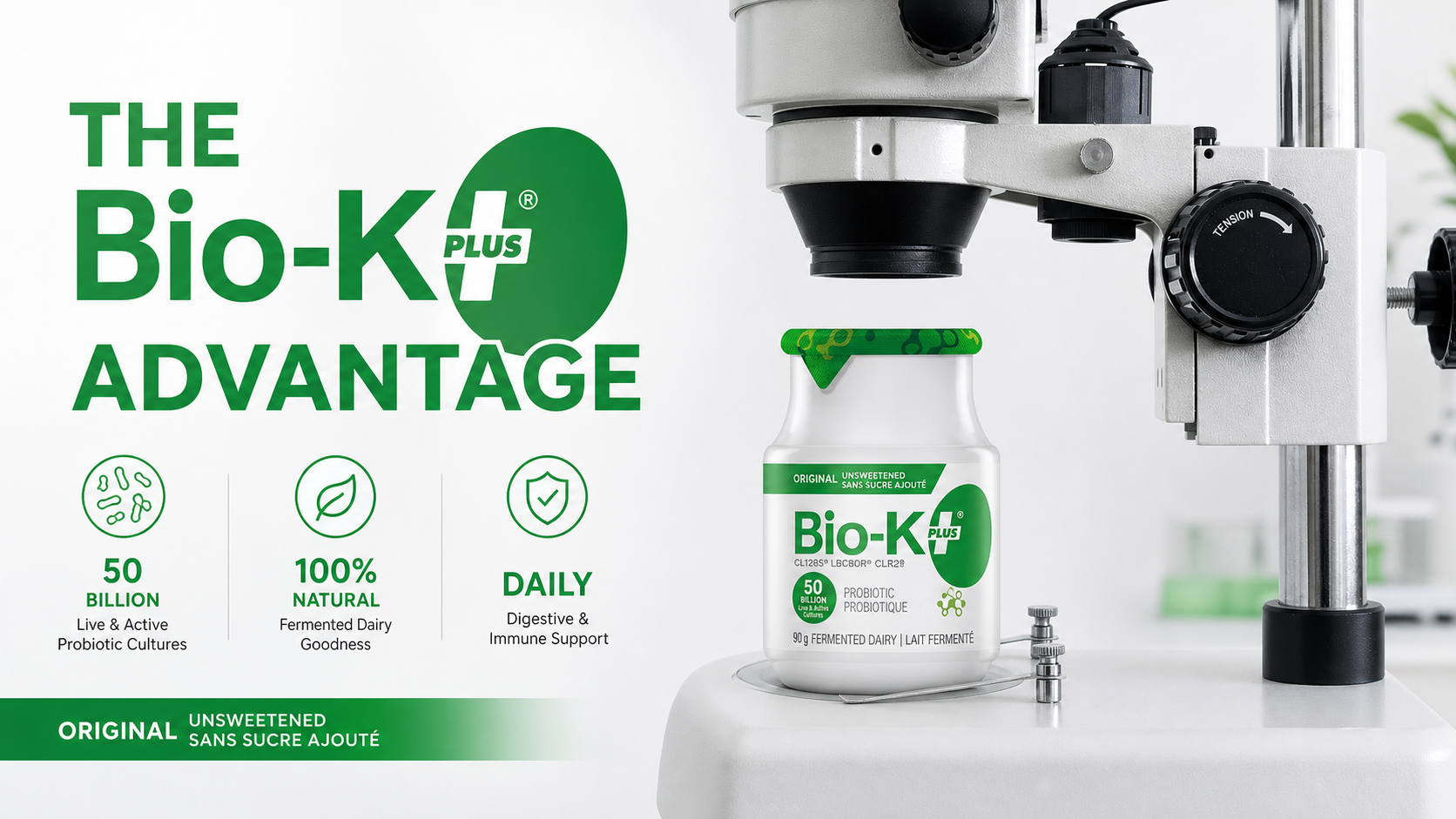
The Bio-K+ Advantage: A Complete Guide to Bio-K+’s 3-Strain Probiotic Formula
The probiotic aisle is crowded with products that look alike and promise similar things, which makes the claim of a genuine difference worth examining closely. The Bio-K+ Advantage is how Bio-K+, a Canadian probiotic company, frames what sets its products apart: a proprietary three-strain formula, decades of published research, and an end-to-end control of the manufacturing process. This guide explains what that advantage actually consists of, the three strains at its core, how probiotics work in the body, and how to evaluate the claims for yourself. It is written for information and is not medical advice.
What the Bio-K+ Advantage Claims to Be
The first thing to understand is what the company is actually claiming, because the phrase is a summary of several distinct commitments.
The Bio-K+ Advantage, as the company describes it, rests on three pillars. The first is a proprietary formula: three specific probiotic strains that the company states are exclusive to Bio-K+ products. The second is clinical evidence: a research record the company summarises as more than 25 years of research, 15 published clinical trials, and more than 40 scientific publications. The third is manufacturing control: the company states that it controls its probiotics from strain development through to the finished product, and that it guarantees live bacteria counts until the expiration date.
These are the company’s own claims, and they are best understood as a description of how Bio-K+ positions itself in a market where many products offer little more than a label. Whether the advantage holds up for a given person is a separate question, and it is the question the rest of this guide helps you answer.
The Three Strains at the Core
The technical heart of the Bio-K+ formula is its strain composition, and understanding the strains is the key to understanding the product.
The formula combines three strains of probiotic bacteria: Lactobacillus casei LBC80R, Lactobacillus rhamnosus CLR2, and Lactobacillus acidophilus CL1285. Each is a specific, named strain rather than a generic species, which matters because in probiotics, the strain is what determines the effect. Different strains of the same species can behave very differently in the body, which is why responsible probiotic labelling identifies the strain, not just the species.
The company’s stated rationale for the combination is synergy: the three strains are described as working together rather than competing, with each chosen to enhance the others’ effects. This is a standard and reasonable design principle in probiotic formulation, though the specific evidence for any given combination depends on the research behind it, which is why the company’s publication record is the relevant claim to examine.
Why Strain Identity Matters in Probiotics
For anyone who has stood in front of a probiotic shelf, the difference between products can seem arbitrary, and the reason is that most people look at the wrong information.
The species name, Lactobacillus acidophilus, for example, is not enough to know what a product does, because that species contains countless strains with different properties. The strain designation, the CL1285 in Lactobacillus acidophilus CL1285, is the specific identity that the research is conducted on, and it is the level at which effects are actually demonstrated. A product that lists only a species, or that does not identify its strains at all, is asking the buyer to take its effects on faith.
This is the most useful filter for evaluating any probiotic: does the product identify its strains, and is there research on those specific strains? Bio-K+’s formula passes the first test by naming its strains precisely, and its research claims are the second test, which the buyer should examine as described below.
How Probiotics Actually Work in the Body
The claims around probiotics make more sense when the basic biology is clear, and it is less mysterious than the marketing often suggests.
The human digestive system is home to a vast community of bacteria, collectively called the gut microbiome, which plays a role in digestion, immune function, and overall health. Probiotics are live bacteria intended to support that community, and the general theory is that introducing beneficial strains can help maintain or restore a healthy balance, particularly after disruption such as a course of antibiotics, which can reduce the gut’s bacterial population along with the infection it targets.
It is important to keep the expectations honest. Probiotics are not medicines, and they are not a treatment for disease; they are supplements intended to support general digestive and immune wellness. The effects of any given strain are specific and modest, which is why the strain identity and the research behind it matter so much. A probiotic is best understood as a maintenance tool rather than a remedy, and that is the frame Bio-K+ itself uses when it describes its products as supporting gut wellness.
How to Evaluate the Research Claims
The company’s research record is the central claim behind the Bio-K+ Advantage, so it deserves careful attention rather than acceptance at face value.
Bio-K+ states that its products are backed by more than 25 years of research, 15 published clinical trials, and more than 40 peer-reviewed scientific publications, along with four patent families. These are the company’s figures, and they describe a genuinely substantial research investment by the standards of the supplement industry. The relevant question for a buyer is not whether the numbers are impressive but whether the research is on the specific strains in the product, which is what connects the publications to the formula you are actually buying.
The responsible way to verify is to look at the company’s published research and any independent assessments, and to understand that clinical trials on specific strains support specific, modest claims rather than broad promises. Bio-K+’s own language reflects this: it describes its strains as clinically proven for gut wellness, which is the appropriate scope for a probiotic claim, rather than overreaching into treatment territory.
Manufacturing Control and Potency
One part of the Bio-K+ Advantage that receives less attention than the research is the manufacturing story, and it is arguably as important.
The company states that it controls its probiotics from strain development through to the finished product, which is a meaningful claim in an industry where many brands purchase bulk probiotic powders from a handful of suppliers and simply repackage them. Full vertical control means the company is responsible for the strain’s quality, stability, and identity at every stage, which reduces the risk of the contamination or mislabelling that has historically been a problem in the category.
The potency guarantee follows from that control. Bio-K+ states that it guarantees live bacteria counts until the expiration date, which addresses the most common failure mode in probiotics: products whose bacterial counts decline below the labelled amount before the bottle is finished. A guarantee of live counts to expiry is a real and verifiable commitment, and it is one of the more meaningful quality signals a probiotic brand can offer.
The Product Range and How to Choose
The Bio-K+ Advantage translates into a product range organised by need rather than by flavour, which is how the company helps a buyer match a probiotic to a purpose.
The company organises its products around life situations: everyday wellness for daily maintenance, immune function for seasonal support, a range for people taking antibiotics, on-the-go formats for travel, a line for people living with IBS, and products for children. This need-based organisation is helpful, because the right probiotic depends on the situation, and a single product rarely suits every purpose.
The practical guidance for choosing is to start with the specific situation rather than the most promoted product, to check that the strain and the format suit the purpose, and to be realistic about what a probiotic can do. A daily wellness product is a maintenance choice, not a treatment, and the expectations should match.
A Balanced View of the Bio-K+ Advantage
The honest summary of the Bio-K+ Advantage is that it represents a specific and verifiable set of commitments, and the buyer’s job is to weigh them appropriately.
What is concrete: a named, proprietary three-strain formula; a stated record of published research on those strains; full manufacturing control; and a potency guarantee to expiry. These are exactly the signals a discerning buyer should look for, and they place Bio-K+ in the more serious tier of the probiotic market.
What should be held with appropriate perspective: the specific health effects of any probiotic are individual and modest, and the company’s claims, however well-supported, describe support for wellness rather than guaranteed outcomes. The marketing language, “science you can trust, results you can feel,” is a promise of quality and consistency, and the way to honour it is to treat the product as one part of a broader approach to gut health that includes diet, lifestyle, and, where relevant, professional advice.
Conclusion
In conclusion, the Bio-K+ Advantage is a summary of real and checkable commitments: a proprietary three-strain formula built on identified strains, a substantial published research record, end-to-end manufacturing control, and a guarantee of live bacteria to expiration. These are the attributes that separate a serious probiotic brand from the undifferentiated majority, and they give a buyer something concrete to evaluate rather than marketing alone. The three strains, L. casei LBC80R, L. rhamnosus CLR2, and L. acidophilus CL1285, are the technical identity of the product, and the company’s research record is the claim that supports them. For anyone considering a probiotic, the right approach is to weigh those commitments, keep expectations aligned with what probiotics actually do, and make gut health one part of a broader wellness picture.
Frequently Asked Questions
1. What is the Bio-K+ Advantage?
The Bio-K+ Advantage is the company’s proprietary three-strain probiotic formula, backed by published research and full manufacturing control, with potency guaranteed to expiration.
2. What three strains are in Bio-K+?
Bio-K+ combines Lactobacillus casei LBC80R, Lactobacillus rhamnosus CLR2, and Lactobacillus acidophilus CL1285.
3. Why does the strain matter in a probiotic?
The strain, not the species, determines a probiotic’s effects, and responsible products identify the specific strains that their research was conducted on.
4. What does Bio-K+ claim about its research?
The company states its formula is backed by more than 25 years of research, 15 published clinical trials, and more than 40 scientific publications.
5. Does Bio-K+ guarantee the bacteria count?
Yes, the company states it guarantees live bacteria counts until the expiration date of the product.
6. Are probiotics a treatment for digestive conditions?
No, probiotics are supplements that support gut wellness, and they are not medicines or treatments for disease; specific health concerns warrant professional advice.