ICON National and the Future of Occupied Affordable Housing Renovation
Affordable housing renovation is about much more than replacing finishes or updating aging buildings. Projects often have to balance construction schedules, financing requirements, resident needs, safety standards, regulatory obligations and long term property performance at the same time. ICON National specializes in occupied affordable housing renovation and works with owners, developers and other project partners across the United States. The company states that it brings more than a decade of Low Income Housing Tax Credit industry experience to projects and provides support from early planning through final project delivery.
Renovating an occupied affordable housing property creates challenges that are different from those found on an empty construction site. Families and seniors may continue living within the community while work progresses, which means contractors need to think carefully about communication, access, scheduling, temporary relocation, safety and disruption.
For affordable housing owners, the quality of project planning can therefore be as important as the physical construction itself.
This guide explores how ICON National approaches affordable housing renovation, why occupied construction requires specialized experience, how Low Income Housing Tax Credit requirements influence project planning and which factors owners should evaluate before beginning a major rehabilitation.
What Is ICON National?
ICON National is a construction services company headquartered in Scottsdale, Arizona, with a focus on occupied affordable multifamily and senior housing renovation.
The company was previously known as MFRG ICON Construction. According to its published history, the business began in 2017 through a partnership involving Multifamily Renovation Group and ICON Commercial Contractors before adopting the ICON National name in 2023 as its ownership structure and geographic reach evolved.
Its core work centers on affordable housing rehabilitation rather than conventional new home construction.
The company reports experience with projects across multiple states and thousands of affordable housing units. Its current website describes a national footprint across 15 states and more than 13,900 housing units within its project portfolio.
That experience is particularly relevant because affordable housing rehabilitation frequently involves several connected disciplines.
These can include:
- Preconstruction planning
- Cost estimating
- Construction management
- Occupied unit renovation
- Resident coordination
- Temporary relocation planning
- Safety management
- Regulatory compliance
- Project closeout
- Warranty support
A successful project needs these elements to work together rather than functioning as separate activities.
Why ICON National Focuses on Occupied Affordable Housing
Occupied renovation is one of the most demanding forms of multifamily construction.
A contractor may be replacing kitchens, bathrooms, mechanical systems, flooring, windows or exterior building components while residents continue living elsewhere within the same property.
That creates additional planning responsibilities.
Construction teams need to control access, maintain safe pathways, communicate schedules clearly and minimize unnecessary disruption.
Residents may include families with children, seniors or people with disabilities, making thoughtful planning especially important.
ICON National states that resident safety and comfort are central to its production process and that its teams coordinate construction activity in ways intended to limit disruption during occupied renovations.
This resident centered approach reflects a broader principle within affordable housing rehabilitation.
A building is not simply a construction asset. It is someone’s home.
How ICON National Approaches Resident Coordination
Resident coordination begins before demolition or installation work starts.
Project teams need clear information about which units will be affected, how long work should take and whether residents can remain in place safely.
Some projects require temporary relocation.
Others can be completed through carefully sequenced work while occupants remain within the property.
The correct approach depends on the project, financing structure, scope of work and applicable housing requirements.
HUD programs can also include specific resident protections in certain rehabilitation and conversion situations. For example, HUD’s Rental Assistance Demonstration guidance describes rights to remain or return for eligible residents when temporary relocation is required under that program.
Developers and contractors therefore need to identify applicable requirements before construction begins.
What ICON National Must Consider During Occupied Renovation
Occupied rehabilitation planning can involve:
- Resident notices
- Daily construction schedules
- Safe access routes
- Temporary relocation procedures
- Accessible accommodations
- Dust and debris control
- Noise planning
- Unit turnover scheduling
- Material storage
- Emergency communication
Not every project requires the same process.
The goal is to create a construction plan that accounts for both technical requirements and the people living within the property.
7 Powerful Benefits of Specialized Affordable Housing Renovation
1. Experience With Complex Affordable Housing Projects
Affordable housing construction can involve more regulatory and financial coordination than a conventional market rate renovation.
Owners may be working with housing agencies, tax credit investors, lenders, architects, consultants and property management teams.
Each stakeholder can have different documentation requirements and deadlines.
ICON National states that it has experience navigating complicated lending programs and affordable housing project requirements.
That experience can be valuable during projects where construction decisions affect financing or compliance schedules.
A general contractor still needs to work closely with the project’s legal, financial and compliance professionals because construction expertise does not replace specialist advice.
However, understanding how affordable housing transactions operate can make communication more efficient.
2. Low Income Housing Tax Credit Project Experience
The Low Income Housing Tax Credit program is one of the most important financing mechanisms used for affordable rental housing in the United States.
The Internal Revenue Service explains that owners of qualified residential low income rental buildings may claim a housing credit for qualifying buildings over the applicable credit period. State or local housing credit agencies are responsible for allocating credits within their jurisdictions.
Affordable housing developers using tax credits must therefore manage more than construction costs.
They may also need to coordinate placed in service requirements, agency documentation, financing milestones and compliance obligations.
ICON National describes more than a decade of experience within the Low Income Housing Tax Credit industry.
This background can help project teams understand why construction schedules and documentation need to align with the wider transaction.
3. Detailed Preconstruction Planning
Good construction projects often begin long before crews arrive on site.
Preconstruction is where owners and contractors define scope, evaluate costs, identify risks and develop a realistic schedule.
ICON National describes estimating as a central part of its preconstruction process. The company states that its team uses project information, historical data and planning tools to develop budgets covering the anticipated scope of work.
Preconstruction may include:
- Reviewing architectural plans
- Understanding property conditions
- Developing preliminary budgets
- Identifying long lead materials
- Establishing construction phases
- Planning resident impacts
- Reviewing permitting requirements
- Coordinating with subcontractors
- Evaluating schedule risks
- Preparing project documentation
The earlier these questions are addressed, the easier it can be to avoid surprises during construction.
How ICON National Preconstruction Supports Project Readiness
Project readiness is particularly important in affordable housing.
A financing closing date may be connected to construction milestones.
Certain rehabilitation work might depend on permits or agency approvals.
Some materials may have extended manufacturing or delivery schedules.
Resident notices can also require advance planning.
ICON National states that its preconstruction team coordinates with clients, architects and municipalities to address permitting and city specific requirements before and during project preparation.
This level of coordination helps turn a general renovation concept into an executable construction plan.
4. Construction Designed Around Residents
Traditional construction scheduling often focuses primarily on labor, equipment and materials.
Occupied affordable housing requires an additional consideration: residents.
A contractor might technically be able to complete several units at once, but doing so could create excessive disruption or make relocation difficult.
Resident centered scheduling may therefore require smaller phases, carefully controlled access and close communication with property management.
ICON National states that its production teams emphasize resident comfort and safety while maintaining regular project communication with owners, architects and other stakeholders.
That approach can help reduce confusion during complex rehabilitation programs.
Resident Communication During ICON National Projects
Clear communication can include:
- Advance notice of construction
- Expected working hours
- Unit access requirements
- Temporary relocation information
- Updates when schedules change
- Safety instructions
- Contact information for questions
- Completion notices
Communication should be understandable and accessible to the population living at the property.
Owners should also consider language accessibility and reasonable accommodations where required.
5. National Affordable Housing Construction Experience
Construction requirements vary from one location to another.
Permitting practices, labor conditions, weather, building codes and subcontractor markets can differ significantly between states and cities.
ICON National reports a project footprint spanning 15 states.
A broader geographic portfolio can provide experience dealing with different municipal processes and construction environments.
That does not mean every project is identical.
Local professionals, code requirements and jurisdiction specific rules remain essential.
The value of national experience is the ability to apply established construction systems while still adapting to local conditions.
6. Stronger Project Management and Coordination
Affordable housing renovation involves many moving parts.
Owners may need to coordinate architects, engineers, contractors, property managers, residents, lenders, housing agencies and investors.
Without structured project management, information can become fragmented.
ICON National describes regular project meetings and communication with clients, architects and subcontractors as part of its project delivery model.
Consistent communication can help project teams address questions before they create schedule or budget problems.
Important project management functions can include:
- Schedule tracking
- Budget monitoring
- Change management
- Subcontractor coordination
- Resident scheduling
- Quality control
- Safety oversight
- Documentation
- Owner reporting
- Closeout preparation
The objective is not simply to complete individual construction tasks.
It is to keep the entire project moving toward completion in a controlled and documented manner.
7. Closeout and Warranty Support
Construction does not end when the last worker leaves the property.
Owners need documentation showing what was installed, which warranties apply and whether outstanding items have been corrected.
ICON National states that its closeout process includes a detailed package containing relevant product information and records of completed scopes of work.
This documentation can become valuable months or years after completion.
Property management teams may need warranty information.
Maintenance teams may need product specifications.
Owners may need records for compliance or financing purposes.
A structured closeout therefore contributes to the long term usefulness of the renovation.
Understanding LIHTC Renovation Projects
Low Income Housing Tax Credit properties operate within a compliance framework that extends beyond construction.
IRS guidance states that building owners use Form 8609 related documentation for housing credit allocation and certification, while Form 8609 A is used for annual reporting during the applicable compliance period.
For construction teams, the important point is that project schedules can influence wider financing and compliance activities.
Contractors are not responsible for providing tax advice.
However, experienced affordable housing contractors should understand why owners and developers may have strict deadlines around completion or documentation.
This understanding helps all project participants work toward the same milestones.
ICON National Project Planning From Start to Finish
Affordable housing renovation generally follows several connected phases.
Initial Assessment
The first step is understanding the property.
This can involve reviewing existing conditions, building systems, architectural plans and proposed improvements.
The project team also needs to determine whether units will remain occupied during construction.
Preconstruction
Once the project scope becomes clearer, detailed planning can begin.
Budgets, schedules, permitting requirements, material procurement and resident logistics are developed during this phase.
Mobilization
Construction teams prepare the site, establish safety procedures, coordinate staging areas and communicate upcoming activity.
For occupied communities, safe separation between residents and active work zones is especially important.
Production
Renovation work moves through the property according to the approved schedule.
Depending on the project, work may include interior unit upgrades, roofing, building envelope improvements, mechanical systems, electrical systems, accessibility improvements or community amenities.
Quality Control
Completed work needs to be reviewed for consistency with plans, specifications and applicable standards.
Issues should be documented and corrected before final turnover.
Closeout
The project team completes final documentation, warranty information and outstanding corrections.
The owner then transitions from construction activity back to normal property operations.
Why Affordable Housing Renovation Matters
Affordable housing properties represent long term community infrastructure.
Renovating existing housing can extend the useful life of buildings, improve living conditions and preserve housing that might otherwise deteriorate.
HUD’s Rental Assistance Demonstration program is one example of a federal framework intended to support preservation and improvement of certain affordable housing properties while maintaining long term affordability requirements.
The specific financing structure varies from property to property.
Some renovations rely on Low Income Housing Tax Credits.
Others may combine debt, grants, housing assistance contracts or additional sources.
Regardless of financing, physical rehabilitation is ultimately about maintaining safe and functional homes.
What Owners Should Look for in an Affordable Housing Contractor
Choosing a contractor for an occupied rehabilitation project requires more than comparing initial price estimates.
Owners should evaluate relevant project experience.
A contractor that primarily builds vacant commercial properties may have limited experience with resident coordination.
Affordable housing knowledge is also important.
Project teams should understand how construction schedules interact with financing and regulatory requirements.
Safety systems need to be reviewed carefully.
Occupied sites require strong controls because residents may be living only a short distance from construction work.
Owners should also ask about communication processes.
Clear reporting helps developers, architects and property managers understand current progress and upcoming decisions.
Finally, evaluate closeout capabilities.
A contractor should be prepared to provide organized documentation when the project is completed.
Questions to Ask ICON National Before a Renovation
Owners considering ICON National or another affordable housing contractor should discuss project requirements in detail.
Useful questions include:
- How many similar occupied renovation projects has the team completed?
- How will resident communication be managed?
- What temporary relocation strategy may be required?
- How will construction areas be separated from residents?
- What preconstruction services are included?
- How will estimates be developed?
- How will schedule changes be communicated?
- What reporting will owners receive?
- How will quality control be documented?
- What information will be included in the closeout package?
These conversations help determine whether the contractor’s delivery process matches the needs of the property.
Safety During Occupied Affordable Housing Renovations
Safety takes on additional importance when construction occurs within an operating residential community.
Workers understand construction environments.
Residents may not.
Children may also be present around multifamily properties.
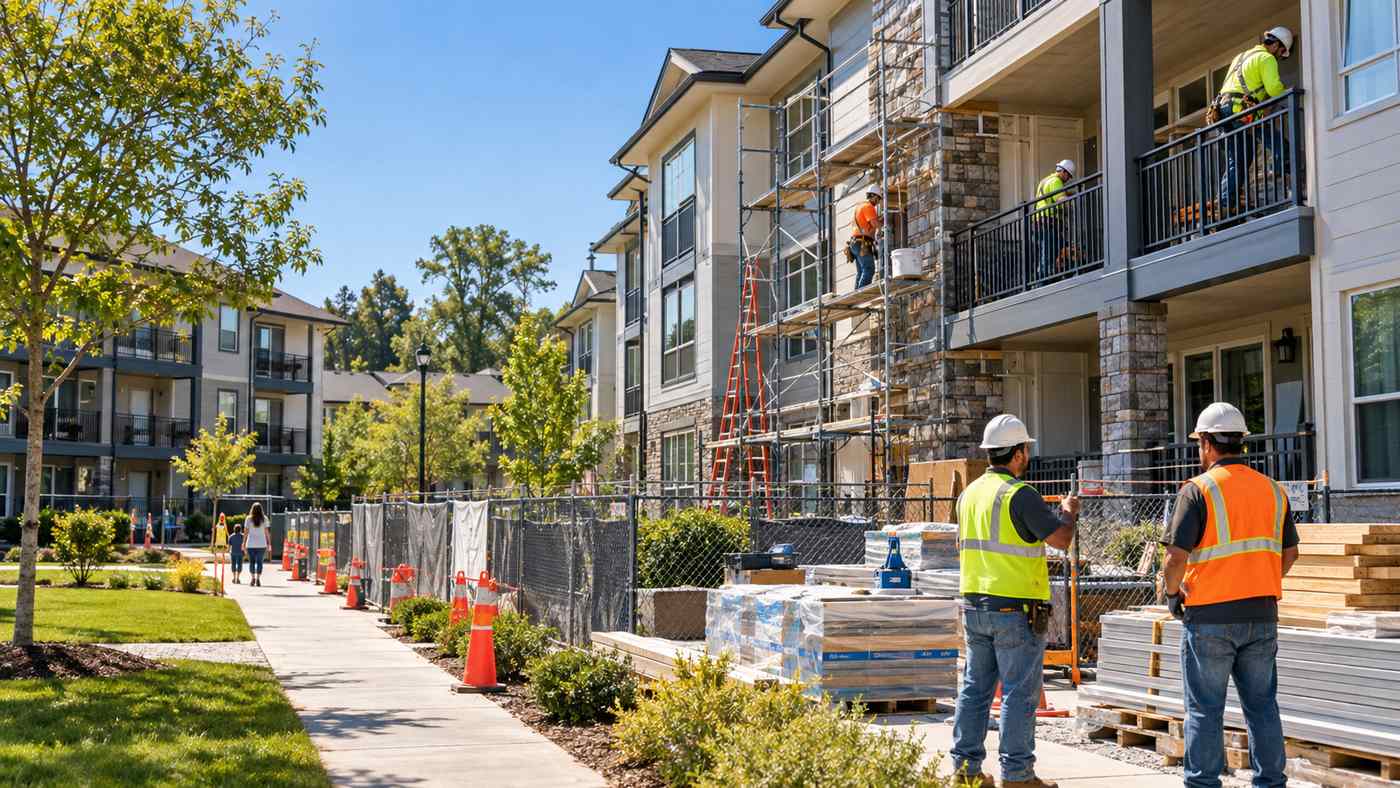
Construction teams therefore need secure barriers, clear signs, controlled access and organized material storage.
Work areas should be separated from normal resident pathways whenever possible.
Planning should also account for emergency access and accessibility requirements.
Safety is not limited to preventing physical entry into work areas.
Dust, noise, utility interruptions and temporary changes to building access can all affect residents.
A comprehensive plan considers these issues before work starts.
Technology and Data in Affordable Housing Construction
Modern construction increasingly relies on digital planning and information systems.
ICON National’s website includes an Affordable Housing Command Center designed to provide information such as state Low Income Housing Tax Credit deadlines, project readiness resources and site context data sourced from public datasets.
Digital tools can help developers organize information earlier in the planning process.
They do not replace architects, legal advisers, tax professionals or housing agencies.
However, easier access to project information can support more informed conversations.
This is particularly useful when developers are considering projects across multiple jurisdictions.
ICON National and Community Impact
Affordable housing construction directly affects communities because the work takes place where people live.
ICON National describes community impact as part of its organizational mission and reports involvement in volunteer programs alongside its construction activity.
For housing owners, community impact is also connected to the quality of the physical renovation.
Improved building systems, safer common areas and updated living spaces can contribute to the long term usability of a property.
The strongest affordable housing renovations therefore combine construction quality with thoughtful resident management.
Frequently Asked Questions
What does ICON National specialize in?
ICON National specializes in occupied affordable multifamily and senior housing renovations, including Low Income Housing Tax Credit related construction projects and associated preconstruction services.
Where is ICON National located?
ICON National’s home office is located in Scottsdale, Arizona, while the company reports completing affordable housing work across multiple states.
Does ICON National work on occupied affordable housing?
Yes. Occupied affordable housing renovation is a central part of the company’s construction focus, including projects where residents remain within the community during rehabilitation.
Does ICON National have LIHTC experience?
Yes. ICON National states that its team has more than a decade of experience in the Low Income Housing Tax Credit industry and works with affordable housing owners and developers on renovation projects.
What preconstruction services does ICON National provide?
Its published process includes cost estimating, budget development, permitting coordination, planning with architects and clients, and preparation for project execution.
Why is resident coordination important during affordable housing renovation?
Residents may continue living at a property while construction occurs, so communication, safety, scheduling, access and temporary relocation planning can be essential to completing the project responsibly.
Conclusion
ICON National operates within a specialized area of construction where affordable housing, occupied renovation and complex project requirements come together. Its focus on preconstruction, resident coordination, Low Income Housing Tax Credit experience, project management and structured closeout reflects the additional planning required for this type of work. For owners and developers, selecting a contractor with relevant occupied housing experience can help create a more organized renovation process while protecting the long term value and usability of affordable housing communities