What a Seattle Car Accident Lawyer Can Do After a Serious Cras
A traffic collision can create medical, financial and insurance problems within minutes. Injured drivers and passengers may suddenly need treatment, vehicle repairs, time away from work and repeated communication with insurance companies. A Seattle car accident lawyer can help an injured person understand Washington law, preserve important evidence, evaluate insurance coverage and pursue a claim against parties who may be legally responsible. Washington also applies comparative fault rules, meaning a person’s own share of responsibility can reduce compensation without automatically preventing recovery altogether.
Car accident cases are rarely determined by one piece of information. Police reports, photographs, medical records, witness statements, insurance policies, vehicle damage and the circumstances surrounding the collision may all become relevant.
Deadlines also matter. Washington law generally provides a three year limitation period for actions involving injury to a person or property, although the correct deadline can depend on the circumstances of an individual case.
Understanding these rules early can help accident victims avoid decisions that may unnecessarily complicate an insurance claim.
This guide explains seven important ways legal representation may help after a Seattle crash, how Washington’s fault and insurance rules work and what injured people should consider before resolving a claim.
What Does a Seattle Car Accident Lawyer Do?
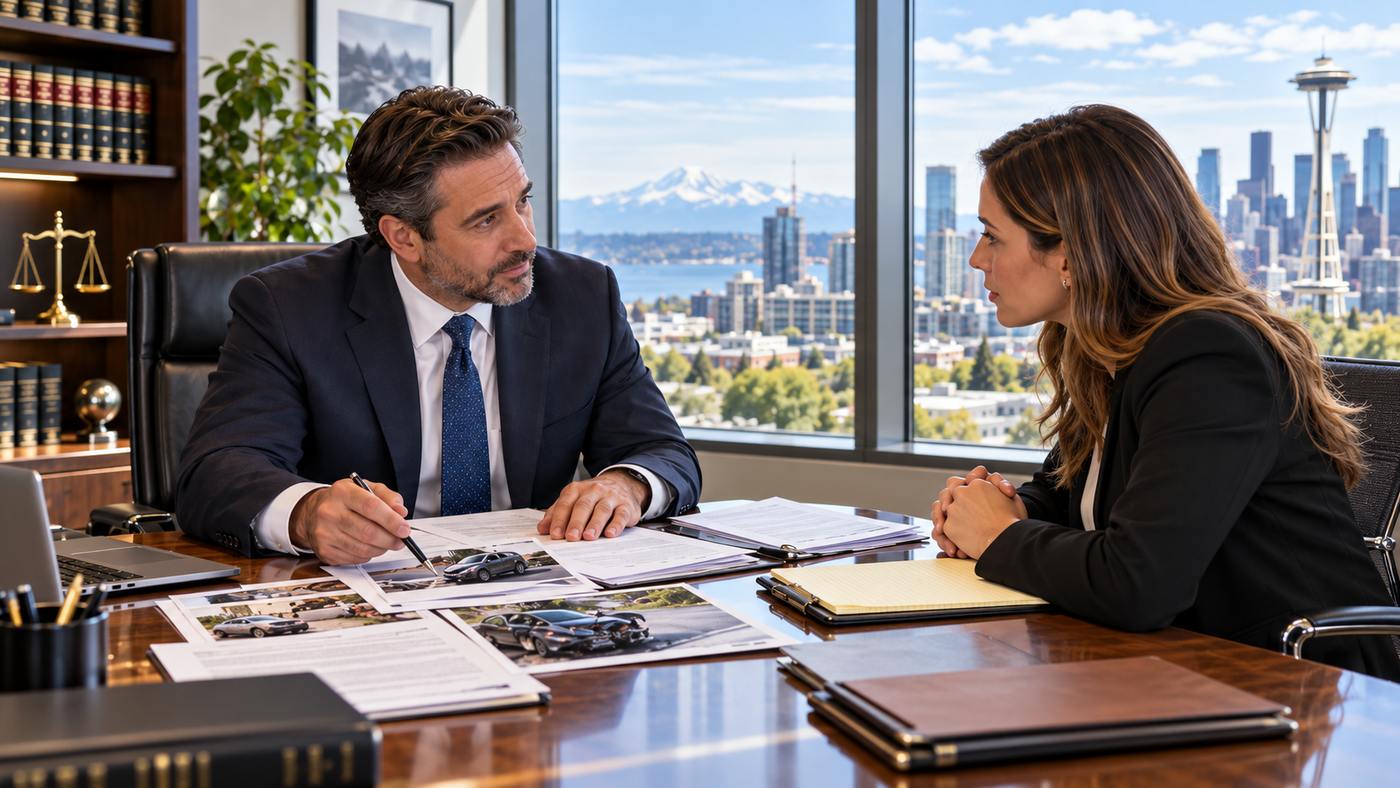
A Seattle car accident lawyer represents people who have been injured or suffered losses in motor vehicle collisions.
The lawyer’s role can include investigating the accident, identifying potentially responsible parties, reviewing insurance coverage, documenting damages and negotiating with insurers.
If the parties cannot reach an appropriate settlement, a lawyer may also evaluate whether filing a lawsuit is appropriate.
Car accident claims can involve many types of collisions, including:
- Rear end crashes
- Intersection collisions
- Highway accidents
- Distracted driving crashes
- Pedestrian accidents
- Bicycle collisions
- Rideshare accidents
- Commercial vehicle collisions
- Hit and run accidents
- Multi vehicle crashes
The facts of each accident determine how responsibility and insurance coverage should be evaluated.
An attorney should therefore examine the specific evidence rather than assuming that one type of collision always produces the same legal result.
7 Trusted Benefits of Working With a Seattle Car Accident Lawyer
1. Understanding Washington Comparative Fault Rules
Determining who caused a collision is one of the most important parts of a personal injury claim.
Washington law follows a comparative fault system.
Under RCW 4.22.005, fault attributable to an injured claimant reduces compensatory damages proportionally but does not automatically eliminate the right to recover.
Consider a simplified example.
If damages were established at $100,000 and a person were found 20 percent responsible, comparative fault principles could reduce the compensatory award according to that percentage.
Actual cases can be considerably more complicated because fault itself may be disputed.
A lawyer can investigate evidence related to:
- Traffic signals
- Vehicle positions
- Driver statements
- Witness accounts
- Photographs
- Video footage
- Police documentation
- Road conditions
- Vehicle damage
- Applicable traffic rules
Washington law defines fault broadly and requires consideration of both the conduct involved and its causal relationship to the resulting damages.
How a Seattle Car Accident Lawyer Investigates Fault
An attorney may begin by gathering information before physical or digital evidence disappears.
Photographs can document vehicle damage, skid marks, intersections and roadway conditions.
Witness information may become important if drivers provide conflicting accounts.
Video can sometimes come from traffic cameras, nearby businesses, residential security systems or vehicle cameras.
The specific evidence available depends on the location and circumstances of the collision.
Early investigation can therefore be important even when responsibility initially appears straightforward.
2. Handling Communication With Insurance Companies
Insurance claims are a major part of most car accident cases.
After a crash, injured people may communicate with their own insurer and potentially the insurance company representing another driver.
Those discussions can involve questions about responsibility, vehicle damage, injuries, medical treatment and settlement.
Insurance adjusters evaluate claims according to policy terms, evidence and applicable law.
A lawyer can handle or assist with these communications so that the claimant understands what information is being requested and why.
The attorney can also review settlement documents before they are signed.
This is important because resolving a claim may affect the ability to seek additional compensation later.
Understanding Washington Auto Insurance Requirements
Washington requires drivers to maintain minimum liability coverage unless they satisfy another legally permitted method of demonstrating financial responsibility.
The Washington State Office of the Insurance Commissioner identifies minimum liability limits of:
- $25,000 for injury or death to one person
- $50,000 for injury or death to multiple people
- $10,000 for damage to another person’s property
These are minimum limits rather than guarantees that every accident will be fully covered.
A serious crash can produce losses that exceed available liability coverage.
This is one reason lawyers often review all potentially applicable insurance policies instead of looking only at the at fault driver’s policy.
3. Documenting Medical Expenses and Injuries
Medical documentation can become one of the most important parts of an injury claim.
A collision can result in injuries that range from relatively minor soft tissue problems to fractures, head injuries or other serious conditions.
Legal claims should be based on documented harm rather than assumptions about what an injury might be worth.
Relevant records can include:
- Emergency department records
- Physician evaluations
- Diagnostic imaging
- Physical therapy records
- Prescription information
- Specialist reports
- Medical bills
- Future treatment recommendations
A lawyer can organize these records and evaluate how they relate to the collision.
The purpose is not simply to collect bills.
The records can also help establish the nature of the injury, treatment provided and the effect the condition has had on the injured person’s life.
Why Continuing Medical Care Can Matter
People injured in accidents should make healthcare decisions based on advice from qualified medical professionals.
From a documentation perspective, consistent records can also create a clearer timeline of symptoms, diagnosis and treatment.
Large unexplained gaps may raise questions during an insurance claim, although legitimate reasons for interrupted treatment can exist.
An attorney can help organize medical evidence, while diagnosis and treatment decisions remain the responsibility of healthcare professionals.
4. Identifying Available Insurance Coverage
The driver who caused the collision is not always the only potential source of insurance coverage.
Depending on the circumstances and policies involved, an injured person may need to review several forms of coverage.
Washington drivers may have Personal Injury Protection coverage.
The Washington Office of the Insurance Commissioner explains that PIP can help cover medical expenses, lost wages and certain other costs regardless of fault. Insurers must offer PIP, and a policyholder who does not want it must reject the coverage in writing.
Standard PIP coverage can provide up to $10,000 in medical and hospital expenses per injured person, with additional coverage options available.
A lawyer can examine whether PIP, liability coverage or other policy provisions may apply.
Uninsured and Underinsured Driver Issues
Another problem occurs when the responsible driver has insufficient insurance or no insurance.
The Washington Office of the Insurance Commissioner describes uninsured and underinsured motorist coverage as protection that may apply when someone is hit by an uninsured driver, a hit and run driver or, under policy terms, another unidentified vehicle.
Coverage depends on the actual insurance contract and circumstances.
People involved in hit and run incidents should also pay particular attention to reporting requirements. Washington’s insurance regulator advises reporting hit and run or unidentified vehicle accidents to local law enforcement within 72 hours and checking the specific insurance policy requirements.
5. Calculating the Full Scope of Accident Losses
A car accident claim can involve more than the initial hospital bill.
Depending on the case, losses may include medical expenses, income lost because of injury, property damage and other legally recognized damages.
The appropriate categories depend on the evidence and applicable law.
A Seattle car accident lawyer can review how an injury has affected a person’s finances and daily life rather than focusing only on one immediate expense.
Documentation may include:
- Medical invoices
- Employment records
- Wage information
- Vehicle repair estimates
- Receipts for accident related expenses
- Treatment recommendations
- Expert evaluations when appropriate
The goal is to develop a claim based on evidence.
Future losses require especially careful analysis because they cannot simply be guessed.
If a serious injury is expected to create future medical or employment consequences, relevant professional evidence may be necessary.
Why Early Settlement Offers Need Careful Review
Insurance claims can sometimes be resolved quickly.
However, speed is not always the only consideration.
An injured person may not immediately know the complete medical outcome, particularly when treatment is ongoing.
Before signing a final release, it can be useful to understand exactly which claims the agreement resolves.
A lawyer can review the proposed settlement and explain its legal effect.
Whether a particular offer should be accepted depends on the individual claim, evidence, risks and personal circumstances.
6. Protecting Important Filing Deadlines
Legal deadlines can affect whether a claim can proceed.
Washington RCW 4.16.080 generally provides a three year period for actions involving injury to a person or property.
However, people should not assume every case has exactly the same deadline.
Special rules can apply depending on the parties involved, the nature of the claim and other circumstances.
Waiting until the final months of a limitation period can also create practical problems even when the deadline has not technically expired.
Evidence may become harder to find.
Witnesses may move or forget details.
Video recordings can be deleted.
Records may take time to obtain.
A lawyer contacted earlier has more opportunity to investigate and prepare the claim.
Accident Reporting Deadlines Are Different
The statute of limitations for a lawsuit should not be confused with accident reporting requirements.
Washington law provides that when a qualifying collision causes injury, death or sufficient property damage and law enforcement does not file the required report, the driver generally must make a written accident report within four days.
Washington State Patrol currently states that a Motor Vehicle Collision Report is required when a collision involves injury or at least $1,000 in damage to any one unit, unless an officer indicates that the officer will complete the collision report.
These reporting requirements operate separately from the deadline for filing a civil injury lawsuit.
7. Negotiating a Settlement or Preparing a Lawsuit
Many car accident claims are handled through insurance negotiations.
A lawyer can prepare a claim using evidence of liability, injuries, financial losses and insurance coverage.
Negotiation may involve disagreement about:
- Who caused the collision
- Percentage of fault
- Whether treatment was accident related
- Medical costs
- Lost income
- Future losses
- Property damage
- Available policy limits
A lawyer cannot guarantee that an insurer will make a particular offer.
The attorney’s role is to present the evidence, explain the legal position and advise the client about available options.
If settlement discussions do not resolve the dispute, litigation may become one option.
How a Seattle Car Accident Lawyer Prepares for Litigation
Preparing a lawsuit can require additional investigation and formal legal procedures.
The process may involve pleadings, written discovery, document requests, depositions, expert testimony, motions and eventually trial if the parties do not settle.
Not every claim needs to reach that stage.
A case may settle before filing, after filing or during later stages of litigation.
The appropriate strategy depends on the facts and objectives of the person involved.
What to Do After a Car Accident in Seattle
The moments after a collision can be confusing.
Safety should come first.
Seattle Police advises calling 911 when medical or police assistance is needed. For minor collisions where police response is unnecessary, drivers should exchange insurance information and follow applicable Washington State Patrol reporting requirements.
When circumstances allow, useful steps can include:
- Move to a safe location when appropriate
- Request emergency help when needed
- Exchange driver and insurance information
- Photograph vehicles and the surrounding scene
- Obtain witness contact information
- Report the collision when legally required
- Seek appropriate medical evaluation
- Notify the relevant insurance company
- Preserve receipts and records
- Consider legal advice when injuries or liability issues are significant
Avoid arguments about fault at the scene.
Accident responsibility can depend on evidence that may not be immediately obvious.
Seattle Collision Reports and Evidence
A collision report can become an important part of an insurance investigation.
Washington State Patrol maintains collision records for the state and provides procedures for requesting reports. WSP notes that an officer generated collision report may take approximately two to four weeks before becoming available through its records system.
Seattle Police also directs people seeking collision records to Washington State Patrol because WSP serves as the statewide custodian of collision reports.
A report is important, but it is not necessarily the only evidence.
Photographs, medical documentation, witness accounts and electronic information can also matter.
Common Causes of Seattle Car Accidents
Collisions can result from many forms of driver behavior or roadway circumstances.
Common factors may include:
- Distracted driving
- Unsafe lane changes
- Following too closely
- Failure to yield
- Speed inappropriate for conditions
- Impaired driving
- Intersection errors
- Driver fatigue
- Poor visibility
- Multiple driver mistakes
The cause must be established using evidence from the individual collision.
A lawyer investigating an accident may therefore examine more than one potential explanation.
How Comparative Fault Can Affect a Seattle Accident Claim
Washington’s comparative fault system makes responsibility especially important.
RCW 4.22.005 states that a claimant’s contributory fault reduces compensatory damages proportionately rather than completely preventing recovery.
This means insurance companies and attorneys may disagree not only about whether someone was responsible but also about how responsibility should be divided.
Consider a collision in which several drivers made mistakes.
Evidence might indicate that one driver caused most of the crash while another driver’s conduct also contributed.
The percentage allocated to each party can affect the final financial result.
For this reason, preserving evidence about how the collision happened can be important.
When Should You Contact a Seattle Car Accident Lawyer?
Not every minor vehicle incident necessarily requires legal representation.
However, speaking with an attorney may be worth considering when a collision involves serious injuries, disputed fault, substantial medical expenses or complicated insurance issues.
Legal guidance may also be useful when:
- Multiple vehicles were involved
- A commercial driver was involved
- The responsible driver was uninsured
- The insurer disputes liability
- A settlement offer appears before treatment is complete
- Injuries interfere with employment
- Long term medical care may be necessary
- Important deadlines are approaching
An initial consultation can help a person understand what issues may need further investigation.
How to Choose a Seattle Car Accident Lawyer
Selecting legal representation is an individual decision.
Potential clients can ask about the attorney’s experience with Washington motor vehicle cases and how the firm handles communication.
Useful questions include:
- Who will manage my case?
- How often will I receive updates?
- What information do you need from me?
- How are legal fees structured?
- What costs may arise during the case?
- How do you investigate disputed fault?
- How are medical records obtained and reviewed?
- What happens if the case does not settle?
- How long might different stages take?
- What responsibilities will I have during the claim?
The answers can help a potential client understand the lawyer’s process before entering an attorney client relationship.
Frequently Asked Questions
How long do I have to file a Seattle car accident claim?
Washington generally provides a three year limitation period for actions involving personal injury or property damage, although individual circumstances can affect deadlines.
Can I recover compensation if I was partly responsible for the accident?
Potentially. Washington law reduces compensatory damages according to the claimant’s percentage of fault rather than automatically barring recovery.
Does Washington require car insurance?
Yes. Washington requires minimum liability coverage of $25,000 per injured person, $50,000 per accident for bodily injury and $10,000 for property damage unless another legally permitted financial responsibility method applies.
Is PIP insurance required in Washington?
PIP is optional, but insurers must offer it. A driver who does not want PIP generally must reject the coverage in writing.
Do I need to report a Seattle car accident?
Washington State Patrol says a collision involving injury or at least $1,000 in damage to one unit requires a Motor Vehicle Collision Report unless an officer indicates that the officer will submit the report.
What can a Seattle car accident lawyer help with?
A lawyer can investigate fault, review insurance coverage, organize medical and financial evidence, communicate with insurers, evaluate settlement options and file a lawsuit when appropriate.
Conclusion
A Seattle car accident lawyer can help injured people navigate Washington’s comparative fault rules, insurance coverage, medical documentation and important legal deadlines after a collision. Every accident claim is different, so compensation and legal strategy should be based on the actual evidence rather than assumptions or generic settlement estimates. Taking appropriate steps early, preserving records and understanding available insurance coverage can make the claims process more organized and help accident victims make informed legal decisions.