Fatal Truck Accidents in West Virginia: Causes, Liability and Wrongful Death Claims
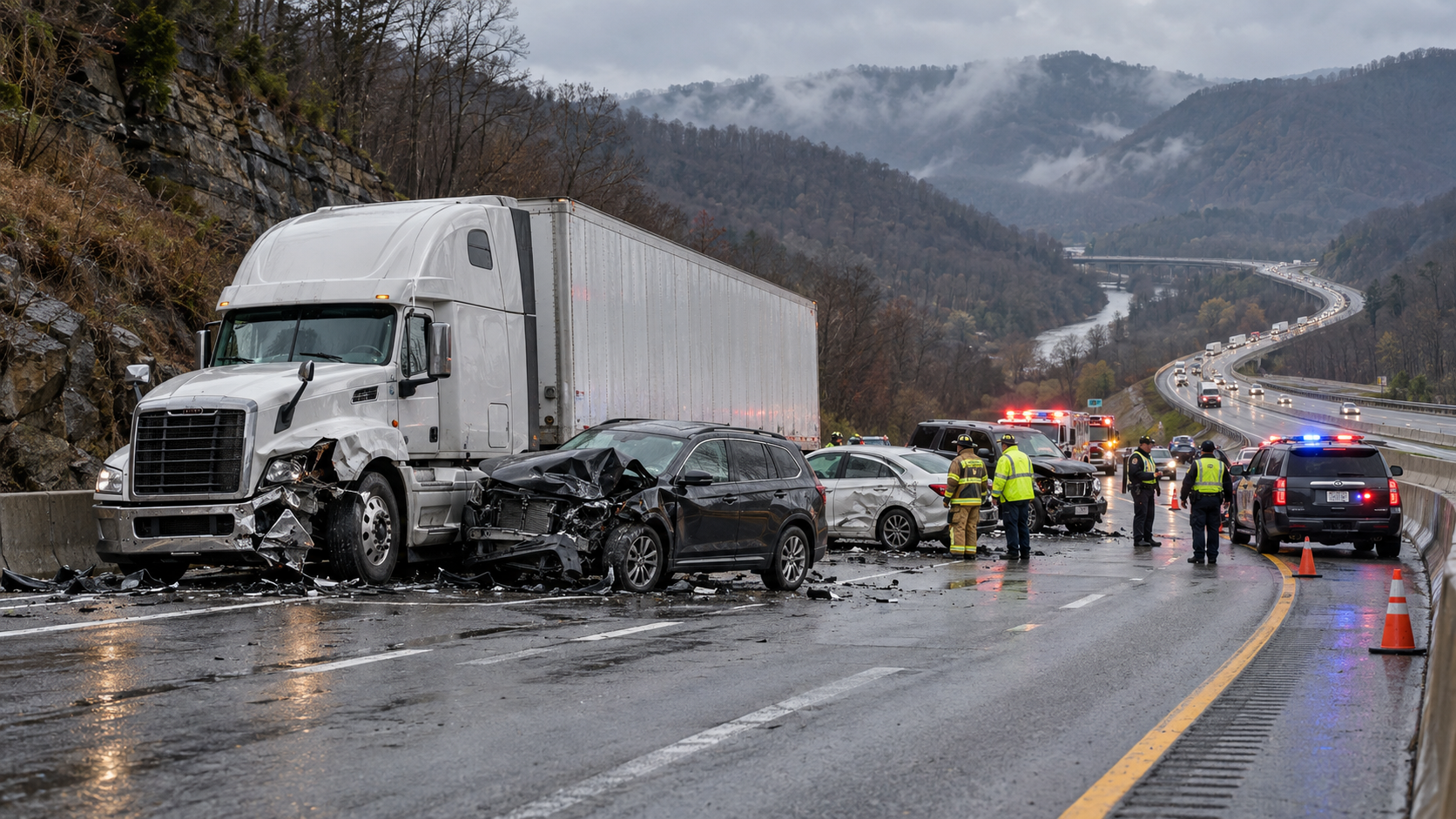
Fatal truck accidents in West Virginia can leave families facing sudden loss while raising complicated questions about commercial driver conduct, trucking company responsibility, federal safety regulations, insurance coverage and wrongful death law. West Virginia’s mountainous roads, interstate freight traffic and changing weather can add complexity to serious truck crashes, but the circumstances of every collision must be investigated individually. When negligence contributes to a death, state law may allow a personal representative to pursue a wrongful death action against the responsible parties.
Commercial truck collisions are different from many ordinary passenger vehicle accidents because multiple companies and records may be involved.
A tractor trailer may be owned by one business, driven for another motor carrier, loaded by a separate company and maintained by yet another contractor.
Determining what happened therefore requires more than reviewing the police report alone.
Electronic driving records, vehicle inspection documents, maintenance history, cargo information, photographs, witness accounts and company safety records can all become important when investigating a fatal crash.
How Common Are Fatal Truck Crashes in West Virginia?
Commercial vehicle crashes remain an important road safety issue in West Virginia.
According to Federal Motor Carrier Safety Administration crash statistics, 29 large trucks were involved in 28 fatal crashes in West Virginia during calendar year 2023. Those crashes resulted in 31 fatalities. The same FMCSA dataset shows 1,095 large trucks involved in fatal and nonfatal reportable crashes in the state during that year.
West Virginia recorded 260 total traffic fatalities from all vehicle types in 2023, according to the state’s FY2024 highway safety annual report.
These numbers provide useful context, but they do not explain why any individual crash occurred.
A detailed investigation is still necessary before responsibility can be assigned.
What Counts as a Large Truck?
Federal crash statistics generally use classifications based on vehicle type and weight.
Large trucks can include vehicles such as:
- Tractor trailers
- Semi trucks
- Large delivery trucks
- Dump trucks
- Tanker trucks
- Heavy commercial straight trucks
The legal and regulatory framework can vary depending on the vehicle, operation and whether interstate commerce is involved.
7 Important Facts About Fatal Truck Accidents in West Virginia
Serious commercial vehicle cases often involve both state negligence law and federal motor carrier regulations.
Understanding the following seven issues can help explain why these cases require careful investigation.
1. Several Parties May Share Responsibility
One of the biggest differences between a commercial truck crash and a typical two car collision is the number of potentially responsible parties.
Depending on the evidence, liability could involve:
- Truck driver
- Motor carrier
- Vehicle owner
- Trailer owner
- Maintenance contractor
- Cargo loading company
- Parts manufacturer
- Other motorists
The existence of several companies does not mean all of them are automatically liable.
Evidence must connect each party’s conduct to the crash.
Truck Driver Responsibility
A commercial driver may be responsible when negligent driving contributes to a fatal collision.
Potential examples include:
- Speeding
- Following too closely
- Distracted driving
- Unsafe lane changes
- Driving too fast for weather
- Failing to maintain control
- Driving while impaired
- Ignoring required rest rules
The exact conduct must be established through evidence rather than assumption.
Motor Carrier Responsibility
A trucking company may face liability depending on its own actions and its relationship with the driver.
Issues can include:
- Driver qualification
- Training
- Supervision
- Maintenance practices
- Safety policies
- Hours of service compliance
A carrier may also possess important documents and electronic records that help explain the events leading to the collision.
2. Driver Fatigue Can Be an Important Investigation Issue
Commercial drivers can spend long periods on the road, so federal regulations restrict driving and on duty time.
FMCSA currently states that property carrying commercial drivers may generally drive up to 11 hours after 10 consecutive hours off duty. They may not drive beyond the 14th consecutive hour after coming on duty following the required rest period. Drivers also generally need a 30 minute interruption after eight cumulative hours of driving without such a break.
Why Hours of Service Records Matter
Many regulated commercial vehicles use electronic logging devices to document driver duty status.
Records may help investigators determine:
- When the driver began working
- How long the driver had been driving
- Whether required breaks were taken
- Whether logs match other company records
- Whether unusual schedule pressure existed
Log data should often be compared with other records rather than examined alone.
For example, fuel purchases, dispatch messages, toll information and GPS data can sometimes help confirm a driver’s timeline.
Fatigue Can Exist Even Without a Technical Violation
A driver may technically remain within hours of service limits and still be tired.
Sleep quality, illness, overnight driving, demanding schedules and other factors can affect alertness.
For that reason, an investigation may consider both regulatory compliance and the driver’s actual circumstances before the crash.
3. Vehicle Condition Can Affect Fatal Truck Accidents in West Virginia
Commercial trucks operate under heavy loads and travel large distances.
Brakes, tires, steering systems, lights and other components need proper inspection and maintenance.
Mechanical failure can contribute to a serious crash when a vehicle cannot stop, steer or remain under control as expected.
Maintenance Records May Become Important Evidence
Records worth reviewing can include:
- Preventive maintenance schedules
- Brake repairs
- Tire replacement
- Driver inspection reports
- Roadside inspection history
- Repair invoices
- Out of service records
A mechanical problem discovered after a crash does not automatically prove negligence.
Investigators still need to determine whether the problem existed before the collision, whether it should have been identified and whether it actually contributed to the death.
West Virginia Terrain Can Increase Vehicle Demands
West Virginia contains steep grades, curves and mountainous road sections.
Heavy vehicles require careful speed management on descents because their stopping characteristics differ significantly from passenger cars.
Brake condition, load weight and driver technique may therefore become particularly relevant in crashes on steep highways.
4. Cargo Loading Can Affect Truck Stability
Commercial trucks are designed to carry substantial weight, but cargo must be loaded and secured appropriately.
Improper loading can change how the vehicle handles.
Potential problems include:
- Shifting cargo
- Excessive weight
- Uneven weight distribution
- Poorly secured freight
- Incorrect trailer loading
A shifting load may affect stability while turning, braking or responding to an emergency.
Cargo Records Can Help Explain the Crash
Investigators may examine:
- Bills of lading
- Weight tickets
- Loading records
- Photographs
- Shipping documents
- Securement procedures
If an outside company loaded or secured the freight, that company may need to be included in the investigation.
Again, involvement in the shipment does not automatically establish legal fault.
The evidence must show how the loading process contributed to the crash.
5. Evidence Can Disappear Quickly After a Fatal Truck Crash
Evidence preservation can become critical because commercial vehicles may be repaired, returned to service or moved shortly after a crash investigation concludes.
Electronic information may also be overwritten according to system settings.
Important evidence can include:
- Electronic logging device data
- Engine control module information
- GPS history
- Dash camera video
- Driver qualification records
- Dispatch communications
- Maintenance records
- Inspection documents
- Mobile phone records where legally obtainable
- Cargo records
- Scene photographs
The Truck Itself Can Be Evidence
Physical inspection can reveal information about:
- Impact location
- Brake condition
- Tire condition
- Lights
- Steering components
- Vehicle damage
- Cargo securement
Accident reconstruction specialists may also examine road marks, debris patterns, final vehicle positions and roadway geometry.
Witness Evidence Matters Too
People who saw the collision or observed the truck beforehand may have information that is not captured electronically.
Witness memories can fade over time, so early identification may be important.
6. West Virginia Wrongful Death Law Controls Who Brings the Claim
West Virginia law provides a wrongful death cause of action when a person’s death results from a wrongful act, neglect or default that would have allowed the injured person to bring an action had death not occurred.
However, family members do not simply file separate wrongful death lawsuits individually.
West Virginia Code §55-7-6 states that the action is brought in the name of the deceased person’s duly appointed personal representative.
Who May Receive Wrongful Death Compensation?
The statute allows damages to be distributed among individuals including:
- Surviving spouse
- Children
- Adopted children
- Stepchildren
- Parents
- Brothers and sisters
- Financial dependants
- Others equitably entitled under the statute
The specific distribution depends on the circumstances and court process.
What Damages May Be Available?
West Virginia’s wrongful death statute states that damages may include:
- Sorrow
- Mental anguish
- Loss of society
- Loss of companionship
- Loss of comfort
- Loss of guidance
- Expected lost income
- Lost services and assistance
- Medical and hospital expenses associated with the fatal injury
- Reasonable funeral expenses
These categories are specifically identified in §55-7-6.
The value of any particular case depends on its evidence and should not be predicted using a universal formula.
7. West Virginia Has a Deadline for Wrongful Death Actions
Time limits are one of the most important legal issues following a fatal collision.
Under West Virginia Code §55-7-6, a wrongful death action generally must be commenced within two years after the person’s death, subject to statutory provisions that may affect particular circumstances.
Why Waiting Can Create Additional Problems
Even when the legal deadline has not yet expired, evidence may become harder to collect with time.
Records may be lost under document retention schedules.
Vehicles may be repaired.
Witnesses may move or forget details.
Physical road evidence can disappear quickly.
For that reason, early investigation may be important in serious commercial vehicle cases.
Special Circumstances Can Affect Deadlines
Cases involving government entities, unusual defendants or other legal issues can involve additional rules.
For example, West Virginia has separate limitations provisions for certain claims against political subdivisions.
Anyone evaluating an actual claim should obtain advice regarding the deadline that applies to the specific facts instead of relying only on a general summary.
Common Causes of Fatal Truck Accidents in West Virginia
There is rarely one universal cause.
A fatal collision may involve several contributing factors.
Speed
A heavy commercial vehicle requires greater distance to slow from highway speeds than a typical passenger vehicle.
Excessive speed can reduce the time available to respond to stopped traffic, curves or changing road conditions.
Even driving at the posted limit may be unsafe when weather, traffic or road geometry requires a lower speed.
Distracted Driving
Commercial drivers may use navigation equipment, communication devices and dispatch technology during work.
Any distraction that takes attention away from the roadway can become relevant in a collision investigation.
Phone records or onboard communication data may sometimes become evidence when legally available.
Unsafe Following Distance
Large vehicles need additional stopping distance.
Following another vehicle too closely can become especially dangerous when traffic suddenly slows.
This is relevant on congested interstate routes and work zones where drivers may encounter unexpected queues.
Weather
West Virginia drivers can experience:
- Heavy rain
- Snow
- Ice
- Fog
- Low visibility
Professional drivers are expected to adjust their operation to actual road conditions.
A crash occurring during poor weather is not necessarily unavoidable simply because weather was present.
Mountain Roads and Downgrades
Steep downhill sections increase the importance of speed control and braking technique.
Heavy trucks can gain speed rapidly on grades.
A driver who approaches a descent too quickly may have difficulty maintaining safe control.
Driver Impairment
Alcohol or drugs can dramatically impair driving ability.
West Virginia’s fault allocation statute also contains a specific provision addressing joint and several liability in certain cases where driving under the influence is a proximate cause of the plaintiff’s damages.
How West Virginia Comparative Fault Can Affect a Claim
West Virginia uses a modified comparative fault system.
Under §55-7-13c, a plaintiff’s fault does not bar recovery unless the plaintiff’s share of fault is greater than the combined fault of all other persons responsible for the damages.
When the plaintiff’s fault is less than the combined fault of others, compensation is reduced according to the plaintiff’s percentage of fault.
Example of Comparative Fault
Suppose compensable damages were determined to be $1 million and the relevant claimant’s legally attributable fault reduced recovery by 20 percent.
The recoverable amount could be reduced accordingly.
Real wrongful death cases can be much more complex because multiple defendants and legal rules concerning allocation may be involved.
This example is only intended to explain the basic concept.
Who Investigates Fatal Truck Accidents?
Different organisations may investigate different aspects of a serious crash.
These can include:
- Local police
- West Virginia State Police
- Commercial vehicle enforcement officers
- Motor carrier representatives
- Insurance investigators
- Accident reconstruction experts
Federal regulators may also become relevant when a motor carrier is subject to FMCSA oversight.
FMCSA maintains safety and crash information relating to regulated motor carriers and commercial vehicles.
What Happens After a Fatal Truck Accident?
Law enforcement typically secures the crash scene and documents evidence.
Depending on the circumstances, investigators may:
- Photograph vehicles and roadway evidence.
- Interview witnesses.
- Measure collision marks.
- Inspect commercial vehicle condition.
- Obtain driver and company records.
- Review electronic vehicle information.
- Evaluate toxicology or impairment evidence where relevant.
- Reconstruct how the collision occurred.
A civil wrongful death investigation may later examine additional material beyond what was needed for the police investigation.
Trucking Company Insurance and Fatal Crashes
Commercial trucking operations generally carry insurance appropriate to their regulatory status and operations.
However, the existence of commercial coverage does not determine liability or the value of a wrongful death case.
Insurance companies may begin investigating shortly after a fatal collision.
Early Settlement Offers Should Be Evaluated Carefully
A settlement may provide certainty, but accepting a final release usually ends the legal claim against parties covered by that agreement.
Families should understand:
- What damages are included
- Whether all potentially responsible parties have been identified
- What rights the release affects
- Whether future claims are being waived
There is no universal settlement amount for a fatal truck crash.
Each case depends on liability, damages, available insurance and other evidence.
How Accident Reconstruction Can Help
Truck crashes can involve complex physics.
Reconstruction professionals may analyse:
- Vehicle speed
- Braking distance
- Vehicle weight
- Road grade
- Impact angles
- Debris
- Electronic data
- Vehicle positions
Modern commercial vehicles can contain electronic systems that provide useful information, although available data vary by vehicle and manufacturer.
A reconstruction should be based on actual evidence rather than assumptions about how the crash must have happened.
What Families Should Preserve After a Fatal Collision
Families can help protect important information by retaining documents connected with the death.
These may include:
- Medical bills
- Funeral expenses
- Employment records
- Tax records
- Insurance correspondence
- Photographs
- Crash reports
- Letters from trucking companies or insurers
Do not destroy original records after scanning them.
Organised documentation can make later evaluation easier.
Why Fatal Truck Claims Can Take Time
Serious truck cases may involve several phases.
These can include:
- Crash investigation
- Estate appointment
- Evidence collection
- Insurance review
- Expert analysis
- Liability assessment
- Damage calculation
- Negotiation
- Litigation where necessary
A quick resolution is not automatically better if critical evidence has not yet been evaluated.
At the same time, unnecessary delay can create problems because of legal deadlines and evidence preservation concerns.
Questions to Ask After Fatal Truck Accidents in West Virginia
When trying to understand a collision, useful questions include:
- Who owned the truck?
- Who employed or contracted with the driver?
- Was the driver operating within federal hours limits?
- Were electronic logs preserved?
- When was the truck last inspected?
- Were brake or tire problems reported?
- What was the cargo?
- Who loaded the trailer?
- Was the truck overweight?
- Were there witnesses?
- Is dash camera footage available?
- What did the police investigation determine?
- Who has been appointed personal representative?
Answers to these questions can help identify the next investigative steps.
Frequently Asked Questions
How common are Fatal truck accidents in West Virginia?
FMCSA data show 28 fatal crashes involving large trucks in West Virginia during 2023, involving 29 large trucks and resulting in 31 fatalities.
Who can file a wrongful death claim after a West Virginia truck crash?
West Virginia law provides that the wrongful death action is brought by the deceased person’s duly appointed personal representative.
How long do families have to file a West Virginia wrongful death lawsuit?
West Virginia Code §55-7-6 generally requires a wrongful death action to be commenced within two years after the person’s death, subject to applicable statutory exceptions.
Can a trucking company be responsible for a fatal accident?
Potentially. Liability depends on evidence involving matters such as driver conduct, company practices, maintenance, supervision and other circumstances surrounding the collision.
What evidence is important after a fatal truck crash?
Important evidence can include electronic logs, truck data, maintenance records, dispatch messages, cargo records, photographs, witness statements and physical evidence from the vehicles and roadway.
What damages are available in a West Virginia wrongful death claim?
State law identifies potential damages including sorrow and mental anguish, loss of companionship, expected lost income and services, medical expenses related to the fatal injury and reasonable funeral expenses.
Conclusion
Fatal truck accidents in West Virginia can involve complicated questions about commercial driving, vehicle maintenance, cargo, federal safety rules and state wrongful death law. A careful investigation may need to examine both the driver’s actions and the conduct of the companies involved while preserving electronic and physical evidence before it disappears. Because West Virginia generally imposes a two year wrongful death filing period, families evaluating their legal options should pay close attention to both evidence preservation and applicable deadlines.