Choosing a Professional Kirkland Roof Repair: What Homeowners Should Know
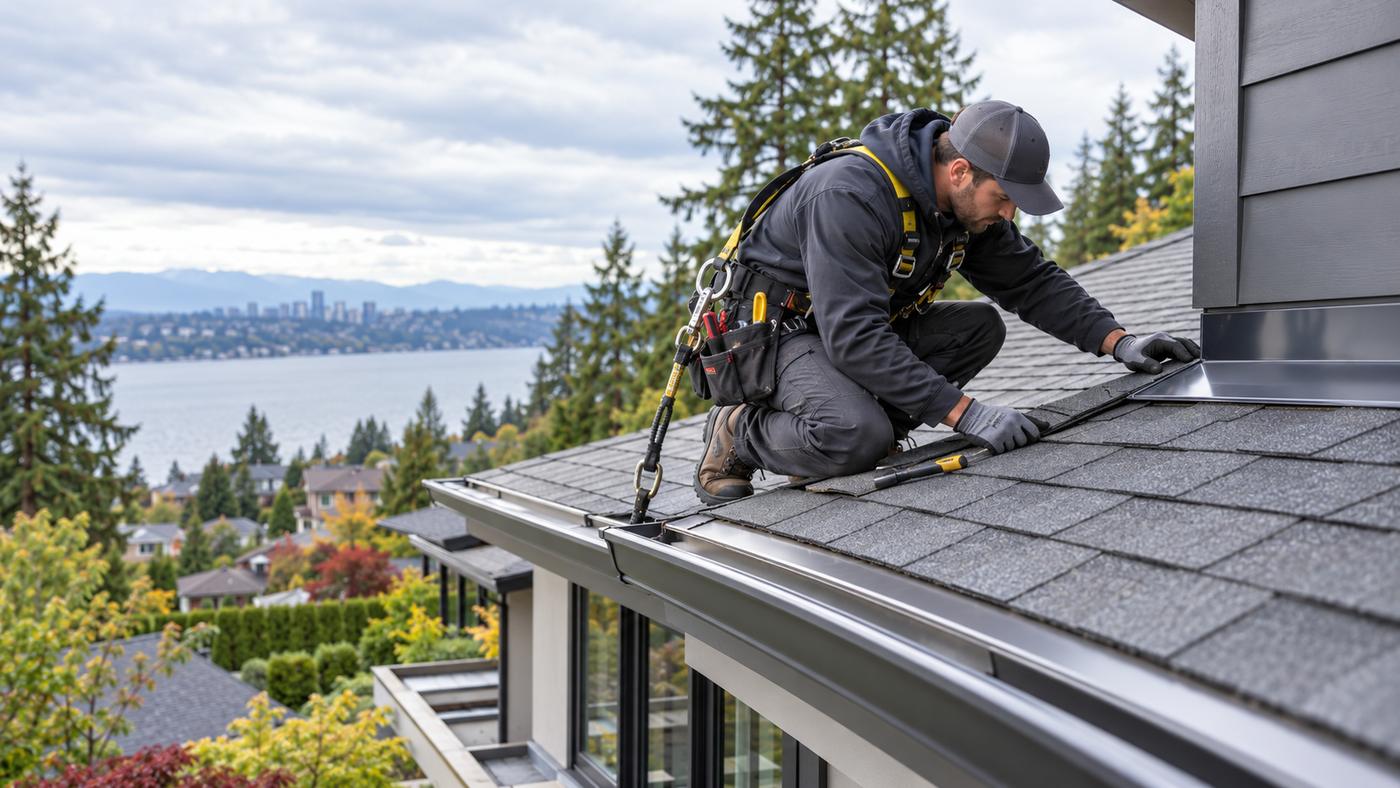
A damaged roof can quickly become more than a cosmetic problem. Water can move beneath shingles, reach roof decking, damage insulation and eventually affect ceilings or interior finishes. choosing a professional Kirkland roof repair contractor therefore involves more than finding someone who can replace a few shingles. Kirkland homeowners should confirm contractor registration, insurance, roofing experience, written estimates, warranty terms and whether permits are required for the proposed work.
Washington’s Department of Labor & Industries recommends verifying contractors before hiring them. Its contractor verification system allows homeowners to check active registration, bonding, insurance, workers’ compensation status, safety citations and certain claims against a contractor’s bond.
The City of Kirkland also has its own requirements. Contractors performing work at a job site within the city are required to have a valid City of Kirkland business licence, while reroofing and some roof alterations can require building permits.
Understanding these details before signing a contract can help homeowners reduce avoidable risk and make a more informed roofing decision.
What Does Professional Kirkland Roof Repair Include?
Roof repair can range from a relatively small leak correction to substantial replacement of damaged roofing material and decking.
Common roofing problems can include:
- Missing shingles
- Damaged flashing
- Roof leaks
- Deteriorated sealant
- Storm damage
- Damaged roof decking
- Vent problems
- Gutter-related moisture
- Moss-related deterioration
- Aging roofing materials
The first step should normally be an inspection.
A professional roofer should determine where the damage originates rather than simply repairing the most visible symptom.
Water can travel beneath roofing materials before appearing inside the home, so an interior ceiling stain may not be directly below the actual roof failure.
Why Kirkland Roof Repairs Need Local Experience
Kirkland’s Pacific Northwest environment exposes residential roofs to repeated moisture, seasonal wind, organic debris and periods of limited drying.
Roofing materials therefore need to be installed and maintained with water management in mind.
Local experience can be valuable because contractors familiar with Kirkland commonly understand:
- Typical residential roof designs
- Local permit procedures
- Flashing requirements
- Drainage challenges
- Moss and debris issues
- Common roofing materials
- Local building practices
A contractor does not need to operate exclusively in Kirkland, but familiarity with Washington construction requirements and local permitting can simplify the project.
7 Smart Tips for Choosing a Professional Kirkland Roof Repair Contractor
1. Verify Washington Contractor Registration
This should be one of the first checks.
Washington regulates construction contractors through the Department of Labor & Industries.
L&I states that roofing is among the contractor specialties that require contractor registration. To register, contractors must satisfy requirements that include business registration, a surety bond or assignment of savings, and general liability insurance.
Homeowners can use Washington’s official contractor verification tool to check whether a company currently has active registration.
What Should You Verify?
Look for:
- Active contractor registration
- Correct business name
- Registration history
- Bond information
- Liability insurance
- Workers’ compensation status where applicable
- Safety citations
- Claims involving the contractor’s bond
L&I explains that its verification tool can show whether registration is active and whether the business has current insurance and bonding information.
Do not rely only on a contractor showing you a registration number.
Verify it independently.
Contractor Registration Is Not a Performance Guarantee
A registered contractor can still perform poor-quality work.
Washington L&I specifically notes that registration does not guarantee that problems will never occur. However, using a properly registered contractor can provide protections that may not exist when working with an unregistered business.
Registration should therefore be viewed as a minimum qualification rather than proof that one contractor is automatically better than another.
2. Check Insurance and Bonding
Roofing work creates risk.
Workers operate at height, roofing materials may be removed and parts of the building can temporarily become exposed.
A legitimate contractor should carry appropriate insurance.
Washington contractor registration includes bonding and liability-insurance requirements.
Ask the roofer about:
- General liability insurance
- Contractor bond
- Employee workers’ compensation coverage where applicable
These protections serve different purposes.
Liability insurance may address covered property damage or other liabilities.
A contractor bond can provide another potential source of protection under qualifying circumstances.
Workers’ compensation relates to employees who may be injured while performing work.
Verify Rather Than Assume
Do not assume a contractor is properly insured simply because their website says “fully insured.”
Use Washington’s official verification system and ask for appropriate documentation when necessary.
3. Get a Detailed Written Roofing Estimate
A professional roof-repair estimate should describe what the contractor intends to do.
A vague quote such as “repair roof leak: $2,500” gives the homeowner very little information.
A stronger estimate may specify:
- Area being repaired
- Roofing materials
- Underlayment work
- Flashing replacement
- Decking repairs
- Vent work
- Removal and disposal
- Labour
- Permit responsibilities
- Warranty terms
Washington L&I recommends evaluating bids based on scope of work, warranties, references, completion dates and price rather than focusing only on the cheapest estimate.
Compare Equivalent Roofing Scopes
Two roofing quotes may look very different because the contractors are proposing different solutions.
For example:
Contractor A may replace damaged shingles only.
Contractor B may remove roofing material, replace damaged sheathing and install new flashing.
The second proposal may cost more because it addresses more of the problem.
Compare scope before comparing price.
Ask About Additional Charges
Roof damage is not always completely visible until roofing materials are removed.
Ask how unexpected decking damage will be charged.
The contract might specify a price per sheet of replacement plywood or another agreed method.
This reduces surprise costs later.
4. Understand Kirkland Roofing Permit Requirements
Permit responsibility should be clarified before work begins.
The City of Kirkland states that building permits are required for construction, modification or demolition of buildings or structures and provides a specific reroofing checklist for applicable residential work.
Kirkland also identifies reroofing as potentially eligible for streamlined review where certain conditions are met.
These conditions include situations where:
- Existing roof pitch is unchanged
- There are no structural roof modifications
- Roof or parapet height is not increased
- Rooftop mechanical equipment is not added or relocated
- Skylights are not added or relocated
- Certain insulation work is not being performed
Structural Changes Can Change the Permit Process
The City’s reroof checklist indicates that additional plan review may be required when the project changes roof pitch, roof height, rooftop equipment, skylights, framing or certain insulation conditions.
A professional roofing contractor should be able to explain whether the proposed job requires a permit and who will obtain it.
Ask Who Is Pulling the Permit
Do not leave this ambiguous.
The contract should identify whether the contractor or homeowner is responsible.
For substantial roofing projects, having the contractor handle the permit can often make administration easier because the contractor is already familiar with the scope.
5. Look for Roof Repair Experience, Not Just General Construction Experience
A contractor can legally perform construction work while still having limited experience diagnosing roofs.
Roofing requires specialised knowledge involving:
- Water shedding
- Flashing
- Underlayment
- Roof ventilation
- Penetrations
- Valley details
- Shingle installation
- Roof transitions
Ask potential contractors how often they repair the type of roof installed on your home.
Asphalt Shingle Roof Repair
Asphalt shingles are common on residential properties.
Repairs may involve replacing damaged shingles, correcting flashing or dealing with deteriorated underlayment.
Matching older shingles can be challenging because colour changes over time.
Metal Roofing
Metal systems require different repair techniques.
Fasteners, seams, panels and flashing details should be evaluated according to the specific roof system.
Low-Slope Roofing
Low-slope roofs rely heavily on membrane integrity and drainage.
Repair methods differ substantially from pitched shingle roofs.
Choose contractors familiar with the material actually installed on your home.
6. Ask About Workmanship and Material Warranties
Roof warranties can be confusing because there may be more than one.
A material manufacturer may provide one warranty while the contractor provides another covering workmanship.
Ask:
- What does the workmanship warranty cover?
- How long does it last?
- Who provides the material warranty?
- Are there exclusions?
- Does maintenance affect coverage?
- Is the warranty transferable?
Get warranty information in writing.
Understand What the Warranty Does Not Cover
A workmanship warranty generally does not mean every future roof problem will be repaired free of charge.
Damage caused by storms, falling trees, unrelated structural movement or neglected maintenance may fall outside coverage.
Read the actual terms rather than relying on verbal descriptions.
7. Evaluate Communication and Professionalism
Roof repair requires trust.
The contractor may need access to your property and could expose part of the roof during construction.
Communication matters.
Professional behaviour can include:
- Returning calls
- Arriving when scheduled
- Explaining the problem clearly
- Providing written documentation
- Discussing change orders before additional work
- Cleaning the job site
- Providing final invoices
A contractor who is difficult to communicate with before receiving payment may not become easier to reach after the project begins.
Signs Your Kirkland Roof May Need Repair
Some roof problems are obvious.
Others develop gradually.
Warning signs can include:
Water Stains
Brown or yellow ceiling stains may indicate moisture entering from above.
However, plumbing or condensation can sometimes produce similar symptoms.
The source should be investigated before assuming the roof is responsible.
Missing or Damaged Shingles
Wind can loosen or remove shingles.
Cracked, curled or severely deteriorated roofing material may also indicate aging.
Damaged Flashing
Flashing is used around vulnerable areas such as:
- Chimneys
- Valleys
- Walls
- Skylights
- Roof penetrations
Failures around these areas are common sources of leaks.
Moss Growth
Moss is common in moist Pacific Northwest environments.
Heavy growth can trap moisture and interfere with roofing materials.
Avoid aggressive cleaning methods that damage shingles.
Roof Decking Damage
Soft or deteriorated roof decking may indicate long-term moisture exposure.
Kirkland’s reroof checklist specifically addresses roofing removal and decking requirements during reroofing projects.
Roof Repair vs Roof Replacement
Not every leak requires a new roof.
Likewise, repairing an extensively deteriorated roof repeatedly may not make financial sense.
Roof Repair May Make Sense When
- Damage is localised
- Most roofing remains in good condition
- Flashing is the primary issue
- Storm damage affects only a limited area
- The roof still has substantial remaining service life
Replacement May Make More Sense When
- Roofing material is extensively deteriorated
- Leaks occur in several areas
- Significant decking damage exists
- Repair costs are becoming repetitive
- The system is nearing the end of its useful life
A professional contractor should explain why repair or replacement is being recommended.
Emergency Roof Repair in Kirkland
Wind, falling branches or sudden leaks can require urgent attention.
Immediate priorities usually involve preventing additional water intrusion and protecting occupants.
Temporary measures may be required before permanent repairs can occur.
What Homeowners Should Do
If water is entering the house:
- Move valuables away from the leak
- Place containers under dripping water
- Avoid areas where ceilings appear unstable
- Contact a professional roofer
- Photograph visible damage where safe
Do not climb onto a wet or storm-damaged roof yourself.
Roof surfaces can be slippery, structurally compromised or close to electrical hazards.
Questions to Ask a Kirkland Roofing Contractor
Before hiring, ask:
- Is your Washington contractor registration active?
- Are you bonded and insured?
- Do you have a valid Kirkland business licence?
- Do you regularly perform roof repairs?
- What do you believe is causing the leak?
- Is the repair temporary or permanent?
- Will a permit be required?
- Who obtains the permit?
- What warranty is included?
- What happens if hidden damage is discovered?
A professional contractor should be able to answer these questions clearly.
Avoid Choosing a Roofer Based Only on Price
Price matters, but roofing is one area where the cheapest offer can become expensive if important work is omitted.
Washington L&I specifically recommends comparing scope, references, warranties, project timing and price rather than focusing exclusively on the lowest bid.
A strong contractor may cost more because the estimate includes:
- Better materials
- Correct flashing work
- Required permits
- Proper disposal
- Insurance
- Warranty support
The goal should be overall value rather than simply the smallest upfront invoice.
Verify References and Previous Roofing Work
Ask for recent local references.
Questions for previous customers might include:
- Was the work completed as promised?
- Did the final price match the estimate?
- Was the property kept clean?
- Were delays communicated?
- Did leaks return?
L&I encourages homeowners to verify references and, when possible, inspect completed work or speak with previous customers.
Online reviews can provide additional context, but they should not replace registration and insurance verification.
Kirkland Business Licensing
Contractor registration through Washington State and local business licensing are different matters.
The City of Kirkland states that contractors performing work or services at a job site within city limits must have a valid Kirkland business licence.
Ask a contractor to confirm compliance before starting work.
This is especially useful when the company is based outside Kirkland but performs projects inside the city.
Frequently Asked Questions
What should I check when choosing a professional Kirkland roof repair company?
Verify Washington contractor registration, bonding, insurance, Kirkland business licensing, roofing experience, written estimates, warranties and permit responsibilities before signing a contract.
Do Kirkland roof repairs require a permit?
Some reroofing and roof alterations require permits. The exact process depends on the scope, including whether roof pitch, structure, height, skylights or rooftop equipment are being changed.
How can I verify a Kirkland roofing contractor?
Use Washington Labor & Industries’ official Verify a Contractor tool to check registration, bond, insurance and other available contractor information.
Should I repair or replace a leaking roof?
Localised damage may be repairable, while widespread deterioration, repeated leaks or significant decking damage can make replacement more practical. A professional inspection is needed to evaluate the specific roof.
Should I choose the cheapest roof repair estimate?
Not necessarily. Washington L&I recommends comparing scope of work, warranties, references, completion dates and price rather than selecting a contractor solely by the lowest bid.
What should a Kirkland roof repair estimate include?
A detailed estimate should identify the repair area, materials, labour, flashing or decking work, disposal, permit responsibilities, expected additional charges and warranty terms.
Conclusion
Choosing a professional Kirkland roof repair contractor requires careful verification rather than relying only on price or online advertising. Homeowners should confirm Washington contractor registration, insurance, bonding, local business licensing and the exact repair scope before work begins. A detailed inspection, clear estimate and written warranty can help ensure that the underlying roofing problem is addressed instead of merely covering the visible symptoms.