Luxury Kitchen Remodeling: How to Create a High-End Kitchen That Works Beautifully
A successful luxury kitchen remodeling project is not simply about buying the most expensive cabinets, countertops or appliances. High-end kitchens feel luxurious because layout, materials, lighting, storage and technology work together as one carefully planned system. The best remodels improve daily cooking and entertaining while also creating a visual connection with the rest of the home.
Current kitchen-design research supports this shift toward personalized, functional spaces. The National Kitchen & Bath Association’s 2026 Kitchen Trends Report found that homeowners increasingly want kitchens that feel integrated with the whole home, provide smarter storage, support social connection and incorporate technology without making the room feel overly complicated. (NKBA)
Luxury therefore does not have to mean excessive ornamentation.
In many of today’s premium kitchens, luxury looks like:
- Custom storage that eliminates clutter
- Natural stone with distinctive character
- Integrated appliances
- Layered lighting
- Quiet, high-quality hardware
- Comfortable circulation
- Materials chosen to age well
This guide explains seven major design upgrades that can turn a standard kitchen renovation into a sophisticated, long-lasting remodel.
What Is Luxury Kitchen Remodeling?
Luxury kitchen remodeling is a comprehensive renovation focused on premium materials, custom design, craftsmanship and functionality.
A high-end project may include:
- Custom cabinetry
- Natural stone countertops
- Oversized islands
- Integrated refrigeration
- Premium cooking appliances
- Butler or walk-in pantries
- Architectural lighting
- Custom millwork
- Smart technology
- Premium plumbing fixtures
However, not every luxury kitchen needs every one of these features.
The objective should be to create a space that reflects how the household cooks, stores food, entertains and moves through the home.
A well-planned $100,000 kitchen can feel more luxurious than a poorly planned project costing considerably more.
Why Luxury Kitchens Are Becoming More Personalized
Kitchen design is becoming less about copying a showroom and more about creating a space around the owner’s lifestyle.
NKBA’s 2026 research found that industry professionals expect kitchens to become increasingly personalized and multifunctional. Dedicated beverage stations, enhanced storage, smart appliances and spaces that connect visually with nearby rooms are among the major trends shaping current remodeling projects. (NKBA)
This means homeowners should begin with lifestyle questions before selecting finishes.
Consider:
- How many people cook at the same time?
- Is the kitchen used for entertaining?
- Are small appliances used daily?
- Is additional pantry storage needed?
- Does the household prefer gas or electric cooking?
- Is accessibility important?
- Are children or pets frequently in the kitchen?
The answers can influence nearly every design decision.
7 Powerful Luxury Kitchen Remodeling Upgrades
1. Start With a Better Kitchen Layout
A luxury kitchen should feel comfortable to move through.
Expensive finishes cannot compensate for a poor layout.
The first stage should therefore focus on:
- Cooking zones
- Food preparation
- Refrigeration
- Cleaning
- Storage
- Seating
- Circulation
Modern kitchens often move beyond the traditional work-triangle concept.
Larger rooms may contain several specialised zones.
For example, one section can contain the primary sink and dishwasher while another includes a prep sink, refrigerator drawers and beverage storage.
Create Clear Work Zones
A practical luxury layout may include separate areas for:
Preparation: Cutting boards, knives, mixing bowls and prep sink.
Cooking: Range, cooktop, ovens, pots and utensils.
Cleaning: Main sink, dishwasher and waste storage.
Beverages: Coffee machine, wine refrigerator, glassware and water station.
Serving: Island or countertop area near dining space.
Separating these functions can make the room easier to use when several people are present.
Expand Only When It Improves the Plan
Bigger does not automatically mean better.
NKBA’s 2026 report found that 76% of surveyed professionals expect kitchen footprints to grow over the next several years, but the purpose of additional space is increasingly functionality rather than simply creating larger rooms. (NKBA)
A slightly smaller kitchen with excellent storage and circulation can be more comfortable than an oversized layout requiring unnecessary walking between work areas.
2. Invest in Custom Cabinetry and Smarter Storage
Cabinetry usually occupies more visual space than any other kitchen element.
It also determines how effectively the room stores everyday items.
Luxury cabinetry can include:
- Custom dimensions
- Furniture-quality finishes
- Integrated appliance panels
- Soft-close hardware
- Interior lighting
- Drawer organisers
- Pull-out storage
- Hidden charging
- Appliance garages
- Floor-to-ceiling storage
The difference between standard and high-end cabinetry is often most noticeable after several years of use.
Doors should remain aligned.
Drawers should operate smoothly.
Finishes should tolerate normal cleaning and daily activity.
Drawers Can Be More Practical Than Lower Cabinets
Deep drawers provide easier access to:
- Pots
- Pans
- Dishes
- Food containers
- Small appliances
Traditional lower cabinets can require homeowners to reach deep into the back.
Drawer systems allow more of the storage area to remain visible.
Floor-to-Ceiling Cabinetry
Tall cabinetry can increase storage while creating a built-in architectural appearance.
NKBA’s current trend research shows strong demand for smarter storage, including floor-to-ceiling cabinets, additional drawers, walk-in pantries and butler pantries. (NKBA)
The uppermost sections can hold infrequently used items such as seasonal serving pieces.
Hidden Appliance Storage
Countertops often become cluttered with:
- Coffee makers
- Toasters
- Blenders
- Mixers
- Air fryers
An appliance garage can keep these devices accessible while allowing them to disappear behind cabinetry when not in use.
This supports the clean visual character common in luxury kitchens.
3. Choose Premium Countertops for Beauty and Performance
Countertops strongly influence both appearance and daily functionality.
Popular high-end options include:
- Quartzite
- Quartz
- Marble
- Granite
- Sintered surfaces
- Porcelain slabs
Each material has advantages and trade-offs.
Natural Quartzite
Quartzite is a natural stone valued for distinctive veining and durability.
Current NKBA research indicates strong interest in natural quartzite alongside engineered quartz for both countertops and backsplashes. (NKBA)
Because it is natural, every slab is different.
Homeowners should select the actual slab rather than relying only on a small sample.
Marble
Marble can provide exceptional visual depth.
However, it requires realistic expectations.
Many marbles can:
- Etch from acids
- Develop patina
- Show stains
- Require periodic care
For some homeowners, this aging becomes part of the material’s beauty.
Others may prefer a more maintenance-friendly surface.
Quartz
Engineered quartz offers consistency and relatively simple maintenance.
It is available in numerous patterns designed to resemble natural stone.
Homeowners should follow manufacturer recommendations regarding heat exposure and cleaning products.
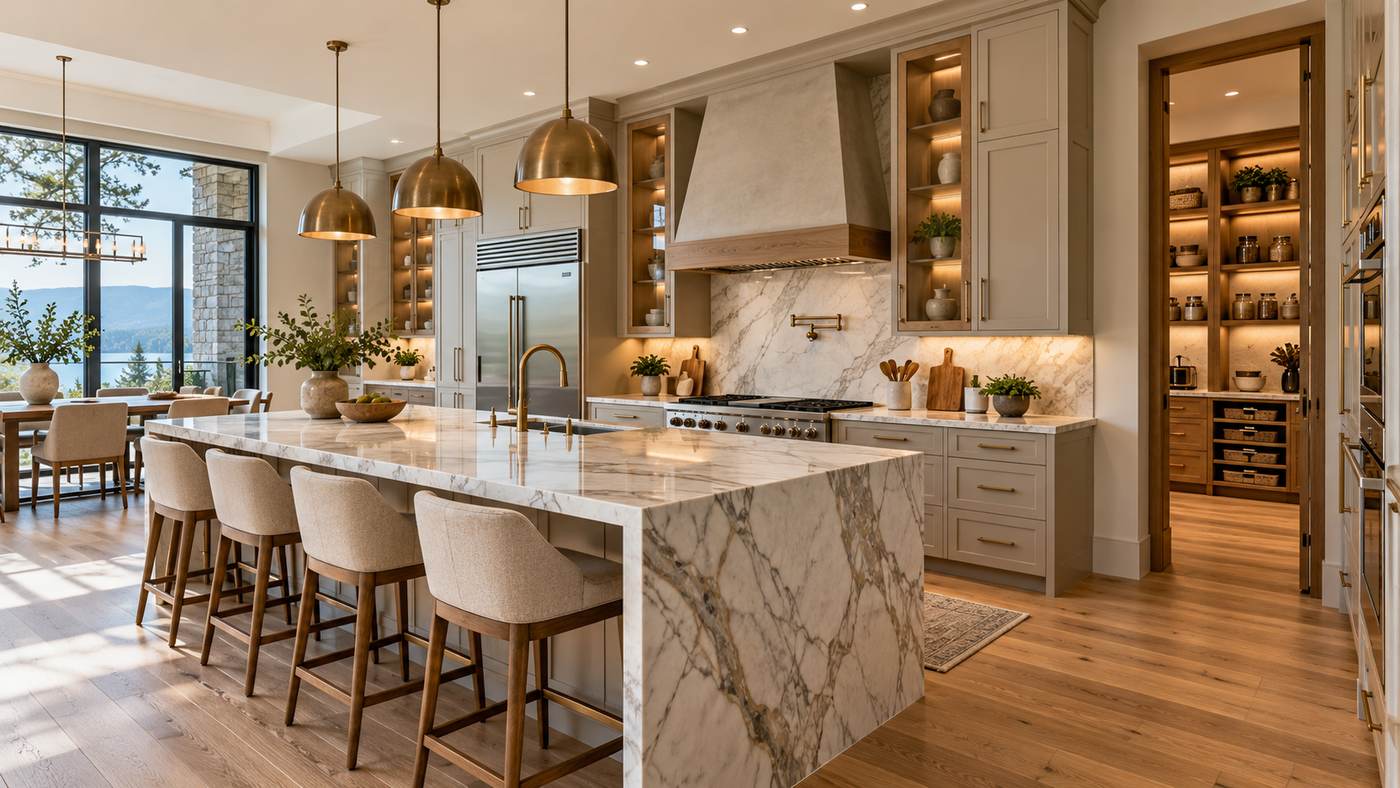
Waterfall Islands
A waterfall island continues the countertop material vertically down one or both sides of the island.
This can create a sculptural appearance.
It works especially well with dramatic stone that has strong veining.
Vein matching should be planned before fabrication.
A skilled fabricator can position the slabs so the pattern appears to continue naturally around the edge.
4. Make the Island a Functional Centerpiece
A large kitchen island can become the visual and functional heart of the room.
However, size should be determined by circulation rather than appearance alone.
A luxury island may incorporate:
- Seating
- Storage
- Prep sink
- Dishwasher
- Microwave drawer
- Beverage refrigerator
- Electrical outlets
- Charging
- Bookshelves
- Decorative panels
Avoid Oversizing the Island
An island should not make nearby cabinets or appliances difficult to use.
Walkways need sufficient clearance.
The required space depends on:
- Number of cooks
- Appliance locations
- Seating
- Door swings
- Traffic patterns
A professional kitchen designer can model these clearances before construction begins.
Consider Two Islands Carefully
Very large kitchens sometimes use two islands.
One can serve food preparation while the second supports seating or entertaining.
This can work well in the right room.
In a smaller kitchen, two islands can create unnecessary obstacles.
Luxury should make movement easier, not harder.
5. Integrate Premium Appliances Into the Design
High-end appliances can provide better capacity, specialised features and visual consistency.
Luxury kitchens may include:
- Built-in refrigeration
- Professional-style ranges
- Wall ovens
- Induction cooktops
- Steam ovens
- Wine refrigeration
- Dishwasher drawers
- Built-in coffee systems
The appliance plan should be finalised before cabinets are ordered.
Changing appliance dimensions later can create expensive cabinetry modifications.
Panel-Ready Appliances
Panel-ready refrigerators and dishwashers accept cabinet panels so they visually blend into surrounding cabinetry.
NKBA’s 2026 research found growing interest in integrated appliance designs, including panel-faced refrigerators and dishwashers. (NKBA)
This creates a cleaner architectural appearance.
Induction Cooking
Induction has become an important premium cooking option.
It heats compatible cookware using electromagnetic energy rather than heating the cooking surface in the same way as traditional electric resistance equipment.
ENERGY STAR states that certified electric cooking products are, on average, 18% more efficient than standard models. (ENERGY STAR)
Induction can also provide:
- Rapid heating
- Precise temperature control
- Easier cooktop cleaning
- Reduced surface heat compared with conventional electric elements
The home may require electrical upgrades depending on existing service and the appliance selected.
Ventilation Should Not Be an Afterthought
Premium cooking equipment can generate substantial:
- Heat
- Moisture
- Smoke
- Grease
- Odours
Ventilation should be designed around the appliance rather than chosen purely for appearance.
NKBA’s latest research also identifies powerful ventilation hoods as a growing priority in wellness-focused kitchens. (NKBA)
6. Use Layered Lighting Instead of One Ceiling Fixture
Lighting can dramatically change the appearance of a luxury kitchen.
A successful lighting plan commonly includes four layers.
Ambient Lighting
Provides general illumination throughout the room.
Examples include:
- Recessed fixtures
- Flush-mounted lights
- Architectural ceiling lighting
Task Lighting
Provides focused illumination over work surfaces.
Under-cabinet lighting is particularly valuable because overhead lighting can place a person between the light source and countertop.
Decorative Lighting
Pendant lights above an island can act like architectural jewellery.
They can provide:
- Scale
- Contrast
- Texture
- Visual identity
NKBA’s 2026 report found that statement lighting is gaining importance, while natural light, high-quality general lighting and task lighting remain major homeowner priorities. (NKBA)
Interior Cabinet Lighting
Glass-front cabinets can use integrated lighting to display:
- Glassware
- Ceramics
- Decorative objects
Interior drawer lighting can also improve visibility.
Use Dimmers and Lighting Controls
Lighting needs change throughout the day.
Bright task lighting may be useful during food preparation.
Lower lighting levels can create a softer atmosphere during dinner or entertaining.
Separate controls give homeowners greater flexibility.
7. Use Materials That Create a Cohesive Luxury Look
Luxury design is rarely about using the greatest number of materials.
A restrained material palette often feels more sophisticated.
For example:
Cabinetry: Warm white oak.
Countertop: Natural quartzite.
Metal: Brushed brass.
Flooring: Wide-plank wood.
Backsplash: Matching stone slab.
Repeating materials creates visual continuity.
NKBA’s 2026 research shows continued strength for natural materials, wood grain, neutral colours and timeless design. Neutral colours were identified as popular by 96% of respondents, while transitional or timeless kitchens remained the leading style direction. (NKBA)
White Oak
White oak has become a particularly popular high-end cabinetry material.
Its relatively subtle grain works well with:
- Modern interiors
- Transitional kitchens
- Organic design
- Minimalist spaces
NKBA’s survey identified white oak as the leading wood choice among respondents. (NKBA)
Slab Backsplashes
Continuing countertop material onto the backsplash creates a seamless appearance.
It also reduces grout lines.
This approach is especially effective when the stone itself is intended to become a visual feature.
Luxury Kitchen Remodeling and Butler Pantries
A butler pantry can move supporting activities away from the main kitchen.
It may include:
- Secondary sink
- Dishwasher
- Beverage refrigerator
- Coffee station
- Small appliances
- Serving storage
- Food preparation space
This allows the primary kitchen to remain visually clean during entertaining.
Walk-In Pantry
A walk-in pantry can store:
- Dry food
- Appliances
- Bulk groceries
- Serving pieces
The most effective pantry design uses shelves at several depths rather than making every shelf extremely deep.
Items stored behind one another can become difficult to access.
Beverage Stations Are Becoming More Common
Dedicated beverage zones are one of the clearest current kitchen trends.
NKBA’s 2026 research found that 85% of respondents expect dedicated beverage areas to remain popular. (NKBA)
A beverage station can include:
- Coffee machine
- Wine refrigerator
- Glass storage
- Small sink
- Water dispenser
- Ice maker
Separating drinks from the cooking zone allows guests or family members to prepare beverages without interrupting food preparation.
Smart Technology in Luxury Kitchen Remodeling
Smart technology works best when it simplifies routines.
Potential upgrades include:
- App-connected ovens
- Smart refrigerators
- Automated lighting
- Leak sensors
- Touchless faucets
- Integrated charging
- Voice-assisted controls
NKBA reports continued growth in smart appliances, connected lighting and wireless charging within kitchen design. (NKBA)
However, technology should not dominate the room visually.
Built-in and discreet solutions generally age better than creating a kitchen around temporary gadgets.
Luxury Kitchen Remodeling Budget Planning
High-end kitchen projects can vary dramatically in price.
The total depends on:
- Kitchen size
- Structural work
- Cabinetry
- Appliances
- Stone
- Plumbing
- Electrical work
- Flooring
- Lighting
- Labour
A useful budget should include a contingency for hidden conditions.
Once walls, cabinets or floors are removed, contractors may discover:
- Old wiring
- Plumbing problems
- Water damage
- Uneven framing
- Subfloor damage
These conditions can change the scope.
Spend Where It Matters Most
Areas that often justify higher investment include:
- Cabinet construction
- Hardware
- Installation
- Countertop fabrication
- Ventilation
- Lighting
Decorative items such as bar stools or accessories can be changed relatively easily later.
Structural mistakes and poorly installed cabinetry are much more expensive to correct.
Hiring a Luxury Kitchen Remodeling Contractor
Luxury work requires coordination among several trades.
A project may involve:
- General contractor
- Kitchen designer
- Architect
- Cabinetmaker
- Electrician
- Plumber
- Stone fabricator
- Appliance installer
- Painter
Before hiring, review:
- Relevant kitchen projects
- References
- Insurance
- Required licensing
- Written scope
- Payment schedule
- Warranty
- Change-order procedures
Permit requirements and contractor licensing rules vary by state and municipality, so homeowners should confirm current local requirements before construction begins.
Common Luxury Kitchen Remodeling Mistakes
Choosing Finishes Before Finalising the Layout
Layout decisions influence cabinets, plumbing, electrical work and appliances.
Making the Island Too Large
Oversized islands can reduce circulation.
Ignoring Ventilation
A powerful range without suitable ventilation can create heat, smoke and grease problems.
Too Many Materials
Using several competing stones, woods and metals can make the room feel visually chaotic.
Poor Lighting
One central ceiling fixture rarely provides enough task lighting.
Choosing Appliances Too Late
Cabinet drawings depend on exact appliance dimensions.
Designing Only for Resale
Resale matters, but the kitchen should first function properly for the people living in the home.
Frequently Asked Questions
What makes luxury kitchen remodeling different from a standard remodel?
Luxury kitchen remodeling usually includes more custom design, premium materials, integrated appliances, advanced storage, architectural lighting and higher levels of craftsmanship.
What kitchen styles are popular in 2026?
NKBA’s 2026 industry research shows strong interest in timeless or transitional design, contemporary minimalism, natural materials and organic styles. (NKBA)
What countertop is best for a luxury kitchen?
Quartzite, quartz, marble and other premium surfaces can all work well. The best option depends on desired appearance, maintenance expectations, budget and how heavily the kitchen is used.
Are custom cabinets worth it in a luxury kitchen?
Custom cabinets can provide better use of unusual spaces, personalised storage and more control over materials and finishes. Their value is greatest when the design uses those custom capabilities effectively.
Should a luxury kitchen include smart appliances?
Smart appliances can add convenience, but technology should solve a real household need. Connected ovens, lighting, refrigeration and charging systems are increasingly common in premium kitchen designs. (NKBA)
Is induction suitable for luxury kitchen remodeling?
Yes. Induction provides fast, precise electric cooking and is increasingly used in high-end kitchens. ENERGY STAR also reports improved efficiency for certified electric cooking products compared with standard models. (ENERGY STAR)
Conclusion
Luxury kitchen remodeling is most successful when premium materials are supported by thoughtful layout, excellent storage, layered lighting and skilled installation. Custom cabinetry, natural stone, integrated appliances and intelligent technology can create a sophisticated space, but every feature should serve a practical purpose. By planning the kitchen around real household routines rather than short-lived trends, homeowners can create a high-end room that remains functional and visually appealing for years