Shutters: 7 Brilliant Secrets to Cut Energy Bills, Master Light Control, and Maximize Property Value
Window fenestrations represent the primary boundary for residential solar heat gain, winter thermal dissipation, and exterior noise infiltration. Installing high-performance interior and exterior shutters provides homeowners with a durable, architecturally integrated fenestration treatment that far outperforms fabric curtains, vinyl roller blinds, and temporary aluminum shades. Unlike flexible window coverings that flutter in breezes, warp under persistent ultraviolet radiation, or trap allergens in porous textiles, solid plantation and architectural panels establish an insulated barrier directly against glazing substrates. By combining adjustable elliptical louvers with rigid structural framing, premium window coverings grant total control over luminous daylight ingress, daytime visual privacy, and perimeter convective air currents, establishing comfortable indoor microclimates while delivering substantial long-term returns on residential property investment.
The Architectural Science of Fenestration Shading and Solar Thermodynamics
Unprotected window glass acts as an efficient conduit for radiative thermal energy transfer. During peak summer cycles, direct sunlight penetrating window panes converts into long-wave infrared radiation, heating interior wall surfaces, flooring finishes, and furniture. This greenhouse dynamic drastically increases residential cooling demand, forcing air conditioning compressors to run extensive duty cycles.
Radiative Heat Gain Mitigation and Solar Heat Gain Coefficient Reduction
The Solar Heat Gain Coefficient measures the fraction of incident solar radiation admitted through an entire window assembly. Standard double-pane clear glass typically exhibits a Solar Heat Gain Coefficient between 0.60 and 0.75, meaning that up to seventy-five percent of ambient solar heat passes unobstructed into living spaces. Installing interior or exterior shutters introduces a solid reflective physical shield that deflects incident infrared wavelengths before they heat interior air masses, reducing incoming solar radiation by up to sixty percent and lowering indoor ambient temperatures by multiple degrees.
Establishing Insulative Dead-Air Pockets Across Window Reveals
During winter heating periods, the thermodynamic challenge reverses: indoor conditioned heat rapidly radiates outward through cold glass panes via conductive thermal loss. Well-fitted perimeter framing creates a closed, stationary air cavity between the glass pane and the solid closed louvers. Air is an inherently poor conductor of thermal energy when trapped in static pockets. This supplementary dead-air insulation layer significantly reduces the window assembly overall U-factor, lowering conductive heat transfer and stabilizing room temperatures against exterior cold snaps.
Precision Luminous Flux and Glare Management
Direct solar glare causes severe visual fatigue on computer monitors and television screens, while ultraviolet radiation fades valuable hardwood floors, custom upholstery, and original artwork. Traditional fabric curtains offer binary light control: they are either open, admitting blinding direct sunlight, or closed, throwing interior rooms into complete darkness. Shutter louvers can be tilted to precise angles, reflecting blinding high-angle rays toward the ceiling to illuminate the room via diffuse ambient reflection while simultaneously preventing exterior sightlines from looking in.
Comprehensive Material Engineering: Selecting the Ideal Substrate
Choosing the appropriate material substrate dictates structural deflection resistance, moisture tolerance, and finish longevity across variable climatic environments.
Natural Hardwoods: Basswood, Poplar, and Paulownia
Natural premium hardwoods remain the gold standard for traditional elegance, organic grain beauty, and wide-span structural rigidity.
Superior Strength-to-Weight Ratio of Basswood
Tilia americana, commonly known as basswood, is the most widely specified architectural hardwood for custom indoor louvers. Basswood possesses a tight, uniform cellular grain structure that resists dimensional movement, bowing, and splitting. Furthermore, its lightweight density allows manufacturers to craft wide panel leaves up to thirty-six or forty inches without sagging or placing excessive cantilever stress on hinges. Natural hardwood accepts rich custom stains and smooth painted finishes, making it the ideal selection for living rooms, master bedroom suites, formal dining areas, and expansive picture windows.
Polyresin and Synthetic PVC with Aluminum Reinforcement Cores
While natural timber performs impeccably in climate-controlled spaces, high-humidity wet zones require waterproof synthetic engineering.
Moisture Resistance and Dimensional Stability
High-density engineered polymer and extruded polyvinyl chloride formulations are completely impervious to moisture absorption, condensation, steam, and direct water splashing. Standard solid vinyl louvers, however, are prone to thermal sagging when exposed to intense summer solar heat. To counteract thermal creep, premium synthetic louvers integrate a rigid extruded aluminum spine running along the center of each blade. This aluminum reinforcement core provides structural rigidity comparable to hardwood, allowing synthetic shutters to span wide bathroom, kitchen, and coastal laundry windows without warping or bowing over time.
Architectural Aluminum for Exterior Weather and Cyclone Protection
For exterior applications, architectural-grade powder-coated extruded aluminum delivers unparalleled structural defense against extreme weather events, high-velocity coastal hurricane winds, and mechanical intruder forced entry. Exterior aluminum panels feature tamper-resistant locking bolts, heavy-duty stainless steel pintles, and aerodynamic louvers that can be closed and locked over glass openings during tropical storm cycles to prevent airborne debris impacts.
Technical Performance Matrix by Material Composition
| Material Formulation | Maximum Clear Panel Width | Moisture & Humidity Tolerance | Thermal Insulation Rating (R-Value) | Primary Application Environment |
|---|---|---|---|---|
| Furniture-Grade Basswood | Up to 36″ – 40″ per Panel | Low to Moderate (Interior Only) | R-2.8 to R-3.2 | Formal living zones, dining rooms, bedrooms |
| Engineered Paulownia | Up to 34″ – 38″ per Panel | Moderate Resistance to Humidity | R-2.6 to R-3.0 | Large feature windows, heritage restorations |
| Aluminum-Cored Synthetic PVC | Up to 30″ – 34″ per Panel | 100% Waterproof & Steamproof | R-3.0 to R-3.5 | Bathrooms, kitchens, laundries, wet rooms |
| Powder-Coated Aluminum | Up to 48″ per Panel (Exterior) | Complete Outdoor Weatherproof | R-1.8 to R-2.2 | Patios, balconies, hurricane / cyclone zones |
| Faux Wood Composite | Up to 26″ – 28″ per Panel | High Resistance to Splashes | R-2.4 to R-2.8 | Rental apartments, utility rooms, closets |
Louver Sizing, Framing Configurations, and Operational Geometry
The aesthetic impact, optical openness, and airflow efficiency of a window treatment are determined directly by louver blade scale and framing layout.
Louver Dimensions: Small, Medium, and Large Profiles
Modern shutters are available in three standard elliptical blade depths:
- 63 mm (2.5 inches): Traditional colonial scale, ideal for compact cottage windows, French door inserts, or historic architectural heritage homes.
- 89 mm (3.5 inches): The modern residential standard, providing an optimal balance of structural strength, optical outward visibility, and proportional harmony across mid-sized windows.
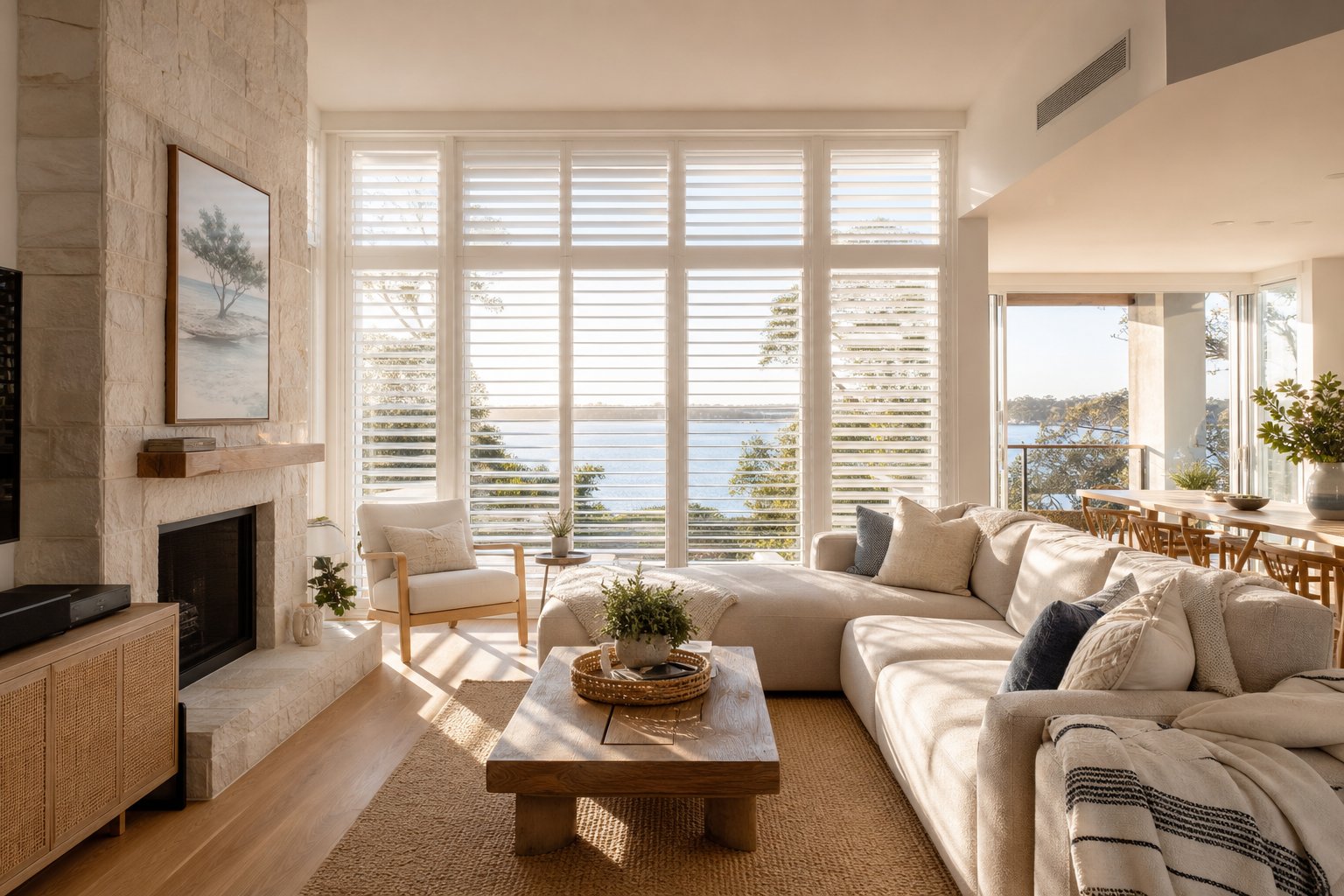
- 114 mm (4.5 inches): Expansive contemporary profile, designed for large floor-to-ceiling glass assemblies, modern coastal architecture, and panoramic scenic window walls where maximizing outward visibility is paramount.
Hidden Tilt Rods vs. Traditional Center Operating Bars
Historic installations employ a vertical wooden tilt bar pinned down the center face of the louvers to coordinate simultaneous blade rotation. Contemporary architectural designs frequently replace the visible wooden bar with an internal rack-and-pinion gear mechanism or a slim stainless steel connector hidden along the rear hinge side of the panel. Clearview hidden tilt mechanisms provide unobstructed sightlines, facilitate easier surface cleaning, and establish a minimalist, modern aesthetic.
Framing Mounting Profiles: Inside Mount vs. Outside Mount
- Inside Mount (L-Frame or Z-Frame): The panel frame installs directly recessed inside the existing window reveal. Z-frames feature a decorative perimeter lip that wraps around the drywall corner, concealing out-of-square plaster imperfections and creating a seamless built-in architectural casing.
- Outside Mount: When windows lack adequate reveal depth due to crank handles, security locks, or shallow drywall sills, the frame mounts directly onto the perimeter wall architrave or surrounding drywall face.
Acoustic Attenuation and Acoustic Isolation Benefits
Beyond solar radiation and illumination control, solid window panels provide noticeable acoustic dampening benefits. Glass panes reflect or vibrate with exterior acoustic frequencies, transmitting street traffic roar, barking dogs, and neighborhood noise directly into interior living spaces. Closing dense wood or solid PVC louvers establishes a physical acoustic baffle that interrupts sound wave propagation, decoupling perimeter glass resonances and cutting noticeable airborne noise intrusion by six to ten decibels.
Professional Cleaning, Preventative Maintenance, and Service Longevity
Unlike fabric draperies that require tedious unhooking, dry cleaning, or washing machine cycles, solid panels are among the lowest-maintenance furnishings in the residential envelope:
- Routine Dusting: Run a soft electrostatic microfiber duster or specialized multi-louver dusting tool horizontally across louvers once every two weeks.
- Deep Cleaning: Wipe down timber panels using a lightly dampened microfiber cloth followed immediately by a dry towel; for waterproof synthetic polymer panels in bathrooms, clean using warm water and a neutral-pH liquid detergent.
- Tension Screw Calibration: If louvers begin to drop or fail to hold their tilt angle over time, locate the adjustable tension screws recessed inside the side stile and turn them a quarter turn clockwise with a Phillips screwdriver to restore firm, smooth movement.
Frequently Asked Questions About Shutters
Do shutters provide better thermal insulation than standard fabric roller blinds?
Yes, solid timber and synthetic panels fit tightly into perimeter frames, creating a sealed dead-air pocket against the glass that insulates against convective and conductive heat transfer much more effectively than loose fabric blinds.
Can plantation shutters be installed on sliding glass patio doors?
Yes, bi-fold and bi-pass track systems allow multiple framed panels to slide smoothly along overhead aluminum tracks, providing full operational access to large patio doors.
How do I know whether to choose real wood or waterproof synthetic PVC?
Choose natural hardwood for wide spans, dry living areas, and rich wood stains; select aluminum-reinforced synthetic PVC for high-humidity areas like bathrooms, kitchens, and laundry rooms.
Will installing custom shutters increase the overall resale value of a home?
Yes, because custom-measured panels are permanently affixed architectural fixtures, appraisers classify them as hard property improvements that increase home equity and buyer curb appeal.
What louver size offers the best balance of outward view and privacy?
The 89 mm (3.5-inch) elliptical louver is the most popular choice because it offers open, panoramic outdoor visibility when tilted flat while ensuring complete privacy when closed.
How do I adjust loose louvers that will not stay open at the desired angle?
Every panel features an adjustable tension screw concealed on the outer edge of the vertical stile; simply tighten this screw slightly with a screwdriver to restore proper friction.
Conclusion
Upgrading window fenestrations with custom-engineered shutters represents one of the most effective and aesthetically rewarding improvements a homeowner can make. By providing a rigid thermal shield that deflects scorching solar radiation in summer and seals in warmth during winter cold snaps, precision-fitted panels reduce household energy reliance and lower utility expenses throughout every season. Their ability to deliver micro-adjustable daylight control, enhance acoustic privacy, and withstand decades of daily use without fraying or fading sets them apart from conventional disposable window coverings. Whether selecting classic basswood for elegant living areas or durable aluminum-reinforced polymer for moisture-prone wet zones, investing in quality architectural window shutters ensures enduring interior comfort, sophisticated aesthetics, and enhanced property value for decades to come.